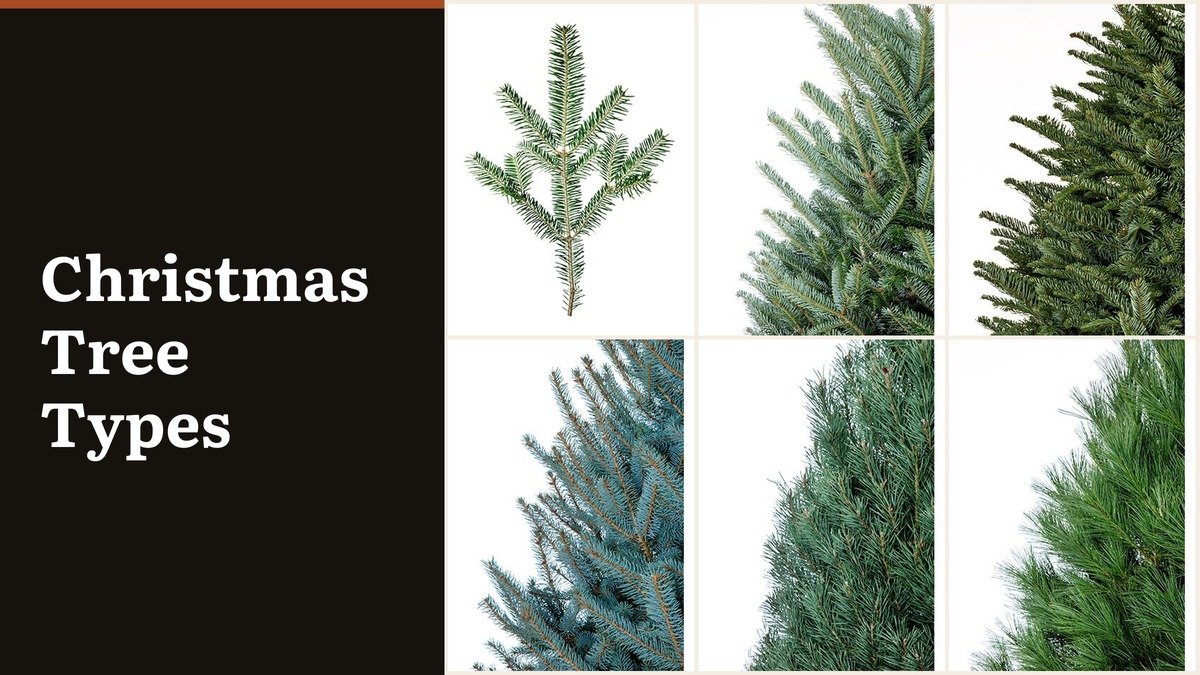
Christmas tree types fall into four families, and the needles tell them apart: firs have soft flat needles, spruces have sharp square ones, pines carry theirs in bundles and cypress has feathery scale-like foliage. Douglas fir is sold with the firs but is not one, and in 2026 it sits in that group on most lots.
Needle length, scent, branch strength and native range set the twelve species apart, and a handful of watering habits decide whether any of them drops needles by New Year.
What Are the Main Christmas Tree Types?
The main Christmas tree types are firs such as Balsam, Fraser and Noble, which have soft needles and the strongest scents, Colorado blue spruce with its sharp silver-blue needles, pines such as Scotch and White with long needles, and Leyland cypress, a feathery hybrid. Douglas fir is sold with the firs but is not one.
Christmas Tree Types by Family, Needle Length and Native Range
| # | Tree | Family | Needle Length | Native Range | Standout Trait |
|---|---|---|---|---|---|
| 1 | Noble Fir | Fir | About 1 in | Siskiyou Mountains to the Oregon and Washington ranges | Stiff branches, silver look |
| 2 | Grand Fir | Fir | 1 to 1 1/2 in | British Columbia to Montana and northern California | Needles in two flat rows |
| 3 | Douglas Fir | Fir-like | 1 to 1 1/2 in | Central California to Alaska and the Rockies | Not a true fir |
| 4 | Concolor Fir | Fir | 1 to 1 1/2 in | Rockies to the California and Oregon coast ranges | Citrus-like scent |
| 5 | Nordmann Fir | Fir | 3/4 to 1 1/2 in | Grown in the Pacific Northwest | Very little scent |
| 6 | Fraser Fir | Fir | 1/2 to 1 in | Southern Appalachians above 4,500 ft | Strong, upturned branches |
| 7 | Balsam Fir | Fir | 3/4 to 1 1/2 in | Northern Alberta to Labrador, south to Pennsylvania | Excellent fragrance |
| 8 | Colorado Blue Spruce | Spruce | 1 to 1 1/2 in | Wyoming and Idaho south to New Mexico and Arizona | Very sharp needles |
| 9 | White Pine | Pine | 2 1/2 to 5 in | Newfoundland to Manitoba, south to Georgia | Soft, little scent |
| 10 | Virginia Pine | Pine | 1 1/2 to 3 in | Central Pennsylvania to Mississippi, Alabama and Georgia | Stout, woody branches |
| 11 | Scotch Pine | Pine | About 1 in | Europe and Asia | Needles stay on when dry |
| 12 | Leyland Cypress | Cypress | Feathery foliage | None, a hybrid grown from cuttings | Dries quickly once cut |
Fir Christmas Trees: Soft, Flat Needles
Firs attach their flat needles one at a time, and their cones stand upright on the branch. Growing regions for these firs run from the Pacific coast to the Atlantic side of the continent.
1. Noble Fir: The Wreath-Maker’s Fir

Foliage: Bluish-green that looks silver | Limbs: Stiff | Needles hold: Excellent | Scent: Very good | Source: Pacific Northwest
Noble fir is native to the Siskiyou Mountains of northern California and to the Cascade and coastal ranges of Oregon and Washington. Needles are about an inch long and turn upward, which exposes the paler undersides of the branches and gives a silvery look.
Limbs are stiff, and few Christmas species keep their needles as well. That stiffness also makes it a go-to for wreaths and garland. Between 25 and 30 percent of Pacific Northwest fresh-tree sales go to it.
2. Grand Fir: Needles in Two Neat Rows
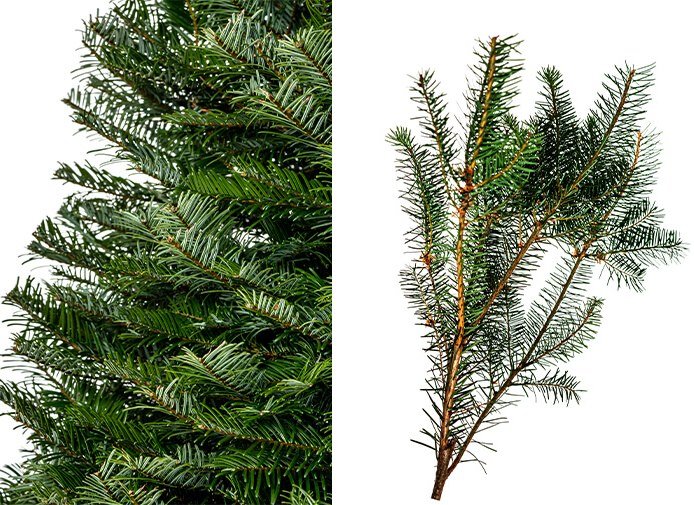
Foliage: Shiny dark green | Scent: Strong, citrusy | Needles hold: Display within two weeks of Christmas | Source: Pacific Northwest, Idaho, Montana
Grand fir needles are shiny, dark green and 1 to 1 1/2 inches long, set in two flat rows that look like feathers. Crushed needles smell of citrus, and the fragrance is strong.
Its natural range runs from British Columbia inland to Montana and south into northern California. Idaho and Montana grow it as a major crop, Washington and Oregon only in small numbers. Because the needles do not hold as long as a Fraser’s, it is best displayed within two weeks of Christmas.
3. Douglas Fir: The Fir That Is Not a Fir
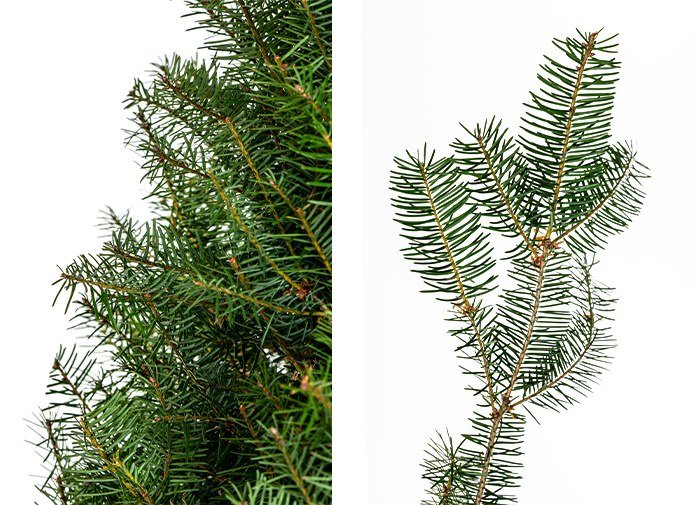
Foliage: Dark green to blue-green | Scent: Very good, sweet | Needles hold: Very good | Limbs: Moderately stiff | Source: Pacific Northwest plantations
Douglas fir carries soft needles, dark green to blue-green and 1 to 1 1/2 inches long, that radiate in every direction. It is not a true fir, but it is sold beside them. Crushed needles smell sweet, and retention is very good.
Its natural range is central California to Alaska and the Rockies. It became a major Pacific Northwest Christmas tree in the 1920s, and since the 1950s the crop has come from plantations. Shipments go to most of the US plus Hawaii, Guam and a few Asian markets; the limbs sag under heavy ornaments.
4. Concolor Fir: The Orange-Scented Western Fir

Foliage: Dull bluish-green | Scent: Very good, citrus or orange-like | Needles hold: Excellent | Limbs: Carry ornaments well | Native to: Rockies west to the coast ranges
Concolor fir, also sold as white fir, has long needles for a fir, 1 to 1 1/2 inches, in a dull bluish-green. The scent is citrus or orange-like, rated very good, and the needle retention is excellent.
It occurs naturally from the Rocky Mountains of Colorado and New Mexico to the Coast Range in California and Oregon, between 6,000 and 11,000 feet in the Rockies. Wild trees reach roughly 350 years. Its needles are softer than those of a Colorado blue spruce, and the branches hold ornaments well.
5. Nordmann Fir: Dark, Glossy and Quiet

Foliage: Glossy dark green | Scent: Very little | Needles hold: Excellent | Limbs: Sturdy and tiered | Source: Pacific Northwest
Nordmann fir is as dark as any fir sold, with glossy needles, 3/4 to 1 1/2 inch, silvery-blue beneath. Layered, sturdy branches give the tree a tiered shape, and needle retention is excellent.
The scent is very light to almost absent, a plus where a strong smell is unwelcome. The species is popular in the United Kingdom. In the US it is grown in the Pacific Northwest and sold at most retail lots west of the Rockies.
6. Fraser Fir: A Mountain Native With Upturned Branches

Foliage: Dark blue-green | Limbs: Strong, turn slightly upward | Scent: Very good | Needles hold: Excellent | Source: Appalachians, with North Carolina leading
In the wild, Fraser fir grows only above 4,500 feet in the southern Appalachians of southwest Virginia, western North Carolina and eastern Tennessee. The highest native stand sits on Mt. Mitchell in North Carolina at 6,684 feet. Each flattened needle measures 1/2 to 1 inch and carries two silvery bands underneath.
The branches turn slightly upward and hold heavy ornaments, and the foliage is dark blue-green. It is named for the Scottish botanist John Fraser, who lived from 1750 to 1811. North Carolina grows the majority of Fraser fir Christmas trees, and harvest comes after 7 to 10 field years.
7. Balsam Fir: The Scent Everyone Remembers

Foliage: Dark green | Scent: Excellent | Needles hold: Excellent | Limbs: Moderate | Source: Canada, the northeast, upper Great Lakes, Pennsylvania
Few trees are as closely tied to the smell of Christmas as the balsam. Scent-wise it sits near the top of every species, with dark green needles of 3/4 to 1 1/2 inches that hold on well. The resin in its bark blisters is the source of Canada balsam, the mounting medium used for microscope slides.
Branches are moderate, which suits a family tree hung with ordinary ornaments. Its range is the largest of any North American fir, stretching across Canada from Alberta to Labrador and down into Pennsylvania; a 6 to 7 foot tree needs 9 to 10 years.
Spruce Christmas Trees: Sharp and Silver-Blue
Spruce needles are square, attached singly, and the cones hang down. One spruce dominates the Christmas trade.
8. Colorado Blue Spruce: Colorado and Utah’s State Tree
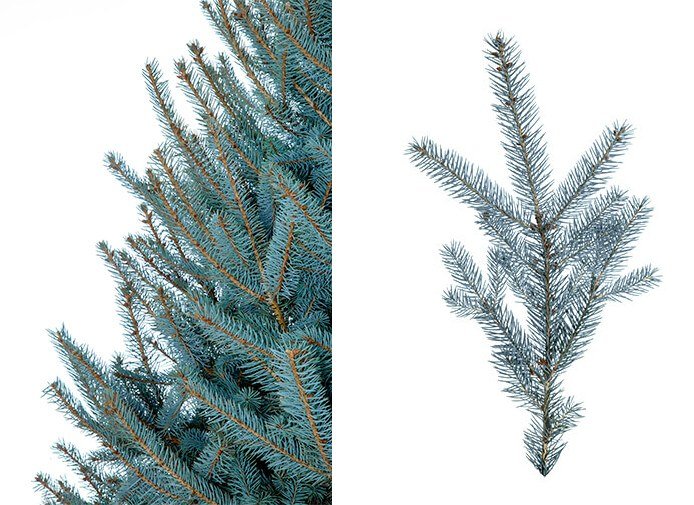
Foliage: Bluish-gray to silvery blue | Limbs: Stiff | Needles hold: Very good if never dry | Scent: Mild, resinous when crushed | Source: Upper Midwest and Great Lakes
Needles on the Colorado blue spruce are 4-sided, 1 to 1 1/2 inches long, very sharp and silvery blue. The Latin name, pungens, means sharp. Put gloves on to decorate it, and consider another tree if small children live in the house.
Stiff branches hold heavy ornaments, and retention is very good as long as the stand never runs dry. Wild stands occupy 6,000 to 11,000 feet, from western Wyoming and eastern Idaho south to New Mexico and Arizona. Colorado and Utah both name it their official state tree.
Pine Christmas Trees: Long Needles in Bundles
Pines carry their needles in bundles: two for Scotch and Virginia, five for White.
9. White Pine: The Largest Pine in the US

Foliage: Bluish-green | Needles hold: Good, bordering excellent | Scent: Little | Limbs: Light ornaments only | Native to: Newfoundland to Manitoba and the Appalachians
No pine in the US grows bigger than the White pine, and its needles are the longest of the twelve: soft, flexible and 2 1/2 to 5 inches, in bundles of five. They are bluish-green, and the scent is faint.
Branches are too soft for heavy ornaments, though the tree is excellent for wreaths and roping. It grows from Newfoundland to Manitoba and south along the Appalachians to northern Georgia and South Carolina. In colonial times trees more than 24 inches across were reserved for ship masts.
10. Virginia Pine: Twisted Needles and Stout Branches
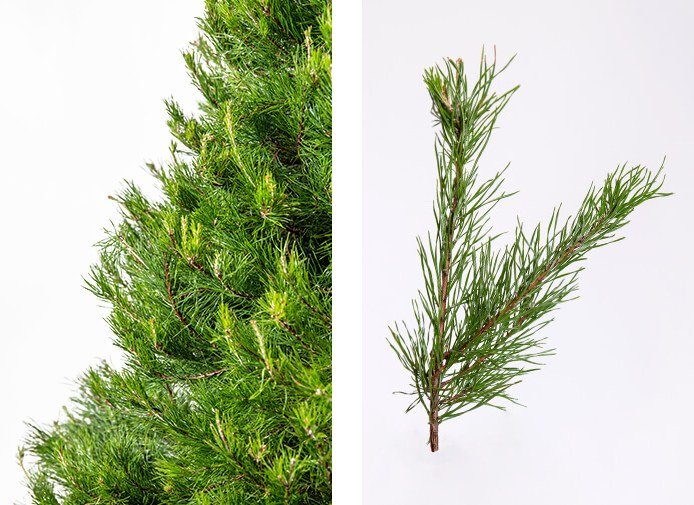
Foliage: Light green, yellowing in late fall | Limbs: Stout, woody, hold ornaments well | Growing time: Crops of 4 to 6 years can work | Native to: Pennsylvania down to Georgia and Alabama
Needles on a Virginia pine twist in pairs and measure 1 1/2 to 3 inches, growing from thick woody limbs that carry ornaments with ease. Shearing is well tolerated, so growers get dense foliage, and late-fall color may drift from light green toward yellow.
Choose-and-cut growers in eastern North Carolina plant it more than any other species. Natural range is central Pennsylvania south into northern Mississippi, Alabama and Georgia. On the living tree, needles drop after 3 to 4 growing seasons.
11. Scotch Pine: An Import From Europe and Asia

Foliage: Bright green to dark green | Needles hold: Excellent, dry or not | Limbs: Stiff | Scent: Good, clean pine | Source: Midwest and Great Lakes
Scotch pine has needles in bundles of two, about an inch long in most Christmas trees, and the foliage runs from bright to dark green. The needles stay on even when the tree is dry, and the scent is a clean pine.
Stiff branches carry light and heavy ornaments alike, and the price is friendly. Its home range is Europe and Asia, and settlers brought it across. Growers in the Great Lakes and the Midwest supply much of it.
Cypress Christmas Trees: One Feathery Hybrid
Cypress is the odd one out, with flat sprays of scale-like foliage in place of needles.
12. Leyland Cypress: A Hybrid Found as Six Seedlings
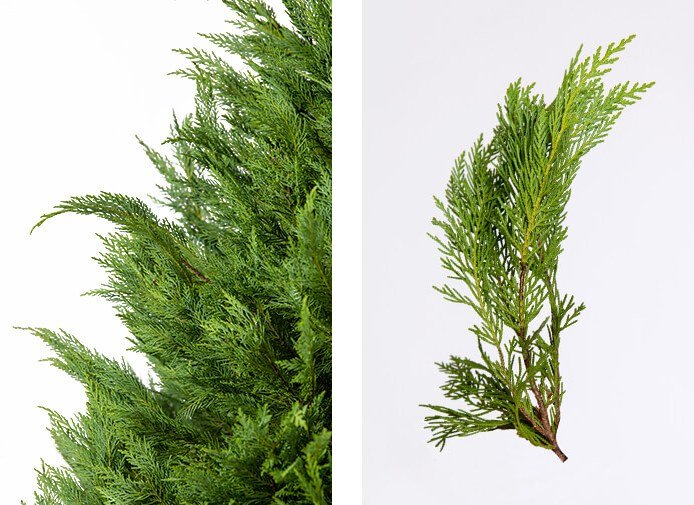
Foliage: Dark green-gray | Scent: Very little | Needles hold: Quick to dry once cut | Limbs: Upright, suits light decor | Origin: Cuttings-grown hybrid
Leyland cypress crosses Monterey cypress with Alaska cedar. Six seedlings were first found in 1888 at Leighton Hall in Wales. The tree is sterile, has no natural range and is propagated from cuttings.
Foliage is a feathery dark green-gray with very little scent. Cut trees dry out quickly, so it fits choose-and-cut farms, and in a warm room it needs frequent watering. Shoppers put off by pine and fir fragrance are often pointed its way, and real allergies call for a doctor’s opinion.
How Christmas Trees Are Grown and Sold
About 25 to 30 million real trees are sold in the US each year, and they are grown in every US state and in Canada. The top producers are Oregon, North Carolina, Michigan, Pennsylvania, Wisconsin and Washington. Growers can read species-level detail in the NC State Extension tree species guide.
- Time to harvest: 7 years on average, spread between 4 and 15 for trees of 6 to 7 feet
- Replanting: 1 to 3 seedlings go in the ground the following spring for every tree harvested
- Shape: growers usually shear to an 80 percent taper, which puts a 10 ft tree at 8 ft across its base
Keeping a Cut Tree Fresh: Cut, Water and Placement
Every cut tree starts with a trunk that can still drink. Within 12 hours of cutting it needs no recut, and most species can go 6 to 8 hours and still take up water. After that, saw a thin slice, 1/4 to 1/2 inch, cut level across the base.
- Quantity: a quart of water per inch of trunk diameter, in a stand with room for a gallon or more
- Timing: the first week is the thirstiest, so look at the stand every day
- Level: keep the water above the base of the trunk at all times
- Position: stand it away from heat sources
What does not help: whittling the sides of the trunk, drilling into the base, using warm or cold water, and adding sugar, bleach, aspirin, preservatives or gels. Flame-retardant sprays add nothing. Over half the weight of a cut tree is water, and hydration is the biggest lever against dropped needles.
Matching Christmas Tree Types to Your Home
Start with what the tree will carry and who lives with it:
- Glass and heavy ornaments: Fraser, Noble, Concolor, Scotch, Virginia and blue spruce
- Lightweight ornaments: Douglas fir, White pine and Leyland cypress
- Scent first: Balsam fir, then Grand fir, Fraser, Noble, Concolor and Douglas fir
- Scent last: White pine, Leyland cypress and Nordmann fir, though anyone with allergies should ask a doctor
- A tree cut the same day: Virginia pine and Leyland cypress, both best from a choose-and-cut farm
- Kids at home: choose anything but the blue spruce, which has very sharp needles
Ornament colors can follow the tree. The meaning of Christmas colors is a place to start, and the calendar for the big day is in Christmas Day: date and calendar.
Frequently Asked Questions
What is the most fragrant Christmas tree type?
Balsam fir tops every other species for scent. Grand fir smells strongly of citrus, while Douglas, Fraser, Noble and Concolor all rate very good.
Which Christmas tree has the longest needles?
White pine, at 2 1/2 to 5 inches. Virginia pine follows at 1 1/2 to 3 inches, and the firs and Colorado blue spruce stay at 1 1/2 inches or less.
Which type is best if I do not want a strong scent?
Nordmann fir has very little to almost no fragrance, and White pine and Leyland cypress also have little. Of the three, White pine is the one tied to fewer allergic reactions.
Are Christmas trees native to where they are sold?
Often not. Fraser fir grows wild only in the southern Appalachians but is grown for sale elsewhere, and Douglas fir ships from the Pacific Northwest to most of the country. Leyland cypress has no natural range at all.