Nine states levy no personal income tax, and the money has to come from somewhere. Texas leans on property, Nevada on gaming, Wyoming on minerals and Alaska on oil, and which of those applies to you decides whether moving actually saves anything.
One thing has changed recently enough to be worth stating plainly. New Hampshire repealed its tax on interest and dividends with effect from January 2025, so it now belongs on this list without the qualification it used to carry.
Nothing Is Free, It Is Just Collected Elsewhere
Every state has to fund schools, roads, courts and health programmes. Removing one revenue source means leaning harder on the others, and there are only three others that matter.
- Property. Texas and New Hampshire both have notably high effective property tax rates. This falls on owners rather than renters directly, though it reaches renters through rent.
- Consumption. Tennessee, Nevada and Washington all run high combined sales tax rates. This falls hardest on people who spend most of what they earn, which means lower incomes.
- Extraction and visitors. Alaska, Wyoming and Nevada export a large part of their tax burden, to oil companies, mineral producers and tourists respectively.
That third category is why the model works so comfortably in a few states and strains in others. A state with minerals or a casino industry can fund itself from people who do not live there. A state without either has to collect from residents one way or another.
Alaska takes this furthest. It has no state sales tax either, and a sovereign wealth fund built from resource royalties pays an annual dividend to residents, making it the only state that sends money to its people rather than only taking it.
States With No Income Tax: What Each One Charges Instead
All nine, with the revenue source that stands in place of an income tax.
| # | State | Sales tax | What funds the state instead |
|---|---|---|---|
| 1 | Alaska | No state sales tax; local sales taxes only | Oil and gas production and property taxes |
| 2 | Florida | Statewide sales tax plus local surtaxes | Sales tax, property tax, corporate income tax |
| 3 | Nevada | Statewide sales and use tax | Gaming taxes, sales tax, property tax |
| 4 | New Hampshire | No state sales tax either | Property tax, business profits and enterprise taxes |
| 5 | South Dakota | Statewide sales tax | Sales and excise taxes, property tax |
| 6 | Tennessee | One of the highest combined sales tax rates | Sales tax, business and excise taxes, severance tax |
| 7 | Texas | Statewide sales tax plus local | Property tax, sales tax, franchise tax |
| 8 | Washington | High combined sales tax | Sales tax, business and occupation tax, capital gains tax |
| 9 | Wyoming | Low statewide sales tax | Mineral severance taxes, property tax |
The Nine States, and the Trade in Each
Each entry gives the replacement revenue source, because that is what determines who actually benefits from the absence of an income tax.
1. Alaska: Oil and gas production and property taxes
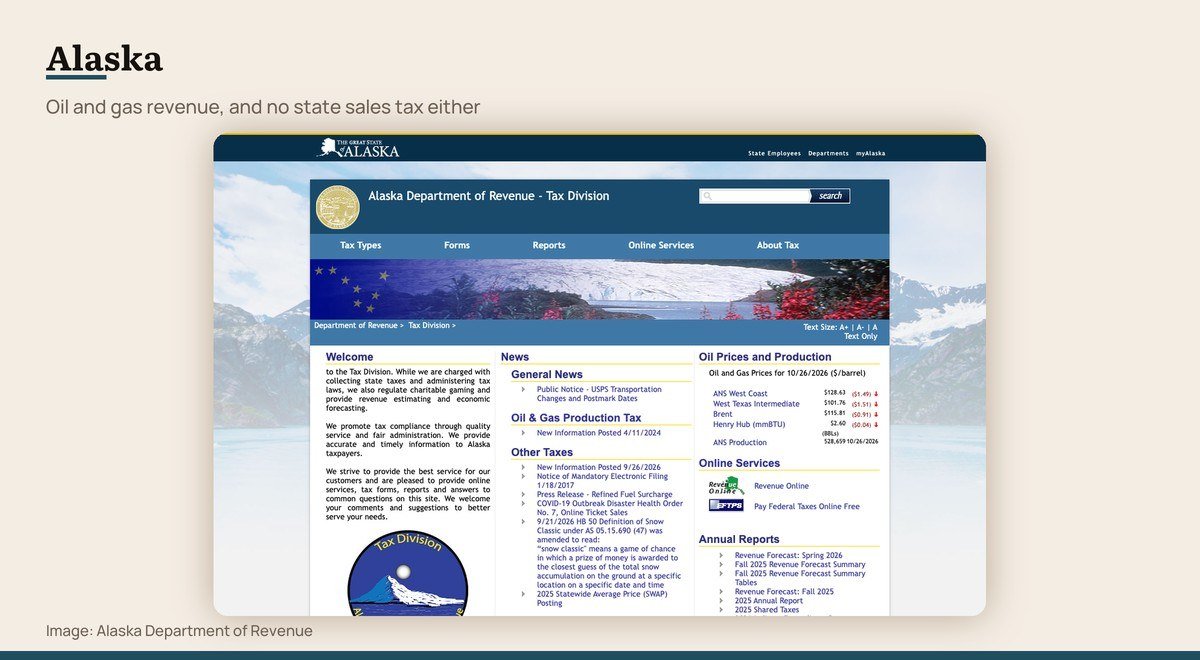
Sales tax: No state sales tax; local sales taxes only · What funds the state: Oil and gas production and property taxes
Alaska is the only state with neither a personal income tax nor a statewide sales tax. Local governments may levy their own sales taxes, and many do, but there is no state-level one to add to them.
What funds the state instead is oil and gas. The Department of Revenue administers production taxes and an oil and gas property tax, which is why Alaska’s budget moves with the price of crude in a way no other state’s does.
Residents also receive an annual payment from the Permanent Fund, the sovereign wealth fund built from resource royalties. Alaska is the only state that pays its residents rather than only charging them.
2. Florida: Sales tax

Sales tax: Statewide sales tax plus local surtaxes · What funds the state: Sales tax, property tax, corporate income tax
Florida has no personal income tax and has not had one for decades, with the prohibition written into the state constitution rather than merely into statute.
The replacement is consumption. Sales tax is the largest single source, supplemented by county surtaxes, and the volume of visitors means a meaningful share is paid by people who do not live there.
Corporations are not exempt. Florida levies a corporate income tax and a franchise tax, so the absence of personal income tax does not extend to businesses in the way it does in some other states here.
3. Nevada: Gaming taxes
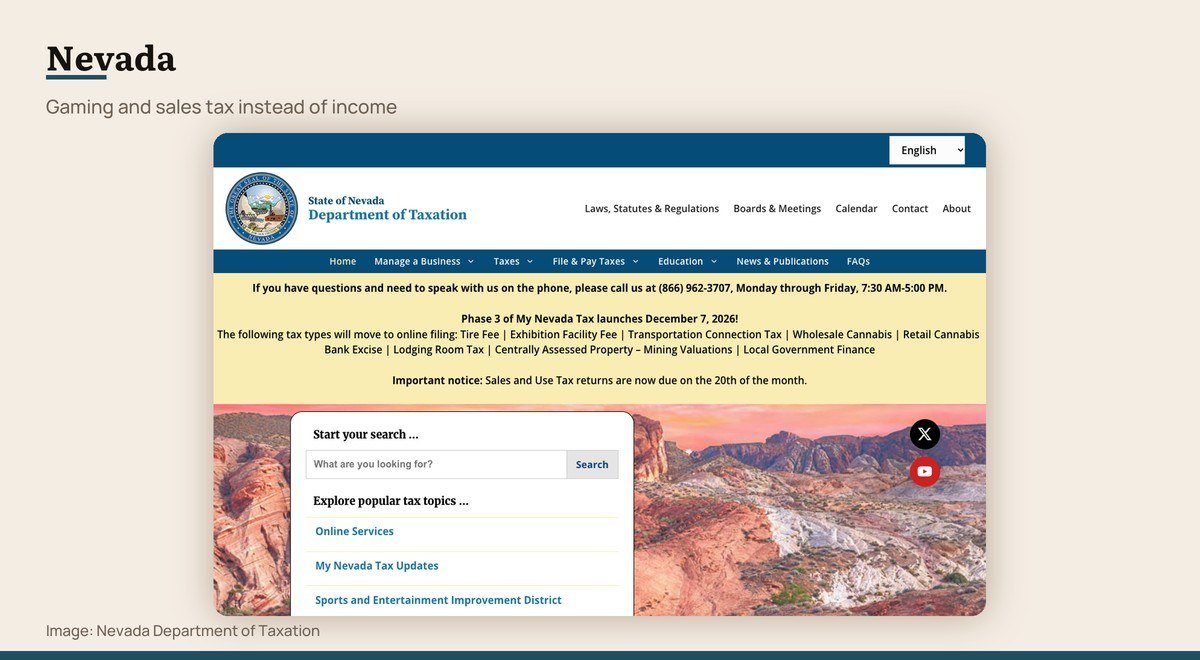
Sales tax: Statewide sales and use tax · What funds the state: Gaming taxes, sales tax, property tax
Nevada has no personal income tax and no corporate income tax, which is an unusual combination even among the states on this list.
Gaming is the historic reason. Taxes on gross gaming revenue, together with sales and use tax, carry a large share of the state’s receipts, and both are heavily paid by visitors rather than residents.
The vulnerability is the mirror image of the advantage. A state funded by discretionary spending from tourists feels a recession faster and harder than one funded by wages.
4. New Hampshire: Property tax

Sales tax: No state sales tax either · What funds the state: Property tax, business profits and enterprise taxes
New Hampshire belongs on this list without qualification now. It never taxed wages, and the interest and dividends tax that applied to investment income was repealed with effect from 1 January 2025, making the 2024 return the last one.
That removes the asterisk New Hampshire carried on lists like this for years. It also has no general sales tax, leaving it with Alaska as the only states that levy neither.
Property tax is what fills the gap, and it is among the highest in the country as a share of home value. The trade is explicit rather than hidden: the state taxes what you own rather than what you earn or spend.
5. South Dakota: Sales and excise taxes
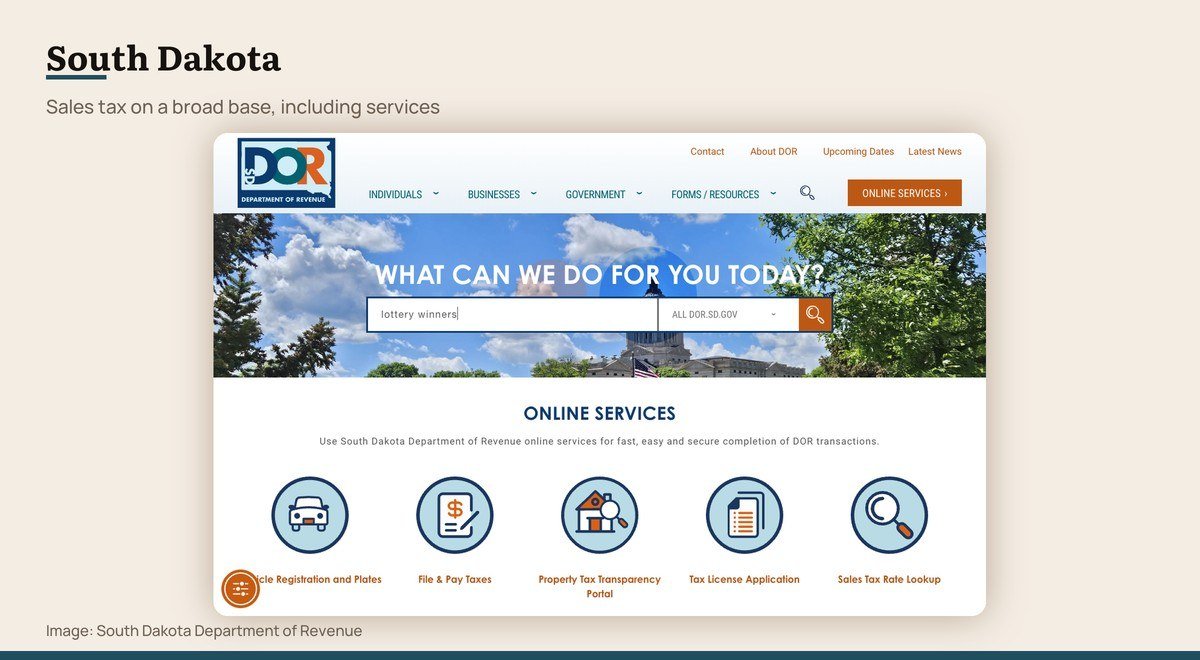
Sales tax: Statewide sales tax · What funds the state: Sales and excise taxes, property tax
South Dakota has no personal income tax and no corporate income tax, and it has never had either.
Its sales tax applies to a notably broad base, covering many services that other states exempt. A wider base allows a lower rate to raise the same money, which is the design choice the state has made.
It is also among the cheapest states in the country on federal price measures, so the absence of income tax compounds with a low price level rather than being offset by one.
6. Tennessee: Sales tax
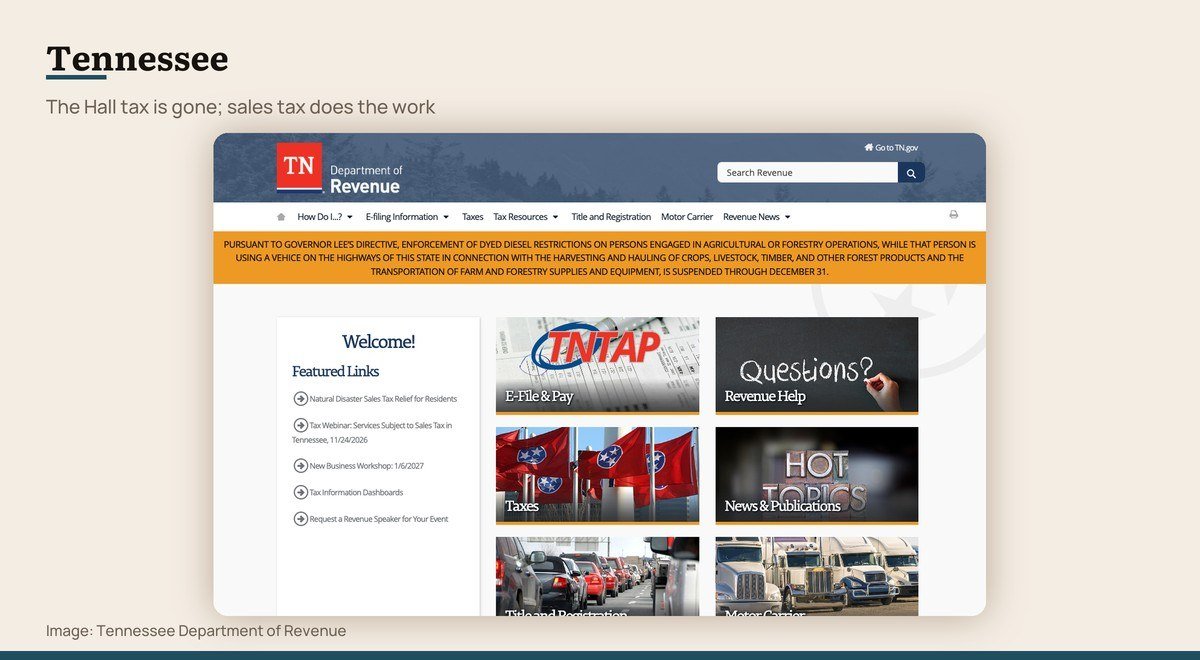
Sales tax: One of the highest combined sales tax rates · What funds the state: Sales tax, business and excise taxes, severance tax
Tennessee completed the phase-out of its Hall income tax on interest and dividends several years ago, and now taxes no personal income at all.
The replacement is one of the highest combined state and local sales tax rates in the country. Tennessee taxes groceries as well, at a reduced rate, which most states with high sales taxes do not.
That structure is the standard criticism of the no-income-tax model, because sales taxes take a larger share of a low income than a high one. It is also why the comparison is not simply about what is absent.
7. Texas: Property tax
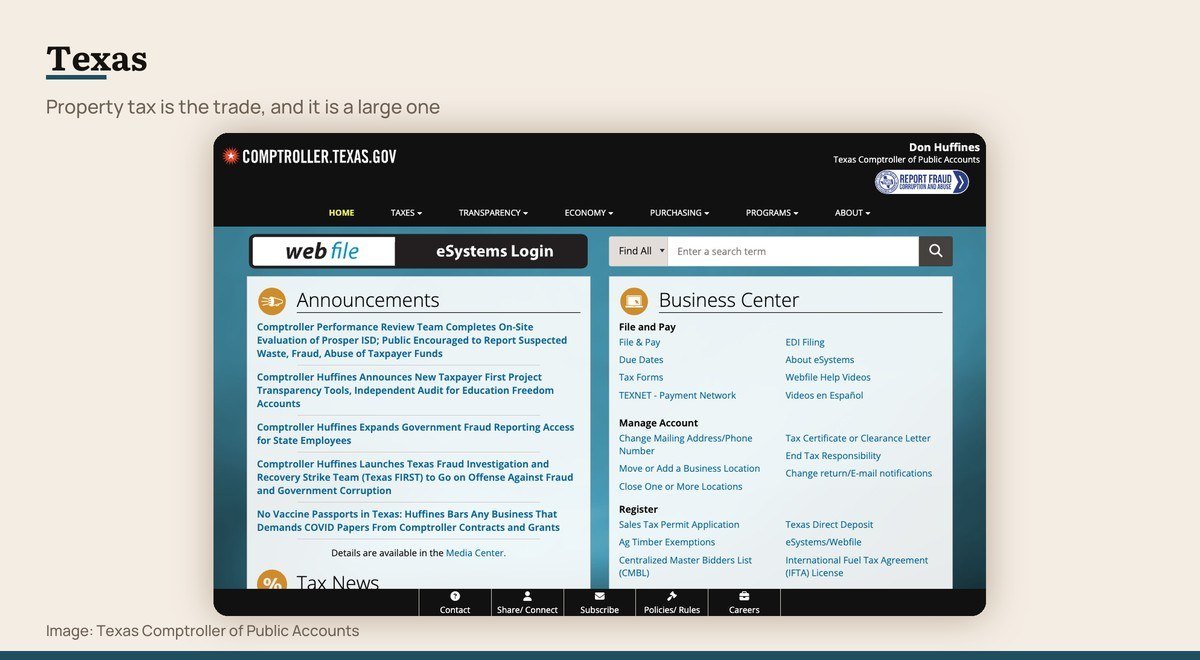
Sales tax: Statewide sales tax plus local · What funds the state: Property tax, sales tax, franchise tax
Texas has no personal income tax, and like Florida the prohibition sits in the state constitution, requiring a vote of the people to change.
Property tax is the trade, and it is substantial. Texas has among the highest effective property tax rates in the country, which funds schools and local government in place of an income tax.
For a homeowner that can reverse the arithmetic entirely. A high earner renting in Texas keeps considerably more than they would in California; a modest earner owning a house may not.
8. Washington: Sales tax

Sales tax: High combined sales tax · What funds the state: Sales tax, business and occupation tax, capital gains tax
Washington taxes no wage or salary income, and it is the one state here with a genuine qualification remaining: since 2022 it levies a tax on long-term capital gains above an annual threshold.
That affects a small number of people and it means the state is not quite income-tax-free in the way the others are. Ordinary earnings are untouched.
Elsewhere the burden sits on consumption and on business. Washington’s business and occupation tax applies to gross receipts rather than profit, which falls hardest on low-margin businesses.
9. Wyoming: Mineral severance taxes

Sales tax: Low statewide sales tax · What funds the state: Mineral severance taxes, property tax
Wyoming has no personal income tax and no corporate income tax, and the smallest population of any state, which is central to how it manages that.
Mineral extraction funds it. Severance taxes on coal, oil, gas and trona, together with the property taxes levied on mineral production, provide a large share of state revenue from a very small number of payers.
The consequence is a budget that tracks commodity prices closely. Wyoming’s tax position is secure while extraction continues and is the most exposed of any state here to a long-term decline in it.
Who Actually Saves, and Who Does Not
The benefit of no income tax is not spread evenly. It scales with income and it is reduced, sometimes eliminated, by whatever replaces it.
A high earner who rents gains the most. There is no income tax to pay, no property tax exposure, and sales tax on consumption is a small share of a large income. This is the case where moving produces a clear, large saving.
A homeowner in Texas or New Hampshire may gain very little. Effective property tax rates in both run well above the national norm, and on a substantial house that bill can approach what a moderate state income tax would have cost.
A lower earner can be worse off. Sales taxes take a larger share of a small income than a large one, so a state funding itself through consumption shifts burden down the income scale rather than removing it.
Residency Is Not Where You Say You Live
Anybody moving for tax reasons should understand that the state being left usually gets a say, and high-tax states audit this aggressively.
Most states apply a day count, commonly around 183 days, alongside a broader test of where your life actually is: where your family lives, where you are registered to vote, where your doctor is, where your possessions are kept.
Keeping a home in the old state is the most common way a claimed move fails. So is continuing to work there, since income earned in a state is generally taxable by that state regardless of where the earner resides.
Retirement income has its own rules and they are favourable. Federal law prevents a state from taxing pension income of a former resident, so a pension follows you to the new state rather than remaining taxable in the old one.
Cost of Living Decides More Than Tax Does
Tax is one line in a household budget and usually not the largest. federal regional price data puts Washington, Florida and Nevada above the national price level while South Dakota, Tennessee, Texas and Wyoming sit below it.
South Dakota is the combination that actually works on both counts: no income tax and prices around eleven percent below the national level. Washington is the opposite, with no wage tax and a price level above the national average.
Housing is where this concentrates, as it is in every cost comparison. A state with no income tax and expensive housing can easily cost more to live in than a state with a modest income tax and cheap housing.
The useful exercise before moving is to price your actual circumstances: your income, whether you will rent or buy, and what you spend. The headline absence of an income tax answers none of those on its own.
Frequently Asked Questions
How many states have no income tax?
Nine: Alaska, Florida, Nevada, New Hampshire, South Dakota, Tennessee, Texas, Washington and Wyoming. New Hampshire joined the list fully when its interest and dividends tax was repealed with effect from January 2025.
Which state has no income tax and no sales tax?
Alaska and New Hampshire. Alaska has no statewide sales tax, though local governments may levy their own, and New Hampshire has no general sales tax at all. New Hampshire funds itself largely through property tax instead.
Do no-income-tax states have higher property taxes?
Several do. Texas and New Hampshire have among the highest effective property tax rates in the country, which is the direct trade for the absent income tax. Others, such as Nevada and Wyoming, do not, because they have other revenue sources.
Does Washington really have no income tax?
It has no tax on wages or salaries, which is what most people mean. Since 2022 it has taxed long-term capital gains above an annual threshold, so it is the one state on this list with a remaining qualification.