Santa’s reindeer names, from the front of the team to the back, are Dasher, Dancer, Prancer, Vixen, Comet, Cupid, Donner, Blitzen and then Rudolph. A poem named the first eight, though two of them went by other names in that earliest printing.
That printing was a newspaper page in upstate New York, wedged between an item on taking honey from the hive and a marriage announcement. From there the names travelled into picture books, a department store giveaway and a stop-motion television special. Anyone planning the wider season can find the dates in our guide to Christmas Day.
What Are Santa’s Reindeer Names?
The poem gives Santa eight reindeer, and the modern team has nine. Rudolph, the red-nosed newcomer from 1939, takes the last place after Blitzen. Santa shouts the first four names with the word “Now” and the next four with “On,” which is the easiest way to keep the order straight.
Santa’s Reindeer Names in 1823 and Today
Six names have never changed since the first printing. Two did change, and Rudolph is not in the 1823 text at all.
| Place | Name today | Spelling in 1823 | Later spelling | Called with |
|---|---|---|---|---|
| 1 | Dasher | Dasher | Dasher | Now |
| 2 | Dancer | Dancer | Dancer | Now |
| 3 | Prancer | Prancer | Prancer | Now |
| 4 | Vixen | Vixen | Vixen | Now |
| 5 | Comet | Comet | Comet | On |
| 6 | Cupid | Cupid | Cupid | On |
| 7 | Donner | Dunder | Donder (1837 onward), Donner on modern rosters | On |
| 8 | Blitzen | Blixem | Blitzen (1844 onward) | On |
| 9 | Rudolph | Not in the poem | Created in 1939 | Not called |
The Newspaper Page Where the Reindeer Names Began
On December 23, 1823, the Troy Sentinel ran “Account of a Visit from St. Nicholas” in column five of page 3. The editor had no idea who sent it in and introduced it with the line “We know not to whom we are indebted for the following description.” Santa’s team in that text is a count of eight tiny rein-deer, hyphen included.
Other papers reprinted it within months, and the Library of Congress card catalog now records more than 300 different editions and adaptations.
The Four Santa Calls With “Now”

Line one of the call runs “Now! Dasher, now! Dancer, now! Prancer, and Vixen.” The poem hands none of these four a personality or backstory, so each name carries only the everyday sense of its word.
1. Dasher: Position One
Dasher is the first name out of Santa’s mouth, and a dasher is someone who runs quickly, which suits the order that closes the call.
2. Dancer: Position Two
Dancer takes second place with a word that needs no translation. Earlier in the poem the same verb belongs to sugar plums.
3. Prancer: Position Three
Prancer is third. A prancer lifts its feet high with each step, and the narrator hears that gait on the roof as the team lands.
4. Vixen: Position Four
A vixen is a she-fox. Because it ends line one, it is the final name before Santa changes his shout to “On.”
The Four Santa Calls With “On”
Line two of the 1823 call is “On! Comet, on! Cupid, on! Dunder and Blixem.” It carries the two names that were later reshaped, and it is the line that changed most over the next two decades.
5. Comet: Position Five
A comet is an icy object with a tail that crosses the sky. The name opens line two and has kept its spelling since the first printing.
6. Cupid: Position Six
Cupid is the love god of Roman myth and the sixth name in the call. The newspaper text and modern versions spell him the same way.
7. Donner: Position Seven
Position seven started out as Dunder, which sounds like the Dutch word for thunder. When a book reprinted the poem in 1837 the name became Donder, and papers copying the poem swiftly followed. Donner is the form common today.
8. Blitzen: Position Eight
The final name began as Blixem, close to the Dutch bliksem for lightning. Moore seems to have changed it himself, since Blitzen first turns up in his own 1844 reprint, and magazines kept printing Blixen for nearly two more decades.
From Newspaper Poem to Picture Book

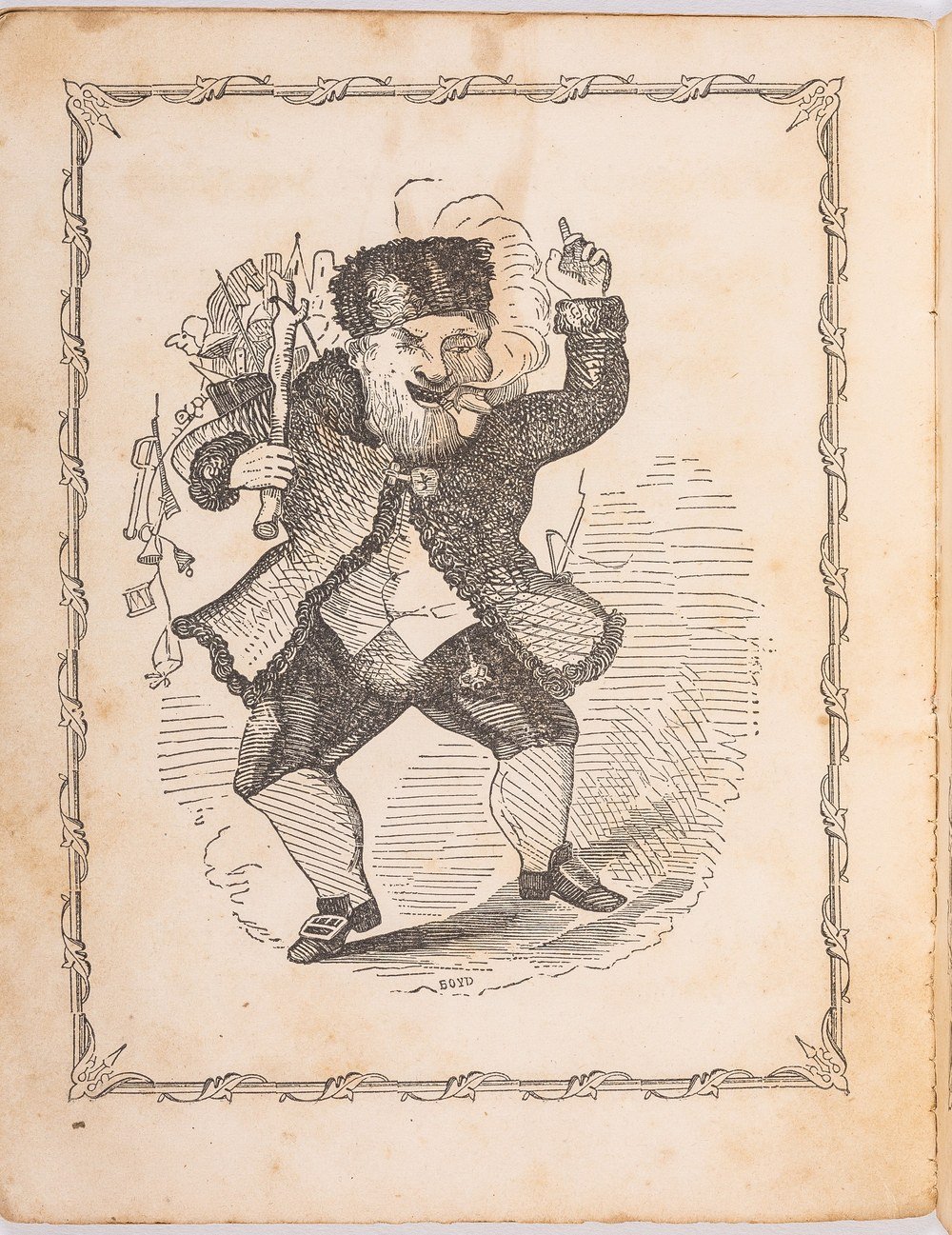
A New York publisher brought out the first fully illustrated book version in 1848, and the orange wrapper alone shows how quickly Santa had become a character in his own right. Inside, the last two names had already shifted to Donder and Blitzen.

The edition is 91 years older than Rudolph, so the spellings of the other eight did not come from the song or the television special. A post on the first illustrated edition shows more of its pages.
Who Is the Author? Moore, Livingston and an Open Question
Clement Clarke Moore, a classics scholar, first stepped forward as the author through a book of verse in 1837, fourteen years after the newspaper printing. His version of events is that the poem was meant for his nine children and read to them on Christmas Eve 1822.
Relatives of Major Henry Livingston Jr., a farmer, surveyor and poet from Poughkeepsie, insist he was the real author. A Vassar College professor gathered evidence for that view in a 2000 book, and a mock trial in New York even took it up. Livingston never claimed the poem in his lifetime, so the matter will likely stay unresolved without new evidence.
How Rudolph Became the Ninth Reindeer
Robert L. May was a Montgomery Ward advertising man when he dreamed up Rudolph in 1939, and the reindeer was Rollo until the story was approved. By 1946 more than five million copies were in print, with the store handing out millions of them free.
The song grew out of that booklet. May’s brother-in-law Johnny Marks boiled the story down to just over 100 words, and Gene Autry took some persuading before he cut the record. Hundreds of versions have followed, and the Library of Congress keeps the first 1939 copyright submission.
The 1964 television special came from Rankin/Bass, then called Videocraft, for NBC and General Electric. Larry Roemer directed, Romeo Muller scripted it, and Burl Ives voiced Sam the Snowman in a stop-motion style called Animagic made with MOM Productions in Tokyo. It has aired every year since and is billed as the longest-running TV Christmas special. A paper-mâché Rudolph that once stood on May’s lawn now lives in the Rauner Library rare book stacks at Dartmouth.
Rudolph’s special sits alongside the other screen favorites in our guide to 20 Christmas movies to watch every December. One joke should be cleared up. A reindeer called Olive is not in the song. The punchline comes from hearing “all of the other reindeer” as “Olive, the other reindeer,” a mix-up that turns up in a Toronto newspaper in 1949, the year the record came out.
The Real Reindeer Behind the Names

Reindeer are domesticated caribou, and both males and females grow antlers, which is unusual among deer. Adult males shed theirs after the autumn rut, while females keep theirs through the winter. Antlers of captive female reindeer average 3 pounds and can reach 7 pounds, and male antlers average 17 pounds and can reach 29 pounds.
Males begin growing a new set in February and females in May. A reindeer with antlers in December is therefore likely to be female or a castrated male, and the poem leaves the team’s sex unspecified.

Wild caribou are built for travel. Western Arctic Herd caribou walk an average of 2,000 miles a year, and adults have been recorded swimming as fast as six miles per hour thanks to buoyant hollow hair and wide hooves. Calves are born between late May and mid-June and can travel over 10 miles a day just two days after birth.
Five Steps to Teach Kids the Reindeer Names
- Start with the first line only: Dasher, Dancer, Prancer, Vixen, with the word “now” before each one.
- Move to the second line, which starts with “on”: Comet, Cupid, Donner, Blitzen.
- Say both lines together at a steady beat until the order of eight is automatic.
- Add Rudolph as the ninth and explain that he comes from a different story, created in 1939.
- Play a quick round: call out a position number and let the children answer with the name.
Frequently Asked Questions
Who is the ninth reindeer?
Rudolph. He was created for a 1939 Montgomery Ward booklet and was never part of the 1823 poem, which has eight reindeer.
Why did the names Dunder and Blixem change?
Dunder became Donder in 1837 when the poem was reprinted in a book, and Blixem became Blitzen in a reprint from 1844. The earlier spellings matched the Dutch words for thunder and lightning.
Is Olive a real reindeer?
No. Olive comes from a mishearing of the line “all of the other reindeer,” and a children’s book and film later turned the joke into a character.
Who is the author of “A Visit from St. Nicholas”?
Clement Clarke Moore took credit for it, but the family of Henry Livingston Jr. claimed it for him. Historians disagree, and the poem first ran with no name attached.