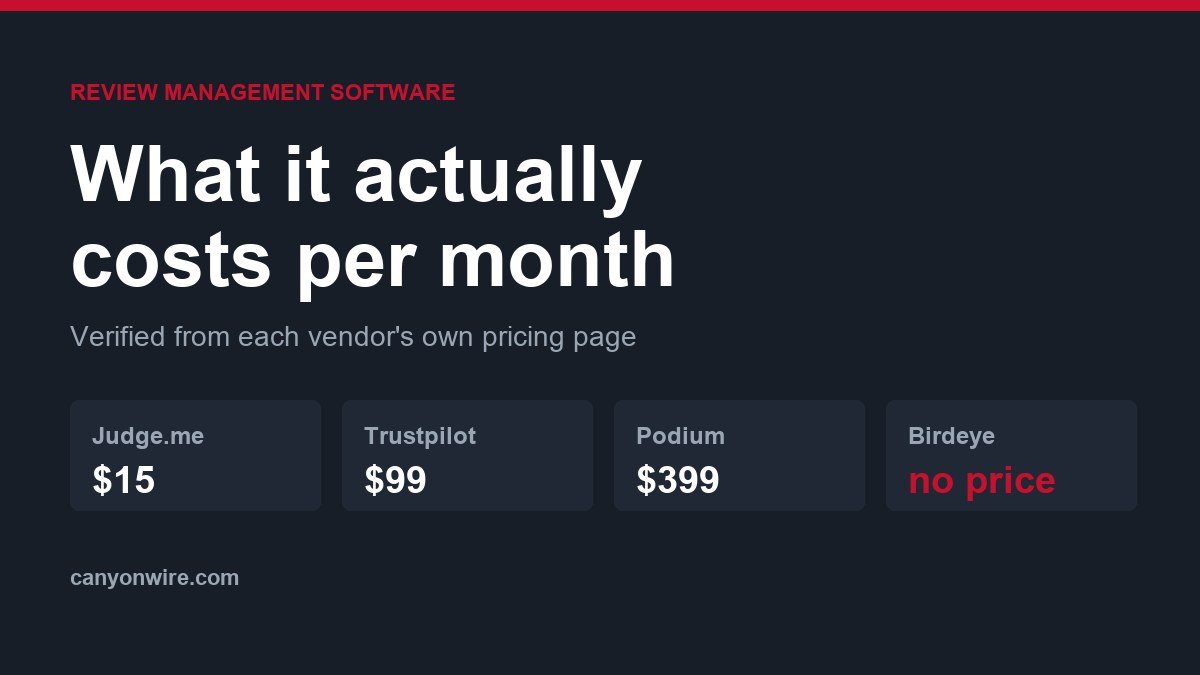
Review management software runs from free to $799 a month. Judge.me charges $15. Trustpilot Premium charges $799 a month for every domain you put on it. Birdeye will not show you a number at all until you hand over a phone number.
This guide gives you the real price of seven platforms, what you get at each tier, and the fees that land on top of the headline rate. Every figure comes from the vendor’s own pricing page. Where a vendor does not publish a price, you get told that plainly instead of a guess.
Review Management Software Pricing at a Glance
| Tool | Entry price | Top published tier |
|---|---|---|
| Judge.me | Free | $15 per month |
| Loox | Free | $299.99 per month |
| Yotpo | $89 per month | $169 per month |
| Okendo | $299 per month | $789 per month bundle |
| Trustpilot | Free | $799 per month, per domain |
| Podium | $399 per month | $599 per month |
| Birdeye | Quote only | Quote only |
Cheapest paid plan in the group: Judge.me at $15 a month. Most expensive published number: Trustpilot Premium at $799 a month, and that is charged per domain rather than per company.
The Three Kinds of Review Software
Prices in this category look wild until you notice that the tools are not competing with each other. They fall into three groups, and each group charges on a different basis. Pick the wrong group and you will pay ten times more than you needed to.
Store review apps. Judge.me, Loox, Yotpo and Okendo sit on your product pages. They email buyers after an order, collect photo and video reviews, and push star ratings into Google Shopping. They are priced by order volume. This is the cheapest group by a wide margin.
Public trust profiles. Trustpilot is the main one. You are paying for a profile on a site your customers already search by name, plus widgets that show your score on your own site. It is priced per domain, so the cost tracks how many brands you run rather than how many orders you take.
Local reputation and lead platforms. Podium and Birdeye pull in Google and Facebook reviews for physical locations, then wrap texting, calls and web chat around them. They are priced per location and sold through a sales team. This is the expensive group.
So the first question is not which tool is best. It is which of those three things you are buying. A single Shopify store asking for Podium is buying a phone system it will never use.
Judge.me: Best for Small Stores on a Budget

Judge.me publishes two plans and nothing else. Free, or $15 a month. The pricing page puts it bluntly: $15 is the most you can ever pay them.
The free plan is the unusual part. It collects unlimited reviews and unlimited review requests, including photo and video reviews, with Google rich snippets included. Most free tiers in this category cap you at a few dozen requests a month and then push the upgrade. This one does not.
The $15 plan adds the AI features, referrals and coupons, SMS, Google Shopping and social pushes, all integrations and full customisation. It works with Klaviyo, Omnisend, Mailchimp, Gorgias, Smile and LoyaltyLion, and it imports existing reviews from AliExpress, Amazon, Etsy and your Google Business Profile.
There is no seat maths. No per location multiplier. No annual commitment needed to reach the advertised rate. Run one store and want product reviews on site, and this is the cheapest honest answer in the category. Over a year you pay $180.
What works:
- Free plan collects unlimited reviews and unlimited requests.
- Flat $15 a month, with no per seat or per location maths.
- Price is visible without a demo or a sales call.
- Widgets and emails support 38 languages.
- Carries SOC 2 Type 2 and ISO 27001.
What to watch:
- Built for product reviews on a store, not multi-location reputation.
- Two plans only, so there is little room to grow into.
- No public trust profile that customers search by name.
Loox: Best for Photo and Video Reviews on Shopify

Loox is Shopify only, and it is built around visual reviews. The pricing page lists three tiers in US dollars: a free Beginner plan, Convert from $49.99 a month, and Unlimited at $299.99 a month.
Beginner is capped at 500 total orders. Convert lifts that cap to unlimited orders and adds video reviews, Google Shopping, referrals, auto translated reviews and AI review replies. It also removes Loox branding from your widgets.
Unlimited is the top tier at $299.99. You get unlimited review requests, unlimited referrals and priority support.
Billing runs through Shopify’s 30 day cycle, so there is no annual contract and you can cancel whenever you like. That is a real advantage over the enterprise end of this list, where twelve months prepaid is standard.
One practical note. Loox moved house. The old loox.io pricing path now returns a 404, and the live page sits on loox.app. If you land on a dead link, that is why.
What works:
- Three published prices, all stated in US dollars.
- Free tier to start, with no card needed.
- Billed through Shopify monthly, with no annual lock in.
- Strong on photo and video reviews specifically.
- Convert removes Loox branding, which many rivals charge more for.
What to watch:
- Shopify only, so it is no use on other platforms.
- Beginner is capped at 500 orders.
- Convert is listed as a starting rate rather than a flat price.
- No public trust profile or local listings management.
Yotpo: Best for Reviews and Loyalty in One Suite
Yotpo publishes pricing for its reviews product. On the pricing page, Reviews and UGC starts at $89 a month on Starter and $169 a month on Pro. Both of those figures cover up to 500 orders a month, and the price climbs as your order volume does.
Starter covers on site display, collection tools and the support centre. Pro adds Google Seller Ratings, AI driven display features and 24/7 live chat and email support. Above those sit Premium and Enterprise, both custom quoted.
The reason to look at Yotpo rather than a cheaper reviews app is the rest of the suite. Loyalty and referrals, SMS and its AI visibility product are sold alongside reviews, and Yotpo advertises up to 35 percent off when you bundle them. If you only want reviews, you are paying suite prices for one module.
What works:
- Reviews pricing is published, starting at $89 a month.
- Reviews, loyalty, referrals and SMS come from one vendor.
- Bundle discounts of up to 35 percent are advertised openly.
- Pro includes Google Seller Ratings and 24/7 support.
What to watch:
- Published tiers cover only 500 orders a month.
- Premium and Enterprise are quote only.
- Costs more than a standalone reviews app for the same job.
Okendo: Best for Shopify Brands Buying More Than Reviews

Okendo sells five separate products and prices them individually. On the pricing page, the Power plan covers up to 3,500 orders a month at these rates: Reviews $299, Loyalty $699, Quizzes $299, Referrals $129 and Surveys $129, each per month.
Bundles are where the maths changes. Each bundle packages three products at roughly 30 percent off, and they are listed at $390, $509 and $789 a month against undiscounted totals of $557, $727 and $1,127. Buy two or three products separately and the bundle is cheaper.
Above the bundles sit Okendo Platform and Platform Scale, both custom priced. Platform Scale is the uncapped one: a fixed annual price with no usage limits for the length of the subscription.
One thing to know before you budget. The page description advertises Okendo from $19 a month. Nothing on the plan listings reconciles with that figure, and the cheapest product on the page is $129. Work from the listed product prices, not the $19.
What works:
- Publishes per product and per bundle pricing, which is rare at this level.
- Reviews, loyalty, quizzes, referrals and surveys can be bought separately.
- Bundles cut roughly 30 percent off buying products individually.
- Platform Scale gives a fixed annual price with no usage caps.
What to watch:
- Reviews alone is $299 a month, far above the standalone apps.
- Published rates cover up to 3,500 orders a month, then rise.
- The advertised $19 entry figure does not match any listed plan.
- Platform tiers are custom priced on annual terms.
Trustpilot: Best for a Public Trust Profile
Trustpilot has a free plan and three published paid tiers. The plans page lists Starter from $99 a month, Plus from $319 and Premium from $799. Enterprise is quote only.
What separates the tiers is how many review invitations you can send. Free gives you 50 a month. Starter gives 100, Plus gives 300, Premium gives 1,000, and Enterprise is unlimited. User logins follow the same ladder: one, one, three, ten, then a thousand.
Here is the part that changes your budget. Every price is per month, per domain, and assumes annual billing. Plus covers up to three domains, but each domain is priced separately. Three domains on Plus is three times $319, which is $957 a month. The contract runs twelve months prepaid, so that is $11,484 committed up front.
Two more details worth knowing. Starter is only sold to new small business customers with revenue up to $5 million, so larger companies start at Plus. And API access is an add on, available on Premium and Enterprise only.
The word “from” in front of each price is doing real work. Trustpilot builds a personalised quote that accounts for your site traffic, business size per domain and annual revenue. Treat the published numbers as floors.
What works:
- Free plan with 50 review invitations a month.
- All three paid tiers are published, from $99 to $799.
- A public profile customers already search for by name.
- Invitation limits and user counts are stated per tier.
What to watch:
- Priced per domain, so several brands mean several subscriptions.
- Contracts run twelve months, prepaid.
- Starter is restricted to new businesses under $5 million revenue.
- API access costs extra and needs Premium or above.
- Published prices are floors, not final quotes.
Podium: Best for Local Service Businesses

Podium gets described as quote only. It is not. The pricing page lists Core at $399 a month and Pro at $599, both stated in USD, with a custom Signature tier above them.
What you get is generous on the things most vendors meter. Contacts, one to one texts, conversation history, call recordings, voicemail transcriptions and team members are all unlimited on every tier. Core includes 250 bulk message credits a month and 5 phone numbers. Pro doubles the credits to 500 and gives you 15 numbers.
Podium then bills a series of extras on top, and it documents all of them on the same page:
- Phone seats run $30 per user per month for one to four users, dropping to $25 for five or more.
- A $500 network optimisation fee applies per location if you take the phones product.
- Every US location carries a $5 monthly carrier fee, and extra phone numbers cost another $5 each.
- High volume carrier verified messaging costs $15 a month on Core and is included on Pro.
- Usage is capped. Automations include 4,000 message segments per location, voice AI gets 300 minutes, AI messaging 1,500 segments, and each phone user gets 1,000 minutes. Overages bill on top.
- Bulk message credits expire at the end of each month and do not roll over.
None of that makes Podium a bad product. It does mean $399 is a floor. Credit where it is due, Podium publishes every one of those fees openly, which most of its rivals do not.
Two quirks to note. Every button on the pricing page says talk to sales, even next to a published price. And HVAC businesses are told to contact sales for applicable pricing, so the listed rates may not apply to that trade.
What works:
- Base prices published in USD, at $399 and $599 a month.
- Add on fees and usage caps documented on the same page.
- Unlimited contacts, texts, users and call recordings on every tier.
- Reviews sit alongside calls, texts and web chat in one inbox.
- More than 200 integrations with support included.
What to watch:
- $399 is a floor. Phone seats add $30 per user per month.
- A $500 network optimisation fee applies per location for phones.
- Usage is capped and overages bill on top.
- Bulk credits expire monthly and do not roll over.
- HVAC businesses are quoted separately.
Birdeye: Best for Multi-Location Brands

Birdeye has a pricing page with no prices on it. What you get instead is a dropdown asking how many locations you run, banded as 1 to 3, 4 to 9, 10 to 39, 40 to 249, 250 to 999 and 1,000 plus, and a field asking for your mobile number.
That tells you something before you speak to anyone. Pricing by location band, gathered through a sales team, means your quote gets shaped by how big you are. Birdeye describes it as one platform and one contract, where you pay only for what you deploy at your locations. You will not be comparing Birdeye on cost until after a call.
The same pattern shows up when hiring services rather than software. The firms least willing to quote up front are rarely the best value once numbers arrive, which is worth remembering when you read our guide on what to ask before hiring an SEO agency.
What works:
- Built for multi-location brands and enterprise rollouts.
- Pricing scales by location count rather than seats.
- One contract covers the whole platform.
What to watch:
- No price published anywhere on the pricing page.
- You must supply a mobile number before seeing a quote.
- Cost cannot be compared against rivals until after a sales call.
What a Year Actually Costs
Monthly headline rates hide the gap between these tools. Here is the same commitment expressed as twelve months at the entry rate, which is how most of these contracts are actually sold:
| Tool | Entry plan | Cost for one year |
|---|---|---|
| Judge.me | Awesome | $180 |
| Loox | Convert | $599.88 |
| Yotpo | Starter | $1,068 |
| Trustpilot | Starter | $1,188 per domain |
| Okendo | Reviews | $3,588 |
| Podium | Core | $4,788 |
Two worked examples show where the extras land.
A local business on Podium Core with four phone seats. You pay $399 for the platform, $120 for the four seats at $30 each, and $5 for the carrier fee. That is $524 a month. Add the one off $500 network optimisation fee and your first month is $1,024.
A company running three brands on Trustpilot Plus. The plan covers up to three domains, but each is priced separately at $319. That is $957 a month, committed for twelve months up front, or $11,484 for the year.
Neither of those numbers appears on a pricing page. Both come straight from the published rates once you apply them to a real setup.
How to Choose Review Software Without a Sales Call
Cost should not decide this on its own. It does narrow the field fast, and the shape of a vendor’s pricing tells you who they built the product for:
- One store, product reviews on site. Judge.me covers it at $15 a month, and the free tier lets you test first.
- A Shopify store that wants photo and video reviews. Loox starts free and runs $49.99 on Convert, billed monthly through Shopify.
- Reviews plus loyalty from one vendor. Yotpo starts at $89, or Okendo bundles three products from $390.
- One brand wanting a public trust profile. Trustpilot starts at $99. Count your domains before you sign.
- A local business chasing calls and messages too. Podium is priced as a lead platform at $399, so only buy it if you want the rest of the platform.
- Dozens or hundreds of locations. You are in quote territory. Ask for the total including onboarding and per location fees.
Ask for the annual total in writing rather than the monthly headline. Trustpilot runs twelve months prepaid, and Okendo’s platform tiers are annual. That is the difference between a trial and a contract, and it applies to any recurring tool, including the ones in our guide to property management software.
Frequently Asked Questions
What is the cheapest review management software?
Judge.me, at $15 a month, with a free plan underneath it that collects unlimited reviews. Loox and Trustpilot also have free tiers, but Loox caps its free plan at 500 orders and Trustpilot limits you to 50 review invitations a month.
Why do so many review platforms hide their pricing?
Because they price per location and per negotiation. A vendor selling to a chain with 200 sites wants the quote shaped by your size and budget. A public price anchors that conversation, so they remove it. Birdeye is the clearest example here. It is a sales model, not a secret.
Is Trustpilot priced per domain or per company?
Per domain. The published tiers are per month, per domain, on annual billing. Plus allows up to three domains, but each one is priced separately, so three brands cost three times the monthly rate.
Do published prices include every cost?
Not on the local platforms. Podium is the clearest case: the $399 plan is the platform fee, and phone seats, carrier fees, the $500 setup charge and usage overages all bill separately. On the store apps, the published price is the price.
Does order volume change what I pay?
Yes, on the ecommerce apps. Yotpo’s $89 and $169 tiers cover up to 500 orders a month. Okendo’s published rates cover up to 3,500 orders a month. Loox caps its free plan at 500 orders. Judge.me is the exception, charging a flat $15 no matter how much you sell.
Can I get review software without an annual contract?
Yes. Judge.me and Loox both bill monthly with no commitment, and Loox runs through Shopify’s own 30 day billing cycle. Trustpilot is the opposite end: twelve months, prepaid.