The fastest growing cities in the US are not the famous ones. Port St. Lucie, a planned community on Florida’s Treasure Coast, grew 26.2 percent between 2020 and 2024, faster than any other American city of 100,000 people or more.
The ten below come from federal population estimates and are ranked on percentage growth from a base of at least 100,000 residents in 2020. Three states account for seven of them, and the reason is more about land than about lifestyle.
Three States, Seven Cities
The list is far less geographically spread than you would expect from a national ranking.
- Florida has three. Port St. Lucie, Cape Coral and Palm Bay, first, second and fifth. All three were platted as large planned communities well before the demand arrived.
- Texas has three. Denton, Frisco and McKinney, all in the band north of Dallas that has absorbed corporate relocations from outside the state.
- Idaho has two. Meridian and Nampa, both on the same corridor west of Boise, which makes Idaho the only state with two entries from a single metropolitan area.
Arizona and California supply one each, Surprise outside Phoenix and Menifee in the Inland Empire. What every one of them shares is available land at a price that coastal and established metropolitan areas cannot match.
That is the actual mechanism behind the list. Fast growth requires somewhere to put people, and cities built on a large pre-existing street grid or on open land at the edge of a metropolitan area can absorb arrivals that a built-out city physically cannot.
Fastest Growing Cities in the US: Population Change 2020 to 2024
Cities with at least 100,000 residents in 2020, ranked by percentage growth since.
| # | City | State | 2020 | 2024 | Growth |
|---|---|---|---|---|---|
| 1 | Port St. Lucie | Florida | 204,859 | 258,575 | 26.2% |
| 2 | Cape Coral | Florida | 194,001 | 233,025 | 20.1% |
| 3 | Denton | Texas | 139,874 | 165,998 | 18.7% |
| 4 | Meridian | Idaho | 117,794 | 139,740 | 18.6% |
| 5 | Palm Bay | Florida | 119,751 | 142,023 | 18.6% |
| 6 | Frisco | Texas | 200,537 | 235,208 | 17.3% |
| 7 | Surprise | Arizona | 143,152 | 167,564 | 17.1% |
| 8 | Nampa | Idaho | 100,428 | 117,350 | 16.8% |
| 9 | McKinney | Texas | 195,333 | 227,526 | 16.5% |
| 10 | Menifee | California | 102,523 | 117,041 | 14.2% |
The 10 Fastest Growing Cities, Ranked
Ranked by percentage growth from the 2020 estimates base to July 2024.
1. Port St. Lucie: 26.2% growth
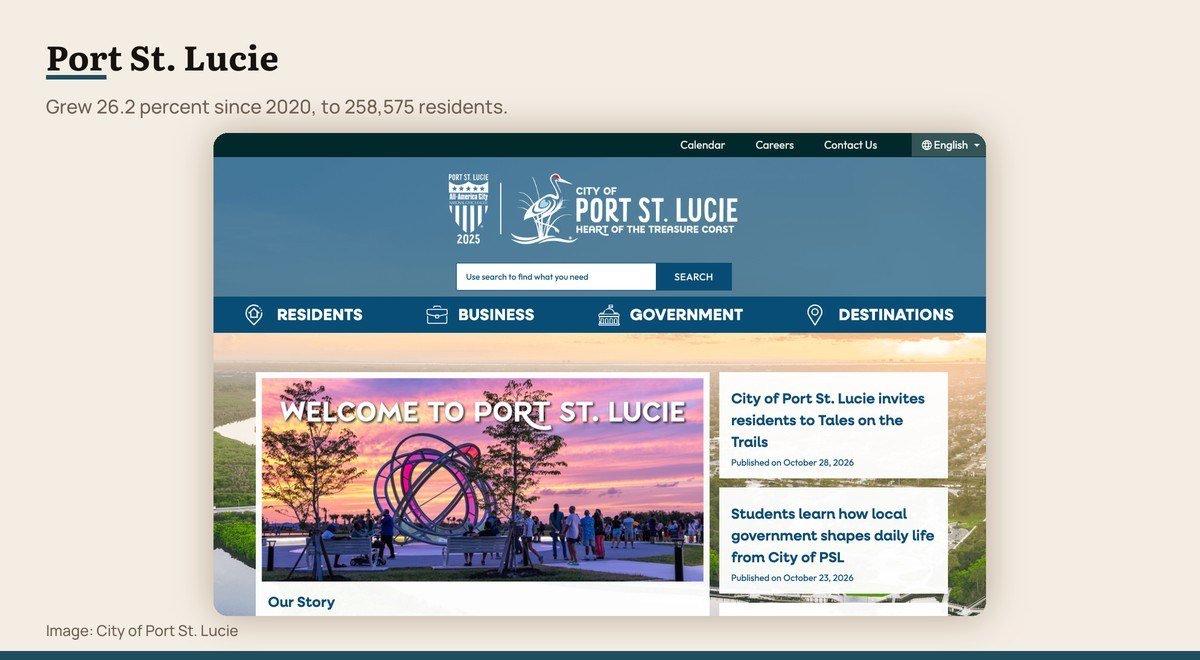
State: Florida · Population 2024: 258,575 · In 2020: 204,859 · Residents added: +53,716 · Growth: 26.2%
Port St. Lucie grew 26.2 percent between 2020 and 2024, the fastest of any American city above 100,000 residents. It added 53,716 people to reach 258,575.
It sits on Florida’s Treasure Coast, north of West Palm Beach, and was laid out as a planned community in the 1960s with far more platted lots than houses. That inventory of ready land is the mechanical reason it could absorb growth this fast.
2. Cape Coral: 20.1% growth

State: Florida · Population 2024: 233,025 · In 2020: 194,001 · Residents added: +39,024 · Growth: 20.1%
Cape Coral added 39,024 residents for 20.1 percent growth, reaching 233,025 on Florida’s Gulf coast.
It shares Port St. Lucie’s origin as a mid-century planned development with a vast pre-platted street grid, and it has more canals than any city in the world. Both features meant land was waiting when demand arrived.
3. Denton: 18.7% growth
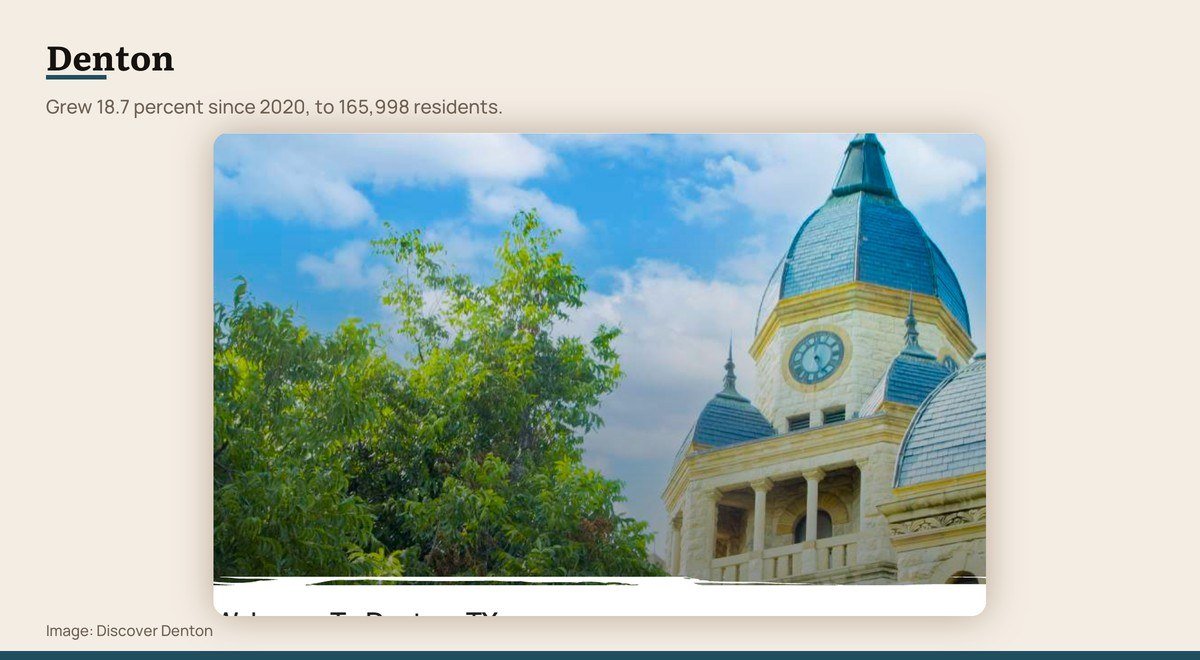
State: Texas · Population 2024: 165,998 · In 2020: 139,874 · Residents added: +26,124 · Growth: 18.7%
Denton grew 18.7 percent to 165,998, the fastest growing city in Texas above 100,000 people and third in the country.
Two universities give it a different profile from the suburban entries around it. The student population keeps the median age low and supports a music and arts scene with a reputation far larger than the city.
4. Meridian: 18.6% growth

State: Idaho · Population 2024: 139,740 · In 2020: 117,794 · Residents added: +21,946 · Growth: 18.6%
Meridian grew 18.6 percent to 139,740, adding 21,946 people and overtaking several larger cities in the process.
It is the fastest growing city in Idaho and sits immediately west of Boise, absorbing the metropolitan area’s expansion. Idaho has been among the fastest growing states in the country throughout this period.
5. Palm Bay: 18.6% growth
State: Florida · Population 2024: 142,023 · In 2020: 119,751 · Residents added: +22,272 · Growth: 18.6%
Palm Bay grew 18.6 percent to 142,023, the third Florida city in the top five.
It sits on the Space Coast in Brevard County, where the launch industry has expanded substantially. That gives it an employment base the retirement-driven Florida stereotype does not capture.
6. Frisco: 17.3% growth

State: Texas · Population 2024: 235,208 · In 2020: 200,537 · Residents added: +34,671 · Growth: 17.3%
Frisco added 34,671 residents for 17.3 percent growth, reaching 235,208 north of Dallas.
It is the largest city in the national top ten by 2024 population and the clearest example of deliberate suburban construction: corporate relocations, professional sports facilities and housing arriving as a coordinated programme rather than organically.
7. Surprise: 17.1% growth

State: Arizona · Population 2024: 167,564 · In 2020: 143,152 · Residents added: +24,412 · Growth: 17.1%
Surprise grew 17.1 percent to 167,564 in the Phoenix metropolitan area, adding 24,412 people.
Arizona’s growth has been concentrated in the suburban ring around Phoenix, and Surprise sits on its north-western edge. Water availability is the constraint everyone in the region now plans around.
8. Nampa: 16.8% growth
State: Idaho · Population 2024: 117,350 · In 2020: 100,428 · Residents added: +16,922 · Growth: 16.8%
Nampa grew 16.8 percent to 117,350, making Idaho the only state with two cities in the national top ten.
It lies west of Meridian on the same corridor out of Boise, and the two together show how concentrated Idaho’s growth has been in one metropolitan area rather than spread across the state.
9. McKinney: 16.5% growth

State: Texas · Population 2024: 227,526 · In 2020: 195,333 · Residents added: +32,193 · Growth: 16.5%
McKinney added 32,193 people for 16.5 percent growth, reaching 227,526 and sitting just below Frisco in both rank and size.
Unlike most fast-growing suburbs it kept a genuine historic centre, with a courthouse square that predates the current growth by more than a century. That is unusual enough in this company to be worth noting.
10. Menifee: 14.2% growth

State: California · Population 2024: 117,041 · In 2020: 102,523 · Residents added: +14,518 · Growth: 14.2%
Menifee closes the national top ten at 14.2 percent growth, reaching 117,041 and the only California city on the list.
It sits in Riverside County’s Inland Empire, where housing costs are a fraction of coastal California’s. Its presence here is the clearest evidence that California’s population movement has been internal rather than purely outward.
Percentage Growth Against People Added
Percentage growth favours smaller cities, and reading it alone produces a distorted picture of where America is actually changing.
Port St. Lucie tops this list at 26.2 percent having added 53,716 people. In the same period Fort Worth added 89,183, San Antonio 92,334 and several other large cities added more in absolute terms than anything in this top ten, while recording single-digit rates.
Both measures are telling you something real. A high percentage means a city is changing character quickly, with schools, roads and water systems under pressure from a base that was not built for the current population.
A large absolute number means more people are affected, and the infrastructure usually already exists. The table carries both columns so the difference is visible rather than hidden inside a single ranking.
What Fast Growth Does to a City
Growth of this speed is not uniformly good news for the people already living there, and three pressures show up consistently.
Housing costs rise faster than incomes during the catch-up period, because supply responds slowly even where land is available. The residents who benefit are those who already owned property; the ones who suffer are renters and anyone buying their first home.
Infrastructure lags by years rather than months. Schools built for a smaller population run portable classrooms, road capacity is designed around traffic counts that are already out of date, and water and sewer systems are the slowest of all to expand.
Water is the binding constraint in the western entries. Phoenix-area and Idaho growth both depend on allocations that were set when far fewer people lived there, and it is the question most likely to shape whether these rankings look the same in five years.
Where These Numbers Come From
The ranking uses the Census Bureau population estimates programme, which publishes annual estimates for every incorporated place between the ten-yearly counts.
These are estimates rather than counts. The Bureau begins from the 2020 census and updates it using births, deaths and migration indicators, so figures carry more uncertainty for small places than for large ones. That is why this list applies a 100,000 resident floor.
Annexation is the other thing to watch, and the methodology the Bureau publishes explains how boundary changes are handled. A city that absorbs adjacent land gains the people living on it, which appears as growth without anybody moving house, and it affects fast-expanding cities more than settled ones.
The next vintage will extend the series to 2025 and is likely to reorder the middle of this list while leaving the Florida and Texas clusters at the top intact.
Frequently Asked Questions
What is the fastest growing city in the US?
Port St. Lucie, Florida, among cities of at least 100,000 residents. It grew 26.2 percent between 2020 and 2024, adding 53,716 people to reach 258,575, helped by a street grid platted decades before the demand existed.
Which state has the most fast growing cities?
Florida and Texas tie with three each in the top ten, and Idaho is the surprise with two, both on the same corridor west of Boise. Arizona and California supply one apiece.
Why are Florida cities growing so fast?
Partly migration and partly land. Port St. Lucie, Cape Coral and Palm Bay were laid out as large planned communities with far more platted lots than houses, so the room to build existed long before the people arrived.
Does fast growth make a city a good place to live?
Not automatically. Rapid growth raises housing costs ahead of incomes and leaves schools, roads and water systems behind for years. It signals that a lot of people chose the city, not that they were all glad afterwards.