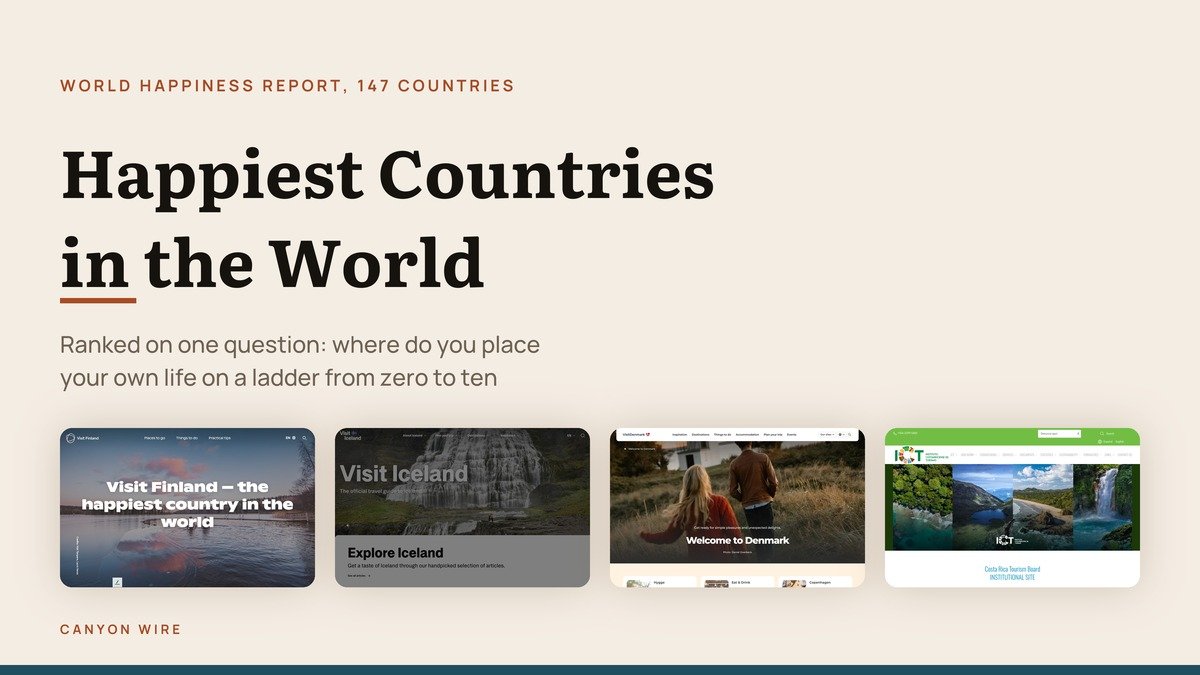
The happiest countries in the world are ranked each year on a single question, and Finland has answered it best every year since 2018. In the latest edition it scores 7.764 out of ten, more than two tenths clear of second place.
The ten below come from the World Happiness Report 2026, which covers 147 countries. Before the list is worth reading, it helps to know exactly what is being measured, because it is not what most people assume.
What the Ranking Actually Asks People
No one is asked whether they are happy. The ranking rests on a zero to ten ladder question, where respondents place their own life on a scale with the best possible life at the top and the worst at the bottom, then give the number.
- It is self-assessment, not observation. Nobody measures a country and assigns it a score. People rate their own lives and the national figure is the average.
- It is evaluation, not mood. The question asks about a life taken as a whole, which is why reserved countries score well and demonstrative ones do not automatically.
- The averages are multi-year. Rankings use several years of responses pooled together, which is why positions move slowly and a single bad year rarely shifts a country far.
The report also publishes the components it uses to explain the scores: income, social support, healthy life expectancy, freedom to make life choices, generosity and perceptions of corruption. Those explain the ranking rather than produce it.
One more measure is worth knowing about, because it is the most revealing. The report publishes inequality of life evaluations, meaning how widely the answers vary inside a country. Nordic countries score well there as well, which means their results are not an average pulled up by a contented minority.
Happiest Countries in the World: Rank, Score and Region
The top ten from the 2026 edition, covering the 2025 survey year.
| # | Country | Rank | Life evaluation | Region |
|---|---|---|---|---|
| 1 | Finland | 1 | 7.764 | Western Europe |
| 2 | Iceland | 2 | 7.540 | Western Europe |
| 3 | Denmark | 3 | 7.539 | Western Europe |
| 4 | Costa Rica | 4 | 7.439 | Latin America and the Caribbean |
| 5 | Sweden | 5 | 7.255 | Western Europe |
| 6 | Norway | 6 | 7.242 | Western Europe |
| 7 | Netherlands | 7 | 7.223 | Western Europe |
| 8 | Israel | 8 | 7.187 | Middle East and North Africa |
| 9 | Luxembourg | 9 | 7.063 | Western Europe |
| 10 | Switzerland | 10 | 7.018 | Western Europe |
The 10 Happiest Countries, Ranked
Scores are out of ten, from the 2026 edition covering the 2025 survey year.
1. Finland: 7.764 out of 10
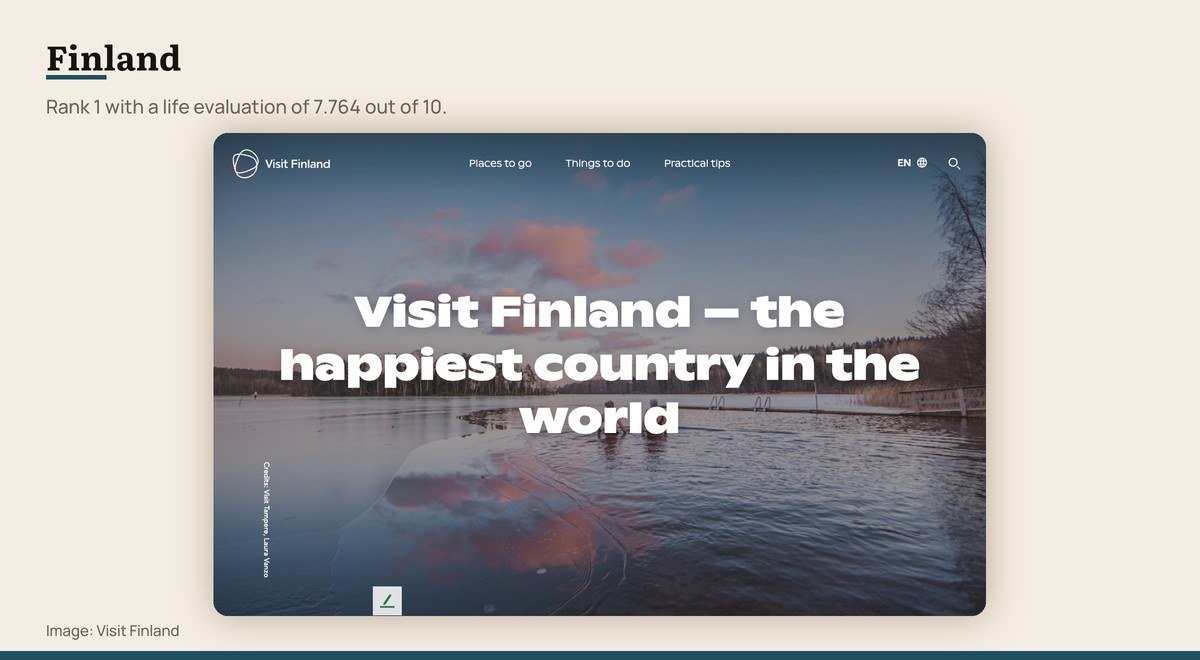
Rank: 1 · Life evaluation: 7.764 · Region: Western Europe
Finland has finished first every year since 2018, which is now the longest run at the top in the report’s history. Its score of 7.764 is more than two tenths clear of second place, the widest gap anywhere in the top ten.
What the ranking measures is not cheerfulness. Respondents place their own life on a ladder from zero to ten, and Finns consistently rate theirs highly despite a climate and a temperament that visitors rarely describe as sunny.
2. Iceland: 7.540 out of 10
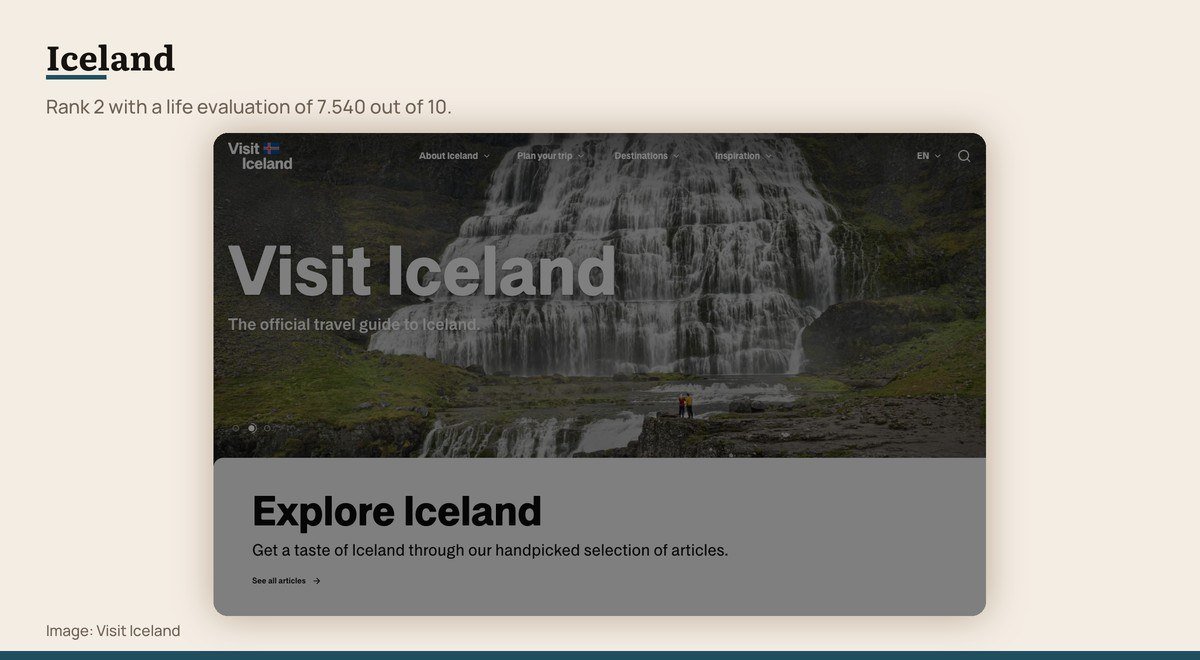
Rank: 2 · Life evaluation: 7.540 · Region: Western Europe
Iceland takes second at 7.540, a thousandth of a point above Denmark. On a sample of this size that difference is not meaningful, and the two have traded places repeatedly.
Iceland is also the smallest country in the top ten by population, which is a recurring feature of this list. Small, cohesive societies with dense social ties score well on the support questions that underpin the headline number.
3. Denmark: 7.539 out of 10
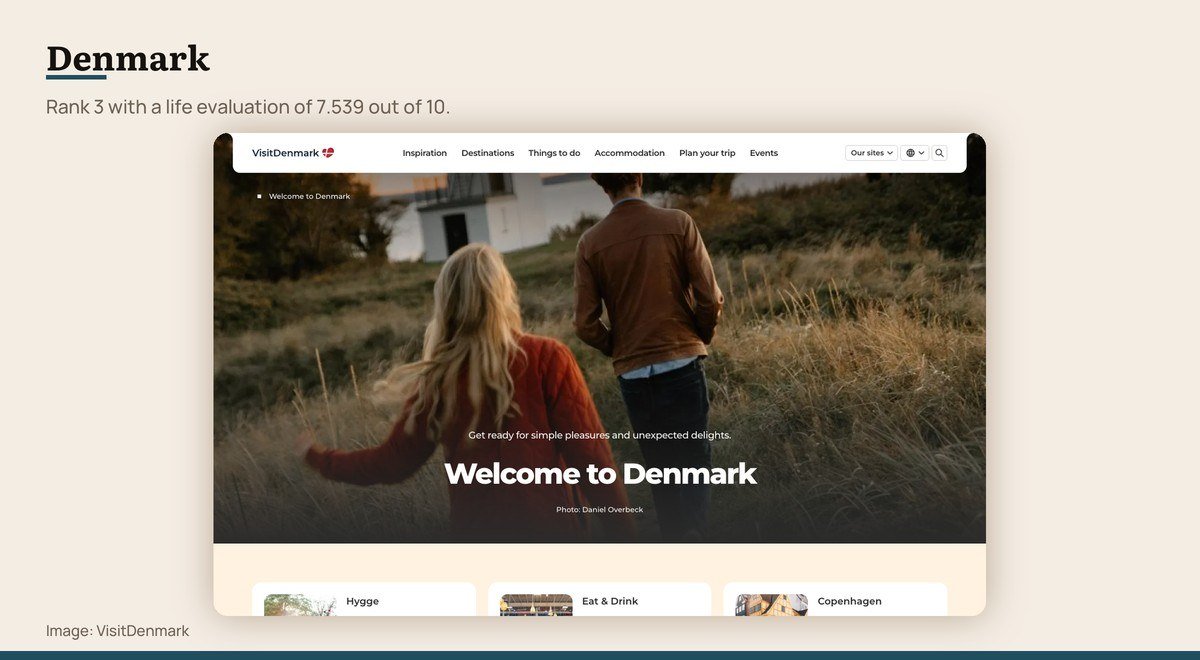
Rank: 3 · Life evaluation: 7.539 · Region: Western Europe
Denmark is third at 7.539, effectively tied with Iceland. It has been in the top three for nearly the whole life of the report and briefly held first place before Finland’s run began.
The Nordic cluster at the top is not a coincidence of culture. These countries share high institutional trust, strong welfare provision and low inequality in how life evaluations are distributed, which is itself one of the measures published alongside the ranking.
4. Costa Rica: 7.439 out of 10
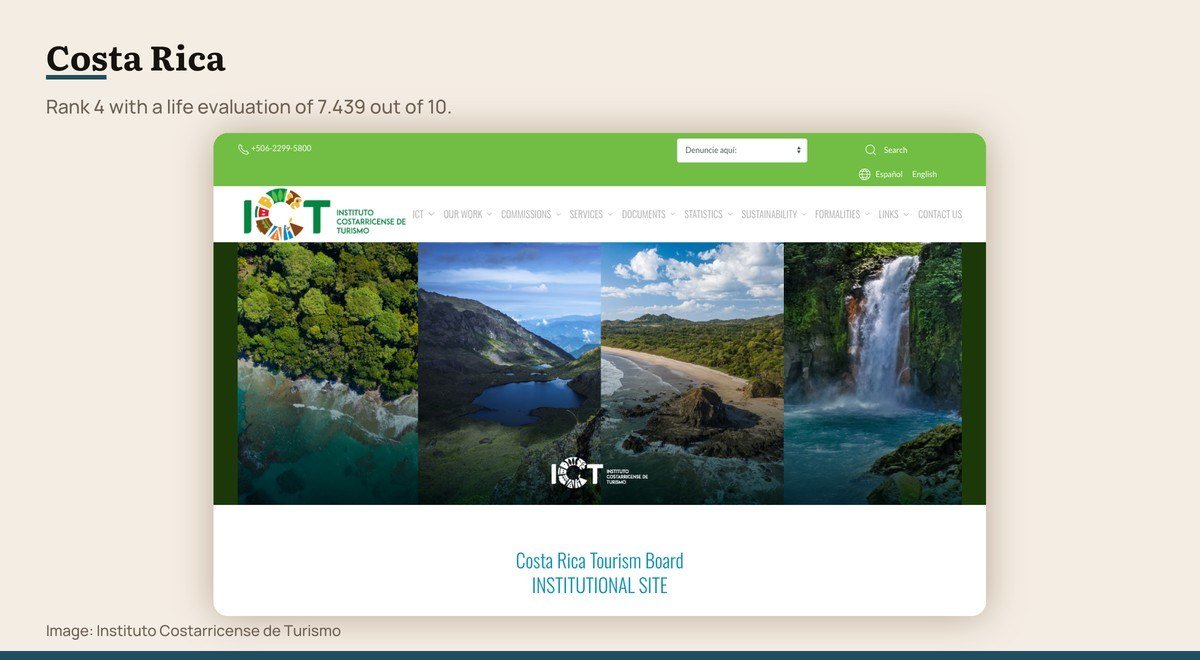
Rank: 4 · Life evaluation: 7.439 · Region: Latin America and the Caribbean
Costa Rica is fourth at 7.439 and the only country outside Western Europe in the top five. It sits well above every country with a comparable income level.
That gap is the most interesting thing in the table. Costa Rica abolished its military in 1949 and has directed public spending towards health and education since, and it consistently outperforms what its economic figures alone would predict.
5. Sweden: 7.255 out of 10
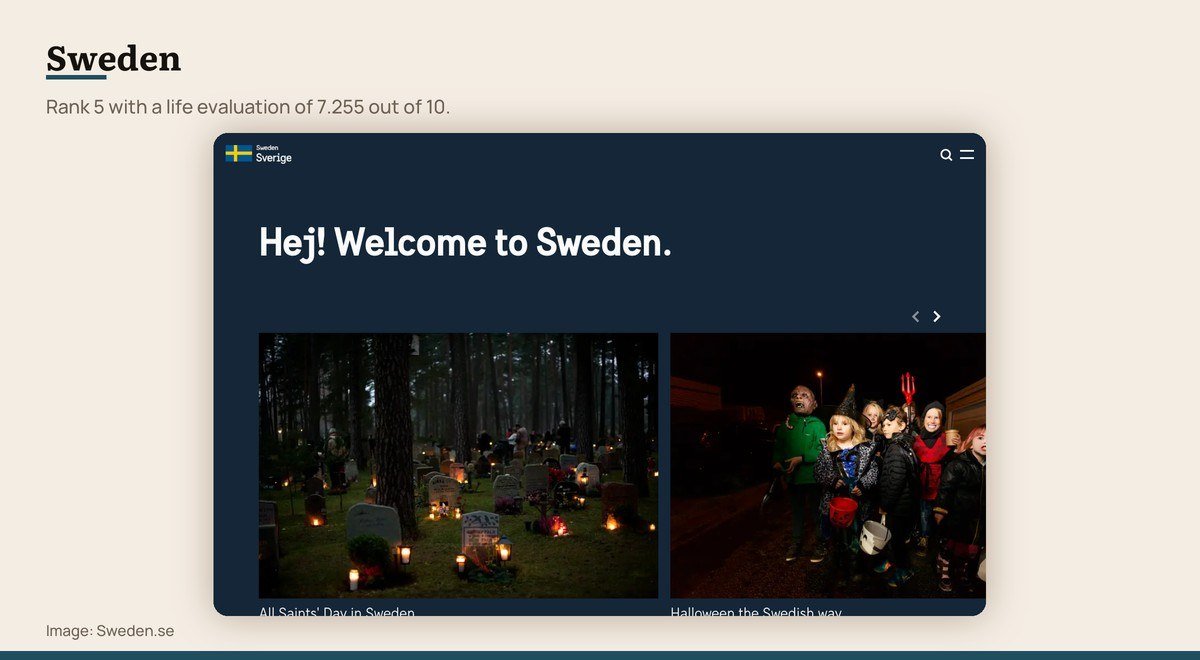
Rank: 5 · Life evaluation: 7.255 · Region: Western Europe
Sweden takes fifth at 7.255, completing the Nordic presence alongside Finland, Iceland, Denmark and Norway. All five are inside the top six.
The Nordic countries rank highly on every component the report publishes, not just the headline. Social support, freedom to make life choices and low perceived corruption all move together, which is why they cluster rather than scatter.
6. Norway: 7.242 out of 10

Rank: 6 · Life evaluation: 7.242 · Region: Western Europe
Norway is sixth at 7.242. It has slipped slightly from earlier editions when it held the top spot, though the movement is small in absolute terms.
Norway is the wealthiest country in the top ten by some distance, which illustrates the report’s own finding that income raises life evaluation with diminishing returns. Past a certain point, more national wealth adds very little.
7. Netherlands: 7.223 out of 10
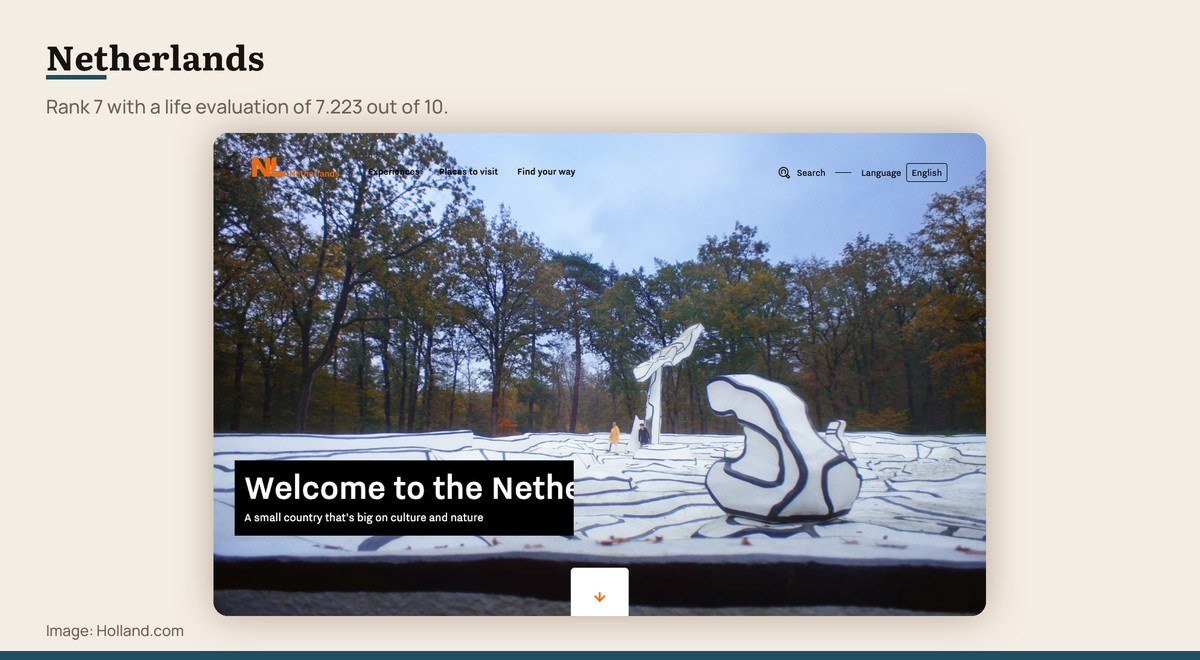
Rank: 7 · Life evaluation: 7.223 · Region: Western Europe
The Netherlands is seventh at 7.223 and the largest Western European country in the top ten by population.
Its presence matters because it shows the Nordic result is not purely about small populations. A country of eighteen million with high density and a large city economy reaches nearly the same level.
8. Israel: 7.187 out of 10
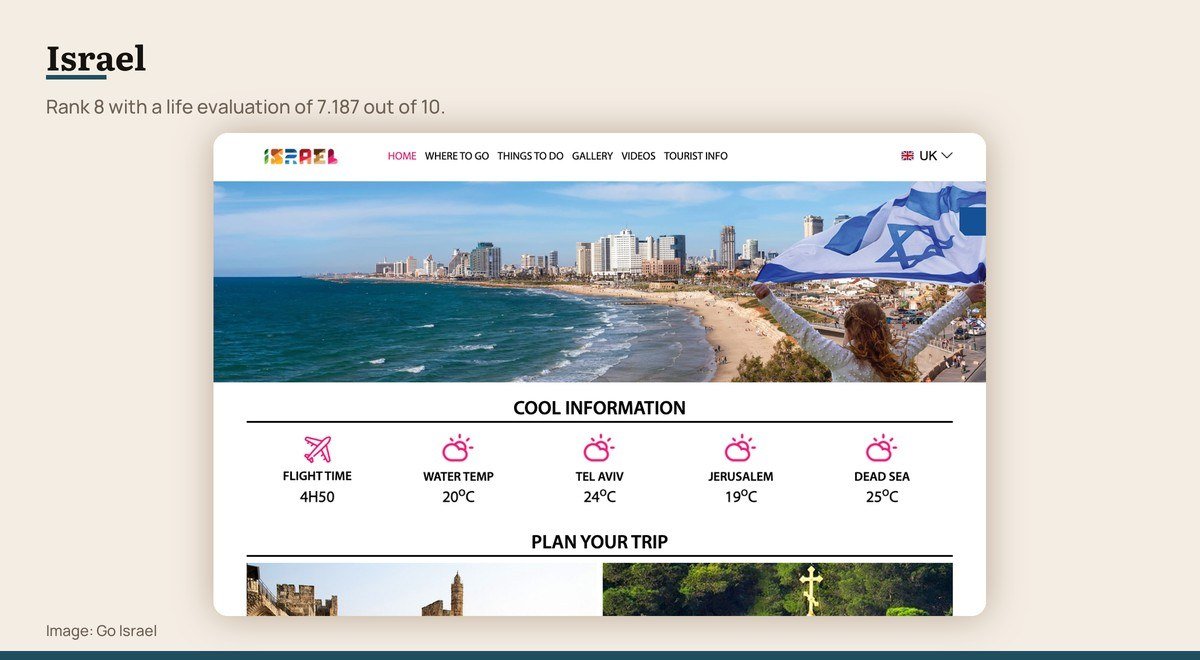
Rank: 8 · Life evaluation: 7.187 · Region: Middle East and North Africa
Israel is eighth at 7.187, the only country from the Middle East and North Africa region in the top ten and a position it has held across several editions.
The report measures how people evaluate their own lives rather than external conditions, and strong family and community ties feed the social support component heavily. It is the clearest case in the table of a score that surprises people reading it from outside.
9. Luxembourg: 7.063 out of 10
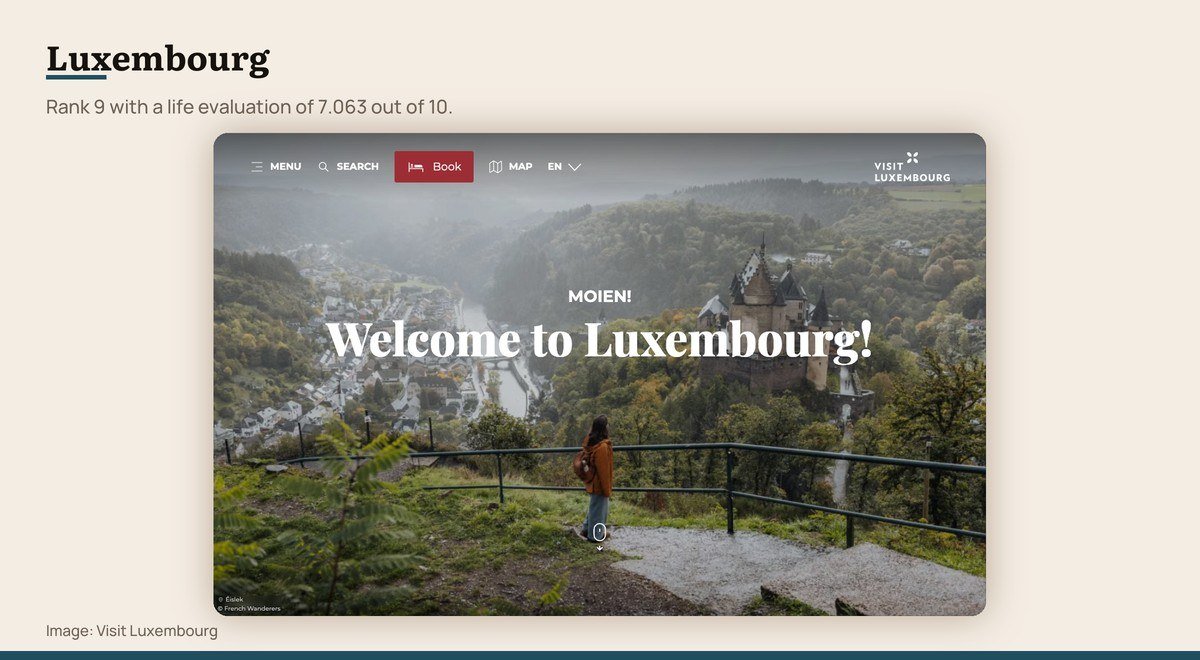
Rank: 9 · Life evaluation: 7.063 · Region: Western Europe
Luxembourg is ninth at 7.063 and the smallest country in the top ten, with a population under seven hundred thousand.
It has the highest income per head of any country ranked. As with Norway, that wealth does not translate into a proportionally higher position, which is consistent across the whole dataset.
10. Switzerland: 7.018 out of 10
Rank: 10 · Life evaluation: 7.018 · Region: Western Europe
Switzerland closes the top ten at 7.018, the last country above seven points. Below it the scores descend steadily rather than falling away.
Switzerland scores particularly well on the corruption perception question. Trust in institutions is one of the strongest correlates of a high life evaluation in this data, and it is the component where the top ten most clearly separate from the rest.
Why the Nordic Countries Keep Winning
Five of the top six are Nordic, and that has been true for most of the report’s existence. The explanation in the data is more specific than a general sense of good government.
These countries score highly on every component at once rather than exceptionally on one. Social support, freedom to make life choices and low perceived corruption all move together, and the combination is what produces a high evaluation.
Trust is the thread running through them. A society where people expect institutions to function and expect a lost wallet to be returned removes a continuous low-level anxiety that does not show up in economic statistics but does show up here.
It is also not about weather, which is the most common objection. Finland, Iceland and Norway have long dark winters and finish first, second and sixth, while many sunnier and warmer countries finish far below them.
The Countries That Beat Their Income
The relationship between national wealth and life evaluation is real and it flattens quickly, which produces the most interesting entries in the table.
Costa Rica is the clearest case. Fourth overall at 7.439, it sits far above every country at a comparable income level and above many much richer ones. It abolished its military in 1949 and has spent on health and education instead ever since.
Luxembourg and Norway illustrate the other end of the same relationship. Both are among the wealthiest countries on earth and both rank below several countries with a fraction of their income per head, because additional national wealth adds very little once basic security is in place.
That pattern is the practical finding buried in the ranking. Beyond a threshold, what raises how people rate their lives is the quality of their relationships, their institutions and their freedom to choose, rather than the size of the economy around them.
Frequently Asked Questions
Which is the happiest country in the world?
Finland, which has finished first every year since 2018. In the 2026 edition it scores 7.764 out of ten, with Iceland second at 7.540 and Denmark third at 7.539, the two of them separated by a thousandth of a point.
How is the happiness ranking measured?
By asking people to place their own life on a ladder from zero to ten, then averaging the answers over several years. Nobody is asked whether they feel happy, and no external observer scores the country.
Why do cold countries rank so highly?
Climate is not one of the factors the report associates with high scores. Trust in institutions, social support and freedom to make life choices are, and the countries at the top score well on all three at once despite long dark winters.
How many countries are ranked?
A hundred and forty-seven in the current edition. Afghanistan finishes last at 1.446, which is more than six points below Finland, a spread far wider than the gaps anywhere inside the top ten.