Minimum wage by state is really two questions, because the federal floor and the state floors have drifted a long way apart. The federal rate is $7.25 an hour and has been since July 2009. The District of Columbia pays $18.40.
That is a gap of more than two and a half times between the lowest legal wage in one part of the country and another. The ten highest rates are below, along with how each one is adjusted, which is what determines whether a state stays near the top.
The Federal Floor Has Not Moved Since 2009
The national minimum wage is set by the Fair Labor Standards Act and stands at $7.25 an hour, effective from 24 July 2009. It is not indexed, so it changes only when Congress passes a new figure, and it has not.
Where a state sets a higher rate, employers must pay the higher one. Where a state sets none, or sets one below the federal figure, the federal rate applies to employees covered by the Act.
- The higher rate always wins. Federal, state and local minimums stack, and the employee is entitled to whichever is largest.
- Local rates exist too. Several cities set minimums above their own state, though a number of states prohibit municipalities from doing so.
- Tipped work is separate. Federal law allows a lower cash wage for tipped employees provided tips bring the total to at least the full minimum, and states vary widely in whether they permit it.
The practical consequence is that there is no single American minimum wage. What somebody is legally owed depends on their state, sometimes their city, and whether their work is tipped.
Minimum Wage by State: The Ten Highest Rates
Rates current on October 28, 2026, against a federal floor of $7.25.
| # | State | Minimum wage | Against federal | Full time year |
|---|---|---|---|---|
| 1 | District of Columbia | $18.40 | 2.5x the federal rate | $38,272 a year at 40 hours |
| 2 | Washington | $17.13 | 2.4x the federal rate | $35,630 a year at 40 hours |
| 3 | New York | $17.00 | 2.3x the federal rate | $35,360 a year at 40 hours |
| 4 | Connecticut | $16.94 | 2.3x the federal rate | $35,235 a year at 40 hours |
| 5 | California | $16.90 | 2.3x the federal rate | $35,152 a year at 40 hours |
| 6 | Hawaii | $16.00 | 2.2x the federal rate | $33,280 a year at 40 hours |
| 7 | Rhode Island | $16.00 | 2.2x the federal rate | $33,280 a year at 40 hours |
| 8 | New Jersey | $15.92 | 2.2x the federal rate | $33,114 a year at 40 hours |
| 9 | Oregon | $15.55 | 2.1x the federal rate | $32,344 a year at 40 hours |
| 10 | Colorado | $15.16 | 2.1x the federal rate | $31,533 a year at 40 hours |
The 10 Highest Minimum Wages, Ranked
Ranked by hourly rate. The annual column assumes forty hours a week for fifty-two weeks, which is a ceiling rather than a typical outcome in low-wage work.
1. District of Columbia: $18.40 an hour
Rate: $18.40 · Against federal: 2.5x the federal rate · Full time: $38,272 a year at 40 hours
At $18.40 an hour the District of Columbia pays the highest minimum wage in the United States, more than two and a half times the federal rate.
DC indexes its rate to inflation, which is why it has pulled ahead of every state rather than moving in steps when legislation passes. The gap between it and second place is larger than the gap between second and sixth.
2. Washington: $17.13 an hour
Rate: $17.13 · Against federal: 2.4x the federal rate · Full time: $35,630 a year at 40 hours
Washington pays $17.13, the highest of any state. It was the first state to index its minimum wage to inflation, in an initiative passed by voters in 1998.
That indexing is why it stays at the top without repeated legislation. Several cities inside the state set higher local rates still, and where a local rate is higher the employer pays that one.
3. New York: $17.00 an hour
Rate: $17.00 · Against federal: 2.3x the federal rate · Full time: $35,360 a year at 40 hours
New York runs a split rate. New York City, Nassau, Suffolk and Westchester counties are at $17.00, and the remainder of the state is at $16.00.
The split exists because living costs inside the New York City commuter belt differ sharply from those upstate. It is the clearest example on this list of a state treating itself as more than one labour market.
4. Connecticut: $16.94 an hour
Rate: $16.94 · Against federal: 2.3x the federal rate · Full time: $35,235 a year at 40 hours
Connecticut pays $16.94, third among the states and fourth overall behind DC.
Its adjustment mechanism is unusual: the rate is tied to the federal employment cost index rather than to consumer price inflation, which means it tracks what employers pay rather than what workers buy.
5. California: $16.90 an hour
Rate: $16.90 · Against federal: 2.3x the federal rate · Full time: $35,152 a year at 40 hours
California’s statewide rate is $16.90, applying to employers of every size after the state removed its small-employer distinction.
The statewide figure is a floor that many Californians sit above, because dozens of cities and counties set higher local minimums, and separate higher rates apply to fast food and healthcare workers.
6. Hawaii: $16.00 an hour
Rate: $16.00 · Against federal: 2.2x the federal rate · Full time: $33,280 a year at 40 hours
Hawaii pays $16.00, having moved up through a series of legislated increases rather than annual indexation.
Its position matters more than the number suggests, because Hawaii has the highest cost of living of any state. A dollar at this rate buys considerably less there than the same dollar in most of the mainland.
7. Rhode Island: $16.00 an hour
Rate: $16.00 · Against federal: 2.2x the federal rate · Full time: $33,280 a year at 40 hours
Rhode Island also pays $16.00, reached through scheduled statutory increases.
It is the smallest state on this list by area and it sits between two higher-paying neighbours, Connecticut and Massachusetts, which is the kind of regional pressure that tends to pull rates upward.
8. New Jersey: $15.92 an hour
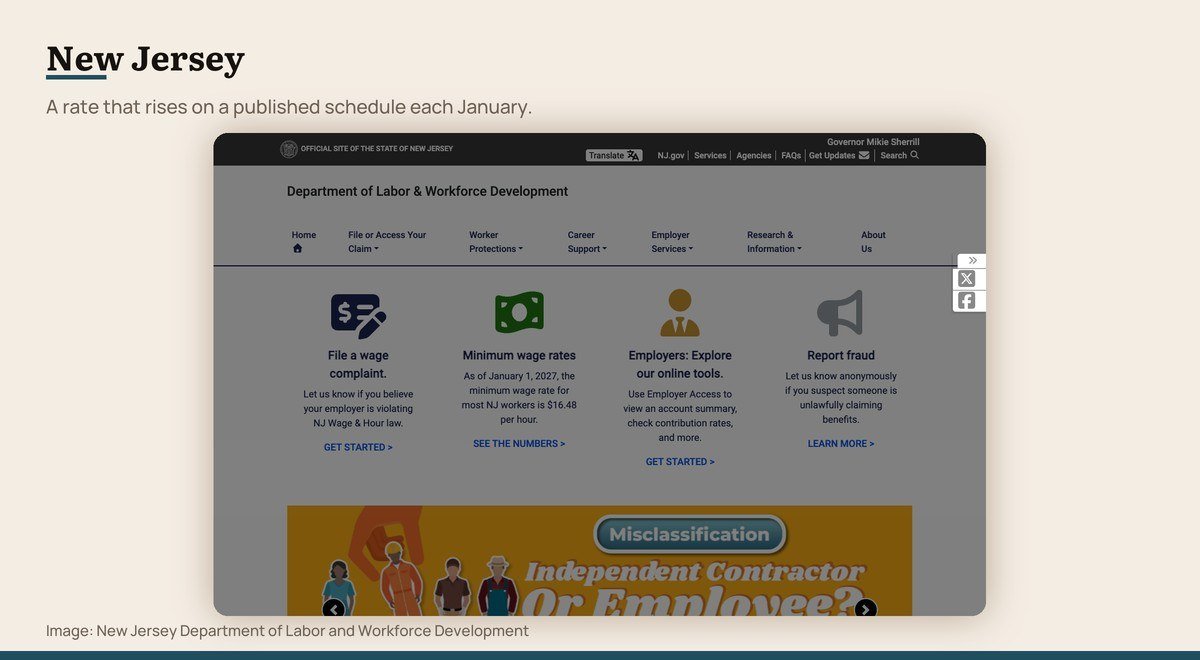
Rate: $15.92 · Against federal: 2.2x the federal rate · Full time: $33,114 a year at 40 hours
New Jersey pays $15.92 for most employers, with a lower rate for seasonal and small employers that is scheduled to converge with the main one.
The state publishes its increases years in advance, which is unusually helpful for employers planning payroll and for workers deciding whether a job will still pay what it does now.
9. Oregon: $15.55 an hour
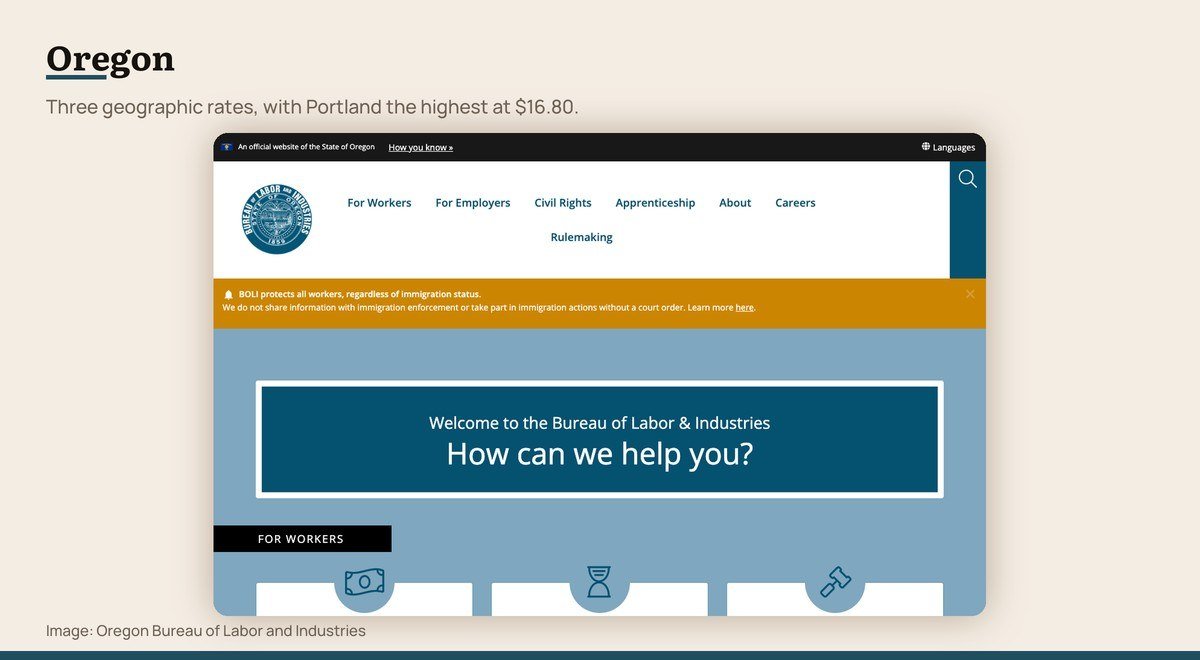
Rate: $15.55 · Against federal: 2.1x the federal rate · Full time: $32,344 a year at 40 hours
Oregon has three rates rather than one. The standard rate is $15.55, the Portland metro area is $16.80, and designated non-urban counties are lower.
No other state divides itself this explicitly by geography. The design recognises that the cost of employing somebody in Portland and in rural eastern Oregon are different problems.
10. Colorado: $15.16 an hour
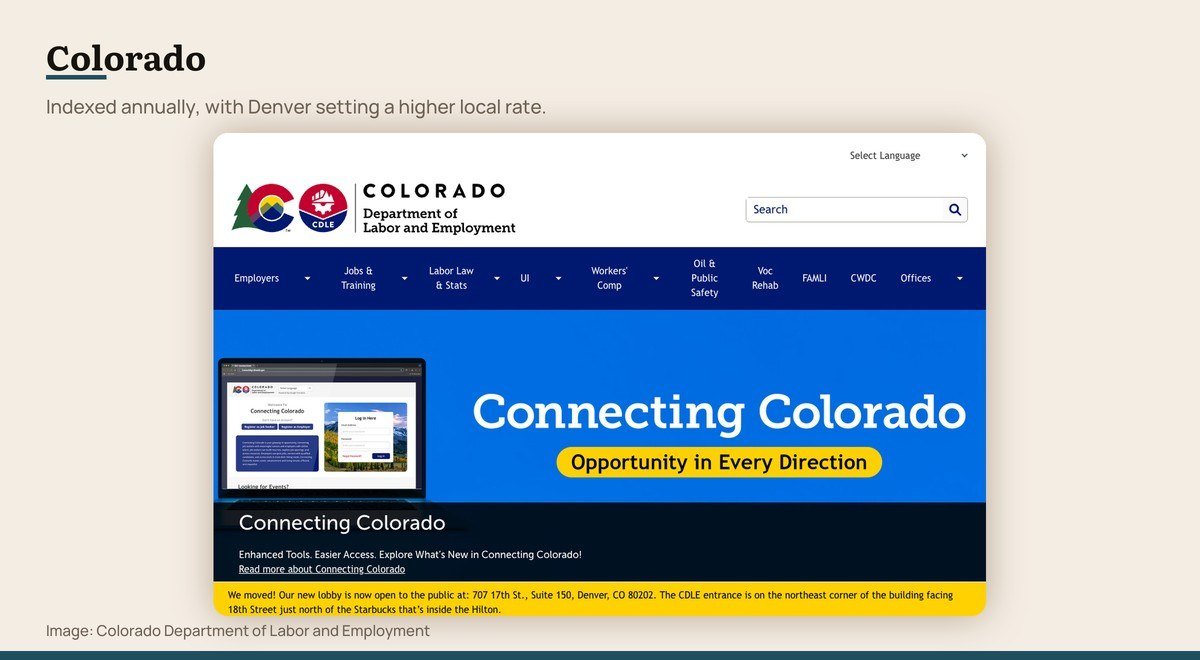
Rate: $15.16 · Against federal: 2.1x the federal rate · Full time: $31,533 a year at 40 hours
Colorado pays $15.16, adjusted each year for inflation under a constitutional amendment approved by voters.
Denver sets its own higher rate, which is permitted because Colorado allows local governments to exceed the state floor. Most states do not, and several explicitly forbid it.
Indexing Is What Separates the Top From the Rest
Look at how each of these states adjusts its rate and a pattern appears immediately: the ones at the top mostly do it automatically.
Washington, Colorado, the District of Columbia and several others tie their minimum to an inflation measure, so the rate rises every January without anyone voting. Connecticut uses the employment cost index instead, tracking what employers pay rather than what prices do.
States that legislate each increase individually move in steps and then stall. That is the mechanism behind the federal rate’s seventeen years without a change, and it is the single best predictor of whether a state will still be near the top of this list in five years.
Indexing also cuts the other way in a downturn, since most such laws hold the rate steady rather than reducing it when prices fall. In practice that has made them ratchets.
What the Rate Buys Where It Is Paid
A high minimum wage and a high real wage are not the same thing, and the cost of living in these states is the reason.
Hawaii is the clearest case. At $16.00 it ranks sixth here, and it has the highest prices of any state, so the same hourly figure stretches considerably less far than it would in a cheaper state. The District of Columbia, New York and California carry the same qualification.
Federal price data shows housing is where the difference concentrates. Goods cost roughly the same everywhere, and rent in the most expensive states runs at nearly three times the level of the cheapest ones, which absorbs a large part of a higher hourly rate.
That does not make the higher rates meaningless. It means a national comparison of hourly figures describes legal obligation accurately and purchasing power only loosely.
What a Full-Time Year Actually Comes To
At forty hours a week for a full year, the federal $7.25 produces $15,080 before tax. The District of Columbia’s $18.40 produces $38,272 on the same arithmetic.
Both figures should be treated as ceilings rather than expectations. Minimum wage work is disproportionately part time, hours fluctuate week to week, and scheduling practices in retail and hospitality often prevent an employee reaching forty hours consistently.
The annual column in the table above is therefore useful for comparing states against each other, and misleading if read as what a minimum wage worker takes home.
Frequently Asked Questions
What is the federal minimum wage?
$7.25 an hour, effective since 24 July 2009. It is not indexed to inflation, so it changes only when Congress legislates a new figure, which it has not done in more than seventeen years.
Which state has the highest minimum wage?
Washington at $17.13 is the highest state. The District of Columbia pays more at $18.40, though it is a federal district rather than a state. Connecticut, California and New York follow.
Can a city set a higher minimum wage than its state?
In some states, yes. Denver, Portland and numerous California cities set rates above their state floor. Other states prohibit local minimum wage ordinances entirely, so it depends on state law rather than on the city.
What happens if a state has no minimum wage law?
The federal rate of $7.25 applies to employees covered by the Fair Labor Standards Act, which is most of them. The same is true where a state sets a rate below the federal one.