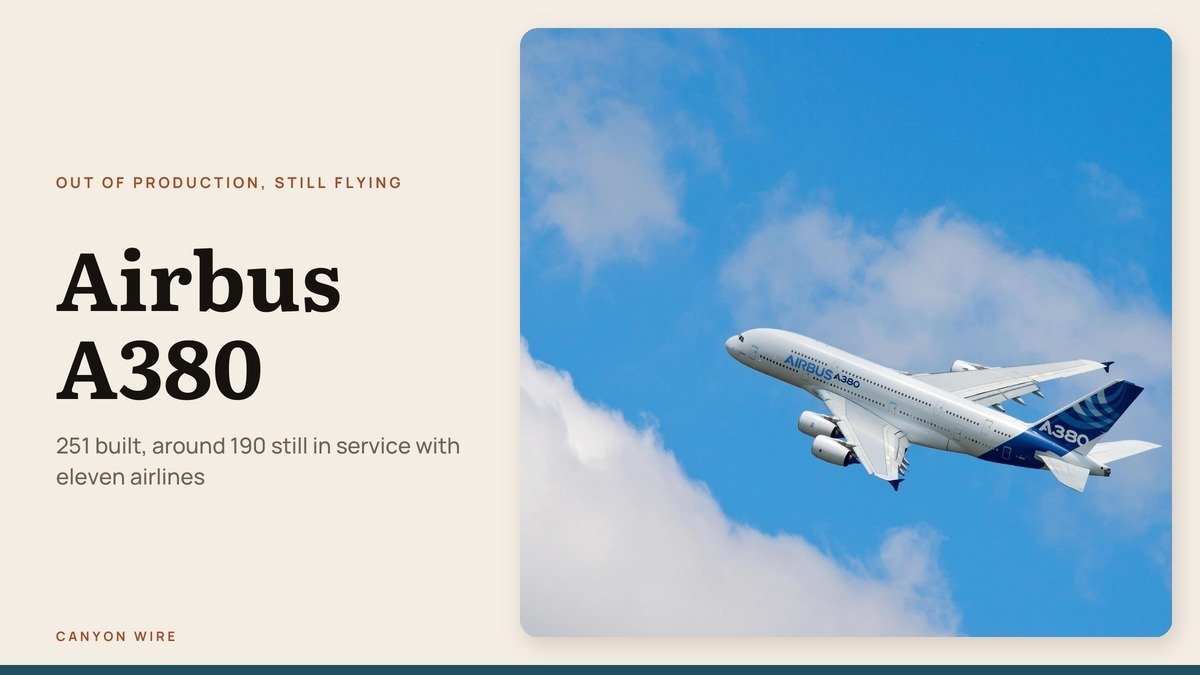
The Airbus A380 is the biggest airliner ever to carry passengers, and the only one with a deck running the full length of the fuselage on two levels. It spans 79.75 metres, takes off at up to 575 tonnes, and is certified to carry 868 people. Airbus built 251 of them between 2003 and 2021 and then closed the line.
What followed was unexpected. Almost the whole world fleet was parked in 2020, several airlines declared the type finished, and then most of them brought it back. Around 190 aircraft sit with eleven carriers in 2026. This is what the A380 measures, what the cabin is like, who flies it today and why nothing is being built to replace it.
How Big the Airbus A380 Actually Is
Scale is easier to feel against the aircraft it was built to beat. The Boeing 747-8 Intercontinental, the largest airliner Boeing ever delivered, is the longer of the two at 76.25 metres against 72.72. On every other measure the A380 is bigger.
| Measure | Airbus A380-800 | Boeing 747-8I |
|---|---|---|
| Length | 72.72 m | 76.25 m |
| Wingspan | 79.75 m | 68.40 m |
| Tail height | 24.09 m | 20 m |
| Maximum take-off weight | 575 t | 448 t |
| Three-class seating | 525 | 467 |
| Range | 14,800 km | 14,310 km |
| Cruise speed | Mach 0.85 | Mach 0.855 |
| Engines | 4 x Trent 900 or GP7200 | 4 x GEnx-2B67 |
The 11-metre span difference is the one that reshapes airports. An A380 needs a wider taxiway fillet, a reinforced apron and in many cases a two-level jet bridge, which is why only part of the world network can take it. Over 400 airports are cleared for the type.
Other dimensions worth holding on to: 845 square metres of wing, 253,983 kg of fuel, a 43,100 ft ceiling, and 22 wheels spreading the weight across the pavement. Operating empty, before a passenger or a litre of fuel is loaded, it weighs 285 tonnes.
Where 868 Seats Could Go Across Two Decks
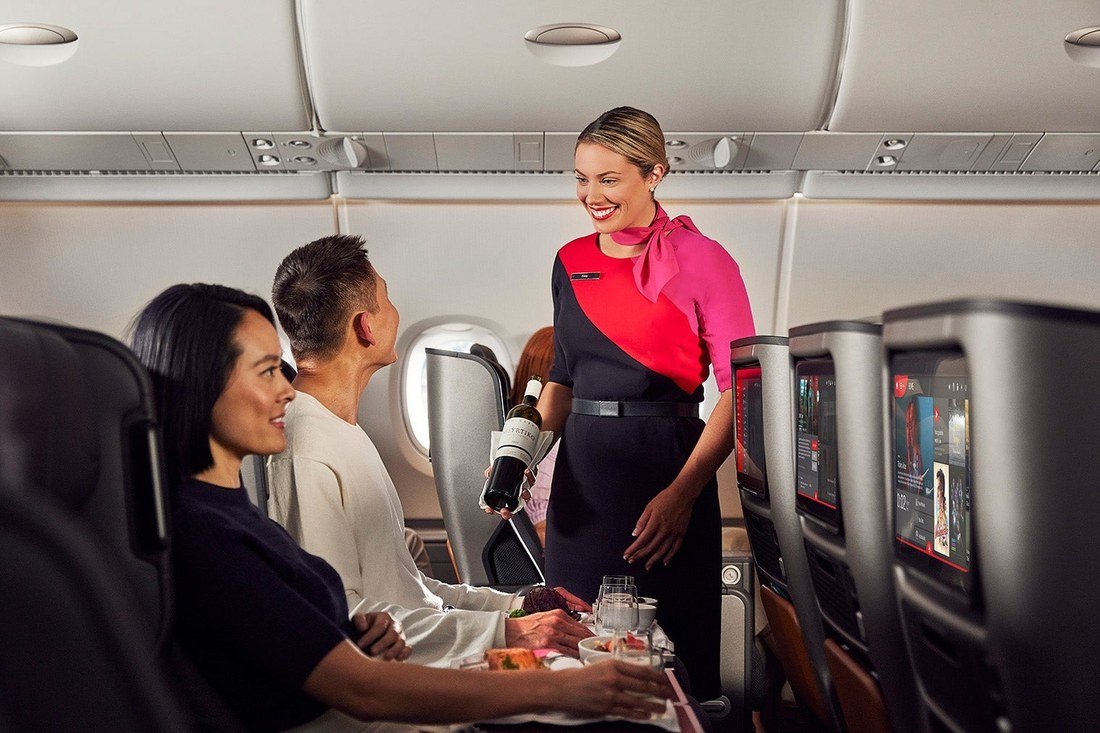
The cabin covers 550 square metres over the main and upper decks. The European type certificate puts the ceiling at 868 people for emergency evacuation, 538 below and 330 above. That number has never been used.
Airlines trade floor area for comfort instead. Real configurations in service today sit between roughly 469 and 519 seats, because a first class suite or a lie-flat business seat occupies several times the space of an economy row:
- Emirates fits first class suites and a stand-up bar at the back of the upper deck, with shower spas on the first class aircraft.
- Singapore Airlines runs six enclosed suites at the front of the main deck, each with a separate bed and chair.
- Qantas rebuilt its upper-deck lounge during a refit programme that took the fleet to 485 seats.
- All Nippon Airways fitted economy couches that convert into flat benches on its three Honolulu aircraft.
Two staircases, one forward and one aft, are the quiet advantage. They let a full aircraft load through two jet bridges at once, so a 500-seat departure takes about as long on stand as a 300-seat one.
The Airlines Flying the Airbus A380 Right Now
Eleven operators hold the type in 2026. The list below includes stored airframes, so the flying total on any given day is lower; Emirates alone keeps around 21 of its 116 parked.
| Airline | Fleet | Status |
|---|---|---|
| Emirates | 116 | Largest operator and the customer for the final delivery |
| British Airways | 12 | Heathrow to the US West Coast and the Gulf |
| Singapore Airlines | 12 | Launch operator in 2007 |
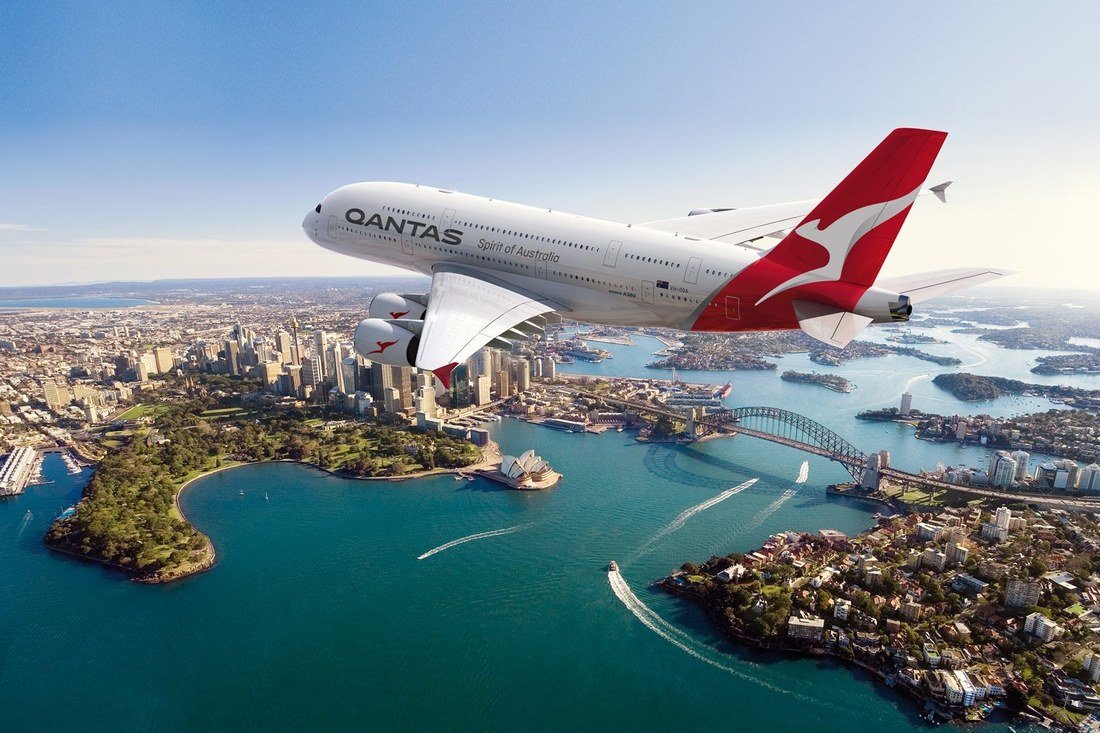
| Qantas | 10 | Retirement starts in 2028 |
| Etihad Airways | 9 | Brought back after a full grounding |
| Lufthansa | 8 | Eight of the original 14 returned from storage |
| Qatar Airways | 8 | Peak-season European and Asian routes |
| Asiana Airlines | 6 | Merging into Korean Air |
| Korean Air | 5 | Exit planned before 2031 |
| All Nippon Airways | 3 | Dedicated to Tokyo-Honolulu |
| Global Airlines | 1 | UK start-up flying charters on a Maltese certificate |
Fleet counts are current as of June 2026. Five airlines have left the type behind permanently: Air France and Thai Airways in 2020, China Southern and Malaysia Airlines in 2022, and the charter operator Hi Fly.
Two moves define the next few years. Qantas pulled its retirement forward by four years to 2028 as Project Sunrise A350-1000ULRs arrive, and Singapore Airlines took the A380 off eleven routes from September 2026 while keeping all twelve aircraft and putting one onto Singapore to Auckland.
Four Engines and a Two-Pilot Flight Deck
Buyers picked one of two engines, and the choice still splits the fleet. The Rolls-Royce Trent 900 produces 334.29 kN of take-off thrust as the Trent 970-84 and 341.41 kN in its Trent 972 forms. Singapore Airlines, Lufthansa, Qantas, British Airways, All Nippon Airways and Asiana all fly it.
The rival came from Engine Alliance, a General Electric and Pratt & Whitney joint venture. Its GP7200 is rated from 70,000 to 81,500 lb of thrust around a 116-inch fan, and powers the Emirates, Etihad, Qatar Airways, Air France and Korean Air aircraft.
The flight deck needs two pilots, the same minimum as a single-aisle A320, and the aircraft is cleared for Category 3 approaches and automatic landings. Airbus kept the cockpit layout close enough to the rest of its range that conversion training is short.
Built From 2003 to 2021: The Programme in Short
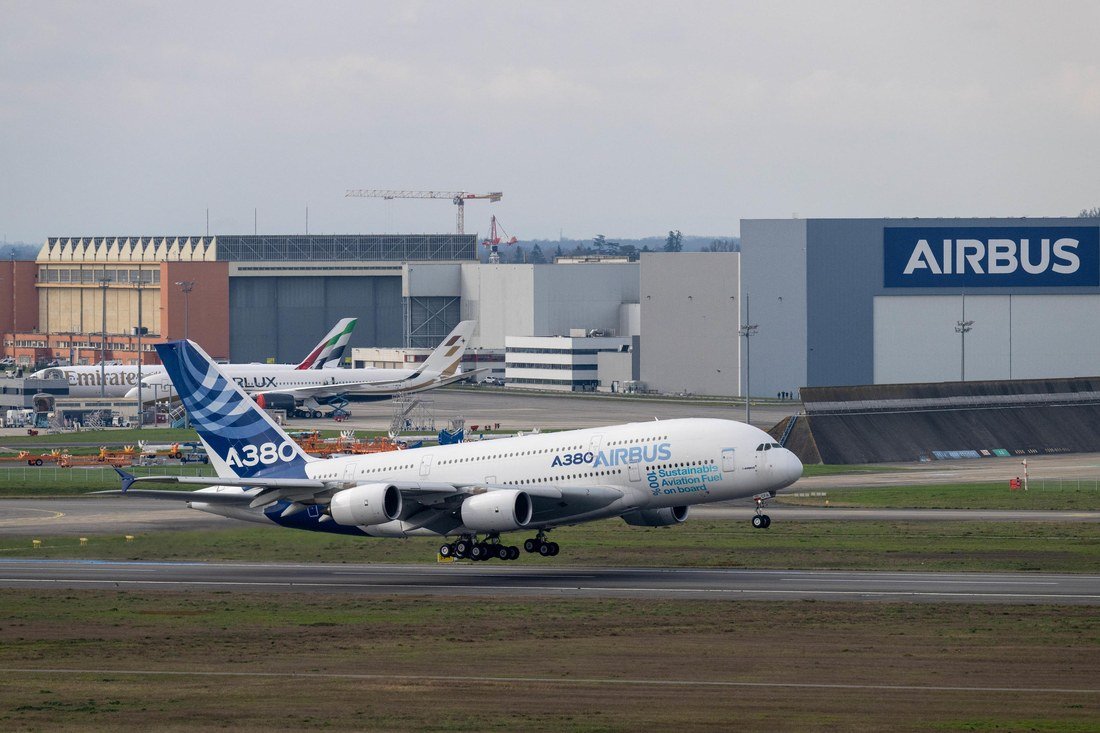
Airbus began studying a double-deck aircraft in the early 1990s, aiming at the only market segment Boeing held alone. Development ran to roughly 15 billion euros, making it the costliest civil aerospace project Europe had undertaken.
- 27 April 2005: maiden flight from Toulouse with six crew aboard.
- 15 October 2007: first delivery, to Singapore Airlines.
- 25 October 2007: first commercial service, SQ380 Singapore to Sydney.
- 2012: peak output of 30 aircraft in a single year.
- February 2019: Airbus confirms the line will close.
- 16 December 2021: aircraft 272 handed to Emirates, the last ever built.
The fleet has since flown more than 800,000 flights. More than 380 patents came out of the programme, from acoustic panelling that cut cabin noise to hydraulic systems that saved weight, and the Trent XWB engine now carrying the A350 made its first flight hanging from an A380 test aircraft.
Why Production Stopped After 251 Aircraft
The A380 was built for a hub-and-spoke world. Airlines would gather passengers at a few huge airports, slots would run out, and the answer would be one very large aircraft per departure. The Gulf carriers built exactly that model. Almost nobody else did.
- Two engines beat four. A Boeing 787 or Airbus A350 carries around 300 passengers on two engines and burns far less fuel per trip, so an airline can run three frequencies where the A380 offered one.
- Routes went direct. Thinner long-haul city pairs became viable without a hub transfer, draining the connecting traffic the aircraft was sized for.
- One customer carried the backlog. Emirates took 123 of the 251 aircraft delivered. Once it trimmed its remaining order in early 2019, nothing was left to keep the line open.
Deliveries tell the story on their own: 30 aircraft in 2012, 15 in 2017, eight in 2019, and five final handovers in 2021. No manufacturer has a four-engine double-deck successor in development, and none is planned.
How to End Up on an A380
Tickets are sold by route, not by aircraft, so the type has to be checked before booking. Three habits make it reliable.
- Target the hubs. Dubai, London Heathrow, Singapore, Doha, Sydney, Frankfurt, Munich, Seoul Incheon, Los Angeles, New York JFK and Paris Charles de Gaulle account for most A380 movements.
- Read the equipment code. Booking engines show the type as 388 or A380. Aircraft swaps happen, so check again in the final week.
- Choose the upper deck for quiet. It is narrower, holds about a third of the seats and clears faster on arrival.
Nothing about the cabin rules changes with the aircraft. The same carry on luggage size allowance applies, and the TSA liquid rules are identical to those on a regional jet.
Airbus has committed to supporting the fleet for decades and has picked the A380 as its flight demonstrator for future propulsion systems, a job an A380 test airframe already did for the Trent XWB. Emirates expects to be flying the type into the middle of the 2030s.
Frequently Asked Questions
How many people fit on an Airbus A380?
Certification allows 868 in an all-economy layout, 538 on the main deck and 330 on the upper deck. No airline has ever fitted that many. Three-class cabins run around 525 seats and most aircraft in service carry between 469 and 519.
Are any new A380s being built?
No. Airbus announced the end of production in February 2019 and delivered the last aircraft, number 272, to Emirates on 16 December 2021. The programme finished with 251 aircraft handed to 14 customers.
Which airline has the most A380s?
Emirates, with 116 aircraft, around 21 of them stored at any one time. It took 123 of the 251 built, received the final delivery, and operates the type to more destinations than every other airline combined.
How far can an A380 fly without refuelling?
Up to 14,800 km, or 7,991 nautical miles, at a cruise of Mach 0.85. That covers Dubai to Los Angeles or Sydney to Dallas non-stop, though payload and headwinds cut into the figure on any given day.