Comparing global entry vs tsa precheck is usually presented as a choice, and for most travellers it is not one. Global Entry includes TSA PreCheck, costs $120 for five years, and does a second job on the way back into the country. PreCheck on its own starts at $76.75.
That $43.25 gap is the entire decision, and the numbers below come from TSA and Customs and Border Protection rather than from a card issuer’s marketing page. There is also a detail that costs people money every day: the same PreCheck membership is sold at three different prices.
Global Entry vs TSA PreCheck: What Each One Covers

The two programmes solve different halves of a journey. PreCheck is about leaving, and Global Entry is about coming home, with PreCheck bundled in.
- TSA PreCheck is expedited security screening at US airports, for five years.
- Global Entry is expedited customs and immigration clearance when you land back in the United States, and CBP confirms it includes TSA PreCheck access.
- Global Entry costs $120 for five years, also usable at land borders.
- PreCheck costs $76.75 to $85.00 for five years depending on the enrolment provider.
If you leave the country even once every couple of years, Global Entry is the better value of the two, because you are paying an extra $35 over the cheapest PreCheck and getting the customs hall thrown in. If you never fly internationally, that $35 buys you nothing.
The Same PreCheck Costs Three Different Prices
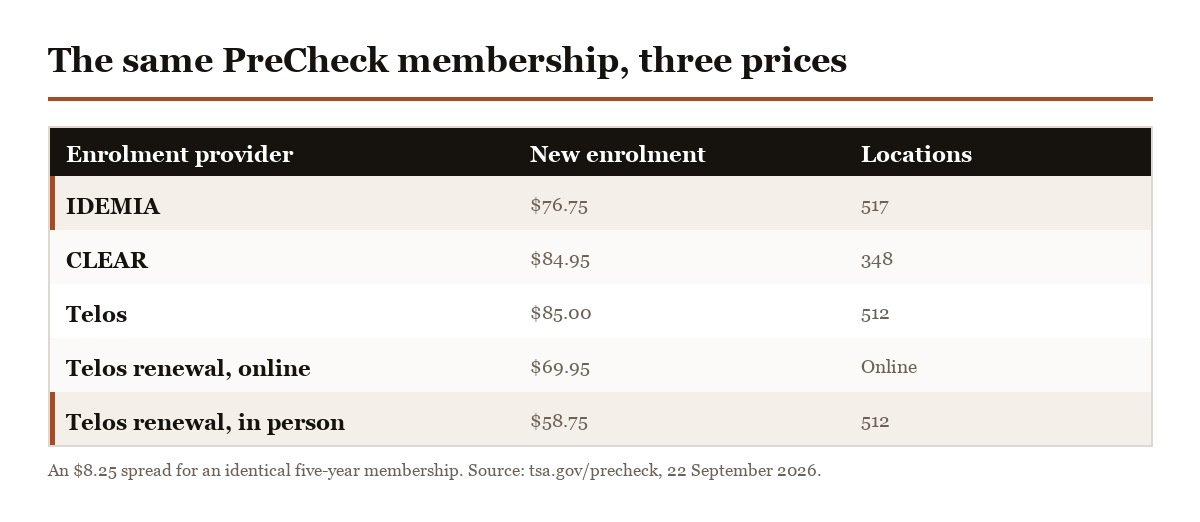
TSA uses three authorised enrolment providers, and its own page lists their prices side by side. The membership is identical whichever one you use.
- IDEMIA: $76.75, with 517 active enrolment locations.
- CLEAR: $84.95, with 348 locations.
- Telos: $85.00, with 512 locations.
That is an $8.25 spread for exactly the same five years of exactly the same benefit, decided purely by which website you happen to land on. Check which providers have enrolment centres near you, then pick the cheapest of those rather than the first link you find.
Renewal is cheaper than joining, and cheaper still in person. Telos renews online for $69.95 or in person for $58.75, so the in-person option saves $11.05 for the cost of a short appointment you may need anyway if your fingerprints have to be retaken.
What Each Programme Actually Gets You
- PreCheck lanes: shoes, belts and light jackets stay on, and laptops and 3-1-1 liquids stay inside your bag.
- Global Entry kiosks: expedited processing at major US airports when you land, plus reduced wait times in dedicated lines when you land.
- Land borders: Global Entry works there too, which PreCheck does not.
- Children: under-18s can use the PreCheck lane free with an enrolled adult, and minors are free with a parent already in or applying for Global Entry.
The screening difference is the part people underrate. Leaving liquids and a laptop in the bag is what makes the lane fast, not the shorter queue, and it means packing to the TSA liquid rules matters less because nothing has to come out for inspection in the first place.
How Long Approval Takes
- Apply online and pay, which CBP says takes as little as five minutes for PreCheck.
- Wait for the background check. CBP states most Global Entry applications are reviewed within two weeks.
- Expect the tail. Some take up to 12 months or longer depending on criminal history.
- Book the interview. An in-person interview is required for first-time Global Entry enrolment.
- Get your Known Traveler Number and add it to every airline profile you hold.
That two-week median with a twelve-month tail is the reason to apply well before a trip rather than in the weeks before one. PreCheck alone is generally quicker because there is no customs interview to schedule, and enrolment centres are more numerous than Global Entry interview sites.
Where CLEAR Fits, and Why It Is Not the Same Thing
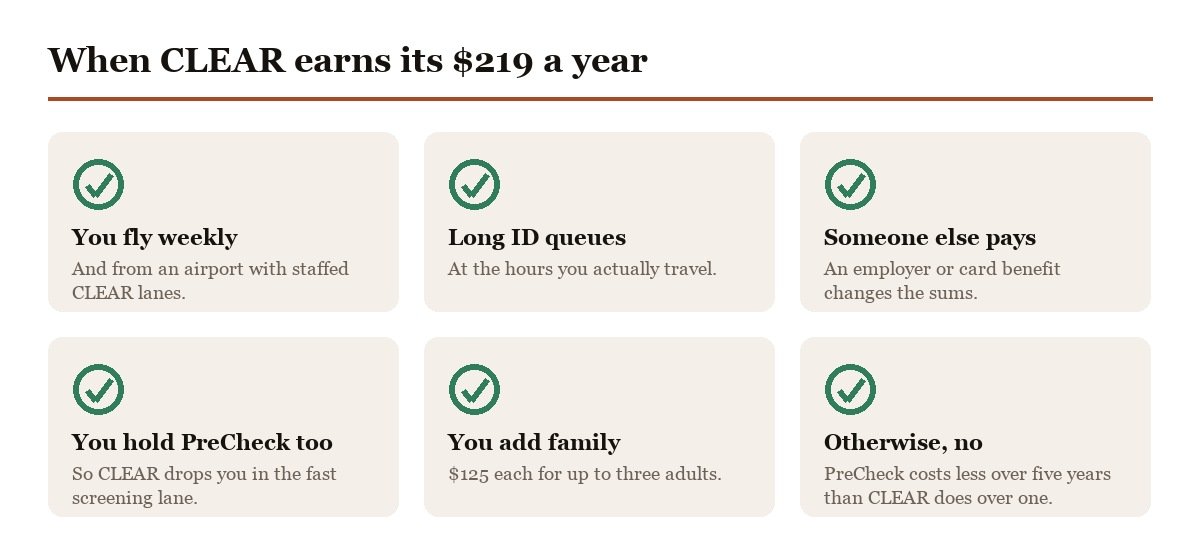
CLEAR is often listed alongside these two as though it were a third version of the same product. It is not. CLEAR verifies your identity so you skip the document check queue, then delivers you to the screening lane you were always going to use.
- CLEAR Plus costs $219 a year, against $120 for five years of Global Entry.
- It is a subscription, so the comparison is $219 annually versus $24 a year equivalent for Global Entry.
- Family members cost $125 each, for up to three adults, and under-18s are free.
- Military and government pricing is $125 a year.
- It does not replace screening. You still go through the PreCheck or standard lane afterwards.
CLEAR earns its money at a handful of very busy airports at peak hours, where the identity check line is the bottleneck. At a quiet airport, or at an airport where CLEAR has no lane, it does nothing at all. CLEAR is also one of the three PreCheck enrolment providers, which is where some of the confusion between the two comes from.
What Happens If You Are Denied
Approval is not automatic, and the background check is the part that decides it. CBP says most Global Entry applications are reviewed within two weeks, while some take up to 12 months or longer depending on criminal history, which is an unusually frank description of how the tail works.
- A conditional or pending status is normal in the first fortnight and is not a refusal.
- Customs violations matter as much as criminal history for Global Entry specifically.
- PreCheck is the fallback, and being turned down for one does not automatically mean being turned down for the other.
- The fee is not refunded if your application is denied, on either programme.
Because the fee is spent either way, the order matters if you are unsure of your own record. Applying for Global Entry first is the efficient route for anyone confident of approval, since it covers both. Anyone with a reason to doubt it may prefer to pay the smaller PreCheck fee and find out cheaply.
Which One to Buy
- Fly internationally at all: Global Entry at $120, which includes PreCheck.
- Domestic only: PreCheck through the cheapest provider with a centre near you.
- Renewing: go in person if you can, at $58.75 rather than $69.95.
- Travelling with children: neither needs buying for under-18s in the PreCheck lane.
- Considering CLEAR: check it operates at your home airport before paying $219.
None of this replaces carrying an acceptable document. A Known Traveler Number gets you into a faster lane, but the identity check at the podium still happens, and the real id requirements apply in the PreCheck line exactly as they do in the standard one.
One free option is worth knowing about before you spend anything. CBP suggests that infrequent international travellers use the free Mobile Passport Control app to cut the wait when they land, which covers part of what Global Entry does at no cost. It is a reasonable first step if you take one international trip every few years.
Whichever you choose, add the Known Traveler Number to every airline profile and loyalty account you hold, not just the one you booked with. A missing number is the most common reason a PreCheck member finds a standard boarding pass in their hand, and it cannot be fixed at the checkpoint. Airlines pass the number to TSA when the boarding pass is issued, so the fix has to happen before check-in closes.
It is also worth checking whether you are already paying for one of these without knowing. Several travel credit cards reimburse the Global Entry or PreCheck application fee once every four or five years as a standing benefit, which turns a $120 decision into a free one. The reimbursement is usually triggered by paying the fee with that card, so check the order of operations before you enrol rather than after.
Frequently Asked Questions
Does Global Entry include TSA PreCheck?
Yes. CBP lists TSA PreCheck access as a Global Entry benefit, so a single $120 payment covers both for five years. You do not need to enrol in PreCheck separately or pay its fee on top.
Is Global Entry worth it over TSA PreCheck?
If you fly internationally, almost always. It costs $35 more than the cheapest PreCheck enrolment, includes PreCheck, works at land borders and speeds up the customs hall. If every flight you take is domestic, the extra $35 gets you nothing.
Why is TSA PreCheck cheaper from one provider?
Because TSA authorises three companies to enrol travellers and each sets its own price. IDEMIA charges $76.75, CLEAR $84.95 and Telos $85.00 for an identical five-year membership, so the only thing you lose by choosing the cheapest is convenience of location.
Do children need their own TSA PreCheck?
Not for the lane itself. Children 17 and under can use the PreCheck lane free when travelling with an enrolled adult. An unaccompanied minor who has PreCheck does need acceptable identification to use it.