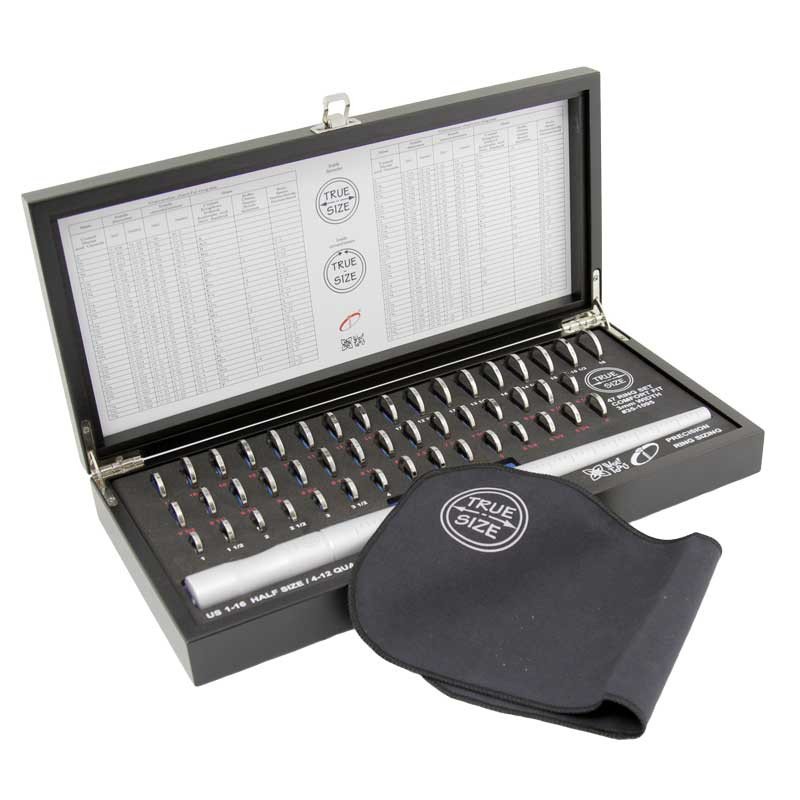
Ring sizes are a scale laid over one physical measurement: the distance round the inside of the band. In the United States that scale runs from about 3 to 13 in half steps, where a size 7 means an inside circumference of 54.4 millimetres and an inside diameter of 17.3.
What follows is the full set of US sizes in millimetres, exactly how much metal one step adds, the four numbering systems still in daily use, and the bench tools that decide a size in the first place.
Every US Ring Size in Millimetres
Diameter is measured across the opening and circumference all the way round it. The second figure is the one the international standard is written in.
| US size | Inside diameter (mm) | Inside circumference (mm) |
|---|---|---|
| 3 | 14.1 | 44.2 |
| 3.5 | 14.5 | 45.5 |
| 4 | 14.9 | 46.8 |
| 4.5 | 15.3 | 48.0 |
| 5 | 15.7 | 49.3 |
| 5.5 | 16.1 | 50.6 |
| 6 | 16.5 | 51.9 |
| 6.5 | 16.9 | 53.1 |
| 7 | 17.3 | 54.4 |
| 7.5 | 17.7 | 55.7 |
| 8 | 18.1 | 57.0 |
| 8.5 | 18.5 | 58.3 |
| 9 | 18.9 | 59.5 |
| 9.5 | 19.4 | 60.8 |
| 10 | 19.8 | 62.1 |
| 10.5 | 20.2 | 63.4 |
| 11 | 20.6 | 64.6 |
| 11.5 | 21.0 | 65.9 |
| 12 | 21.4 | 67.2 |
| 12.5 | 21.8 | 68.5 |
| 13 | 22.2 | 69.7 |
Nothing in the table is approximate. The scale is arithmetic: pick any two rows a full size apart and the diameter differs by the same 0.81 millimetres, at the bottom of the range and at the top.
A Ring Size Is a Circumference
The international standard defines a ring size as the circumference of the largest cylinder that can be inserted into the ring, given in millimetres. Everything else, including the American number, is a label attached to that measurement.
This is why the European numbers look so plain. A ring marked 54 has a 54 millimetre inside circumference and there is no conversion to do. The standard also allows a ring to be stamped with nothing but its circumference, which is the most portable marking a ring can carry.
For anyone buying across borders, the millimetre figure is worth recording alongside the size number. A size 7 is unambiguous only inside North America, while 54.4 millimetres is the same ring anywhere.
What One Size Actually Changes
The steps between sizes are smaller than most people picture, which is why a ring that feels badly wrong is usually only one size out.
| Step | Diameter added | Circumference added | Where it is used |
|---|---|---|---|
| Quarter size | 0.20 mm | 0.64 mm | The smallest step any maker offers |
| Half size | 0.41 mm | 1.28 mm | The standard retail increment |
| Full size | 0.81 mm | 2.55 mm | Roughly one thirty-second of an inch across |
| Two sizes | 1.63 mm | 5.11 mm | About as far as most bands can be altered comfortably |
Half a size is four tenths of a millimetre across. That is less than the thickness of a credit card, and it is still the difference between a ring that spins and one that will not come off over a knuckle. It also explains why measuring to the nearest whole millimetre is useless: the answer lives in the first decimal place.
Four Systems, One Measurement
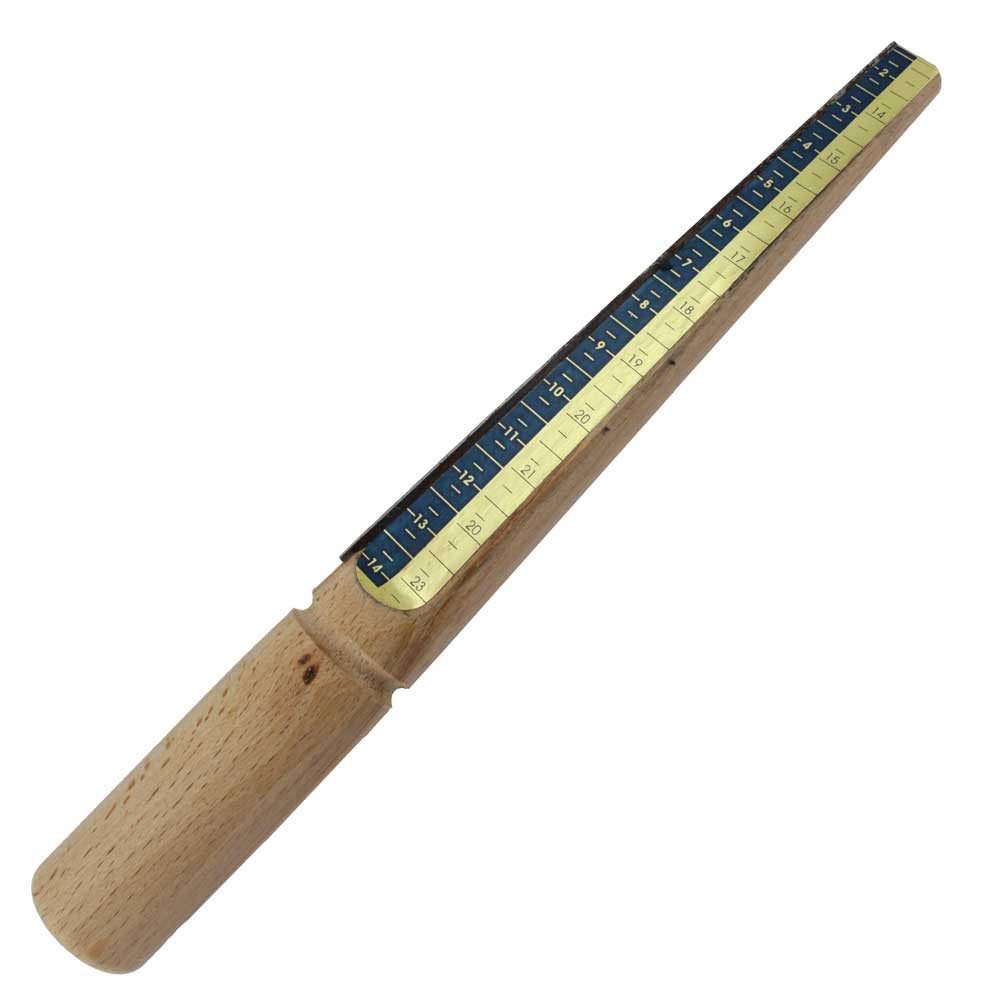
Four numbering conventions are in common use, and only one of them states the measurement directly. The rest are scales that have to be converted.
| Where it is used | How a size is written | Smallest step |
|---|---|---|
| United States, Canada, Mexico | A number from about 3 to 13 | Half and quarter steps |
| ISO, most of Europe | The inside circumference in millimetres | Whole millimetres |
| United Kingdom, Ireland, Australia | A letter from A upwards | Half-letter steps |
| Japan and much of East Asia | Its own numeric scale | Whole numbers only |
The British system runs on letters rather than numbers, with half-letter sizes in between, and continues past Z for the largest fingers. Japan uses whole numbers on a scale of its own that does not line up with the American one at any point.
A conversion table is the usual way across, but it is a table of approximations in both directions, because the scales were set independently and do not share a step size. Asking a retailer for the circumference in millimetres avoids the problem outright.
The Tools That Set a Size
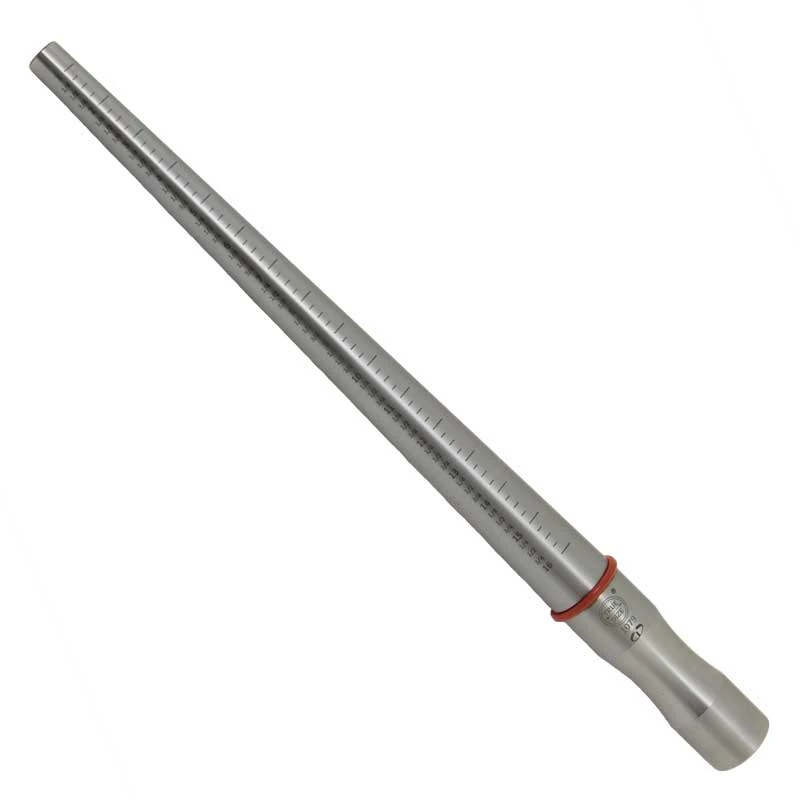
Ring sizing is a workshop measurement before it is a retail one. Four tools do nearly all of it, and each of them answers a different question.
| Tool | What it is | What it does |
|---|---|---|
| Ring mandrel | A tapered steel cone marked with the full size scale | Reads the size of an existing ring and shapes a band to a size |
| Ring sizer set | A loop of machined metal rings, one per size | Measures a finger by trying sizes until one passes the knuckle and stays |
| Stretcher and reducer | A bench press with a tapered head and a set of dies | Enlarges a plain band, or compresses one, without cutting it |
| Wax tube sizer | A wooden mandrel scaled for carving wax models | Sets the size of a ring before it is ever cast in metal |
The mandrel is the reference object in the whole system. It is a tapered steel cone with the size scale engraved along it, and sliding a ring down until it stops reads the size directly off the metal. It is also what a band is hammered round when it is being enlarged, which is why the same tool both measures and makes.
The wax tube sizer is the one most people never see. A ring that will be cast starts as a carved wax model, and the size has to be cut into the wax before casting, with an allowance for the metal shrinking as it cools.
Quarter Sizes and Where They Help
Most retailers stock half sizes and stop there. Quarter sizes exist, and they matter in two specific situations rather than as a general refinement.
- Wide bands. A band of 6 millimetres or more grips along its whole width, so a quarter size is genuinely noticeable where it would not be on a narrow one.
- Fingers that sit between sizes. Some people measure consistently halfway between two half sizes, and a quarter size is the only honest answer.
- Not for cold hands. A quarter size will not compensate for a finger that changes by a half size between morning and evening.
- Not as a substitute for sizing beads. A ring that spins because the knuckle is wider than the base needs a fitted bar, not a smaller number.
Custom makers cut to quarter sizes as a matter of course. A mass-produced band usually does not offer them, and rounding up is the safer direction when it does not.
Making a Ring Bigger or Smaller
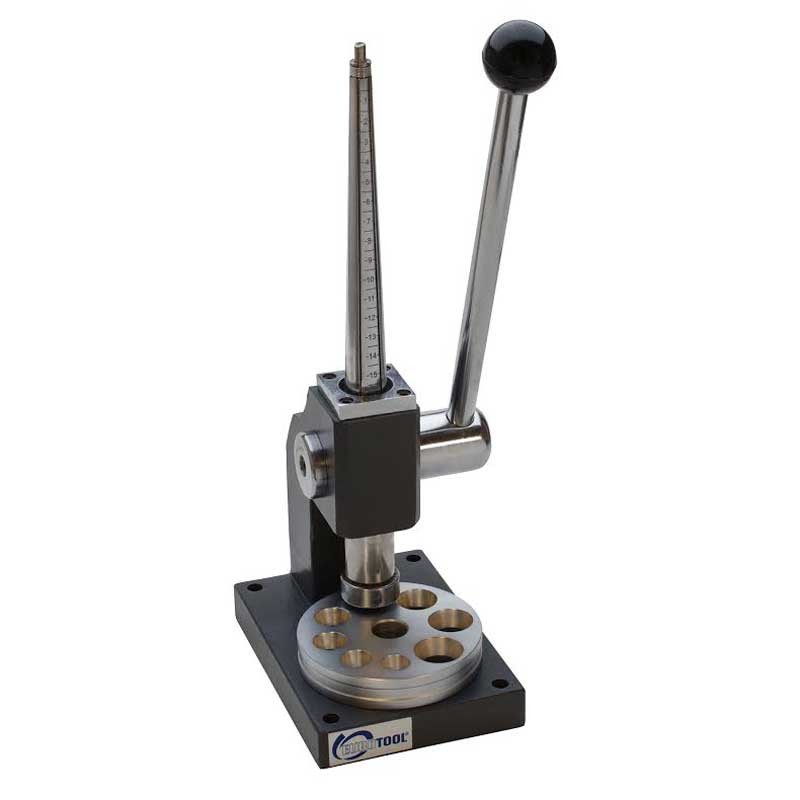
A finished ring is not fixed. A plain band can be stretched on a press without being cut, and a band with a plain section can be cut and rejoined at a different circumference.
- Stretching forces the band down a tapered head, thinning the metal slightly as it widens. It works over short distances and only on plain bands.
- Reducing compresses a band in a set of dies, which works over shorter distances still before the band distorts.
- Cutting and soldering is the standard method for larger changes: remove a section or add one, then rejoin and refinish.
- Sizing beads change nothing about the size and simply hold the band against the underside of the finger, which stops it spinning.
- Full eternity bands are the common exception. Stones all the way round leave no plain section, so there is nothing to cut.
Hardness decides the rest. Gold, silver and platinum are worked routinely; tungsten cannot be resized at all, and titanium is limited to a slight stretch at best.
Why the Same Finger Measures Differently
A finger is not a fixed object, and the variation across one day is larger than the step between two sizes. That is the single biggest source of a ring arriving wrong.
- Temperature. Cold fingers measure smaller, and a ring sized outdoors in winter will be loose indoors.
- Time of day. Fingers are smallest in the morning and largest by late afternoon.
- Salt and heat. A salty meal, a hot bath or a long flight all read larger.
- The knuckle. Where the knuckle is wider than the base, the ring has to clear the knuckle, and the base measurement is irrelevant.
- Which hand. The dominant hand usually measures slightly larger.
Measuring at the end of a normal day, at room temperature, on three separate occasions is the whole technique. For a ring bought as a gift, anchoring it to the wearer’s month stone is a surer touch than guessing the measurement, and the stones are set out in our guide to birthstones by month. The month flowers in the birth flowers guide work the same way.
Frequently Asked Questions
What do ring sizes actually measure?
The inside of the band. The international standard defines a ring size as the inside circumference in millimetres, and the US number is a scale laid over that measurement.
How much bigger is one ring size?
A full size adds 0.81 millimetres of inside diameter and 2.55 millimetres of circumference. A half size is 0.41 and 1.28 millimetres, and a quarter size is half of that again.
Do US and European ring sizes convert exactly?
Not exactly. European sizes are the circumference in whole millimetres while US sizes step by 2.55 millimetres, so most conversions land between two European numbers and get rounded.
Can any ring be made a different size?
No. Plain gold, silver and platinum bands resize readily. Full eternity bands have no plain section to cut, tungsten is too hard to work, and titanium can usually only be stretched slightly.