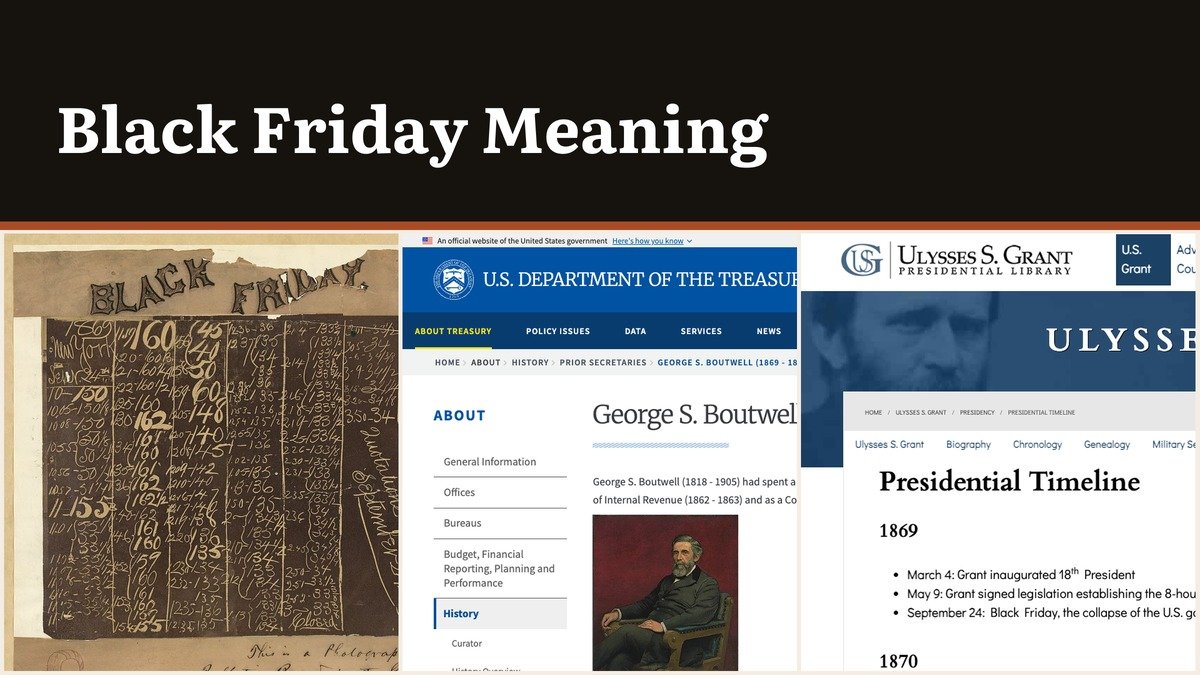
The Black Friday meaning most Americans know is the Friday after Thanksgiving, the day holiday shopping traditionally begins. The word black in the name points to trouble, though. Philadelphia police used it for their worst traffic day of the year, and Wall Street had used it long before for the gold crash of September 24, 1869.
None of that is about profit. The familiar line that stores finally move from red ink to black ink on that day is a later invention, and the claim tying the date to a slave market is a myth. What follows traces the name stage by stage, from a color that signals calamity to a word printed on store banners every November.
What Does Black Friday Mean?
Black Friday means the day after Thanksgiving in the United States, treated as the opening of the holiday shopping season. The name follows an old habit of calling a day of calamity black. Philadelphia police pinned it on post-Thanksgiving gridlock in the 1950s, and retailers later recast it as a story about profits.
Thanksgiving falls on the fourth Thursday of November, a rule Congress set in 1941 after Franklin Roosevelt moved the holiday up a week in 1939, so Black Friday is always the next day. Here are the Thanksgiving dates for every year of the next decade.
Black Days in History: Why the Color Signals Disaster
English has attached black to unlucky or disastrous days for centuries. Friday the 13th is often called a black Friday wherever it falls, and specific dates have earned the label after a defeat or a crash:
- Black Saturday: December 10, 1547, when the English defeated the Scottish army at the Battle of Pinkie Cleugh. The name was in use by 1576.
- Black Friday, December 6, 1745: the day London learned that Bonnie Prince Charlie had arrived in Britain.
- Black Friday, May 11, 1866: a stock market panic in London.
- Black Friday, September 24, 1869: the gold panic on Wall Street.
- Black Thursday, October 24, 1929: the stock market crash that came before the Great Depression. The name was in print by the next day.
One more use came close to the modern day. In November 1951 the editor of Factory Management & Maintenance, M. J. Murphy, called the Friday after Thanksgiving Black Friday because so many workers called in sick to stretch the holiday weekend. That use was apparently a one-off and had nothing to do with shopping.
September 24, 1869: The Original Black Friday
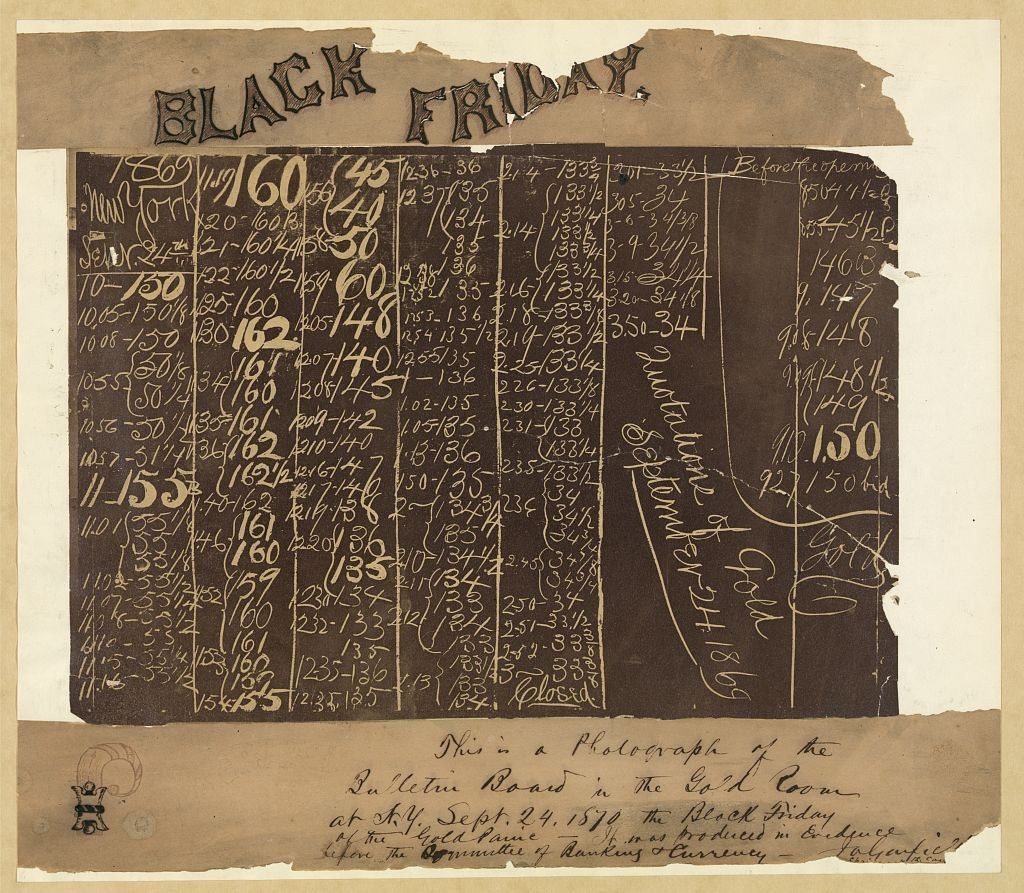
The photograph above shows the bulletin board of the New York Gold Exchange, known as the Gold Room, on the day itself. When trading opened at 10:00 a.m., gold rose from $143 to $150 and finally reached a high of $162. Shortly after noon the floor learned that the federal government was flooding the market with gold. The price crashed, and a crowd gathered looking for Jay Gould and Jim Fisk, the two men who had driven it up.
The Gold Ring and the White House Insider
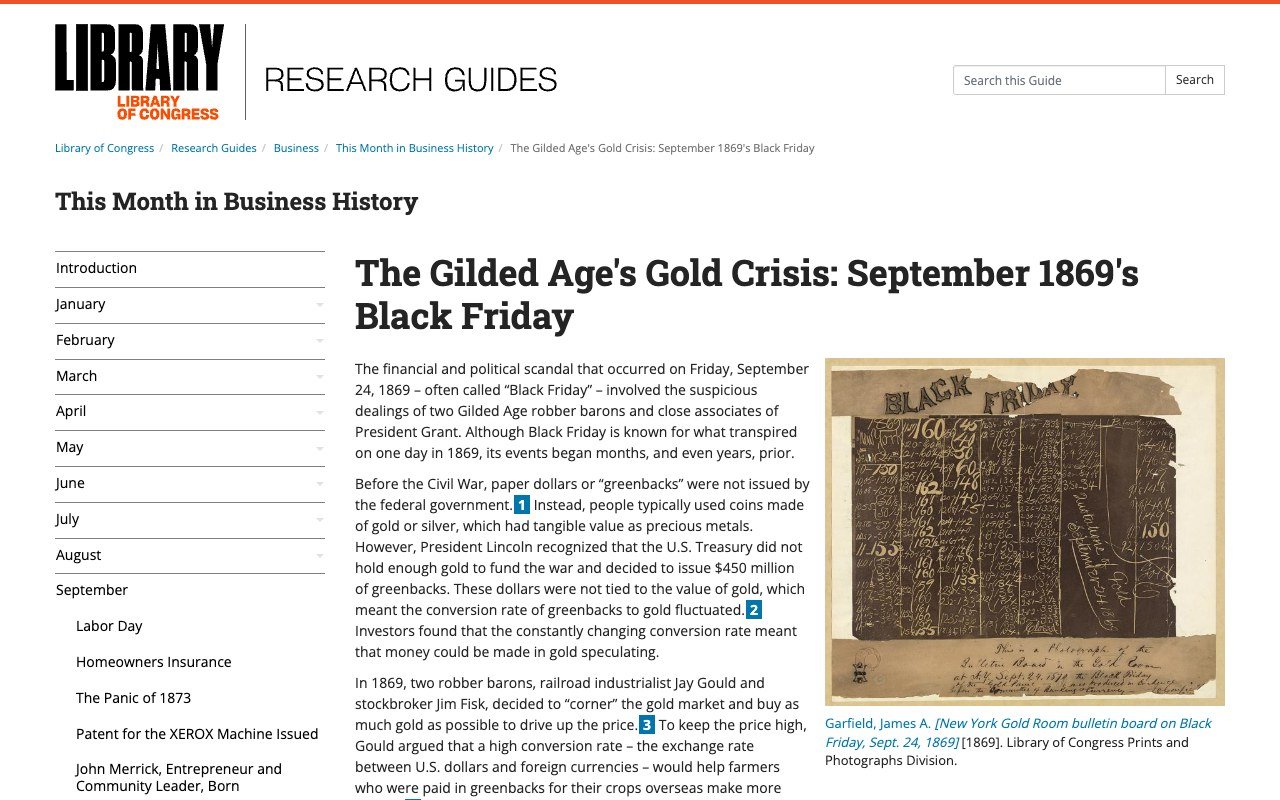
The scheme grew out of Civil War money. To fund the war, President Lincoln issued $450 million in greenbacks that were not tied to gold, so the rate between greenbacks and gold kept moving, and speculators saw a chance. In 1869 Gould, a railroad industrialist, and Fisk, a stockbroker, set out to buy enough gold to push the price up and hold it there.
Their route to the president ran through Abel Corbin, Grant’s brother-in-law, whom Gould knew through the Erie Railroad. The Library of Congress research guide to the 1869 gold crisis sets out the steps that followed:
- Gould and Fisk cornered Grant on a steamship trip between New York and Boston, on a line Fisk owned. Grant said he would not manipulate the price of gold.
- Through Corbin they secured the post of assistant U.S. treasurer in New York for a friend of Grant’s, and Gould gave the new official a $10,000 gift in exchange for inside information.
- A letter from Corbin urging Grant to keep gold high made the president suspicious instead. Julia Grant wrote to Corbin’s wife warning her about his speculation.
- That warning arrived on September 22. Gould offered Corbin $100,000 to hold off selling, then quietly sold his own gold while his brokers kept making small purchases.
- Fisk, who never heard about the letter, kept telling other traders that Grant supported a high price. By the evening of September 23, more than $325 million in transactions had gone through the Gold Room.
The Treasury’s $4 Million Answer
Treasury Secretary George S. Boutwell, who took office in 1869, held the lever Gould feared. That same Thursday evening, Grant authorized Boutwell to release $4 million of government gold onto the market. When the sale was announced on Friday, the price fell within minutes, from $162 to somewhere between $133 and $135.
Fallout for Gould, Fisk and the Grant Administration
Gould escaped the crowd and walked away with nearly $12 million in profits, one of the Gilded Age windfalls that belongs alongside the largest fortunes ever recorded. Few others were so lucky. Many brokerage firms shut, the value of gold and stocks fell by about $100 million, the overseas grain market was ruined and prices for farm goods dropped sharply.
A House Committee on Banking and Currency report dated March 1, 1870 confirmed that financiers had tried to manipulate the gold market. It found no grounds for criminal charges against the main players and cleared Grant of direct wrongdoing. Even so, the gold plot was the first of several scandals of the Grant years, and the federal government did not begin regulating commodities trading until decades later.
Black Friday Meaning by Era: How the Name Has Shifted
The same two words have pointed at very different things over a century and a half. This table follows who used the name in each period and what the black stood for.
| Era | Who used the name | What black described |
|---|---|---|
| 1869 | Wall Street traders and the press | The gold crash and the ruin of speculators |
| 1951 | Factory editor M. J. Murphy | Workers missing from the job after Thanksgiving |
| 1950s to early 1960s | Philadelphia traffic police | Gridlock, crowds and canceled days off |
| 1960 | Women’s Wear Daily | Police warnings of record traffic jams in Philadelphia |
| 1961 | Philadelphia merchants and city officials | A name they wanted to swap for Big Friday |
| 1966 | The American Philatelist | A police term that was “not a term of endearment” |
| Late 1970s to 1980s | Retailers and marketers | Profits, through the invented red-to-black story |
| Late 1980s to early 1990s | Shoppers and stores nationwide | The opening day of holiday shopping |
| 2025 | National Retail Federation | The top shopping day by number of shoppers |
How Philadelphia Turned a Police Gripe Into a Shopping Term
Philadelphia had a particular reason to dread the day. The Army-Navy football game was played there the next day, the city being neutral ground roughly equidistant between West Point and Annapolis, so out-of-town crowds streamed in on the Friday just as holiday shoppers filled the stores. Officers came to call the two days after Thanksgiving Black Friday and Black Saturday.
The first known printed shopping use appeared in Women’s Wear Daily on November 28, 1960. A piece on Christmas sales forecasts reported that Philadelphia store executives were bitter about radio bulletins repeating Mayor Dilworth’s plea to leave cars at home, and about police forecasts of record traffic jams for “black Friday.”
The city then tried to change the word. On December 18, 1961, Public Relations News described what happened next:
- Merchants took the problem to Deputy City Representative Abe S. Rosen, a veteran municipal publicity man.
- Rosen recommended turning Black Friday and Black Saturday into Big Friday and Big Saturday.
- Local media promoted Christmas-decorated downtown, family outings to the department stores, extra parking and added police to keep traffic moving.
- The newsletter called it one of the biggest shopping weekends in recent history.
The new name never took. Police Commissioner Albert N. Brown issued a release calling the day Big Friday, but Evening Bulletin reporters Joseph P. Barrett and Nathan Kleger kept printing the police term, and television later spread it. The word was common around Philadelphia by the 1970s and reached national use in the late 1980s and early 1990s.
Does Black Friday Mean Stores Go Into the Black?
No. Old ledgers did record profits in black and losses in red, and the idea that retailers finally turn profitable after Thanksgiving is easy to repeat. Bonnie Taylor-Blake, the American Dialect Society member who found the 1961 newsletter, dates the first push for that explanation to the late 1970s and calls it invented. Retailers embraced it in the late 1980s, and even the New York Times piece that introduced Cyber Monday on November 19, 2005 described Black Friday as the day retailers hope to turn a profit.
In Philadelphia the profit story is sometimes credited to the Strawbridge department store family, but only by word of mouth, with no documents behind it. Peter Strawbridge himself said in 1984: “If anything it should be called ‘Green Friday.’”
The Slave-Market Claim and Other Misreadings
A darker claim, shared widely online, says the name comes from discounted sales of enslaved people after Thanksgiving. Nothing in the historical record supports it. The picture that often accompanies the claim is a 1905 photograph of Aboriginal prisoners at Wyndham, in Western Australia, taken four decades after slavery ended in the United States.
A smaller mix-up treats the 1869 gold panic as the direct parent of the shopping name. The two share a label and the old sense of black as disaster, but the shopping meaning grew out of Philadelphia traffic duty, not Wall Street.
How to Explain the Name in Four Steps
If someone at the Thanksgiving table asks where the name comes from, this order keeps the answer short and accurate:
- Start with the color. For centuries a black day has meant a disaster, from Black Saturday in 1547 to Black Thursday in 1929.
- Mention the first famous Black Friday, the gold crash of September 24, 1869, when Gould and Fisk’s corner collapsed.
- Move to Philadelphia, where traffic police in the 1950s used the name for the post-Thanksgiving jams, and Women’s Wear Daily printed it on November 28, 1960.
- Finish with the rebrands: Big Friday failed in the early 1960s, and the red-to-black profit story was added in the late 1970s and 1980s.
Frequently Asked Questions
Is the shopping day named after the 1869 crash?
Not directly. The 1869 gold panic was the first famous Black Friday, but the shopping name came from Philadelphia police describing holiday traffic. Both uses draw on the old sense of black as a day of disaster.
What does in the black have to do with Black Friday?
Only as a later rationalization. The idea that stores reach profit that day dates from the late 1970s, roughly two decades after the police name first appeared.
When did Black Friday become a national term?
In the late 1980s and early 1990s. It was common around Philadelphia in the 1970s, but as late as 1985 retailers in Cincinnati and Los Angeles still did not know it.
Is Black Friday still the biggest shopping day?
By shopper count, yes. In 2025 the National Retail Federation holiday weekend survey found 80.3 million people shopped in stores and 85.7 million online on Black Friday, the most of any day that weekend for both.