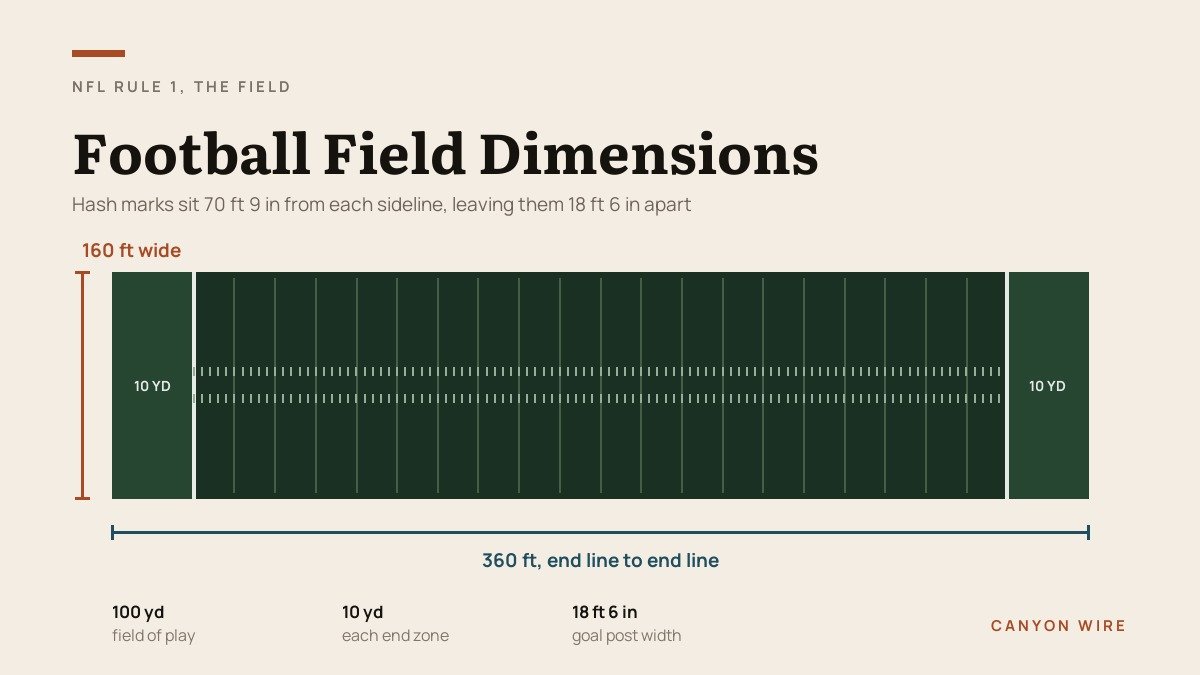
The football field dimensions everyone quotes are 100 yards by 53 and a third. The rulebook puts it differently, and more precisely: the game is played on a rectangle 360 feet long and 160 feet wide, with goal lines established 10 yards in from each end line.
Those two statements describe the same rectangle, but the rulebook version includes the end zones, which is where most of the confusion about field length starts. Every measurement below comes from Rule 1 of the NFL playing rules, down to the width of the lines and the colour of the ribbon on top of the goal posts.
| Measurement | NFL specification |
|---|---|
| Overall field | 360 feet long by 160 feet wide |
| Field of play | 100 yards between the goal lines |
| End zones | 10 yards deep, 30 feet from goal line to end line |
| Hash marks | 70 feet 9 inches in from each sideline |
| Yard lines | Every 5 yards, 4 inches wide |
| Goal line width | 8 inches |
| Goal post crossbar | 10 feet above the ground, 18 feet 6 inches wide |
| Uprights | 35 feet above the crossbar, 3 to 4 inches thick |
| White border | At least 6 feet wide along the sidelines and end lines |
Football Field Dimensions From Goal Line to End Line
The area bounded by the goal lines and sidelines is the field of play. The areas behind each goal line, bounded by the goal line, end line and sidelines, are the end zones. Add them together and the 100 yard playing surface becomes a 120 yard field, which is where the 360 feet comes from.
Measurements run from the inside edges of the boundary lines, and the goal line itself belongs to the end zone. Each goal line is painted 8 inches wide so that its field-of-play edge sits exactly 30 feet from the inside edge of the end line. That detail decides touchdowns: the ball has to break the plane of that specific edge, not the middle of the stripe.
The playing rules are equally exact about everything around the lines:
- Yard lines run every 5 yards, measure 4 inches wide, and stop 8 inches short of the white border before extending 4 inches beyond it.
- Field numerals are white, 2 yards tall, and the bottoms begin 12 yards in from each sideline.
- Pylons are weighted and placed at the four inside corners where goal lines meet sidelines, plus two more on each end line.
- The surface of the entire field of play has to be a League-approved shade of green.
- Benches and rigid fixtures must sit at least 30 feet back from the sidelines.
Hash Marks: The Measurement That Separates the NFL From College
The inbounds lines, which everyone calls hash marks, sit 70 feet 9 inches in from each sideline and intersect every yard line at a right angle. That leaves the two rows just 18 feet 6 inches apart, which is exactly the width of the goal posts.
No other level of the sport uses that number, and the difference changes how the game is played:
- NFL: 70 feet 9 inches from each sideline, so the hashes are 18 feet 6 inches apart.
- College: 60 feet from each sideline, leaving 40 feet between them.
- High school: 53 feet 4 inches from each sideline, a full third of the field width apart.
Because NFL hashes are almost in the middle, a ball spotted on one still leaves usable space on both sides. On a college field the same spot creates a genuine short side and wide side, which is why college offenses are built with more emphasis on formation strength and why a college kicker faces sharper angles than a professional one. The marks themselves began as a way to stop play restarting from the sideline where the ball went out.
Goal Posts, Crossbars and Why Field Goals Look Easier Than They Are
Each goal is a single standard post set in the plane of the end line, offset behind it so players cannot run into the base. The crossbar is 18 feet 6 inches long with its top face 10 feet above the ground, and the uprights extend 35 feet above that.
The scoring area is defined as the vertical plane extending indefinitely above the crossbar and between the outer edges of the posts, which is why a kick passing above the top of an upright can still be good. Posts are bright gold, between 3 and 4 inches in diameter, padded, and each carries an orange ribbon 4 inches by 42 inches to show the officials and the kicker which way the wind is blowing.
A 40 yard field goal attempt is therefore a kick of about 47 yards, because the posts sit on the end line 10 yards beyond the goal line and the ball is snapped roughly 7 yards behind the spot. The arithmetic is why a drive stalling at the 30 is a very different problem from one stalling at the 25, and why broadcasters carried by the main sports streaming services put a graphic on screen for every attempt beyond 50.
The Border, the Bench Area and the Yellow Line
The field is rimmed by a solid white border at least 6 feet wide along the end lines and sidelines. Outside that, a broken limit line a further 6 feet out encloses the non-bench areas and angles back from each 25 yard line to pass behind the benches.
Inside each bench area there is a yellow line 6 feet behind the white border. Everyone except one player charting the game has to stay behind it, which is the rule officials are enforcing when they wave a sideline back during a close game. A club whose white border is at least 12 feet wide does not need the broken restraining line at all, but the yellow bench line is never optional.
There is one sanctioned exception to the border. In a multi-purpose stadium where football overlaps with another sport, a club may ask the League Office to replace the 6 foot solid border with a single 4 inch white line at the same distance. Decorations in the end zones and at midfield also need approval, specifically so they cannot be confused with the real markings.
An NFL Field Against a Soccer Pitch
The other football uses ranges rather than fixed numbers. Under Law 1 a pitch may be anywhere from 90 to 120 metres long and 45 to 90 metres wide, narrowed to 100 to 110 metres by 64 to 75 metres for international matches. No two grounds have to match, and historically they rarely did.
That single difference explains a lot about how the two sports feel:
- NFL: one fixed rectangle, 360 feet by 160, identical in all 32 stadiums.
- Soccer: a permitted range, so a tight pitch and a wide one are both legal and clubs have used the choice tactically.
- Fixed points in soccer: the goal is always 7.32 metres wide and 2.44 metres high, the penalty mark always 11 metres out, and the centre circle always 9.15 metres in radius.
- Line widths: soccer lines must not exceed 12 centimetres; NFL yard lines are fixed at exactly 4 inches.
A standard international pitch is therefore wider and longer than an NFL field, with no end zones behind the goals and no equivalent of the hash marks that reset every play to a narrow strip. The one piece of geometry soccer polices as tightly as the NFL polices its field is the invisible one, the line drawn off the second last defender for the offside rule, which exists on no pitch and is measured to the centimetre anyway.
The Ball Has Dimensions Too
Rule 2 specifies the ball as tightly as Rule 1 specifies the field. It is an inflated urethane bladder inside a pebble grained natural tan leather case, with no corrugations, in the shape of a prolate spheroid.
- Inflation: 12.5 to 13.5 pounds per square inch.
- Long axis: 11 to 11.25 inches.
- Long circumference: 28 to 28.5 inches.
- Short circumference: 21 to 21.25 inches.
- Weight: 14 to 15 ounces.
The referee is the sole judge of whether a ball meets those specifications, and a League-approved inflation measurement device is provided to officials at every game. Taken together with Rule 1, it means almost nothing on an NFL field is left to the home club’s discretion. The layout of the field has barely changed in a century, and the standardisation is the reason a team can walk into any stadium and find the same geometry.
Frequently Asked Questions
How long is a football field?
360 feet, or 120 yards, from end line to end line. The field of play between the goal lines is 100 yards, and each of the two end zones adds 10 yards.
How wide is a football field?
160 feet, which is 53 and a third yards. That width is identical at NFL, college and high school level; what changes between them is where the hash marks sit inside it.
How far apart are NFL hash marks?
18 feet 6 inches, because each row is 70 feet 9 inches in from its sideline. That is the same width as the goal posts, and far narrower than the 40 feet used in college football.
How tall are football goal posts?
The crossbar sits 10 feet above the ground and the uprights extend another 35 feet above it, for a total height of 45 feet. The crossbar is 18 feet 6 inches long.