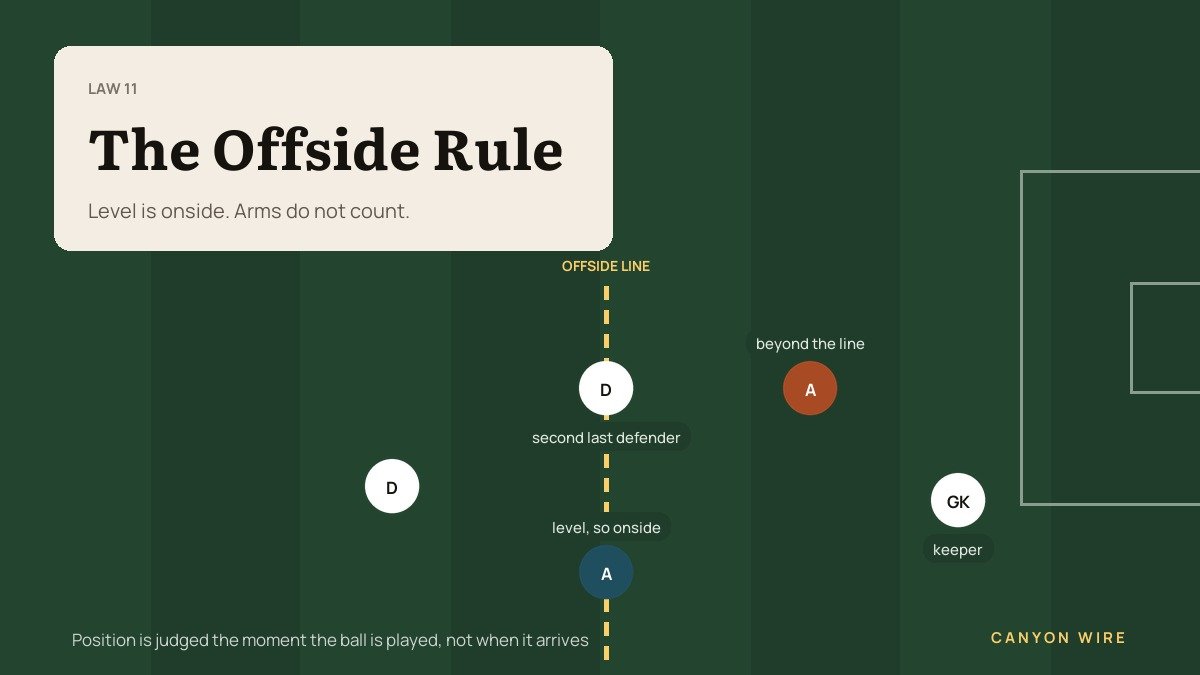
Most explanations of the offside rule get the first part right and the important part wrong. Being in an offside position is not an offence. A player can stand behind the last defender all afternoon without conceding a free kick, and only becomes guilty of anything by getting involved in the play.
That separation, between where a player is standing and what the player then does, is where every argument about offside actually lives. The position itself is a geometry question that a camera can answer. Involvement is a judgement call that no camera can. Here is what Law 11 says about both, including the parts about arms, deliberate saves and throw-ins that routinely catch people out.
| Situation | Offside? |
|---|---|
| Standing beyond the last defender, not involved | No, position alone is not an offence |
| Level with the second last opponent | No, level is onside |
| Only an arm is beyond the defender | No, hands and arms do not count |
| Receiving the ball direct from a throw-in | No, throw-ins are exempt |
| Receiving the ball direct from a corner or goal kick | No, both are exempt |
| Blocking the goalkeeper’s line of vision | Yes, that is interfering with an opponent |
| Scoring from a rebound off the post | Yes, that is gaining an advantage |
| Receiving the ball after a defender deliberately passes it | No, deliberate play resets it |
What the Offside Rule Actually Says About Position
A player is in an offside position when any part of the head, body or feet is in the opponents’ half, not counting the halfway line itself, and any part of the head, body or feet is nearer to the opponents’ goal line than both the ball and the second last opponent.
Two details inside that sentence settle most disputes:
- Arms are excluded. The hands and arms of every player, goalkeepers included, are not considered. An attacker whose shoulder is past the defender may be offside; one whose elbow is past is not.
- Level is onside. A player level with the second last opponent, or level with the last two opponents, is not in an offside position. Ties go to the attacker.
The second last opponent is usually a defender, because the goalkeeper is normally the last. When a keeper comes out, the rule does not change: it still counts the second last opponent, whoever that happens to be.
Position is judged at the moment the ball is played or touched by a team-mate, not when it arrives. A striker who times a run to be level at the pass and ten yards clear when the ball reaches him is onside, which is the whole craft of attacking movement.
The Three Ways a Player Commits an Offside Offence
Standing in an offside position becomes an offence only when the player becomes involved in active play. Law 11 sets out exactly three routes:
- Interfering with play. Playing or touching a ball passed or touched by a team-mate. This is the straightforward one.
- Interfering with an opponent. Clearly obstructing an opponent’s line of vision, challenging for the ball, clearly attempting to play a ball which is close when that action impacts an opponent, or making an obvious action that clearly affects an opponent’s ability to play the ball.
- Gaining an advantage. Playing a ball that has rebounded or been deflected off the goalpost, crossbar, a match official or an opponent, or one deliberately saved by any opponent.
The second route is why a player standing offside and doing nothing can still have a goal chalked off. If he is in the goalkeeper’s eyeline when a shot is struck from outside the box, he has interfered with an opponent without ever touching the ball.
The restart is an indirect free kick to the defending team, struck from the place where the offence occurred rather than from where the pass was played. That matters when an attacker is caught offside deep inside the penalty area: the defending side restarts there, not at the halfway line.
When You Cannot Be Offside
Three restarts are exempt entirely. There is no offside offence if a player receives the ball directly from a goal kick, a throw-in or a corner kick. The exemption is often misremembered as applying only to throw-ins, which is why long throws into a crowded box are defended so differently from crosses.
Position in your own half is also never an offence. A player standing in their own half when the ball is played cannot be offside no matter where the defenders are, and the halfway line itself counts as being in your own half. Those two exemptions together explain the deep defensive line teams drop into when they cannot trust the timing of an offside trap.
Deliberate Play Versus a Deliberate Save
The hardest distinction in Law 11 is what happens when a defender touches the ball before an offside attacker receives it. If a defender deliberately plays the ball, by passing it, clearing it or attempting to control it, the attacker has not gained an advantage and the offside is wiped out. If the ball merely deflects off a defender, it is not.
There is an exception inside the exception. A deliberate save does not reset anything. The Laws define a save as stopping, or attempting to stop, a ball going into or very close to the goal with any part of the body except the hands and arms, unless it is the goalkeeper inside the penalty area. A goalkeeper who parries a shot has made a save, so an offside attacker who scores from the rebound has gained an advantage and the goal does not stand.
The practical test officials apply is whether the defender had control of the decision. A deliberate pass is a choice. A block from two yards, or a ball hitting a sliding leg, is not. Everything about the history of the offside law is a series of attempts to draw that line somewhere defensible.
How Semi-Automated Technology Judges the Line
Offside is now measured rather than estimated at the top level. Semi-automated offside technology uses up to 30 tracking cameras running at twice the frame rate of broadcast equipment, capturing data at 100 frames per second where the older system managed 50.
What the cameras are tracking is finer than a line on a screen:
- 10,000 mesh points per player. Every limb and extremity that matters to an offside decision, including the upper arm, toes, knees and head, is modelled as a surface rather than a dot.
- All 22 players at once. The system tracks both teams continuously, so the second last opponent is identified automatically rather than chosen by an operator.
- An automatic alert. The software flags a potential offside to the VAR instead of waiting for a manual check, which is where most of the time saving comes from.
FIFA used a version of it at the 2022 World Cup, pairing limb tracking with a sensor inside the ball to fix the exact moment of the pass. The Premier League adopted it from matchweek 32 of the 2024-25 season on 12 April 2025, after a debut in the FA Cup fifth round that February. European competition had it earlier, which is one reason the same incident could be resolved in seconds in the Champions League and take three minutes in a domestic league on the same weekend.
What the technology does not do is decide involvement. It answers the geometry and hands the judgement back. A goal ruled out for a shoulder is a measurement; a goal ruled out for blocking the keeper’s view is still an opinion, and it always will be. Fixtures are spread across several broadcasters, and our guide to the best sports streaming services covers which ones carry the replays worth watching.
Frequently Asked Questions
Can you be offside in your own half?
No. A player must have part of the head, body or feet in the opponents’ half to be in an offside position, and the halfway line counts as being in your own half.
Do arms count for offside?
No. The hands and arms of all players, including goalkeepers, are excluded from the measurement. Only the head, body and feet are considered, which is why an arm ahead of the defender is irrelevant to the decision.
Can you be offside from a throw-in?
No. There is no offside offence if a player receives the ball directly from a throw-in, a goal kick or a corner kick. The exemption applies only to the first touch from that restart.
What is the punishment for offside?
An indirect free kick to the defending team, struck from the place where the offence occurred. There is no card and no further sanction, because offside is a technical infringement rather than misconduct.
Why do some offside checks still take so long?
The technology settles the geometry automatically, but two steps around it remain manual. An operator still confirms the exact frame the ball left the passer’s foot when the system cannot fix it, and no software can rule on whether a player interfered with an opponent. A long check is almost always an argument about involvement or about the moment of the pass, not about where the line sits.