The best inventory management software is rarely the one with the longest feature list. It is the one whose free tier, order cap and user limit match the way you actually sell, because those three numbers set your monthly bill far more reliably than any feature grid does.
Getting that match right matters more than it used to. Businesses in the United States held $2,764.7 billion of stock at the end of July 2026, and the total inventories to sales ratio had fallen to 1.30 from 1.37 a year earlier, according to the Census Bureau’s monthly inventories figures. Leaner stock leaves less room for a bad count. The eight tools below are grouped by the job they suit, with the limits that decide what each one really costs.
Best Inventory Management Software Compared
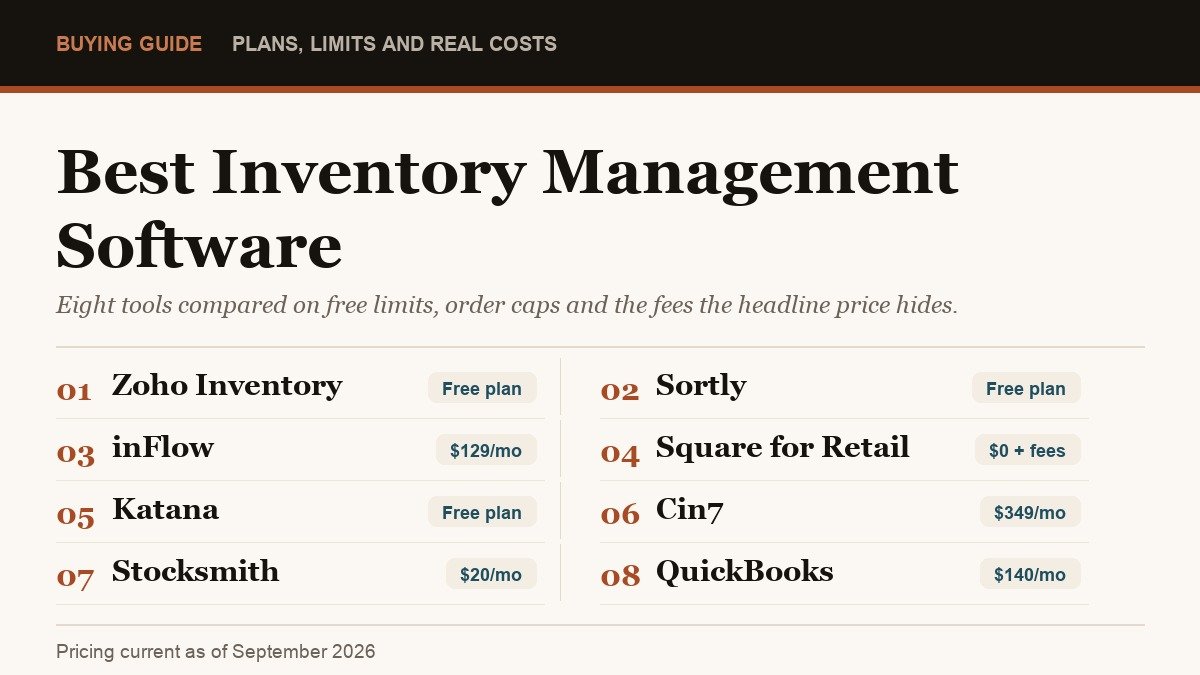
| # | Tool | Free plan | Paid starts at | Suits |
|---|---|---|---|---|
| 1 | Zoho Inventory | 50 orders a month | $29/mo billed yearly | Online sellers watching costs |
| 2 | Sortly | 100 items, 1 user | $49/mo | Equipment, tools and supplies |
| 3 | inFlow Inventory | None, 14-day trial | $129/mo billed yearly | Barcode picking and packing |
| 4 | Square for Retail | $0 plus card fees | $49/mo per location | Shops with a counter |
| 5 | Katana | 30 SKUs | $299/mo | Makers and small manufacturers |
| 6 | Cin7 | None | $349/mo | High order volume |
| 7 | Stocksmith | None, 14-day trial | $20/mo | Recipes and materials costing |
| 8 | QuickBooks Online | None for inventory | $140/mo | Books and stock in one place |
Three of the eight run a free tier you can keep rather than a trial that expires, and each one counts something different: Zoho counts orders, Sortly counts items and Katana counts SKUs. Working out which counter you will hit first is usually the whole decision.
1. Zoho Inventory: Best Overall for Small Online Sellers
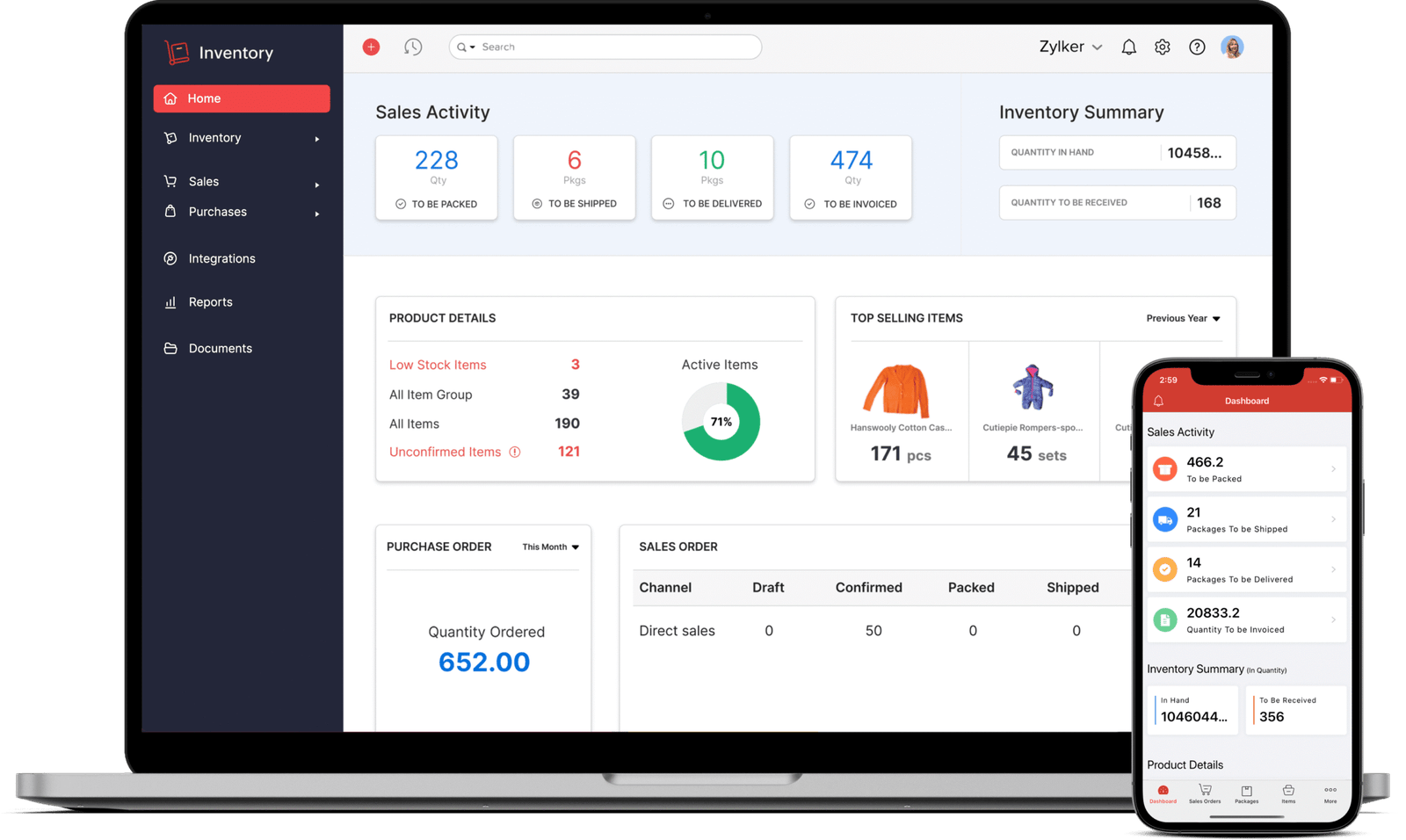
Zoho Inventory charges per organisation rather than per user, which is unusual here and starts paying for itself the moment a second person needs a login. The free plan covers 50 orders a month, one user and one location, and Standard at $29 a month billed annually lifts that to 500 orders, three users and two locations.
Most growing sellers end up on Premium at $79 a month billed annually, because that is the tier where barcode generation, serial and batch tracking, stock counting and the vendor portal arrive. Paying month to month instead costs $39, $99 and $159 for Standard, Premium and Plus.
The ceiling is order volume rather than catalogue size. Plus allows 7,500 orders a month across ten users and six locations, and Enterprise allows 15,000 across ten locations. Sellers running several storefronts will recognise the same channel list that shows up across dropshipping platforms and apps.
- Free: 50 orders a month, one user, one location.
- Paid from: $29 a month billed annually, or $39 month to month.
- Watch for: barcode, batch and serial tracking begin at Premium, not Standard.
2. Sortly: Best for Equipment, Tools and Supplies
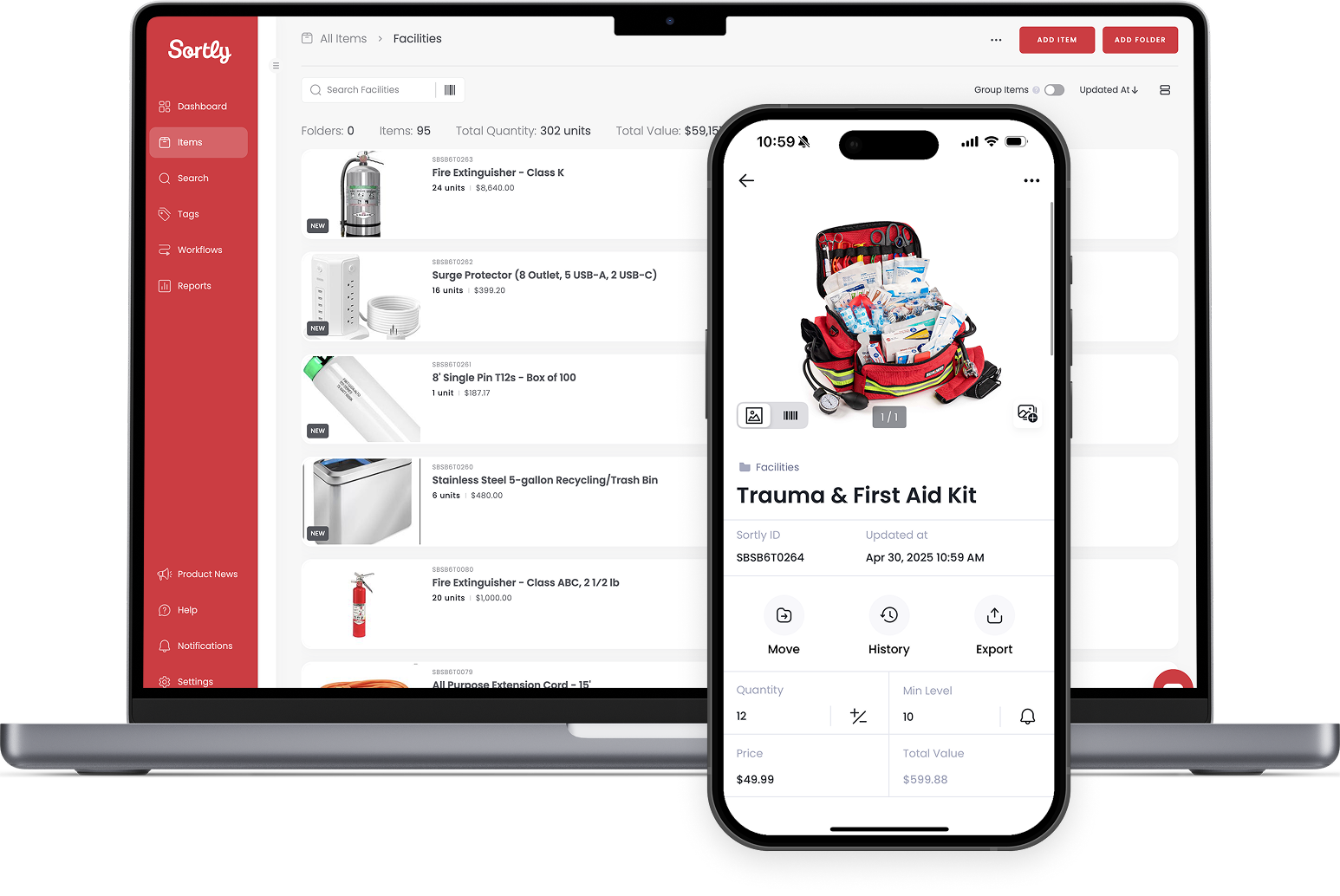
Sortly is built around photographs and folders instead of SKUs and sales orders, which makes it the natural choice for tracking gear, spare parts and site supplies rather than a product catalogue. The free plan holds 100 items for a single user.
Paid tiers count items and licences. Advanced at $49 a month covers 500 items and two users, Ultra at $149 covers 2,000 items and five users and adds barcode labels and purchase orders, and Premium at $299 covers 5,000 items, eight users, custom role permissions and a QuickBooks Online connection.
The lower numbers quoted elsewhere are the annual promotion. Sortly’s pricing page sets out a 50 percent discount on yearly plans that applies only to the first year of a new subscription, after which yearly plans carry a 20 percent discount. The 14-day trial asks for a card.
- Free: 100 items, one user, two active jobs.
- Paid from: $49 a month, or $288 for a first year of Advanced on the annual offer.
- Watch for: item counts rather than order counts are what you run out of.
3. inFlow Inventory: Best for Barcode Picking and Packing
inFlow is aimed at businesses moving real stock through a room with shelves in it. Entrepreneur at $129 a month billed annually covers two team members, unlimited products, 1,200 sales orders a year, one integration and one location, with a $100 hardware credit.
The next step is a large one. Small Business at $349 a month raises that to five members, 12,000 sales orders a year, three integrations and unlimited locations, and it carries a compulsory one-time onboarding package of $499. Mid-Size at $699 adds unlimited orders, five integrations, lot numbers and advanced access rights, with the same onboarding charge.
Two sibling products sit alongside it. inFlow Stockroom, which scans consumables and internal supplies in and out with no costing or sales side, starts at $69 a month standalone or $39 a month as an add-on, and inFlow Manufacturing starts at $179 a month. The 14-day trial needs no card.
- Free: none, but a 14-day trial without a card.
- Paid from: $129 a month billed annually.
- Watch for: the required $499 onboarding fee from Small Business upwards.
4. Square for Retail: Best for a Shop With a Counter
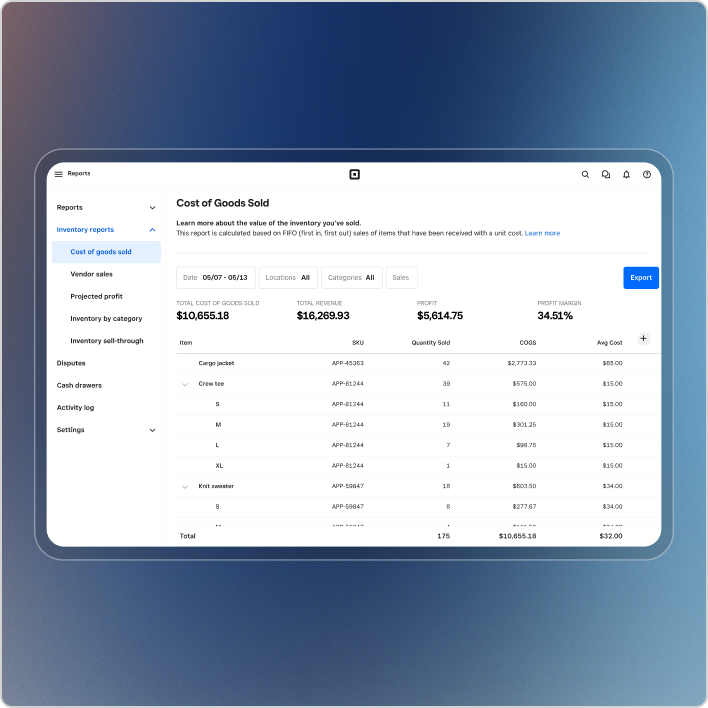
Square is the only entry here where the subscription is not the main cost. The free plan is $0 a month per location and takes 2.6 percent plus 15 cents on a tapped, dipped or swiped card, and 3.3 percent plus 30 cents online.
Stock control proper begins one tier up. Square Plus at $49 a month per location is where inventory management and stock intake, vendor and purchase order management and cost of goods sold reporting appear, and it also cuts card rates to 2.5 percent plus 15 cents in person. Premium at $149 a month per location adds transfer orders, cross location returns and 24/7 phone support at 2.4 percent plus 15 cents.
Because the charge is per location, a second shop doubles the subscription rather than sharing it. Businesses processing more than $250,000 a year can ask about custom rates under Square Pro.
- Free: $0 a month per location, card fees still apply.
- Paid from: $49 a month per location.
- Watch for: purchase orders and cost of goods sold are not on the free plan.
5. Katana: Best for Makers and Small Manufacturers
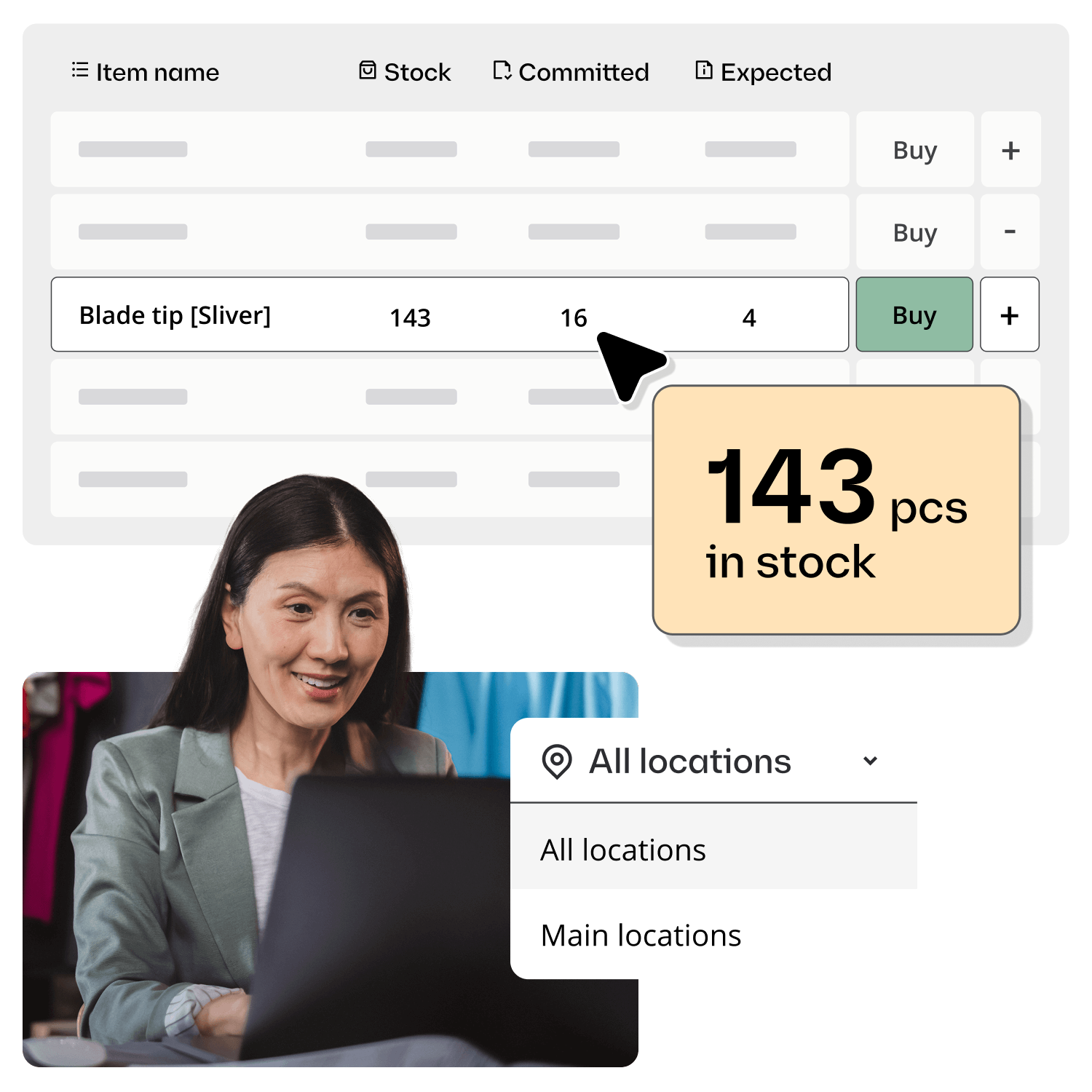
Katana runs the most generous free tier in this list once you read past the headline. It caps SKUs at 30 but leaves users, integrations and locations unlimited and includes API access, with no card required. For a workshop with a short product list that is a working system rather than a demo.
Core starts at $299 a month, removes the SKU limit and keeps users unlimited, which is rare in a category that usually bills per seat. One inventory location is included, and onboarding comes with the plan.
The catch is that several of the things manufacturers arrive for are priced separately. Manufacturing is $199 a month, traceability is $249 a month and warehouse management is $149 a month on top of Core, so a workshop that needs production and traceability is budgeting closer to $750 a month than $299.
- Free: 30 SKUs with unlimited users, integrations and locations.
- Paid from: $299 a month for Core.
- Watch for: manufacturing, traceability and warehouse features are paid add-ons.
6. Cin7: Best for High Order Volume
Cin7 is priced for businesses whose order count has outgrown everything above it. Standard is $349 a month for five users, two ecommerce or app integrations and 6,000 sales orders a year, with unlimited inventory locations.
Pro at $599 a month raises that to ten users, four integrations and 24,000 orders a year and adds material requirements planning. Advanced at $1,199 a month covers 15 users, six integrations, 120,000 orders a year and advanced warehouse management, and a custom tier sits above it.
The annual order allowance is the first number to check. Six thousand orders a year works out at roughly 16 a day, which an established seller can pass without noticing, and extra integrations and order volume are bought separately rather than bundled.
- Free: none.
- Paid from: $349 a month for Standard.
- Watch for: annual sales order caps of 6,000, 24,000 and 120,000 by tier.
7. Stocksmith: Best for Recipes and Materials Costing

This one answers to a new name. Craftybase now trades as Stocksmith, the same team and the same software, so an older bookmark still lands in the right place.
It tracks materials, recipes and bills of materials rather than finished goods alone, which is what makers of food, cosmetics and handmade products need for costing and compliance. Indie is $99 a month billed monthly or $83 billed annually, and covers 1,000 order lines a month with unlimited users and unlimited sales channel integrations.
Business at $199 a month, or $166 billed annually, lifts the cap to 5,000 order lines and adds automatic stock sync, production scheduling and an Amazon integration. Growth at $349 a month, or $291 annually, adds QuickBooks inventory sync. Below Indie sit two smaller plans: Studio at $41 a month billed annually or $49 month to month, and Pro from $20 a month, which connects one sales channel rather than unlimited. Every plan opens with a 14-day trial that needs no card.
- Free: none, but a 14-day trial on every plan without a card.
- Paid from: $20 a month for Pro on a single sales channel, $41 for Studio and $83 for Indie, both billed annually.
- Watch for: order lines a month, not orders, are the unit being counted.
8. QuickBooks Online: Best if Your Books Are Already There
QuickBooks does track inventory, but not on the plans most small businesses sign up to. Inventory tracking appears on Plus at $140 a month for five users. Simple Start at $38 and Essentials at $85 do not include it, and neither does the free plan.
That makes QuickBooks costly as an inventory tool on its own and sensible as one if Plus was already on the cards for the bookkeeping. An introductory 50 percent off for three months is usually offered, alongside a 30-day trial.
The useful test is which problem is bigger. If counts, purchase orders and stock valuation are the pain, a dedicated tool at $29 to $49 a month next to a cheaper bookkeeping plan will cost less and do more than moving up to Plus for the stock features alone.
- Free: a free plan exists, but without inventory tracking.
- Paid from: $140 a month for Plus, the first tier that tracks stock.
- Watch for: Simple Start and Essentials cannot track inventory at all.
Where the Advertised Price Stops
Four of these eight carry a cost that does not appear on the plan card, and in two cases it is larger than a month of subscription. Reading the footnotes before the feature list is the quickest way to avoid a surprise in the first invoice.
- Onboarding: inFlow requires a one-time $499 package from Small Business upwards, and Katana lists optional onboarding at $2,000 for free plan users.
- Add-ons: Katana sells manufacturing, traceability and warehouse management at $199, $249 and $149 a month on top of the Core subscription.
- Per location billing: Square charges its $49 and $149 tiers for each location, so the second shop pays again in full.
- Introductory rates: Sortly halves the yearly price for the first year only, then settles at a 20 percent yearly discount.
Per seat and per location pricing quietly reshapes a shortlist once a team grows, a pattern that also runs through review management software pricing and through digital signage platforms, where a second screen or a second branch repeats the whole fee.
The Cap You Hit First Decides the Price
Every tool here throttles something, and the throttles are not comparable. A business doing 400 orders a month from a 60 item catalogue is fine on Sortly and already over the line on Zoho Standard. A business with 4,000 items and 30 orders a month is the exact opposite.
- Orders a month: Zoho Inventory, from 50 free to 15,000 on Enterprise.
- Sales orders a year: inFlow at 1,200 and 12,000, Cin7 at 6,000, 24,000 and 120,000.
- Items or SKUs: Sortly from 100 to 5,000, Katana capped at 30 only on the free plan.
- Order lines a month: Stocksmith at 1,000 and 5,000.
- Users: unlimited on Katana and Stocksmith, capped on Sortly, inFlow and Cin7.
Count last year in whichever unit the vendor uses before comparing prices. A tool that looks twice as expensive is often cheaper once the tier that actually fits your volume is the one being priced.
Which Inventory Tool to Choose
For most small online sellers, Zoho Inventory is the sensible default: the free plan is genuinely usable, the per organisation pricing does not punish adding staff, and Premium at $79 a month covers barcodes and batch tracking. If what you are tracking is equipment or supplies rather than stock for sale, Sortly does that job better at any price.
A shop with a till should start with Square and accept that real inventory work costs $49 a month per location. A workshop that builds things should start on Katana free and budget for the manufacturing add-on. Warehouses that pick and pack want inFlow, and only businesses well past 6,000 orders a year should be looking at Cin7 pricing at all.
Frequently Asked Questions
What is the best software for inventory management?
There is no single winner, because these tools cap different things. Zoho Inventory suits online sellers, Sortly suits equipment and supplies, inFlow suits barcode driven warehouses, Katana suits manufacturers and Cin7 suits high order volume. Match the cap to your volume first, then compare price.
Can I use Excel for inventory management?
It works until two things happen: more than one person edits the file, or stock has to match what a sales channel thinks it has. A spreadsheet has no barcode scanning, no reorder alerts and no audit trail, so most businesses move once counts start disagreeing with reality.
Is there genuinely free inventory management software?
Yes, on three of the tools here. Zoho Inventory allows 50 orders a month on one location, Sortly holds 100 items for one user, and Katana allows 30 SKUs with unlimited users and locations. Square is also free per location, though card processing fees still apply.
Does QuickBooks track inventory?
It does, but only from the Plus plan at $140 a month, which includes five users. The free plan, Simple Start at $38 and Essentials at $85 do not track inventory, so QuickBooks is rarely the cheapest route to stock control by itself.