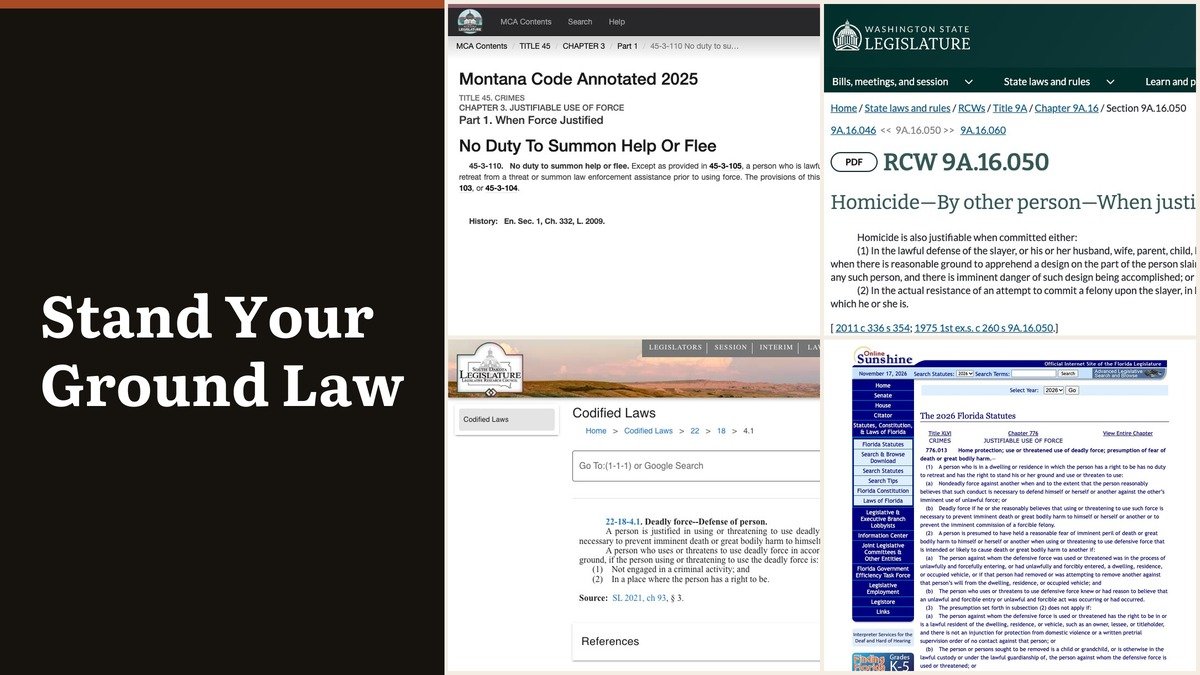
A stand your ground law removes the duty to retreat when a person faces a threat in a place where they have a legal right to be. In 2026 the rule is written into statute in dozens of states, and it is the reason a street confrontation can be judged very differently in Texas than in New York.
The phrase gets used loosely, so the details matter: what the statutes actually say, where retreat still counts, and what researchers have measured since the first laws passed.
What Is a Stand Your Ground Law?
A stand your ground law provides that a person who is lawfully present, and not engaged in criminal activity, has no duty to retreat before using force they reasonably believe is necessary. Under traditional self-defense, a person must retreat first if a safe retreat is available. Stand your ground laws remove that duty in some self-defense cases outside the home.
Stand Your Ground vs Castle Doctrine vs Duty to Retreat
The three rules answer the same question, must a person step back before using force, with different scopes:
- Duty to retreat: the traditional rule. A person who knows a safe retreat exists must take it before using deadly force.
- Castle doctrine: the exception that removes the duty to retreat inside the home. Some versions extend it to a workplace or occupied vehicle.
- Stand your ground: the widest rule. It removes the duty to retreat in places beyond the home, wherever the person has a right to be. It evolved from the castle doctrine.
Florida’s statute shows the widest version. Section 776.012(2) provides that a person using deadly force has no duty to retreat and has the right to stand their ground if they are not engaged in a criminal activity and are in a place where they have a right to be.
Stand Your Ground Law in 25 States: Retreat Rule and Statute
States fall into groups by the retreat rule in their own statute, jury instruction or court ruling.
| # | State | Rule | Citation |
|---|---|---|---|
| 1 | Alabama | Stand your ground by statute | Ala. Code Section 13A-3-23 |
| 2 | Arizona | Stand your ground by statute | Ariz. Rev. Stat. Sections 13-405(B), 13-411(B), 13-418(B) |
| 3 | Florida | Stand your ground by statute | Fla. Stat. Section 776.012(1)-(2) (2026) |
| 4 | Iowa | Stand your ground by statute | Iowa Code Section 704.1(3) |
| 5 | Kansas | Stand your ground by statute | Kan. Stat. Ann. Sections 21-5222(c), 21-5230 |
| 6 | Kentucky | Stand your ground by statute | Ky. Rev. Stat. Sections 503.050(4), 503.055(3) |
| 7 | Montana | Stand your ground by statute | Mont. Code Ann. § 45-3-110 |
| 8 | North Dakota | Stand your ground by statute | N.D. Cent. Code § 12.1-05-07(2)(b)(2) |
| 9 | Oklahoma | Stand your ground by statute | Okla. Stat. tit. 21, § 1289.25(D) |
| 10 | South Carolina | Stand your ground by statute | S.C. Code § 16-11-440(C) |
| 11 | South Dakota | Stand your ground by statute | S.D. Codified Laws § 22-18-4.1 |
| 12 | Texas | Stand your ground by statute | Tex. Penal Code §§ 9.31(e)-(f), 9.32(c)-(d) |
| 13 | Wyoming | Stand your ground by statute | Wyo. Stat. § 6-2-602(e) |
| 14 | Delaware | Duty to retreat in public, castle exception at home | 11 Del. C. Section 464(e)(2) |
| 15 | Hawaii | Duty to retreat in public, castle exception at home | Haw. Rev. Stat. Section 703-304(5)(b) |
| 16 | Maine | Duty to retreat in public, castle exception at home | 17-A Me. Rev. Stat. Section 108(2)(C)(3)(a) |
| 17 | New York | Duty to retreat in public, castle exception at home | N.Y. Penal Law § 35.15(2) |
| 18 | Rhode Island | Duty to retreat in public, castle exception at home | State v. Urena, No. 2004-199-C.A., slip op. at 8-9 & n.4 (R.I. June 16, 2006) (quoting State v. Quarles) |
| 19 | Colorado | No duty to retreat under case law | Colorado Judicial Branch, COLJI-Crim 2025, H:12 (applying Colo. Rev. Stat. § 18-1-704) |
| 20 | Illinois | No duty to retreat under case law | Illinois Pattern Jury Instructions-Criminal 24-25.09X, Committee Note (citing People v. Hughes and People v. Miller) |
| 21 | New Mexico | No duty to retreat under case law | UJI 14-5190 NMRA |
| 22 | Oregon | No duty to retreat under case law | State v. James, 350 Or. App. 71, 80 (2026) |
| 23 | Washington | No duty to retreat under case law | State v. Courtney, No. 76108-1-I, slip op. at 22-25 (Wash. Ct. App. Apr. 23, 2018) (unpublished) (quoting WPIC 16.08) |
| 24 | District of Columbia | Qualified or location-specific rule | In re Robertson, D.C. Ct. App. Nos. 00-FM-925 & 04-FM-1269, slip op. at 24-25 (Jan. 24, 2008), quoting Gillis v. United States, 400 A.2d 311, 313 (D.C. 1979) |
| 25 | Pennsylvania | Qualified or location-specific rule | 18 Pa.C.S. § 505(b)(2.3)-(2.4) |
Tennessee also has a stand your ground statute. State law controls and it changes, so the current code or a lawyer in the state can advise on a specific case.
How Statute States Write the Rule
The wording is close across states, with the same two conditions repeated: the person is not engaged in criminal or unlawful activity, and is in a place where they may lawfully be. The differences sit in the details around that core.
Florida: The Presumption of Fear

Section 776.013(2) creates a presumption that the defender reasonably feared death or great bodily harm when the other person was unlawfully and forcefully entering, or had entered, a dwelling, residence or occupied vehicle, or was removing someone against their will. Subsection (3) carves out exceptions.
Texas: Not Provoked, Not in Criminal Activity
Texas Penal Code 9.32(c) provides that a person with a right to be present, who has not provoked the other person and is not engaged in criminal activity, is not required to retreat before using deadly force. Section 9.32(b) presumes the belief reasonable for an occupied habitation, vehicle or place of business or employment, and sets the same provocation and criminal-activity limits.
South Dakota, Montana and Wyoming

South Dakota’s 22-18-4.1 provides that a person using deadly force in accordance with the section has no duty to retreat and the right to stand their ground if they are not engaged in criminal activity and are in a place where they have a right to be.

Montana’s 45-3-110 goes beyond retreat. A person lawfully in a place who is threatened with bodily injury or loss of life has no duty to retreat from the threat or summon law enforcement assistance before using force.

Wyoming’s 6-2-602(e) applies to a person attacked in any place where they are lawfully present, provided they are not the initial aggressor and not engaged in illegal activity. Iowa’s 704.1(3) uses a similar test for any place where the person is lawfully present, and Kentucky’s 503.050(4) states simply that a person has no duty to retreat before using deadly physical force.
Where the Duty to Retreat Still Applies
Not every state removed the duty. Delaware, Hawaii, Maine and New York keep it in statute for deadly force when retreat is possible with complete safety, with exceptions such as the home. New York’s 35.15(2) excepts a person in their own dwelling who was not the initial aggressor is under no duty to retreat.
Rhode Island reaches the same result through case law. In State v. Urena, the court held that a person must attempt retreat if they are consciously aware of an open, safe and available avenue of escape.
Two jurisdictions sit in between. Pennsylvania’s 505(b)(2) provides that the actor is not obliged to retreat from a dwelling or place of work, and 505(b)(2.3) creates a no-duty rule for other places under conditions. In the District of Columbia, case law imposes no duty to retreat, but a fact-finder may consider whether the defendant could safely have stepped back or walked away.
No-Retreat Rules That Come From Courts

Some states reach no-retreat through case law and jury instructions rather than a statute. An Illinois jury instruction states that a person who has not provoked the force has no duty to attempt to escape. New Mexico’s UJI 14-5190 provides that an assailed person need not retreat and may stand their ground.
Washington’s RCW 9A.16.050 makes a homicide justifiable in resisting an attempted felony, including in or upon a dwelling or other place of abode where the person is. The statute contains no retreat wording, and the rule is left to court decisions. Colorado’s official jury annotations note that no statute governs the duty to retreat and that the doctrine derives from the common law.
What the Research Shows About Stand Your Ground Laws
RAND’s review of the research, updated in January 2026, found supportive evidence that stand your ground laws increase total and firearm homicides. Its state data, valid as of January 1, 2025, counted 35 states with stand your ground statutes or statutes expanding the castle doctrine beyond the home: 30 stand your ground and 5 castle-expanded.
- Homicides: 15 studies. The 6 higher-quality studies found effects consistent with increases, with 2 statistically significant and 1 suggestive.
- Firearm homicides: 16 studies. Of the 8 higher-quality studies, 7 found higher rates, 2 were significant overall and 1 was significant in urban areas.
- Other violent crime: 8 studies, and only 1 not seriously flawed found significant results, for robbery, rape and aggravated assault.
- Inconclusive: suicide, mass shootings, police shootings, defensive gun use and gun industry outcomes.
- No qualifying studies: hunting and recreation, and unintentional injuries.
RAND dates the first stand your ground law to Utah in 1994. The widespread movement began in 2005, when Florida adopted a law that became the basis for a model law from the American Legislative Exchange Council, and 28 more states passed similar laws afterwards. For violent-crime context, the most dangerous cities in the US ranking covers the rates.
Common Misconceptions About Stand Your Ground
- It allows force anywhere. Statutes tie it to a right to be in the place, no criminal activity and, in Florida, a reasonable belief that force is necessary to prevent imminent death or great bodily harm.
- Florida was first. Utah passed the first law in 1994. Florida’s 2005 law became the model for later ones.
- It is the same everywhere. New York, Delaware and Maine keep a retreat duty, and Pennsylvania and the District of Columbia sit in between.
- It only matters to criminal cases. Florida’s 776.032 grants immunity from criminal prosecution and civil action, and once a prima facie claim is raised, the party seeking to overcome it must do so by clear and convincing evidence.
- The castle doctrine and stand your ground are one rule. The castle doctrine covers the home, and stand your ground extends no-retreat to public places.
Penalties and other legal consequences sit in separate statutes. The death penalty states guide covers the most serious ones.
Frequently Asked Questions
What does a stand your ground law do?
It removes the duty to retreat before using force in a place where the person has a right to be. The person must usually not be engaged in criminal activity, and the force must be one the law would otherwise justify.
How many states have stand your ground laws?
RAND counts 30 states with stand your ground statutes and 5 more with statutes expanding the castle doctrine beyond the home, as of January 1, 2025. Other organizations use stricter definitions and count fewer.
Does stand your ground apply in your own home?
Yes, though the castle doctrine usually covers the home already. Stand your ground extends protection outside it, in any place where the person is lawfully present.
Do stand your ground laws increase homicides?
RAND found supportive evidence that they increase total and firearm homicides. Seven of the 8 higher-quality firearm homicide studies found higher rates, and findings on other outcomes were inconclusive.