The First Amendment protects religion, speech, the press, peaceable assembly and petition from government interference, but it does not stop a private employer, store or social media company from limiting what you say. In 2026 most First Amendment disputes come down to two questions: is the government involved, and does the speech fall into one of the narrow categories the Supreme Court leaves unprotected?
This guide works through both, then covers the places the rules shift: public schools, government jobs, protests and the internet.
What Does the First Amendment Protect?
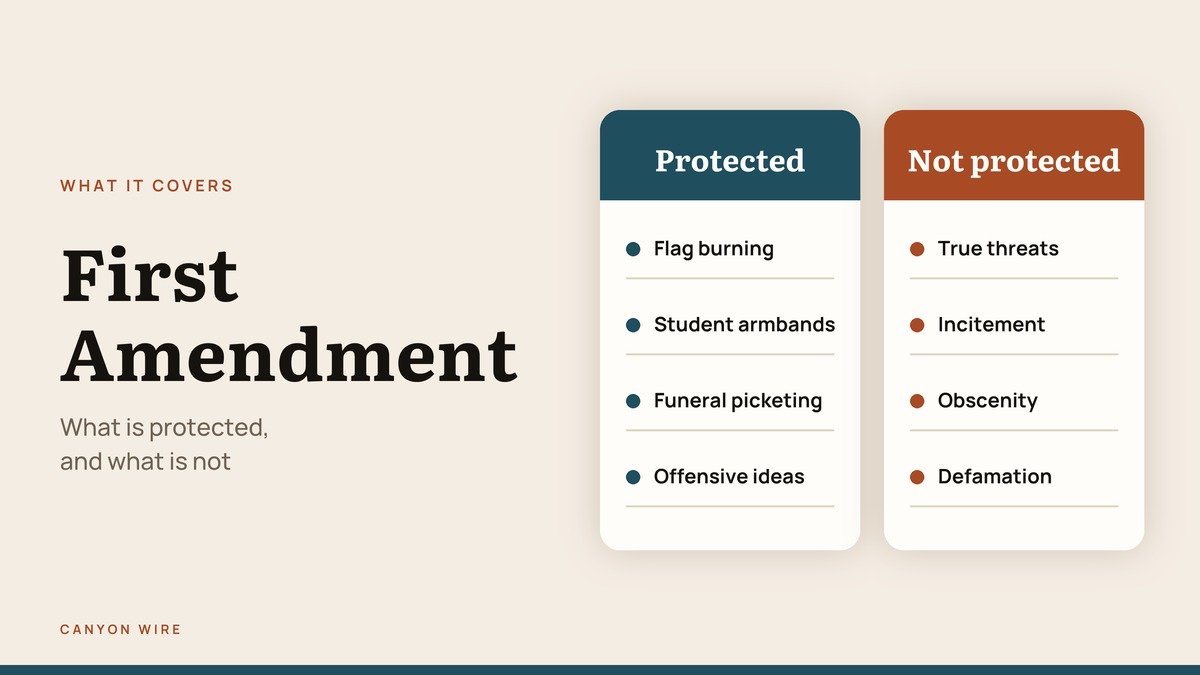
It protects five freedoms from government action: no official religion and free religious exercise, freedom of speech, freedom of the press, the right to assemble peacefully, and the right to petition the government. Protected speech includes words and symbolic acts such as flag burning, but excludes incitement, true threats, obscenity and defamation.
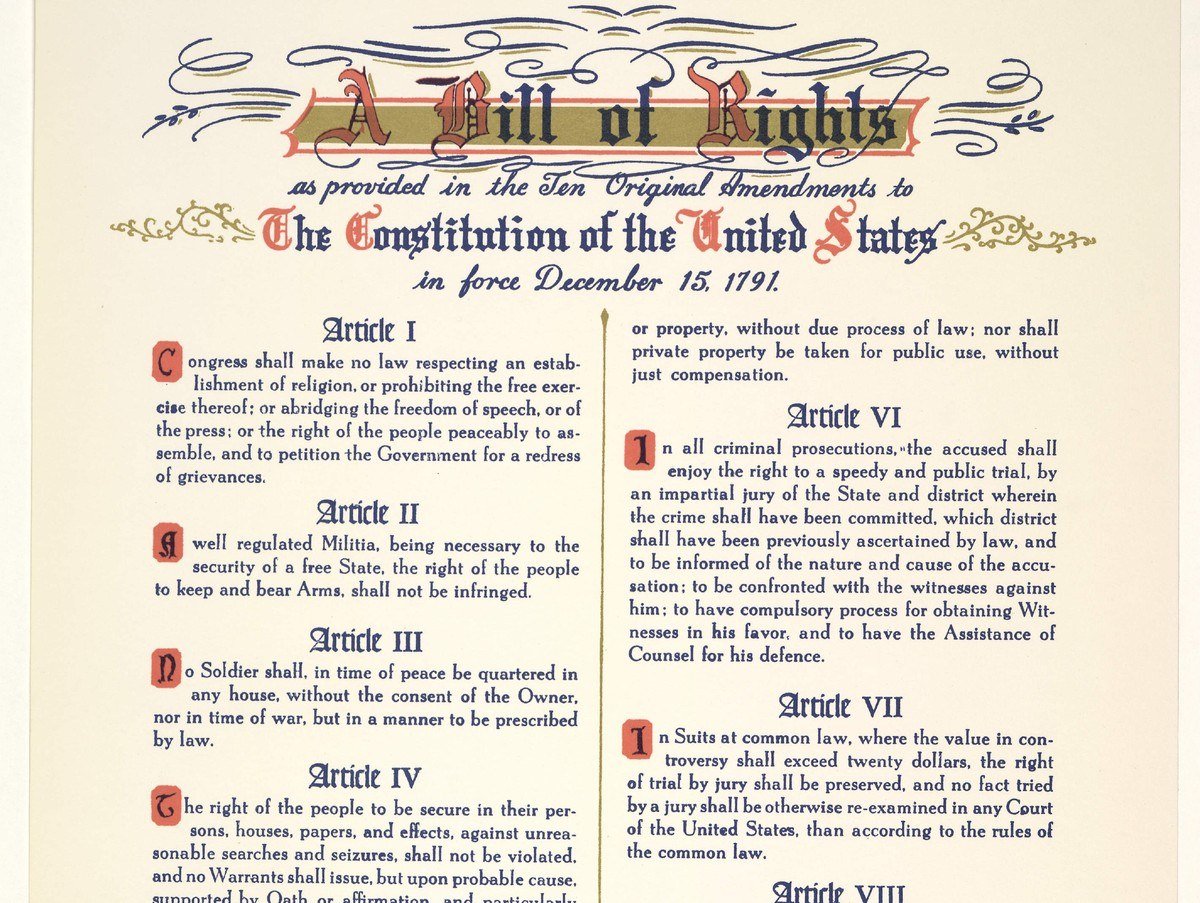
The text was proposed by the First Congress on September 25, 1789, and ratified on December 15, 1791, with the rest of the Bill of Rights. It opens with the words “Congress shall make no law,” which is why the question of who is acting matters so much.
The First Amendment Limits Government, Not Private Companies
Courts call this the state action requirement: a constitutional claim needs an act by the government or by someone closely enough tied to it to count as government. A private company that fires a worker for a post, deletes a comment or bans a user is not violating the First Amendment, whatever else the law says.
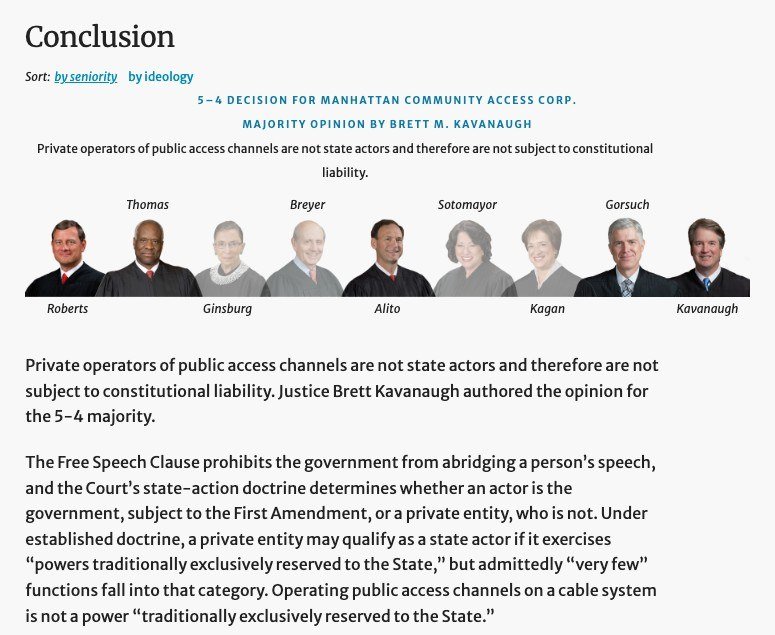
In Manhattan Community Access Corp. v. Halleck, decided June 17, 2019, a 5-4 Court held that the private corporation overseeing Manhattan’s public-access cable channels was not a state actor. Justice Brett Kavanaugh wrote that a private entity becomes one only when it performs a function “traditionally exclusively reserved to the State,” and that “very few” functions qualify.
The line runs the other way for officials. In Lindke v. Freed (March 15, 2024), a unanimous Court held that a public official who blocks a critic on social media acts for the state only if the official had authority to speak for the government on that topic and used it in the posts.
The amendment originally bound only the federal government. Through the incorporation doctrine, the Court applied it to states, starting with Gitlow v. New York on June 8, 1925, so a state legislature, a city police department or a public university faces the same limits as Congress.
Five Kinds of Speech the First Amendment Does Not Cover
The Supreme Court has kept the list of unprotected speech short. Each category has a test, and speech that does not meet the test stays protected.
| # | Category | Test the government must meet | Leading case |
|---|---|---|---|
| 1 | Incitement | Directed to inciting imminent lawless action and likely to produce it | Brandenburg v. Ohio (1969) |
| 2 | True threats | Speaker at least recklessly disregarded that the words would be seen as threatening | Counterman v. Colorado (2023) |
| 3 | Obscenity | Prurient, patently offensive, and lacking serious literary, artistic, political or scientific value | Miller v. California (1973) |
| 4 | Defamation of officials | False statement made with knowledge or reckless disregard of falsity | NYT v. Sullivan (1964) |
| 5 | Fighting words | Words that by their utterance inflict injury or tend to incite an immediate breach of the peace | Chaplinsky v. New Hampshire (1942) |
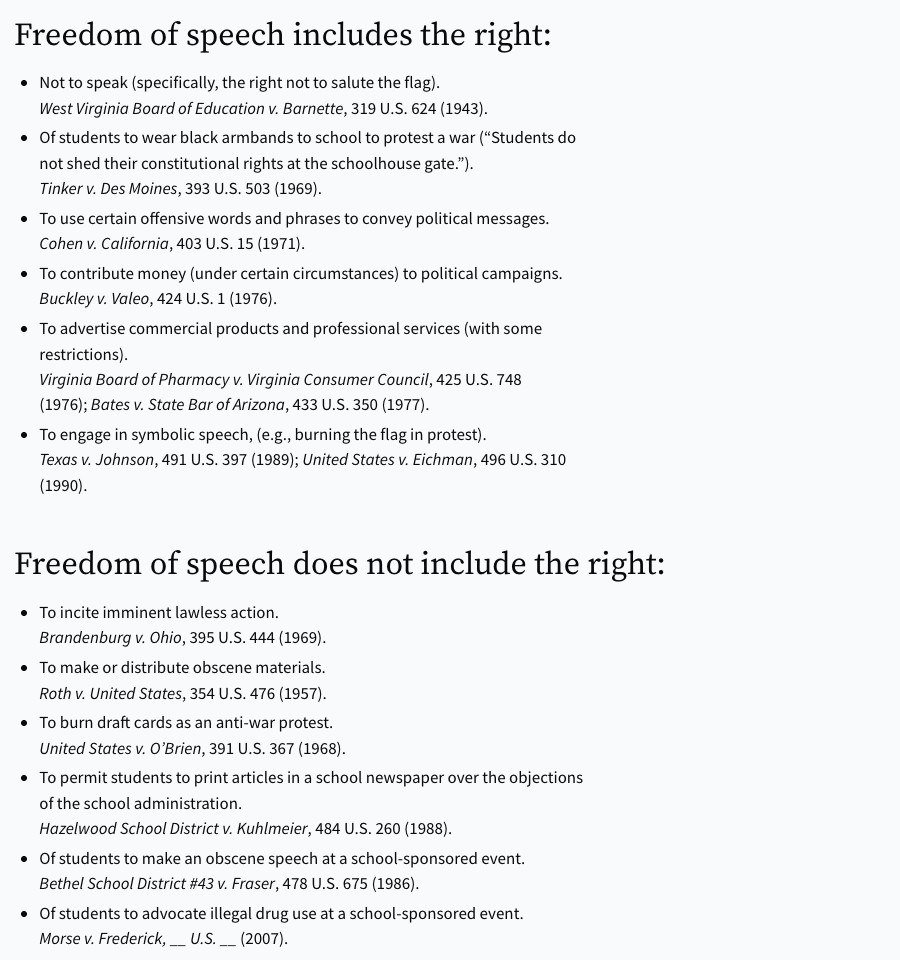
Incitement is the narrowest. Brandenburg v. Ohio (June 9, 1969) reversed the conviction of a Ku Klux Klan leader for a rally speech and overruled the 1927 Whitney v. California decision. Advocating force in the abstract is protected; urging a crowd to break the law right now, when it is likely to happen, is not.
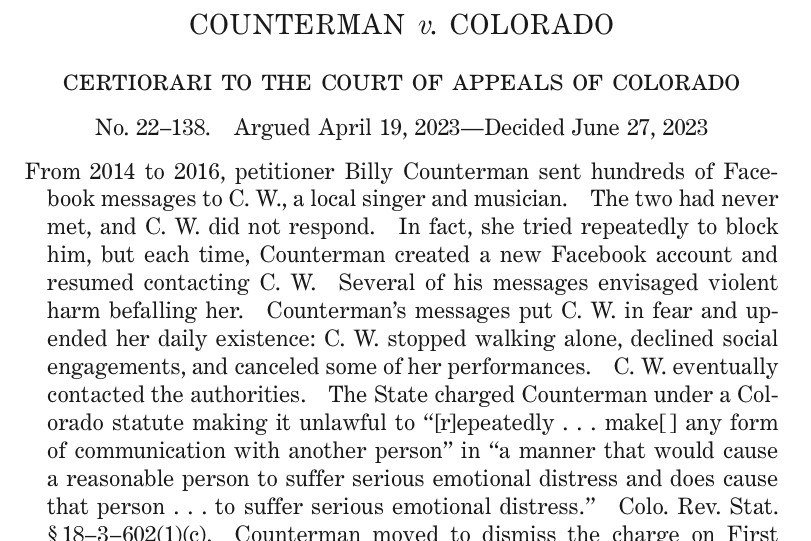
True threats got a new standard in 2023. Billy Counterman sent hundreds of Facebook messages to a local musician from 2014 to 2016, creating new accounts each time she blocked him. In Counterman v. Colorado, decided June 27, 2023, a 7-2 Court held that prosecutors must prove he understood the threatening nature of his words, and that recklessness is enough.
Defamation is protected only partly. Under New York Times Co. v. Sullivan (1964), a public official must prove “actual malice.” Hustler Magazine v. Falwell (1988) applied the same showing to public figures suing over parody for emotional distress. Deadlines for defamation suits are short: our guide to the statute of limitations covers defamation among civil claims.
Offensive Speech the Supreme Court Has Protected
Being hurtful, hateful or unpopular does not remove protection. The Court has drawn that line in some of its most criticized rulings:
- Flag burning: Texas v. Johnson (1989), 5-4, protected a man who burned a flag outside Dallas City Hall in 1984.
- Funeral protests: Snyder v. Phelps (2011), 8-1, shielded Westboro Baptist Church members who picketed a Marine’s funeral from a $5 million damages award.
- Refusing to speak: West Virginia v. Barnette (1943) held students cannot be forced to salute the flag, overruling a decision from three years earlier.
- Compelled messages: 303 Creative v. Elenis (2023), 6-3, held Colorado cannot force a web designer to create wedding websites conveying messages she disagrees with.
Hate speech has no separate category. It loses protection only when it fits an existing one: Virginia v. Black (2003) let states ban cross burning carried out with intent to intimidate, which is a true threat.
Protest Permits and Time, Place and Manner Rules
Government may regulate when, where and how people speak, even in a park or on a sidewalk. Under Ward v. Rock Against Racism (1989), such a rule is valid if it is justified without reference to the content of the speech, narrowly tailored to a significant government interest, and leaves open ample alternative channels.
That 6-3 decision upheld New York City’s requirement that Central Park concerts use a city sound system and technician. Permit rules for parades and noise limits work the same way. What a city cannot do is arrest peaceful marchers for their message: in Edwards v. South Carolina (1963) the Court reversed the convictions of 187 students who protested at the State House.
First Amendment Rights at Public Schools
Students keep their rights, but schools get more room than a city council does. The key rulings:
- Tinker v. Des Moines (1969): black armbands protesting the Vietnam War were protected because they caused no material and substantial disruption.
- Bethel School District v. Fraser (1986): a school could punish a lewd speech at a student assembly.
- Hazelwood v. Kuhlmeier (1988): a principal could edit a school-sponsored newspaper for legitimate teaching reasons.
- Morse v. Frederick (2007): a school could bar a banner it read as promoting illegal drug use.
- Mahanoy Area School District v. B.L. (2021): a cheerleader’s weekend Snapchat post, made off campus, was protected.
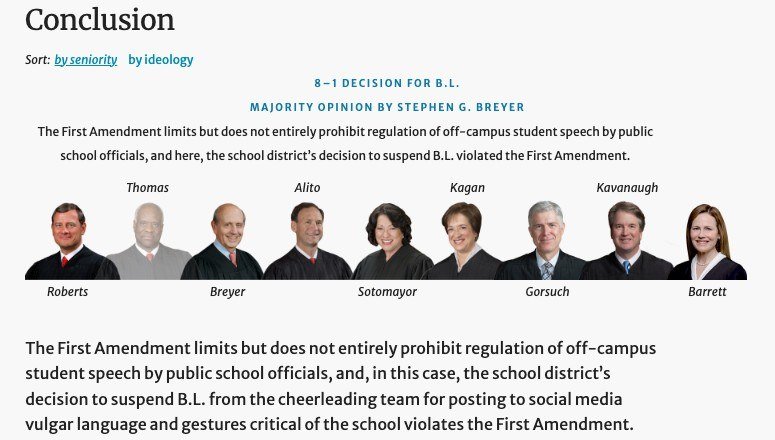
Mahanoy was decided 8-1 on June 23, 2021. Justice Stephen Breyer wrote that schools can regulate some off-campus speech, but off-campus posts normally fall under parental responsibility rather than the school’s.
Speech at Work: Public Employees vs Private Employers
A private employer is not bound by the First Amendment at all. Government employees get partial protection, set by three cases:
- Pickering v. Board of Education (1968): an 8-1 Court held a teacher could not be fired for a letter to a local newspaper criticizing the school board’s spending.
- Garcetti v. Ceballos (2006): a 5-4 Court held speech made as part of an employee’s official duties, such as a deputy district attorney’s work on a case, is not protected.
- Borough of Duryea v. Guarnieri (2011): a unanimous Court held a public employee’s petition is protected from retaliation only if it touches a matter of public concern.
Social Media, Age Checks and Online Speech
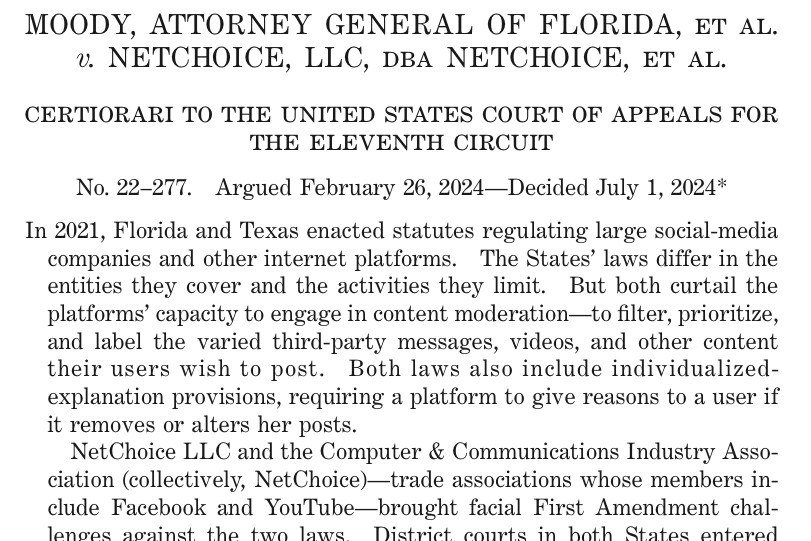
The Supreme Court has treated platform moderation as speech by the platform. In Moody v. NetChoice, decided July 1, 2024, it reviewed 2021 Florida and Texas laws that limited how large platforms filter and label posts. The Court sent both cases back for proper analysis, while holding that curating others’ content is expressive activity the First Amendment covers.
Other recent cases mark the edges:
- Free Speech Coalition v. Paxton (June 27, 2025): 6-3, upheld Texas’s age verification law for sites where over one-third of content is sexual material harmful to minors.
- Murthy v. Missouri (June 26, 2024): 6-3, two states and five users suing over federal pressure on platforms lacked standing.
- TikTok v. Garland (January 17, 2025): the Court unanimously rejected TikTok’s First Amendment challenge to the Protecting Americans from Foreign Adversary Controlled Applications Act, citing data on 170 million U.S. users.
Because platforms set their own rules, the practical protections online are often privacy settings, not constitutional claims; our guide on how to protect your privacy online covers those controls.
How Courts Test a First Amendment Claim
Judges sort speech laws into three tiers, and the tier usually decides the case:
- Content-based or viewpoint-based laws get strict scrutiny and are presumed unconstitutional.
- Content-neutral laws, or laws that only incidentally burden adults’ protected speech, get intermediate scrutiny.
- Laws reaching only unprotected speech, such as obscenity, get rational-basis review.
Chiles v. Salazar, decided March 31, 2026, shows the first tier at work. An 8-1 Court held that Colorado’s conversion therapy ban, as applied to a licensed counselor who uses only talk therapy, regulates speech based on viewpoint, and that the lower courts erred by not applying sufficiently rigorous scrutiny.
This guide is general information about how the First Amendment works, not legal advice for a specific dispute.
Frequently Asked Questions
Can a private company punish me for what I say?
Generally yes, as far as the First Amendment goes, because it restrains only government. Under the Halleck decision, even running a forum for speech does not by itself turn a private company into a state actor.
Is hate speech protected by the First Amendment?
Usually. The Supreme Court has no hate speech exception, and Snyder v. Phelps protected deeply offensive funeral signs. Hateful speech loses protection when it becomes a true threat, incitement or targeted intimidation such as cross burning meant to intimidate.
Does the First Amendment apply to state and local governments?
Yes. Starting with Gitlow v. New York in 1925, the Court applied each First Amendment freedom to the states through the Fourteenth Amendment’s Due Process Clause.
Can I be punished for a threatening post online?
Yes, if it is a true threat. Since Counterman v. Colorado in 2023, prosecutors must show you were at least reckless about how threatening the words would seem.