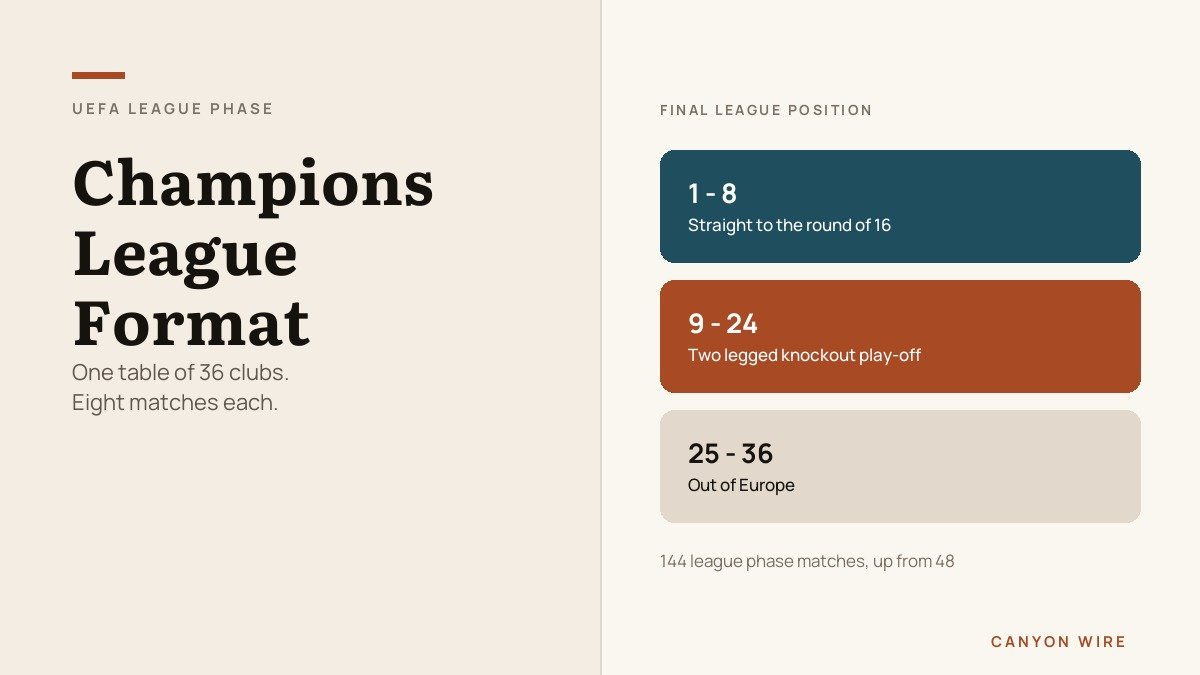
The Champions League format no longer has groups. Since 2024 all 36 clubs sit in a single league table, each plays eight different opponents rather than the same three twice, and where a club finishes in that one table decides whether it gets a bye, a play-off, or nothing at all.
It is a Swiss system, borrowed from chess, and it changed the maths of the competition more than the name suggests. The old group stage produced 48 fixtures. The league phase produces 144. What follows is how the draw is built, what each finishing position is worth, and how the knockout bracket is assembled afterwards.
| Finishing position | What it earns | Next match |
|---|---|---|
| 1st to 8th | Direct entry to the round of 16 | Round of 16, seeded |
| 9th to 16th | Knockout play-off, seeded | Two legged play-off, second leg at home |
| 17th to 24th | Knockout play-off, unseeded | Two legged play-off |
| 25th to 36th | Elimination from Europe | None |
How the Champions League Format Builds the League Phase Draw
The 36 clubs are split into four pots of nine, ranked by UEFA club coefficient. Every team is then drawn against two opponents from each pot, playing one of each pair at home and the other away. That is eight matches: four home, four away, eight different opponents, and a guaranteed spread of difficulty from the strongest pot to the weakest.
Three constraints shape the draw procedure:
- No domestic ties. Clubs from the same association cannot be drawn against each other in the league phase.
- A country cap. No club may face more than two opponents from any single other association, so nobody draws three Premier League sides.
- No three-year repeats. The same fixture cannot be played with the same team at home for three consecutive seasons.
Because every club meets a different set of opponents, the table is not a like-for-like comparison in the way a domestic league is. UEFA’s answer is that the spread is tight enough not to matter: the largest average gap between any team’s strongest and weakest opponent is 19 coefficient points, far narrower than the old format produced.
Eight Matchdays, One Table, Three Outcomes
Clubs play one match per matchday across eight rounds, and the single table ranks all 36 together. When teams are level on points the order is settled by goal difference, then goals scored, then away goals, then wins, then away wins. Those five apply throughout the league phase. A further set of tiebreakers, covering the collective record of a team’s opponents, disciplinary points and finally the club coefficient, only comes into play once the final matchday is complete.
The three outcomes are unusually stark. Finish in the top eight and the reward is a month off and a seeded place in the round of 16. Finish between ninth and twenty fourth and there is a two legged play-off to survive first. Finish twenty fifth or lower and the season in Europe is over, with no drop into a secondary competition, which is the single harshest element of the design.
That cliff edge is why the final matchday is played simultaneously. With a dozen clubs separated by a point or two and three different fates available, staggered kick offs would be indefensible.
The Knockout Play-Off and How the Bracket Is Seeded
The 16 clubs that finish ninth to twenty fourth are paired for a two legged play-off. Teams ranked ninth to sixteenth are seeded and play the second leg at home; those from seventeenth to twenty fourth are unseeded. The eight winners join the top eight in the round of 16.
Seeding then carries through the bracket rather than being redrawn at every stage, so league phase position keeps paying dividends deep into the knockouts. A club that finishes first is positioned to meet lower ranked opposition for as long as the form holds, which is the mechanism that gives eight otherwise meaningless league phase matches real weight.
Knockout ties themselves are settled the familiar way. Under Article 21 of the regulations, a tie level on aggregate after two legs goes to two 15 minute periods of extra time at the end of the second leg, and then to a penalty shoot-out. There is no away goals rule. It was abolished, so a 1-1 away draw is worth exactly as much as a 1-1 at home and no more. The shoot-out itself runs on the standard five kicks each, taken by different players, before sudden death begins. Goals in those ties are judged by the same standard as in any league match, which our guide to the offside rule sets out in full.
What Changed When the Groups Disappeared
The old format ran eight groups of four, with the top two advancing and the third place team dropping into the Europa League. It produced 48 matches and a familiar problem: by matchday five, a large share of fixtures were dead rubbers between a qualified giant and an eliminated minnow.
The league phase attacks that directly:
- Volume. 144 league phase matches instead of 48, with every club playing eight different opponents rather than three.
- Fewer dead rubbers. With 24 of 36 places still live and three tiers of outcome, there is something to play for far lower down the table.
- Harder floor. Weaker clubs no longer get a soft landing in the Europa League, so the bottom third of the table is a genuine relegation fight.
- More goals. The league phase has produced an average of 3.26 goals per game, the highest the competition has recorded.
The counter argument is the calendar. Two extra fixtures per club, plus a play-off round for sixteen of them, lands on players who already carry domestic and international schedules. The competition’s own history, traced through the European Cup and its successors, is a steady march towards more matches for more clubs, and this is the latest step rather than a break from it.
Who Qualifies for the Champions League in the First Place
Most places come from domestic league positions, with the number of entrants per country set by the association coefficient. The strongest leagues send four clubs directly; weaker associations send one, which then has to come through qualifying rounds in the summer.
Two of the 36 places work differently. They go to the associations that performed best across all UEFA competitions the previous season, which means a strong European campaign by a country’s clubs earns that country an extra entrant the following year. The holders also qualify automatically, so a club can win the trophy and return to defend it even after a poor domestic season. Squads for all of it are assembled inside the two registration periods covered in our guide to the football transfer window. If you are planning which matches to watch, our rundown of the best sports streaming services covers where the fixtures are shown.
The Same Design Now Runs the Europa and Conference Leagues
UEFA did not confine the redesign to its top competition. Both other European tournaments moved to a 36 team league phase at the same time, with the same three tier outcome at the bottom of the table, so a club dropping between competitions finds a familiar structure rather than a new one.
The differences are in the number of fixtures and the shape of the draw:
- Champions League. 36 clubs in four pots of nine. Eight matches each, two opponents from every pot, one home and one away.
- Europa League. 36 clubs, eight matches each, four at home and four away, on the same pattern as the Champions League.
- Conference League. 36 clubs in six pots of six, but only six matches each, one against an opponent from each of the other five pots plus one more.
All three then split identically: the top eight are seeded straight into the round of 16, ninth to twenty fourth play a two legged knockout play-off, and twenty fifth downwards are out. Learning the Champions League format therefore covers the rest of the European calendar, which was part of the point. A supporter following a club across two competitions in consecutive seasons no longer has to learn a second set of rules.
Frequently Asked Questions
How many games does each team play in the Champions League league phase?
Eight, against eight different opponents, four at home and four away. Each club faces two teams from each of the four seeding pots, one of each pair home and the other away.
How many teams qualify for the Champions League knockout stage?
Twenty four of the 36 continue. The top eight go straight to the round of 16, teams ranked ninth to twenty fourth contest a two legged knockout play-off, and the bottom twelve are eliminated from European competition entirely.
Is there still an away goals rule in the Champions League?
No. Away goals no longer break a tie in the knockout rounds. A two legged tie level on aggregate goes to two 15 minute periods of extra time at the end of the second leg, and a penalty shoot-out after that.
What happens to teams that finish 25th or lower?
They are out of Europe for the season. Unlike the old group stage, where third place meant a drop into the Europa League, the league phase has no safety net below twenty fourth place.