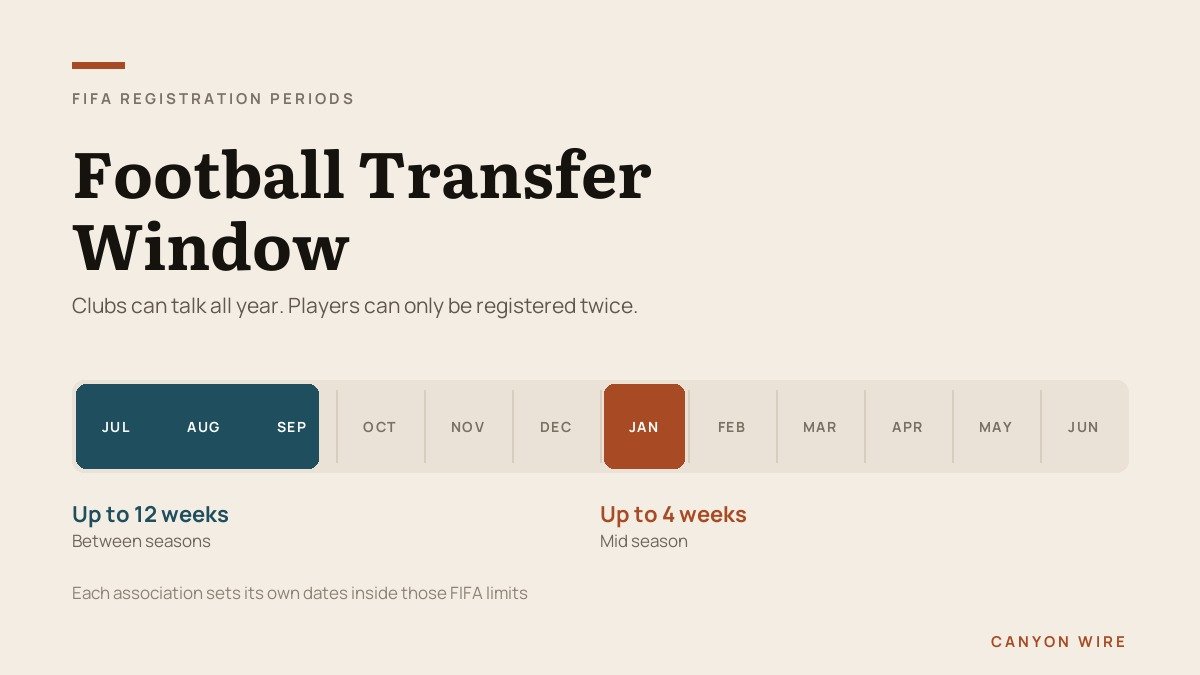
The transfer window is not a football term at all. FIFA calls it a registration period, and that distinction explains most of what confuses people about it: the window does not control when clubs may agree deals, only when a player may be registered to play.
Clubs negotiate all year. What the calendar restricts is the paperwork, and the paperwork is what makes a player eligible. Here is how the two annual periods are set, who is allowed to sign outside them, the limits on how many clubs one player can turn out for, and the separate rulebook that governs loans.
| Rule | What it says |
|---|---|
| Number of windows | Two registration periods per season |
| Longer window | Maximum 12 weeks, between seasons |
| Shorter window | Maximum 4 weeks, mid season |
| Who fixes the dates | Each national association, filed with FIFA in advance |
| Clubs per season | A player may be registered with up to three |
| Clubs he may play for | Only two in official matches |
| Loans out at any one time | Six, with exemptions for under 21s and club-trained players |
How the Transfer Window Works Under FIFA’s Rules
Players may only be registered during one of two annual registration periods. That single sentence from the Regulations on the Status and Transfer of Players is the foundation. Everything else is exceptions to it.
The two periods are capped rather than fixed. The longer one falls in the break between seasons and may not exceed 12 weeks. The shorter one sits in the middle of the season and may not exceed four. Within those limits each national association picks its own dates, which is why the English and Spanish windows close on different days and why a club can sometimes sell to a league whose window is still open after its own has shut.
Associations do not choose late. Registration periods have to be filed with FIFA well in advance through the transfer matching system, and any association that fails to communicate its dates has them determined by FIFA instead. The rules also do not apply to competitions in which only amateur players take part.
Who Can Sign Outside the Window
The best known exception is the free agent. A professional whose contract expired before the end of a registration period may be registered outside one, which is why clubs with an injury crisis in November sign players who have been training alone since the summer.
The other exceptions are narrower and less discussed:
- Contracts terminated with just cause. Where a contract has been ended with just cause, FIFA may permit registration outside a period.
- Maternity cover. A female player may be registered outside a registration period to temporarily replace a player on maternity leave, with the replacement registration running until the next period begins.
- Returning from maternity leave. The regulations require that a player returning from maternity leave is able to be registered and eligible for domestic competition.
None of these open the door to a transfer fee. A club cannot buy a player under contract outside the window; it can only register someone who has no club to be bought from.
Three Clubs, Two Teams: The Limit Most Fans Miss
A player may be registered with a maximum of three clubs during one season, and may play official matches for only two of them. The third registration is legal; appearing for the third club is not.
A further restriction sits underneath it. No player may play official matches for more than two clubs competing in the same national championship or cup in the same season, and individual competitions may impose stricter rules of their own. That is why a January signing who has already played for two clubs that season is cup tied in a way that surprises supporters every year.
There is one carve out, for players moving between associations whose seasons overlap. A player crossing between a summer to spring calendar and a spring to autumn one may be eligible for a third club, because the two leagues disagree about which season he is in.
Loans Have Their Own Rulebook
A loan is treated as a transfer for most purposes, including the requirement that it happen inside a registration period, but it carries extra conditions:
- Minimum length. A loan must run at least until the next registration period, so a club cannot recall a player the moment an injury clears.
- Maximum length. A loan agreement may run for no more than one year at a time.
- No sub-loans. The club taking a player on loan cannot send him to a third club without written authorisation from the club that released him.
- Volume caps. A club may have no more than six professionals loaned out and six loaned in at any one time, and no more than three with any single other club.
- Exemptions. Players aged 21 and under and club-trained players do not count towards those caps, which is the point: the limits target hoarding, not youth development.
Those volume caps were phased in deliberately, with the six and six limit taking full effect from July 2024. The target was the practice of signing dozens of young professionals and parking them elsewhere, which concentrated talent at a handful of clubs without ever putting them on the pitch.
Bridge Transfers and the 16 Week Rule
One rule exists purely to catch a trick. A bridge transfer is a move routed through an intermediate club, usually in a different country, so that the real buyer and seller can avoid tax, training compensation or rules on third party ownership.
FIFA deals with it by presumption rather than proof. If the same player is transferred twice within 16 weeks, the regulations presume the clubs and player involved arranged a bridge transfer unless they establish otherwise, and the Disciplinary Committee can sanction everyone concerned. Putting the burden on the parties is what makes the rule workable, since proving intent across two jurisdictions almost never is.
The Money That Moves With Every Transfer
A transfer fee is not paid entirely to the selling club. Two mechanisms divert part of it to the clubs that did the training, and both run automatically rather than by negotiation.
- The solidarity contribution. When a professional moves during a contract, 5 percent of the compensation is deducted and shared among every club that trained him between the calendar years of his 12th and 23rd birthdays.
- How that 5 percent is split. Each of the years covering his 12th to 15th birthdays is worth 5 percent of that pot; each year from his 16th birthday onwards is worth 10 percent of it.
- Training compensation. Paid separately to a player’s training clubs when he signs his first professional contract, and on each transfer until the end of the calendar year of his 23rd birthday.
Training compensation falls due within 30 days of registration and is owed by the new club, not the seller. It is not payable if the former club terminated the contract without just cause, which closes the obvious loophole. The practical effect is that a youth system is an asset even for a club that never fields the player: a teenager who moves twice for large fees pays his first coaches twice over.
Deadline Day and What Actually Has to Be Submitted
Deadline day is a registration deadline, not a negotiation one. A deal agreed at midday counts for nothing unless a valid application to register the player reaches the association through the electronic registration system before the window closes.
That is why the final hours look chaotic in a way the fee and the handshake do not explain, and why the rolling deadline day broadcasts carried by the major sports streaming services have an audience at all. Contracts have to be signed, medicals completed, international clearance requested where the player is moving between associations, and the submission made in time. A transfer can collapse with both clubs in full agreement, purely on the clock.
The window system itself only dates from 2002 in its current form, which is recent enough that older supporters remember clubs signing players in April. Teams chasing late European qualification now have to build squads months earlier, and the ones that get it wrong spend the second half of the season working with what they have. For a sense of what is riding on those squads, the Champions League format leaves no safety net below twenty fourth place.
Frequently Asked Questions
How many transfer windows are there in a season?
Two. A longer one between seasons, capped at 12 weeks, and a shorter mid season one capped at four weeks. Each national association sets the exact dates inside those limits, so they differ by country.
Can a club sign a player outside the transfer window?
Only a free agent. A professional whose contract expired before the end of a registration period may be registered at any time. A player still under contract at another club cannot be signed until a window opens.
How many clubs can a player play for in one season?
Two in official matches, although he may be registered with three. He also cannot play for more than two clubs in the same national championship or cup in a season, and some competitions impose stricter limits of their own.
How long can a loan last?
No more than one year at a time, and at least until the next registration period opens. The club holding a player on loan cannot pass him to a third club without written permission from the club that sent him.