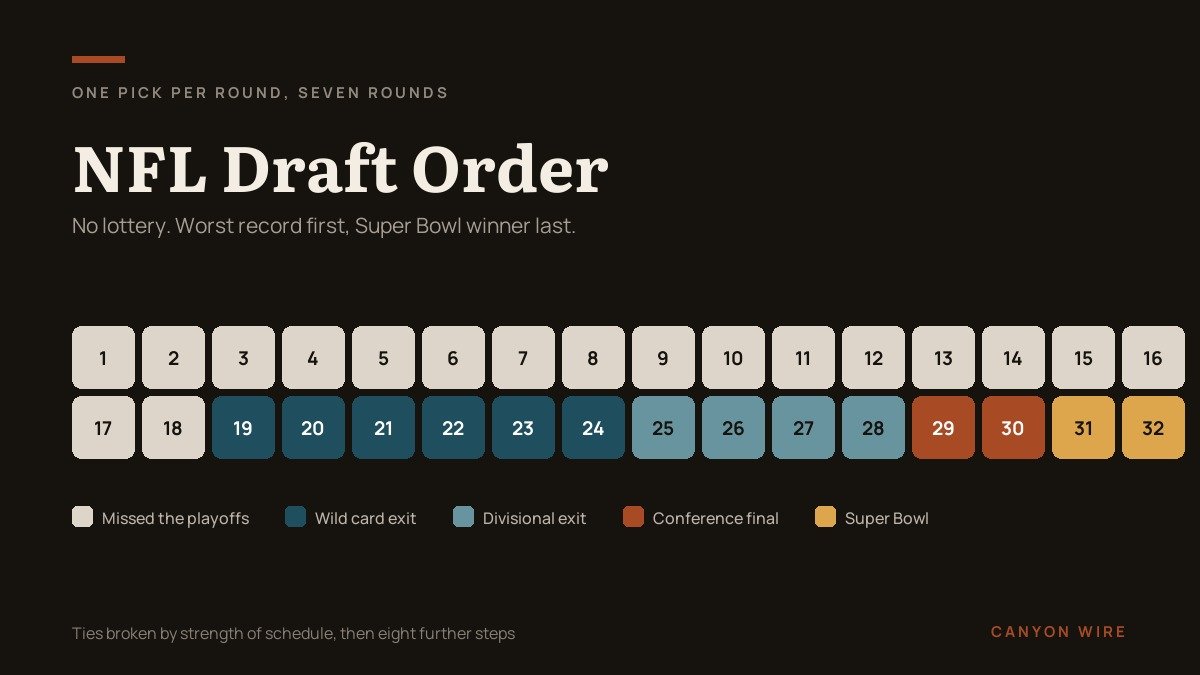
The NFL draft order is the least random allocation system in major American sport. There is no lottery and no weighted ping pong balls. Each of the seven rounds starts with the team that finished with the worst record and ends with the Super Bowl champion, and every slot in between is filled by a rule rather than a draw.
The part most people get wrong is the middle. Teams are not simply ranked by record from 1 to 32: the 18 clubs that missed the playoffs are sorted one way and the 14 that reached them are sorted another, by how far they went rather than how good their season was. Here is the full method, the nine step tiebreaker, and where the extra picks come from.
| Picks | Who gets them | Sorted by |
|---|---|---|
| 1 to 18 | Teams that missed the playoffs | Reverse order of regular season record |
| 19 to 24 | Wild card round losers | Reverse order of regular season record |
| 25 to 28 | Divisional round losers | Reverse order of regular season record |
| 29 and 30 | Conference championship losers | Reverse order of regular season record |
| 31 | Super Bowl runner up | Fixed |
| 32 | Super Bowl champion | Fixed |
How the NFL Draft Order Is Set, Pick by Pick
Every club receives one pick in each of the seven rounds, and the sequence repeats identically from round to round unless trades move it. The league’s own draft rules describe the order as the reverse of the previous season’s finish, which works cleanly for the teams that missed the postseason and needs a second system for the ones that did not.
For playoff teams, the question is not how many games they won but how long they survived. A club knocked out in the wild card round picks ahead of one that reached the divisional round even if it had the better regular season. Within each of those groups, reverse order of record applies again as the internal sort.
The result is that losing a playoff game early is worth a better pick than a strong regular season, and the two teams in the Super Bowl take the last two slots regardless of anything else. That pairing of 31 and 32 is the only part of the order published each spring that is fixed before the regular season even ends.
Because the sequence repeats, a slot is worth more than one player. The club holding the first pick also holds the 33rd, the 65th and so on down the draft, which is why a bad season compounds into an advantage across all seven rounds rather than just the opening night.
Tiebreakers: Strength of Schedule, Then Eight More Steps
Identical records are common, so the league runs a long tiebreaker. The first step is strength of schedule, meaning the aggregate winning percentage of a team’s opponents, and the team that played the weaker schedule gets the higher pick. The logic is inverted from the playoff seeding everyone is used to: a soft schedule is rewarded here, not punished.
If strength of schedule is also level, divisional or conference tiebreakers apply. Where those do not resolve it, or the tied teams are in different conferences, the sequence runs:
- Head to head record, if applicable.
- Best won, lost and tied percentage in common games, with a minimum of four.
- Strength of victory across all games.
- Best combined ranking among all teams in points scored and points allowed.
- Best net points in all games.
- Best net touchdowns in all games.
- A coin toss.
Reaching the coin toss is rare but it does happen, and the toss settles the order of selection rather than being rerun each round. Teams that lose it simply pick one slot later in every round for the whole draft.
Compensatory Picks Add Up to 32 More Selections
Beyond the 224 regular selections, the league can award as many as 32 compensatory picks under the collective bargaining agreement. They go to clubs that lost more or better qualifying free agents than they signed, and they are placed at the end of rounds three through seven.
The mechanics are narrower than most people assume:
- Net loss, not gross. The value of the compensatory free agents each team gained and lost is totalled, and picks are awarded equal to the net loss.
- A hard cap. No club may receive more than four compensatory picks in a single year.
- Rounds three to seven only. There is no compensatory pick in the first or second round, so losing a star in free agency never returns a premium selection.
A separate category rewards clubs for losing staff rather than players. When a female employee or an employee of colour is hired away as a head coach or primary football executive, the former club receives a third round selection in each of the next two drafts, provided that person had been employed there for at least two full seasons. If two or more qualifying employees leave in the same hiring year, the award runs for three drafts instead.
The Clock: Eight Minutes, Then Seven, Then Five
The draft runs over three days. Only the first round takes place on Thursday, starting at 8 p.m. Eastern, with the second and third rounds on Friday and rounds four to seven on Saturday.
- Round 1: eight minutes per pick.
- Round 2: seven minutes.
- Rounds 3 to 6: five minutes, including compensatory picks.
- Round 7: four minutes.
Letting the clock expire is not a forfeit. A team that runs out of time can still make its selection afterwards, but the next club is free to pick immediately, so the penalty is losing the player rather than losing the pick. Selections are submitted electronically and checked for eligibility by league staff before the commissioner announces them.
Trading Picks and Why the Order Rarely Survives Intact
Once slots are assigned, each one is an asset. Clubs may negotiate trades at any time before and during the draft, swapping picks in the current or future drafts, or trading players whose rights they hold. During the draft both clubs have to telephone the NFL Head Table and relay matching trade information before it is approved and announced.
This is the structural difference between building a roster in the NFL and in football elsewhere. An NFL club acquires young talent through an allocation it cannot buy its way up without paying in picks, while a European club with money signs whoever is available inside a transfer window. One system distributes talent towards weak teams by design; the other concentrates it wherever the revenue is.
Who Is Eligible to Be Drafted
A player must have been out of high school for at least three years and must have used up his college eligibility before the start of the next college football season. That three year rule is why there is no equivalent of signing a 17 year old, and why the pipeline runs through college football rather than an academy system.
Underclassmen and players who graduated with eligibility remaining may apply to enter early, with a deadline of seven days after the NCAA National Championship Game. League staff verify the college background of roughly 3,000 prospects a year, work with NCAA compliance departments to confirm it, and check all-star game rosters to make sure only eligible players appear.
The seven round structure is itself a modern compromise. Earlier drafts ran to as many as 30 rounds, which is how players who became all time greats were taken in the 14th and 17th. The current format is short enough that the difference between a late pick and an undrafted free agent is now mostly a matter of which club wanted to use a slot rather than a bonus. Those slots sit on a field whose every measurement is fixed too, as our guide to football field dimensions sets out.
Frequently Asked Questions
Who gets the first pick in the NFL draft?
The team with the worst record from the previous regular season, as long as it missed the playoffs. There is no draft lottery in the NFL, so the worst record guarantees the first selection in every round unless the pick has been traded.
How is a tie in the NFL draft order broken?
Strength of schedule first, with the weaker schedule earning the higher pick. If that is level, division or conference tiebreakers apply, then head to head, common games, strength of victory, combined points ranking, net points, net touchdowns and finally a coin toss.
Each step only matters if the one before it fails to separate the teams, so most ties are settled by the first or second criterion.
How many rounds are in the NFL draft?
Seven, with each of the 32 clubs holding one pick per round for 224 selections, plus as many as 32 compensatory picks at the end of rounds three through seven.
Where does the Super Bowl winner pick?
Last, at 32, in every round. The losing Super Bowl team picks 31st. Those two positions are the only ones in the order decided by a single game rather than by regular season record.