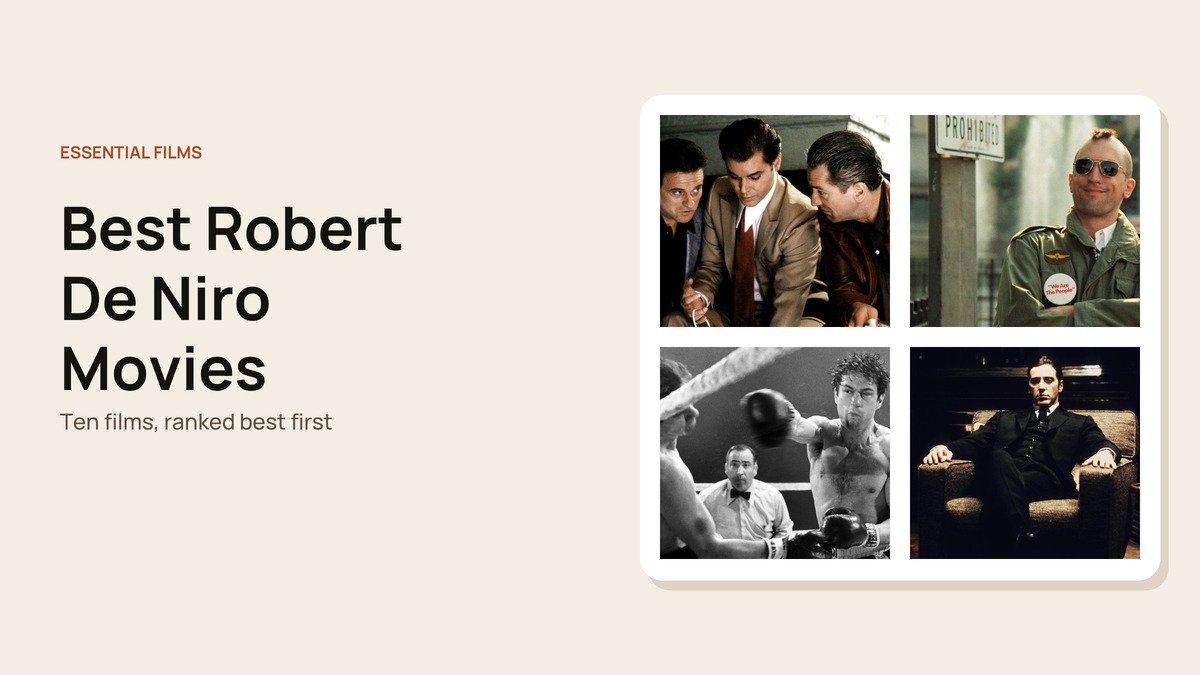
The best Robert De Niro movies span more than half a century, from the street-level crime dramas he made with Martin Scorsese in the 1970s to comedies, family sagas and late-career epics. De Niro built his name on total immersion, disappearing into gangsters, boxers and loners, and then proved just as sharp in comedy. His record includes two Academy Awards and a long run of nominations, but the truer measure is how many of his characters have become shorthand for an entire type of screen performance.
Each film earns its place on the strength of what De Niro does in it, then on how well the film holds up around him. Some of the choices are lead roles that carry an entire picture; others are supporting parts where he steals scenes from the edges. The spread runs from Coppola and Leone to Tarantino and David O. Russell, though Scorsese, his most important collaborator, inevitably claims the largest share.
Best Robert De Niro Movies Compared: Year, Role and Director
| # | Movie | Year | Role | Director |
|---|---|---|---|---|
| 1 | GoodFellas | 1990 | James Conway | Martin Scorsese |
| 2 | Taxi Driver | 1976 | Travis Bickle | Martin Scorsese |
| 3 | Raging Bull | 1980 | Jake LaMotta | Martin Scorsese |
| 4 | The Godfather Part II | 1974 | Vito Corleone | Francis Ford Coppola |
| 5 | The Irishman | 2019 | Frank Sheeran | Martin Scorsese |
| 6 | Once Upon a Time in America | 1984 | Noodles | Sergio Leone |
| 7 | Cape Fear | 1991 | Max Cady | Martin Scorsese |
| 8 | Silver Linings Playbook | 2012 | Pat Solatano Sr. | David O. Russell |
| 9 | Meet the Parents | 2000 | Jack Byrnes | Jay Roach |
| 10 | Jackie Brown | 1997 | Louis Gara | Quentin Tarantino |
1. GoodFellas (1990): The Gangster Gold Standard

GoodFellas, Martin Scorsese's portrait of three decades in the New York mob, casts De Niro as Jimmy Conway, the smooth, generous hijacker who becomes a mentor to Ray Liotta's Henry Hill. Jimmy loves stealing for its own sake, tips doormen with hundred-dollar bills and treats the airport cargo trade as his personal supermarket. Joe Pesci plays the hair-trigger Tommy DeVito, Paul Sorvino plays the soft-spoken boss Paul Cicero, and Lorraine Bracco plays Karen, the woman Henry marries.
De Niro never raises his voice for long, which is exactly why Jimmy is so frightening. After the great airline heist he starts eliminating anyone who might talk, and the film tracks his paranoia through glances, pauses and a terrible friendliness. His chemistry with Liotta and Pesci makes the crew feel like a real family, which only sharpens the betrayals. It tops the ranking for a performance with no wasted gesture, in a film that has shaped the gangster genre ever since.
2. Taxi Driver (1976): The Icon

Scorsese's Taxi Driver introduces Travis Bickle, an insomniac Marine veteran who drives a taxi through Manhattan's night streets and grows disgusted by what he sees. Cybill Shepherd plays Betsy, a political campaign volunteer Travis briefly dates, and Jodie Foster plays Iris, a child prostitute he becomes determined to save. Harvey Keitel plays her pimp, Sport, and Peter Boyle plays Wizard, a veteran cabbie who cannot offer Travis the guidance he needs. Travis's loneliness slowly hardens into a violent sense of mission.
De Niro's Travis is one of the most influential characters in film history, a man who keeps a diary, trains his body obsessively and arms himself while insisting he is the sane one. The performance balances pathos and threat so precisely that viewers are never sure whether to pity or fear him. It earned a Best Actor nomination at the 1977 Academy Awards. Second place reflects a role that made De Niro a defining figure of 1970s American cinema, and its power has not faded.
3. Raging Bull (1980): The Oscar Win

Scorsese filmed Raging Bull in black and white, following the middleweight Jake LaMotta through his years in the ring and the long, lonely aftermath. Joe Pesci plays his brother Joey, who manages his career and absorbs much of his rage, and Cathy Moriarty plays Vickie, Jake's second wife, whom he accuses of infidelity again and again. Frank Vincent's Salvy and Nicholas Colasanto's Tommy Como represent the mob interests that want Jake to throw a fight before he can get his title chance.
The fight sequences are visceral, but De Niro's real achievement is the way he exposes LaMotta's insecurity: every blow he aims at his family comes from fear. The film never asks the audience to like Jake, only to understand him, and De Niro commits completely, including a startling physical change for the later scenes. He won the Academy Award for Best Actor at the 1981 ceremony, along with the Golden Globe for Best Actor in a Motion Picture Drama. It ranks third by the narrowest of margins.
4. The Godfather Part II (1974): Young Vito

The Godfather Part II, directed by Francis Ford Coppola, cuts between Michael Corleone's reign in the 1950s, with Al Pacino, Robert Duvall and Diane Keaton, and the story of his father's youth. De Niro plays that father, Vito Corleone, as a quiet immigrant from Sicily who works in a grocery, starts a family in New York's Little Italy and gradually becomes the protector of his neighbors. John Cazale also appears as Fredo, whose fate in Michael's half of the story echoes the family's moral decay.
The challenge was enormous: De Niro had to suggest the same man Marlon Brando had already played in The Godfather, without imitation. He does it through economy, speaking mostly Sicilian and letting watchful silence carry the role, so that Vito's eventual ruthlessness seems like a logical response to his world. He won Best Supporting Actor at the 1975 Academy Awards. Fourth place reflects a performance that, with a smaller share of screen time, holds its own inside one of the great sequels.
5. The Irishman (2019): The Long Goodbye

Scorsese's The Irishman is narrated by Frank Sheeran, an elderly man in a nursing home looking back on his life as a World War II veteran, truck driver, mob hitman and union man. De Niro plays Frank across decades as he falls in with the Pennsylvania crime boss Russell Bufalino, played by Joe Pesci, and becomes a trusted friend and bodyguard to the Teamsters leader Jimmy Hoffa, played by Al Pacino. Harvey Keitel appears as Angelo Bruno and Ray Romano as Bill Bufalino, Russell's lawyer cousin.
Frank is a man who does what he is told, and De Niro plays that passivity with devastating effect: the violence is routine, the loyalty is real, and the cost only becomes clear when he is old and alone. The final hour, as Frank tries and fails to reconnect with his estranged daughter Peggy, contains some of the most moving work of his career. It ranks fifth as a late masterpiece that reflects on every gangster he played before it.
6. Once Upon a Time in America (1984): Leone's Epic

Sergio Leone's Once Upon a Time in America follows David Aaronson, known as Noodles, from a childhood in the Jewish neighborhoods of New York's Lower East Side through Prohibition-era bootlegging and into old age. De Niro plays the adult Noodles, a gangster who returns to New York in 1968 after decades away, haunted by guilt over the deaths of his closest friends. James Woods plays Max, his ambitious partner, Elizabeth McGovern plays Deborah, the woman Noodles loves, and Joe Pesci and Burt Young play gangsters in their orbit.
Noodles is a sad, sometimes repellent figure, and De Niro plays him with a heavy-lidded weariness that suits the film's dreamlike structure, which jumps between eras the way memory does. The performance includes some genuinely ugly moments, and De Niro refuses to soften them. Sixth place reflects an ambitious, divisive role in a film that is long, melancholy and unforgettable, a meeting of an actor and a director who each thought in grand terms.
7. Cape Fear (1991): Pure Menace
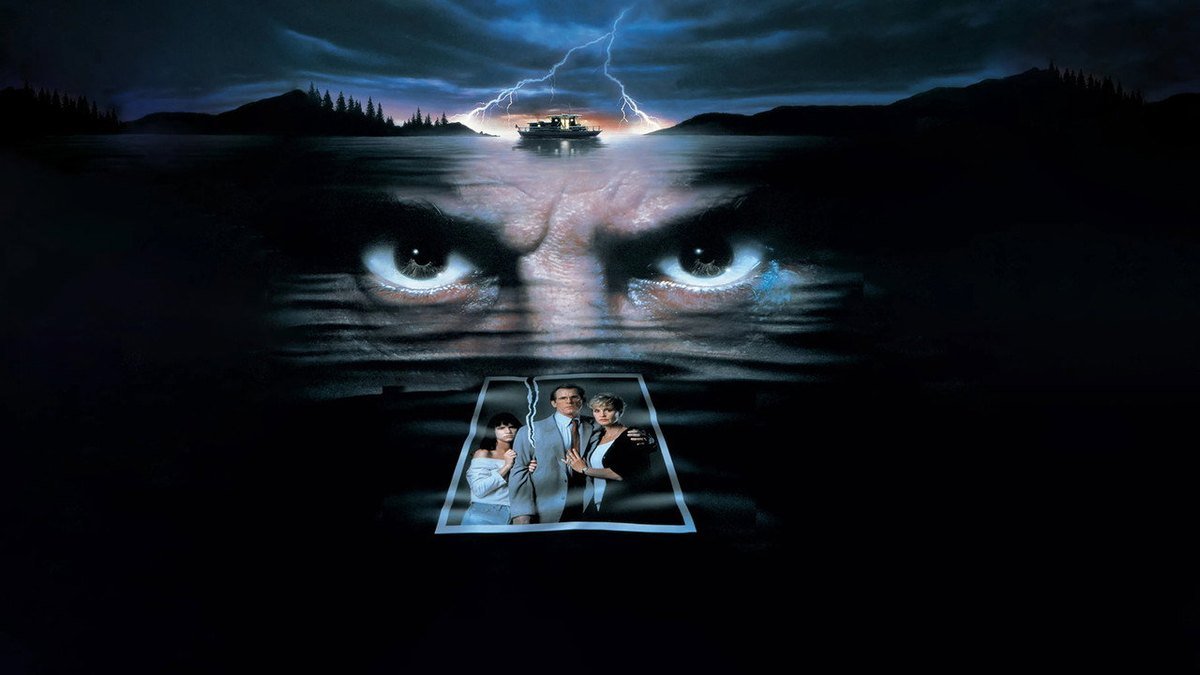
Scorsese's Cape Fear casts De Niro as Max Cady, a convicted rapist released after fourteen years who targets Sam Bowden, the public defender who buried evidence that might have helped Cady at his trial. Nick Nolte plays Sam, Jessica Lange plays his wife Leigh, and Juliette Lewis plays their teenage daughter Danielle, whom Cady manipulates with unnerving ease. Joe Don Baker plays Claude Kersek, the private investigator Sam hires when the law cannot stop Cady.
Tattooed, muscled and grinning, Cady is De Niro's most theatrical villain, and he plays him with outrageous confidence, from the drawling Southern accent to the notorious scene with Lewis in the school theater. The film remakes a 1962 thriller, and De Niro makes the part entirely his own. He was nominated for Best Actor at the 1992 Academy Awards. It ranks seventh as a showcase for his gift for menace, and it pairs well with courtroom dramas about lawyers whose past decisions come back to haunt them.
8. Silver Linings Playbook (2012): The Comeback

David O. Russell's Silver Linings Playbook centers on Pat Solatano Jr., played by Bradley Cooper, who moves back in with his parents in suburban Philadelphia after a stay in a psychiatric hospital. De Niro plays his father, Pat Sr., a superstitious Eagles fanatic who has turned to bookmaking while dreaming of opening a restaurant. Jennifer Lawrence plays Tiffany, a young widow who strikes an unusual deal with Pat Jr., Jacki Weaver plays his mother Dolores, and Anupam Kher plays Dr. Patel, Pat's therapist.
Pat Sr. has his own obsessive tendencies, and De Niro plays them with warmth and humor, revealing where his son's struggles might come from. His tearful attempt to reconnect with Pat Jr. is one of the film's most affecting scenes. He received a Best Supporting Actor nomination at the 2013 Academy Awards, his first nomination in more than twenty years. Eighth place reflects a reminder of how good he can be in an ensemble, in a film that belongs with the best modern romantic comedies.
9. Meet the Parents (2000): Comic Timing

Jay Roach's Meet the Parents follows Greg Focker, a male nurse played by Ben Stiller, who travels to his girlfriend Pam's family home before proposing. De Niro plays her father, Jack Byrnes, a former CIA operative who is protective, suspicious and determined to find something wrong with Greg. Teri Polo plays Pam, Blythe Danner plays her mother Dina, and Nicole DeHuff plays Pam's sister Debbie, whose wedding provides the backdrop for a weekend of escalating disasters.
The joke is that De Niro plays Jack with the same stony intensity he brought to his gangsters, and it makes every scene funnier. A lie detector test, a missing cat and a catastrophic game of pool volleyball all depend on his deadpan glare. Ninth place reflects a smart reinvention: De Niro playing on his own screen image to become a comic star in his late fifties, a turn that led to the sequels Meet the Fockers and Little Fockers.
10. Jackie Brown (1997): Small Role, Big Impact
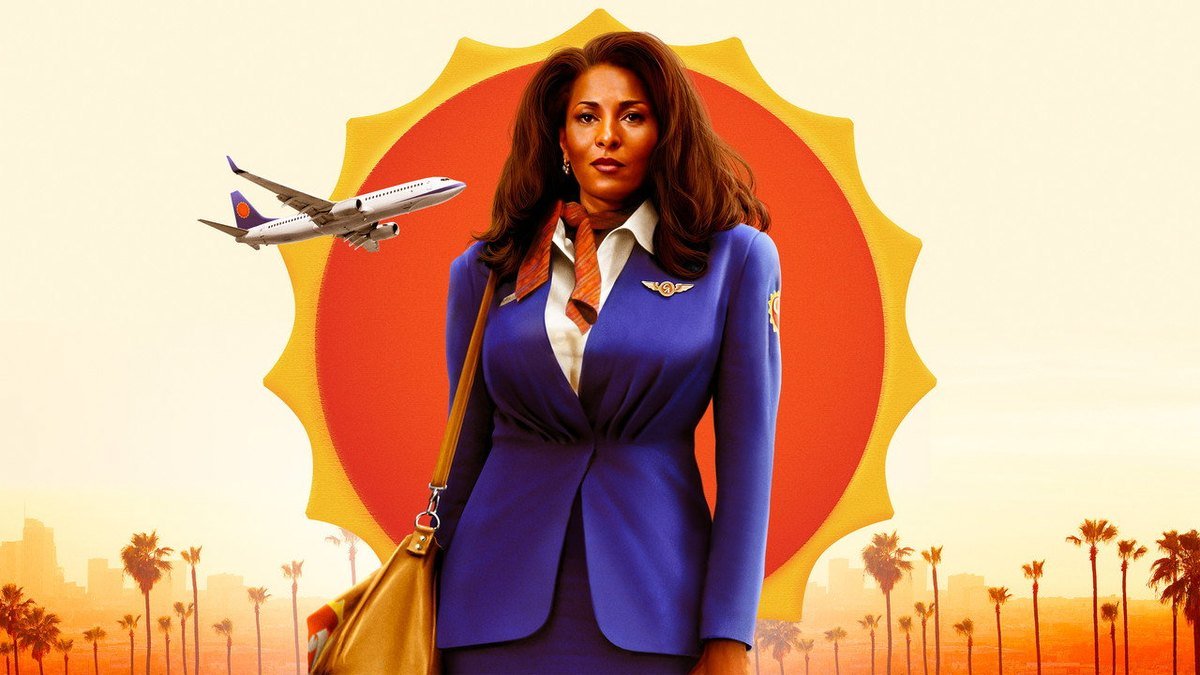
Quentin Tarantino's Jackie Brown stars Pam Grier as a flight attendant caught smuggling cash for Ordell Robbie, an arms dealer played by Samuel L. Jackson. De Niro plays Louis Gara, Ordell's old friend just out of prison, a dazed, mumbling ex-con who spends much of his time on Ordell's couch beside Melanie, a stoned beach girl played by Bridget Fonda. Michael Keaton plays Ray Nicolette, the ATF agent pressuring Jackie to help catch Ordell.
It is a small, sly supporting part, and De Niro plays against type by making Louis passive and barely present, until a sudden burst of temper in a shopping mall parking lot changes everything. The restraint is both the joke and the threat. Tenth place reflects a performance that shows his willingness to serve a director's vision, even in a role with few lines, and his scenes with Fonda are among the funniest in a very funny film.
Robert De Niro's Oscar History, Win by Win
De Niro's Academy Award record stretches across five decades. These are his wins and nominations:
- The Godfather Part II: won Best Supporting Actor at the 1975 ceremony.
- Taxi Driver: nominated for Best Actor at the 1977 ceremony.
- The Deer Hunter: nominated for Best Actor at the 1979 ceremony.
- Raging Bull: won Best Actor at the 1981 ceremony.
- Awakenings: nominated for Best Actor at the 1991 ceremony.
- Cape Fear: nominated for Best Actor at the 1992 ceremony.
- Silver Linings Playbook: nominated for Best Supporting Actor at the 2013 ceremony.
- Killers of the Flower Moon: nominated for Best Supporting Actor at the 2024 ceremony.
The pattern is telling. His recognition clusters in the 1970s, when he was reinventing screen acting with Scorsese and Coppola, then returns in waves as he moved into character parts. The later nominations came for supporting roles as fathers and patriarchs, a sign of how gracefully his screen presence has aged.
Where to Start With Robert De Niro
- For the essential crime trilogy: Taxi Driver, GoodFellas and The Irishman, which together trace his work with Scorsese from youth to old age.
- For a single defining performance: Raging Bull, the role that won him Best Actor.
- For laughs: Meet the Parents, then Analyze This (1999), in which he plays a mob boss in therapy.
- For something overlooked: Once Upon a Time in America, a slow, haunting epic that rewards patience.
Frequently Asked Questions
What is the best Robert De Niro movie?
GoodFellas (1990) takes first place for his performance as Jimmy Conway, just ahead of Taxi Driver and Raging Bull.
Which film won Robert De Niro the Oscar for Best Actor?
Raging Bull, at the 1981 Academy Awards. He had already won Best Supporting Actor for The Godfather Part II at the 1975 ceremony.
Who does Robert De Niro play in The Irishman?
Frank Sheeran, a truck driver turned mob hitman who becomes close to the Teamsters leader Jimmy Hoffa, played by Al Pacino.
What are Robert De Niro's best comedies?
Meet the Parents (2000) is the standout, with Midnight Run (1988) and Analyze This (1999) close behind.