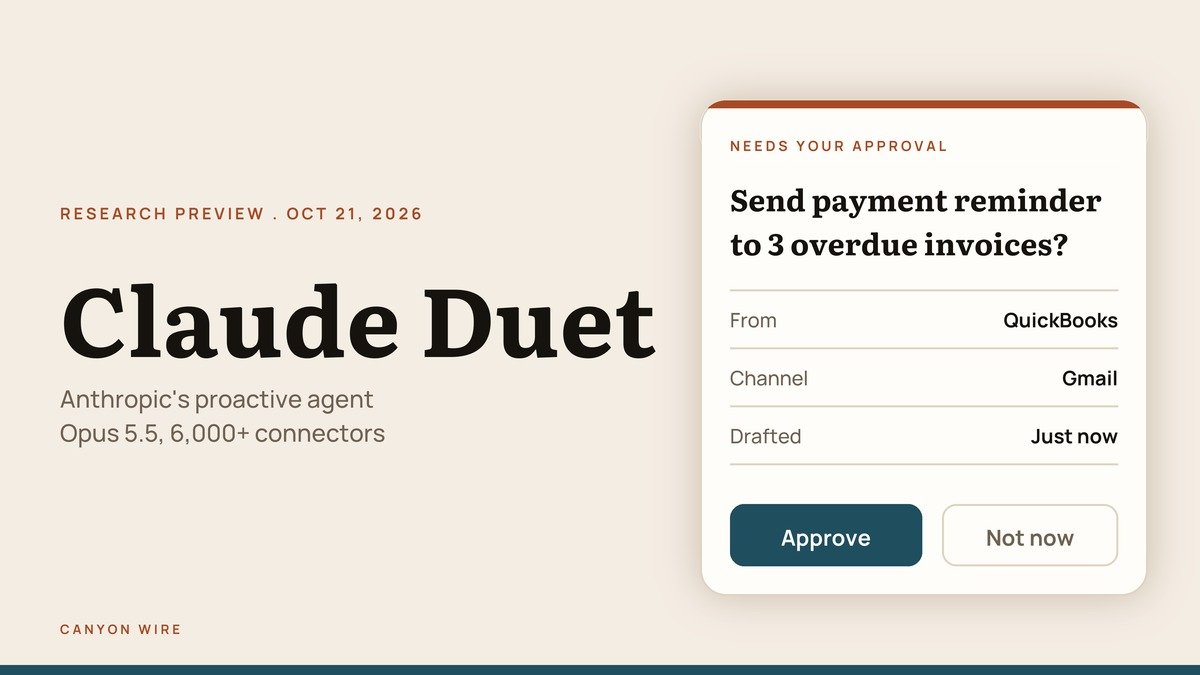
The interesting thing about Claude Duet is not the model behind it. It is the inversion. Anthropic opened the research preview on October 21, 2026, and the product it shipped drops the premise that an assistant sits still until you type at it. This one watches your accounts, forms a view about what matters, and interrupts you when it decides something cannot wait.
That changes what the thing has to be good at. A chat window only has to answer well. An agent that files payroll and sends contract reminders has to be right about timing, about tone, and about when to stop and ask. Here is how the app is built, what it plugs into, and what Anthropic admits it has not solved.
Claude Duet in Plain Terms
It is a proactive software agent that runs on Claude Opus 5.5, carries over the memory, skills and connected apps from your existing Claude account, and works on a cloud virtual machine with its own browser so your devices do not need to stay awake.
Anthropic aimed it at professionals and small business owners, not at consumers looking for errand help. The launch material is thick with invoices, payroll and signatures, and thin on restaurant bookings, which matches what the company says about the product’s strengths.
How It Differs From the Claude App
Both products share an account, a model family and a memory. The split is in who initiates and what survives you closing the window.
| # | Dimension | Claude app | The agent app |
|---|---|---|---|
| 1 | Who starts | You open a chat | It messages you, starting with a morning brief |
| 2 | When work happens | While the session is open | On its own virtual machine, after you close the app |
| 3 | Shape of a reply | A conversation you read | A finished doc, sheet, deck or dashboard |
| 4 | Acting on your accounts | You act on what it suggests | It acts, pausing for approval on sensitive steps |
| 5 | Where it lives | The Claude app and web | A separate iOS and Android app, plus claude.ai |
| 6 | Input | Typed prompts | Text or voice in one ongoing thread |
The single thread matters more than it sounds. A quick question and a project spanning a week start in the same conversation, so the agent accumulates context on your work instead of beginning cold each session. That is the piece that separates it from a scheduled automation, which knows only the trigger it fired on.
For developers already running Claude Code plugins, the mental model carries over: a long-lived agent with tool access and an approval gate, pointed at business accounts instead of a repository.
Running a Business Through Connectors
Reach comes from the Claude Marketplace, which holds more than 6,000 connectors and plugins built on the same tool-calling foundations as the Model Context Protocol ecosystem. The agent decides which of them a task needs rather than making you wire a flow.

Anthropic’s launch examples are concrete. It surfaces Gmail and Slack messages you missed and drafts replies. It checks Intuit QuickBooks or Stripe for unpaid invoices and writes the reminders. It prepares and runs payroll in Gusto with hours, bonuses and reimbursements already filled in. It drafts a job posting and, after your edit and approval, puts it on LinkedIn. It prepares agreements and routes them through Docusign for signature.
Sales and marketing work sits in the same set. Follow-up emails come out of the contact and deal history in HubSpot, a product launch becomes a social campaign in Canva, and a Shopify storefront can be set up, designed and managed through it, with a visual editor that previews the storefront before anything goes live listed as coming later.
Buying Things With a Virtual Card
Purchasing runs through Link, Stripe’s digital wallet. The agent confirms the item with you, Link asks you to approve the spend, and the charge goes out on a virtual card, so your real card number is never handed to the merchant or to the agent. Shop Pay covers checkout at Shopify stores.
Two lines bound this. A few actions are refused regardless of approval, trading securities and moving money between accounts among them, which keeps the agent off brokerage and transfer rails entirely. And signing in to sites with logins stored in 1Password is marked as a future capability that will need your permission, not something live today.
The Security Design Underneath
Credentials are handled the way Anthropic handles them for its managed agents, so the system never directly sees your passwords or sign-in tokens. Approvals, logins and safety checks execute inside the agent’s own cloud environment rather than passing through the model context.

Outgoing actions pass the same auto mode classifier that protects Claude and Claude Code from taking steps you did not request. Prompt injection defences come from Anthropic’s browser-use research, which matters because an agent reading your inbox is reading text written by strangers who may be trying to instruct it.
A new classifier and safety system prompt inspect every message for information leaks. Credit card numbers and government identification are refused by default. Health and personal finance details move only on an explicit instruction from you. Internal red teams and an external penetration testing firm probed the infrastructure before launch, and it sits under the public bug bounty programme.
Plans, Limits and the Waitlist
The research preview is open by waitlist to Claude Pro and Max subscribers in the United States. Team and Enterprise plans are excluded for now. Pro runs $17 a month on the annual plan, billed as $200 up front, or $20 monthly; Max starts at $100 a month.
There is no extra charge, which is the appealing part, and no extra allowance either, which is the catch. The agent shares your plan’s usage limits with the rest of Claude and consumes them differently from a normal conversation. Background checks count. Larger jobs such as a financial model or a deck take more model turns and more background work.
That economics explains the cadence. The agent polls connected accounts every few hours rather than continuously, because constant checking would drain a plan far faster. You can set which topics it raises and how often. Full detail sits on the Claude Duet product page.
What Early Testers Did With It
Anthropic ran the agent past small business owners before the preview opened. Jess Provencher, a broker and owner at Pro Homes, takes a rundown each morning; one day it flagged unprompted that a property showing sat on her calendar for the wrong day. Amin Ebrahimi, who owns Shahs of Kabob in South Florida with roughly 110 employees, worked through invoices store by store and used it for accounting, customer support and marketing.
Brand strategist Mya Dalton had the agent spot a client call on her calendar, prepare a brief for it, and then point out that the call fell immediately before her flight and offer to move it. Inside the company, Claude Code lead Boris Cherny talks through a mental to-do list with it on walks, and the Duet team uses it to schedule user interviews, build prototypes and ship code for the product itself.
Control over access stays granular. Any app you have connected can be disconnected at any point, and before the agent sends a message, makes a payment, signs a document or deletes anything, it shows you the exact action it intends to take and holds until you approve it. Reading, drafting and preparing work are the only things it does without checking.
Where the Preview Falls Short
Anthropic published the gaps rather than waiting to be told. The agent may misread a thread or misjudge urgency. Anything arriving between two check-ins can be missed. Personal errands such as booking tickets are weaker than work tasks because the core was built around business workflows.
It also cannot show you its browser while it works, so the process is opaque even though the result is reviewable, and it sits in an app separate from the main Claude app with no announced plan for merging them. Anyone comparing it against ChatGPT alternatives or standalone AI video tools should weigh that a preview changes shape without warning.
Frequently Asked Questions
What does Claude Duet cost on top of my plan?
Nothing extra. It is included with Claude Pro and Max during the research preview and draws on the usage limits those plans already give you, rather than carrying its own price or its own allowance.
Does it work on a laptop?
Yes, through the web at claude.ai. The dedicated apps are iOS and Android only, and there is no separate desktop application for it at launch.
Can it spend my money without permission?
No. Purchases go through Stripe’s Link wallet, which asks you to approve each spend, and payment leaves on a virtual card. Trading securities and moving money between accounts are blocked even if you approve them.
How often does it check my accounts?
Every few hours rather than continuously, a pace set to avoid burning through plan limits. You can configure which subjects it should raise with you and how frequently it reaches out.