Every consumer tool in this category sells you a monthly plan whether you make four images or four hundred. The best ai image generators for anyone with uneven output work the other way: you pay per picture, or you run the model on your own hardware and pay nothing per picture at all. The cheapest option below works out at three tenths of a cent an image.
This is also the honest answer to the question people usually mean when they ask for a generator with no limits. Open-weight models from Black Forest Labs and Stability can be downloaded and run in your own environment, and Stability draws the line at a published revenue figure rather than a feature gate. All pricing is current as of October 2026.
| # | Platform | How you pay | Cheapest image price | Self-host? | Best for |
|---|---|---|---|---|---|
| 1 | Black Forest Labs | Per image | $0.041 at 768 x 768 | Yes, open weights | FLUX direct from the source |
| 2 | Stability AI | Licence, not usage | Free under the revenue cap | Yes, that is the point | Running models yourself |
| 3 | Replicate | Per image or per second | $0.003 with FLUX schnell | No, hosted | The lowest cost per picture |
| 4 | fal.ai | Per second of GPU time | From $1.99 an hour | Dedicated deployments | Running your own app |
| 5 | Together AI | Per image | $0.03 with Wan 2.6 | Dedicated endpoints | Comparing rival models |
1. Black Forest Labs: FLUX 3 Straight From the People Who Built It

FLUX 3 Image · $0.041 at 768 x 768, $0.048 at 1K, $0.07 at 1.5K, $0.10 at 2K, $0.607 at 4K · no subscription, no seat fees · open-weight licensing available
FLUX is the model most of the other platforms on this page are reselling, and buying it directly removes a markup. Pricing is per image and scales with the resolution tier you ask for: 4.1 cents at 768 by 768, 4.8 cents at 1K, 7 cents at 1.5K, 10 cents at 2K and 60.7 cents at 4K. There are no subscriptions and no seat fees.
Two details are worth more than the headline rate. Reference images are included at no extra charge regardless of how many you supply, which matters if you work by feeding the model examples rather than by writing longer prompts. And rejected requests, failed generations and outputs withheld by moderation are not charged, which is unusual and quietly generous. The current line runs FLUX 3 for image and video alongside the older FLUX.2 variants and FLUX.1.
2. Stability AI: Free Until Your Company Makes a Million

Community licence free for anyone under $1M in annual revenue · covers Stable Diffusion 3.5 Suite, SDXL Turbo, Stable Audio 3.0 and Stable Fast 3D · Enterprise licence above that
Stability prices by who you are rather than by what you generate, and it publishes the threshold. The Community licence is free for researchers, developers, small businesses and creators with less than $1 million in annual revenue, and it covers the Stable Diffusion 3.5 Suite, SDXL Turbo, Stable Audio 3.0 and Stable Fast 3D.
Cross that revenue line and you need the Enterprise licence, which adds commercial use terms and implementation support at custom pricing, with optional custom model training on top. For most individuals, freelancers and early-stage companies this is the closest thing in the category to genuinely unrestricted use: you deploy the models in your own environment, with what Stability describes as full control over your data, and you generate as much as your hardware allows.
3. Replicate: Three Tenths of a Cent per Image
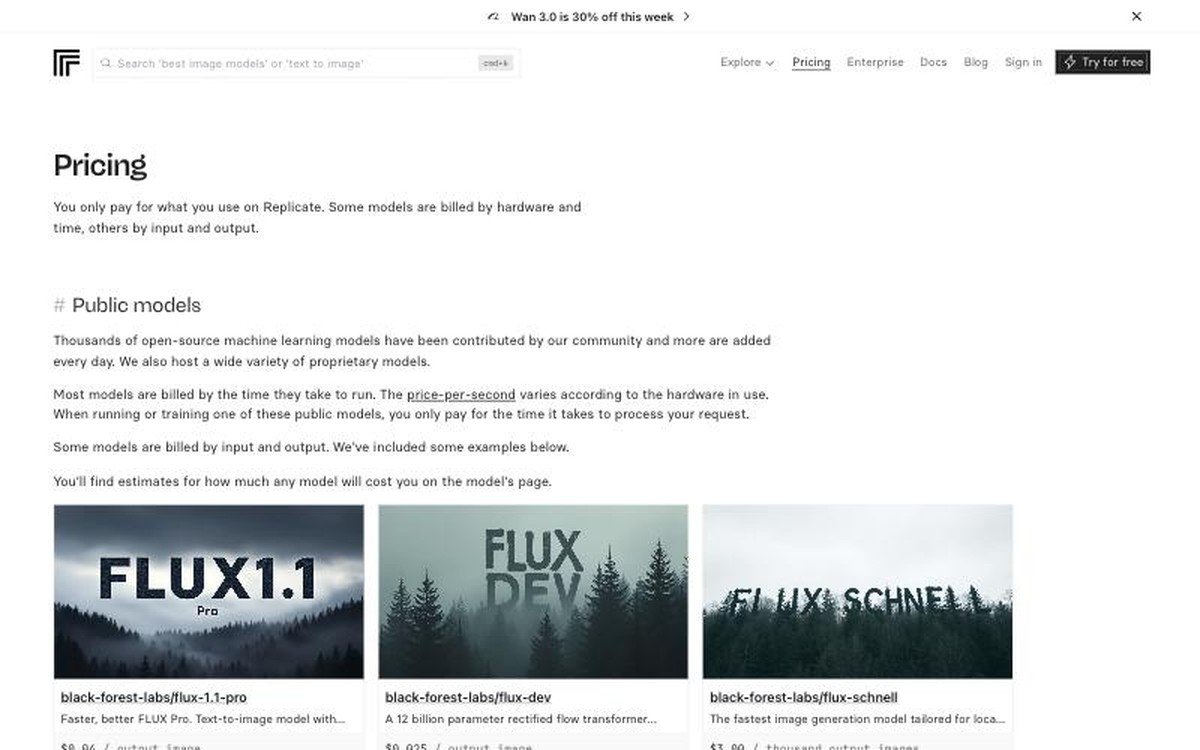
FLUX schnell $3.00 per thousand images · FLUX dev $0.025 per image · FLUX 1.1 pro $0.04 · most models billed by run time, price per second varying with the hardware
Replicate is where the per-image economics get genuinely cheap. Its published rates put FLUX schnell at $3.00 per thousand output images, which is three tenths of a cent each, against 2.5 cents for FLUX dev and 4 cents for FLUX 1.1 pro. For bulk work such as product variations or thumbnail testing, that gap decides the project.
The platform hosts thousands of community-contributed open-source models alongside proprietary ones, and the billing model varies by model: most are charged by the time they take to run, with the per-second rate set by the hardware, while others are billed per input and output. Each model’s own page carries a cost estimate, which is the detail that makes budgeting possible before you commit.
4. fal.ai: Rent the GPU Rather Than the Model

H100 80GB from $4.50 an hour list, as low as $2.49 · RTX PRO 6000 from $4.00, as low as $1.99 · B200 192GB from $7.99 · model APIs billed per unit alongside the raw compute
fal sells two things from one platform: model APIs priced per unit, and the serverless GPU fleet underneath them. The second is what makes it interesting for anyone running their own fine-tune or a model nobody hosts, because you deploy your app on the same inference platform the hosted APIs use.
Published hourly rates run from $4.50 for an H100 with 80GB, falling as low as $2.49, through $6.00 for an H200, $7.99 for a B200 and $12.99 for a B300 with 288GB, each with a lower committed rate. An RTX PRO 6000 with 96GB is the cheap entry at $4.00 list and $1.99 committed. Whether this beats per-image pricing is simple arithmetic: at roughly $2.50 an hour you need to be generating steadily for it to win against three tenths of a cent a picture.
5. Together AI: Price the Rival Models Against Each Other
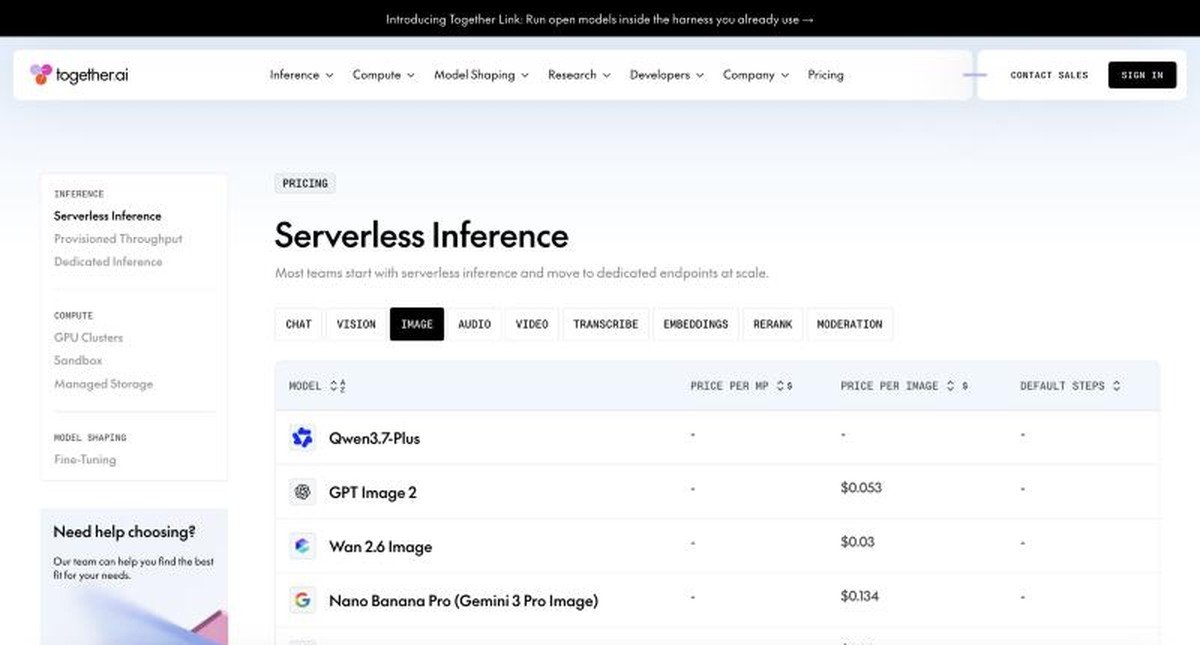
GPT Image 2 $0.053 per image · Nano Banana Pro $0.134 · Wan 2.6 Image $0.03 · one platform, one bill, with dedicated endpoints available at scale
The useful thing about Together is not that it is cheapest, because it is not. It is that the big proprietary models sit in one price list where you can compare them honestly. GPT Image 2 costs 5.3 cents an image, Nano Banana Pro costs 13.4 cents, and Wan 2.6 Image costs 3 cents, all on the same page under the same billing.
That answers a question the consumer subscriptions obscure completely. Inside a monthly plan you cannot tell whether the model you are using is four times the cost of the one next to it, because everything is denominated in that vendor’s own credits. Here the arithmetic is in dollars. Together positions serverless inference as the starting point and dedicated endpoints as the step up once volume justifies it, with GPU clusters and fine-tuning alongside.
Open Weights Are the Real Answer to “No Limits”
People searching for an image generator without restrictions usually mean one of two things: a tool that will not refuse their prompt, or a tool that does not meter them. The second is a solved problem, and the solution is open weights. Black Forest Labs offers open-weight licensing for FLUX, and Stability builds its whole business around letting you deploy models in your own environment.
Running a model yourself changes the economics rather than the content policy. You still pay for the hardware, whether that is your own GPU or rented time from a platform like fal, and you take on the setup. What you stop paying is a per-image fee, and what you gain is that your prompts and outputs never leave infrastructure you control, which is the part that matters for confidential or client-owned work.
- Open weights mean you can download and run the model, not that it has no safety training.
- Stability draws its free line at $1 million in annual revenue, published openly.
- Self-hosting shifts cost from per-image fees to hardware and engineering time.
- For occasional use, per-image pricing is almost always cheaper than renting a GPU.
Working Out Which Pricing Model Actually Costs Less
The three ways to pay here do not compare directly, so convert everything to cost per finished image before choosing. At Replicate’s FLUX schnell rate of $3.00 per thousand, a thousand images costs three dollars. The same thousand at Black Forest Labs’ 1K tier costs $48, and at Nano Banana Pro rates through Together it costs $134.
Renting a GPU flips the calculation above a certain volume. An H100 at around $2.49 an hour pays for itself against 13.4-cent images after roughly nineteen pictures an hour, and never pays for itself against three-tenths-of-a-cent ones. The question is therefore not which platform is cheapest but which model you need and how many pictures you make.
If your output is small and occasional, the consumer subscriptions covered in our AI video generator roundup follow the same logic, and a general assistant like the ones in our ChatGPT alternatives comparison may already include enough image generation for your needs.
What the Comparison Measures
All rates are list prices current as of October 2026. Prices published only in a local currency, or behind a region check, are left out rather than converted, and promotional discounts are excluded because they rotate.
No platform was ranked on image quality. The same FLUX model produces the same picture whether you call it at Black Forest Labs, Replicate or fal, so quality is a property of the model rather than of the shop you buy it from. The comparison is on price, licence terms and what you are permitted to do with the output, which is where these five genuinely differ. Design teams weighing the subscription route instead may find our design software comparison a better starting point.
How to Choose Between the Best AI Image Generators
If you generate in bulk and do not care which model, Replicate at three tenths of a cent an image with FLUX schnell is the cheapest honest answer on this page, by a factor of ten or more. If you specifically want FLUX at its best, buying directly from Black Forest Labs removes a layer of markup and gives you the current FLUX 3 line.
If the work is confidential or you expect heavy sustained volume, go to open weights. Stability’s Community licence costs nothing below $1 million in annual revenue and lets you run the models on your own hardware, and fal will rent you the GPU if you do not own one. Together is the one to use when you have not decided yet, because it is the only place you can price GPT Image 2, Nano Banana Pro and Wan against each other in plain dollars.
Frequently Asked Questions
What is the cheapest AI image generator?
Replicate running FLUX schnell, at $3.00 per thousand output images, or three tenths of a cent each. FLUX dev costs 2.5 cents and FLUX 1.1 pro 4 cents on the same platform, and buying FLUX 3 directly from Black Forest Labs starts at 4.1 cents.
Can you run an AI image generator on your own computer?
Yes, with open-weight models. Black Forest Labs offers open-weight licensing for FLUX, and Stability’s Community licence covers the Stable Diffusion 3.5 Suite and SDXL Turbo free of charge for anyone under $1 million in annual revenue.
Is pay-per-image cheaper than a monthly subscription?
For uneven or occasional output, almost always. A subscription charges the same whether you make four images or four hundred, while per-image pricing scales with use. Above steady high volume, renting a GPU by the hour becomes cheaper than either.
Does an open-weight model have no content restrictions?
No. Open weights mean the model can be downloaded and run in your own environment; they do not mean the model has no safety training, and the licence still governs what you may do with it. Stability and Black Forest Labs both publish licence terms that apply regardless of where the model runs.