Payment management software is sold under one name to two different buyers. One wants to stop chasing supplier invoices around an inbox. The other wants a customer to be able to pay at a checkout. The products that serve those jobs look similar in a search result and price themselves on opposite principles.
Tools that take money in charge almost nothing monthly and a few percent per transaction. Tools that send money out charge by the seat and only pennies to move a payment. Below are ten of them with the figures each vendor publishes, starting with acceptance and ending with payables.
How Payment Management Software Divides Up
Three categories hide under the term. Payment acceptance moves a customer card or bank debit through the networks and settles the proceeds. Accounts payable software captures a supplier invoice, routes it for approval and releases the money. Spend platforms do both and add corporate cards on top.
The cost structures follow from that. Acceptance is priced as a share of the money passing through, because the card networks take their cut the same way. Payables software has no percentage to take, so it charges a subscription and a few cents per transfer. Comparing a 2.9 percent rate with a $49 seat is comparing nothing.
Settlement speed is the third axis, and it is the one buyers underestimate. Paying a supplier by standard automated clearing house transfer is nearly free but takes days. Every platform here sells a faster lane at a premium, and those premiums vary far more than the base rates do.
Ten Payment Tools Compared on Price and Free Tier
Each row shows the job the vendor sells the product for, the cheapest way in, what a transaction costs and whether there is a tier that costs nothing.
| # | Tool | Best for | Starting price | Per transaction | Free tier |
|---|---|---|---|---|---|
| 1 | Stripe | Selling online with developers on staff | $0 / month | 2.9% + 30c online, 2.7% + 5c in person | Yes |
| 2 | Square | Selling across a counter | $0 / month per location | 2.6% + 15c tapped, 3.3% + 30c online | Yes |
| 3 | PayPal | Checkouts where buyers expect the button | $0 / month | 3.49% + $0.49 on PayPal Checkout | Yes |
| 4 | Helcim | Wanting the processor margin in writing | $0 / month | Interchange + 0.50% + 25c | Yes |
| 5 | Adyen | Enterprise volume on a known card mix | $0 / month | $0.13 + Interchange++ 0.60% on US cards | No |
| 6 | BILL | Payables and receivables in one place | $49 per user / month | ACH $0.59, mailed check $1.99, card 2.9% | No |
| 7 | Melio | Small businesses paying a few dozen suppliers | $0 (Go), then $25 / month | 5 free ACH a month on the free tier | Yes |
| 8 | Ramp | Cards and bill pay on one free plan | $0 per user / month | Free wires and same-day ACH through Bill Pay | Yes |
| 9 | Tipalti | Paying a global payee network | $99 / month (AP) | Per-invoice and per-payment fees on top | No |
| 10 | Stampli | Heavy invoice approval workflows | Quote only | Not published | No |
The Ten Tools in Detail
1. Stripe: Payment Management Software for Anyone Selling Online
Best for: Selling online with developers on staff. Starting price: $0 / month. Per transaction: 2.9% + 30c online, 2.7% + 5c in person.
Stripe is the reference point every other online rate gets measured against. There is no setup fee and no monthly charge, and a domestic card taken online costs 2.9 percent plus 30 cents. The surcharges are the part people miss: 0.5 percent more on a manually keyed card, 1.5 percent more on an international one and 1 percent on top if the currency has to be converted.
One integration reaches more than 125 payment methods, including buy now pay later at 5.99 percent plus 30 cents for Klarna and stablecoin settlement at 1.5 percent. Card-present sales are cheaper at 2.7 percent plus 5 cents, with 10 cents more per authorisation for Tap to Pay. Disputes cost $15 each, and businesses at volume negotiate onto interchange-plus terms.
2. Square: A Subscription That Buys a Lower Card Rate
Best for: Selling across a counter. Starting price: $0 / month per location. Per transaction: 2.6% + 15c tapped, 3.3% + 30c online.
Square is unusual in selling the discount rather than the software. The free plan costs nothing per location and takes 2.6 percent plus 15 cents on a card tapped, dipped or swiped, and 3.3 percent plus 30 cents online. Square Plus is $49 a month per location for 2.5 percent plus 15 cents in person and 2.9 percent plus 30 cents online.
Premium at $149 a month pushes the in-person rate to 2.4 percent plus 15 cents and adds 24/7 priority support. Anything over $250,000 a year can ask about custom Square Pro terms. Fraud prevention, next-day transfers and offline payments are on every plan, card readers start at $59, and payroll is a separate product at $35 a month plus $6 for each person paid.
3. PayPal: Familiar at the Checkout, Expensive at the Till
Best for: Checkouts where buyers expect the button. Starting price: $0 / month. Per transaction: 3.49% + $0.49 on PayPal Checkout.
PayPal charges more per sale than anything else here and sells reach in exchange. PayPal Checkout, Guest Checkout and a Venmo payment all cost 3.49 percent plus a fixed $0.49 in the United States. Accepting a card directly through Standard Credit and Debit Card Payments is cheaper at 2.99 percent plus the fixed fee, and the Advanced service lands at 2.89 percent.
The cheap routes are easy to miss. A QR code payment is 2.29 percent plus fixed, and ACH Services runs at 0.80 percent capped at $5.00. Working the other way, a cross-border sale adds 1.50 percent, Pay Later costs 4.99 percent and a Virtual Terminal transaction 3.39 percent. Approved charities pay 1.99 percent plus fixed on Payments Pro.
4. Helcim: Interchange Plus a Margin It Prints in Public
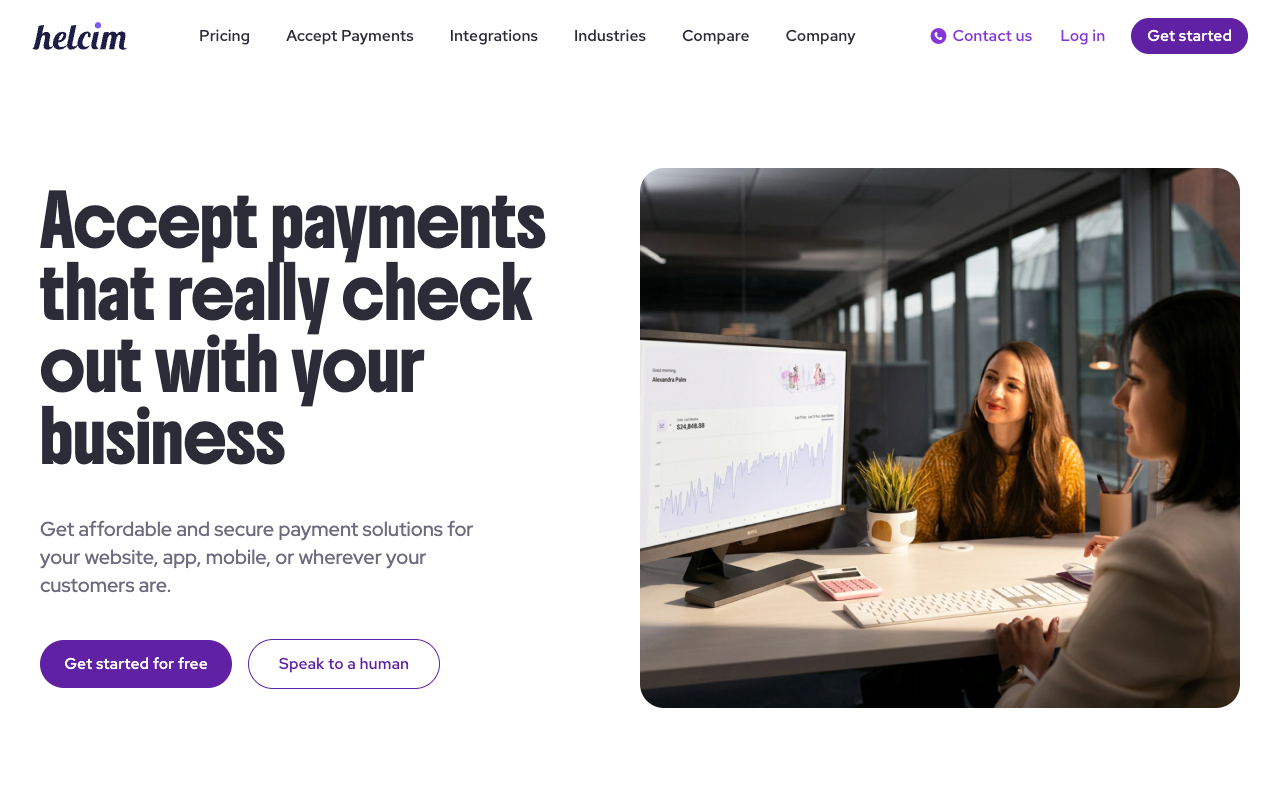
Best for: Wanting the processor margin in writing. Starting price: $0 / month. Per transaction: Interchange + 0.50% + 25c.
Most processors describe interchange-plus pricing without saying what the plus is. Helcim states it: interchange plus 0.50 percent plus 25 cents. On the rates shown for online payments that works out at 2.31 percent plus 25 cents, and 2.99 percent plus 25 cents on other card types. Volume discounts apply above that.
The fee list is mostly zeros, which is the point. No monthly account fee, no signup fee, no annual PCI compliance charge, no cancellation fee and no cost to bring card and customer data across from another provider. Deposits land the next business morning. A lost chargeback costs $15 and a won one costs nothing, recurring billing adds 0.4 percent, and a rejected ACH is $5.
5. Adyen: Priced for Businesses That Know Their Interchange
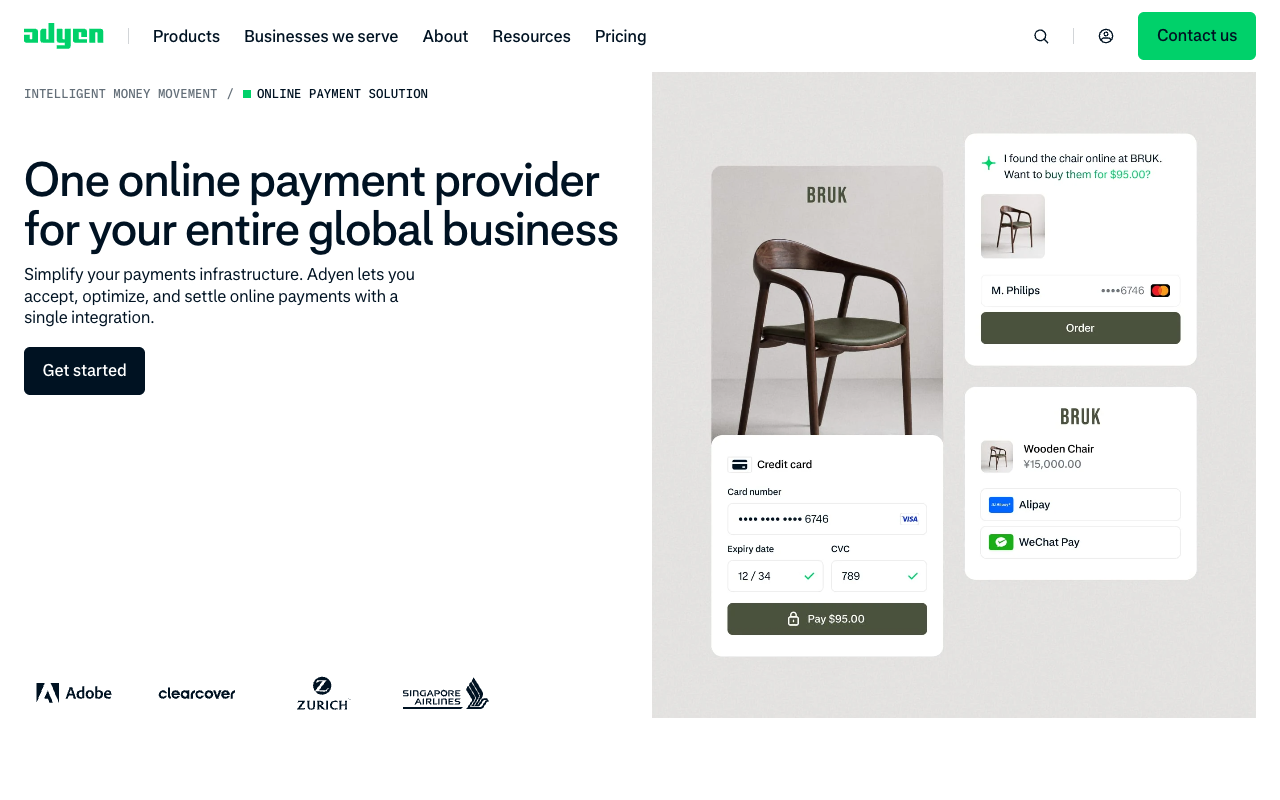
Best for: Enterprise volume on a known card mix. Starting price: $0 / month. Per transaction: $0.13 + Interchange++ 0.60% on US cards.
Adyen never quotes a blended rate. Each transaction is a fixed $0.13 processing fee plus the fee for the payment method used, which on the major US card schemes is interchange plus 0.60 percent. American Express, Diners and Discover run at a flat 3.95 percent, and wallets such as Apple Pay and Google Pay inherit the rate of the card behind them.
US ACH Direct Debit is a flat $0.27, Cash App Pay is 2.90 percent plus 30 cents, and settlement currency and timing are chosen rather than assigned. There is no setup fee and no monthly fee, but the model only rewards a business that already understands its own card mix. Below real scale, a blended rate is simpler and usually cheaper after integration time.
6. BILL: Payables, Receivables and a Published Fee Table
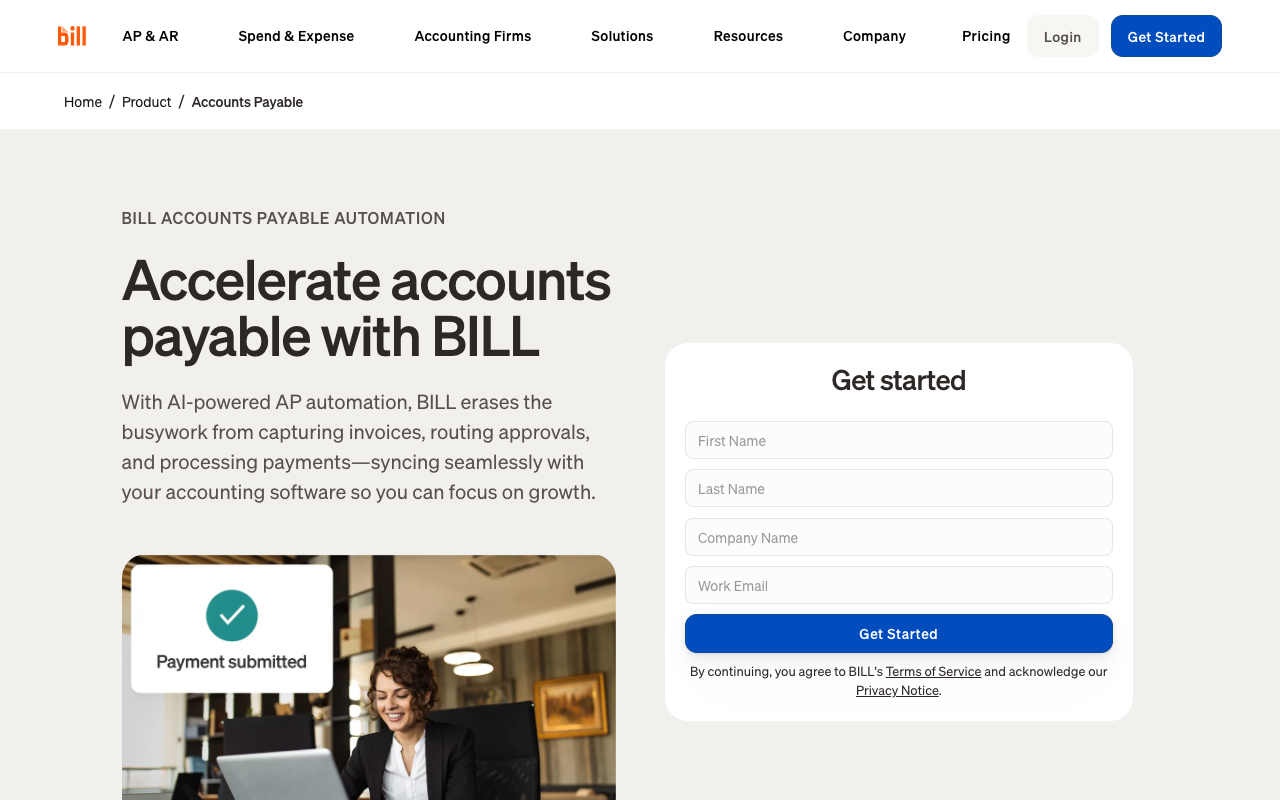
Best for: Payables and receivables in one place. Starting price: $49 per user / month. Per transaction: ACH $0.59, mailed check $1.99, card 2.9%.
BILL handles money going out and money coming in from one account, and it is the only platform here that prints its transaction fees beside its plan prices. Essentials costs $49 per user a month, Team $65 and Corporate $89, with Enterprise quoted. A bank-funded ACH payment is $0.59, a posted check $1.99 and a virtual card costs nothing.
Speed and funding method are where the bill grows. Pay Faster ACH is $11.99 with a 10:00 am Pacific cutoff for same-day settlement, an overnight check is $24.99, and an instant payment is 1.0 percent between a $9.99 minimum and a $100 maximum. Funding by credit card instead of bank adds 2.9 percent. An international wire in the local currency is free beyond the exchange rate.
7. Melio: The Free Plan That Sends Real Money
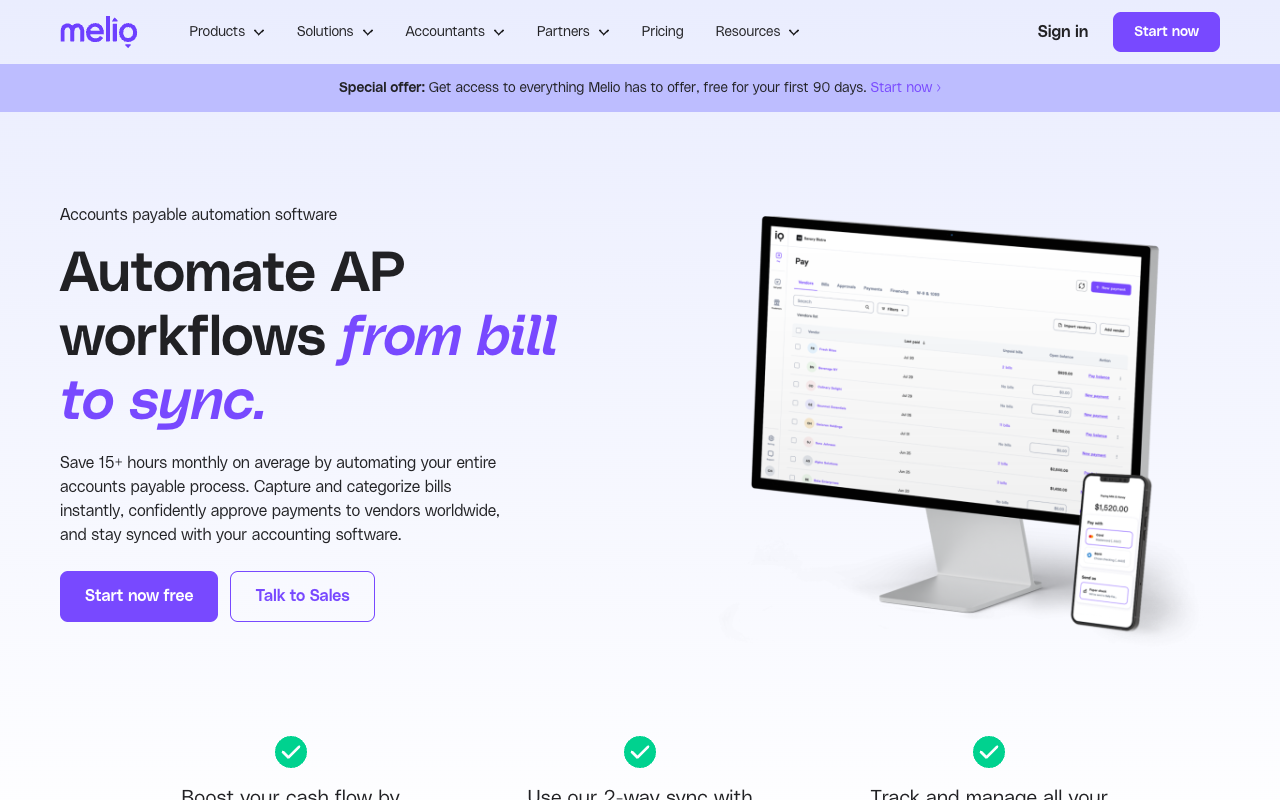
Best for: Small businesses paying a few dozen suppliers. Starting price: $0 (Go), then $25 / month. Per transaction: 5 free ACH a month on the free tier.
Melio is built for a business paying a manageable number of suppliers, and its free plan is not a trial. The Go tier costs nothing permanently, carries a single user and includes five ACH payments a month plus free invoicing. Core is $25 a month, Boost $55 and Unlimited $80, with $10 a month per extra user on the first three.
Free ACH allowances scale with the tier: 20 a month on Core, 50 on Boost and no limit on Unlimited, which also removes the per-seat cost. Accounting sync is tiered the same way, with QuickBooks Online and Xero from Core, QuickBooks Desktop from Boost and NetSuite only at the top. Melio also runs a 90-day promotion that opens the paid features at no cost.
8. Ramp: Accounts Payable Bundled With Corporate Cards
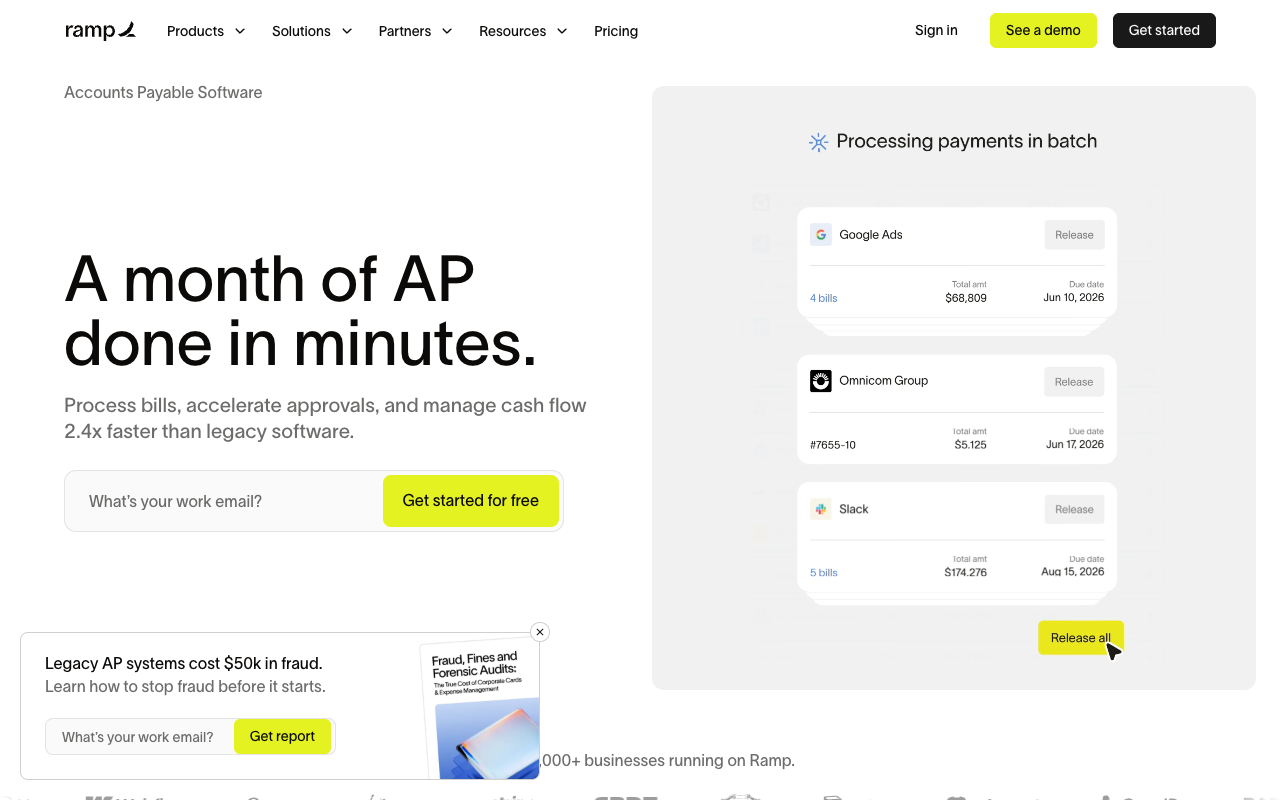
Best for: Cards and bill pay on one free plan. Starting price: $0 per user / month. Per transaction: Free wires and same-day ACH through Bill Pay.
Ramp charges nothing per user on its free tier and still includes invoice capture, approval workflows, automated fraud checks, payment by ACH, card, check and wire, accounts receivable, unlimited corporate cards and travel booking. Plus costs $15 per user a month plus a platform fee scaled to team size, and brings AI coding plus NetSuite and Sage Intacct sync.
The free software is funded by the banking relationship rather than by fees. Ramp advertises 2 percent on balances in its FDIC-insured checking account, 4.57 percent in a Ramp Investment Account, and free wires and same-day ACH through Bill Pay. The company says 85,000 finance teams use it. The consideration is concentration, since the software and the cash sit with one provider.
9. Tipalti: Paying a Global Payee Network Without a Spreadsheet
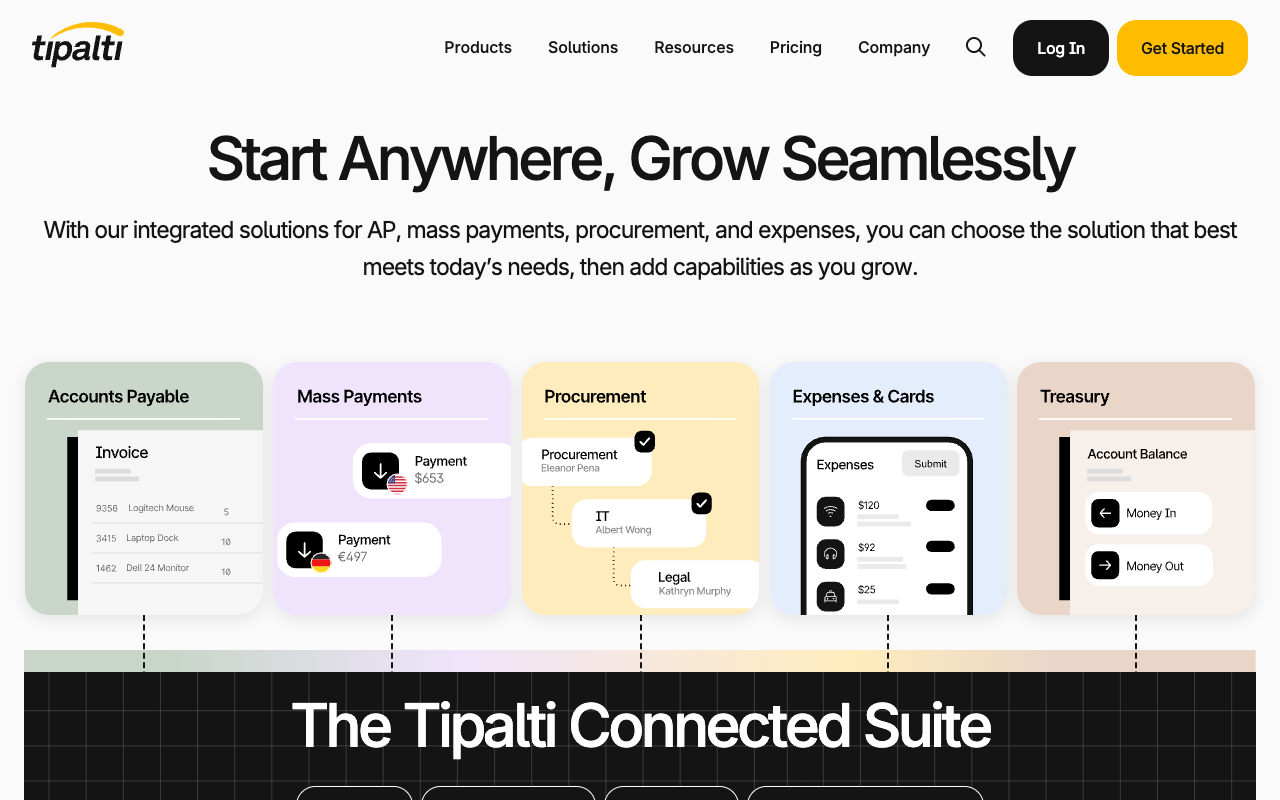
Best for: Paying a global payee network. Starting price: $99 / month (AP). Per transaction: Per-invoice and per-payment fees on top.
Tipalti publishes a floor rather than a price. Accounts Payable starts at $99 a month and Mass Payments at $249, both with unlimited users and a self-service supplier or payee portal, and both carry per-invoice and per-payment charges the page does not quantify. Expect the quote to be the real number.
The reason to look at it is cross-border volume. Suppliers onboard themselves in 27 languages, invoices are read in 146, and tax compliance is handled inside the payout. Two and three-way purchase order matching and automated reconciliation with the ledger come as standard. Marketplaces paying creators, sellers and trial participants in dozens of countries are the natural buyer.
10. Stampli: Invoice-Centred Approvals, Price on Application
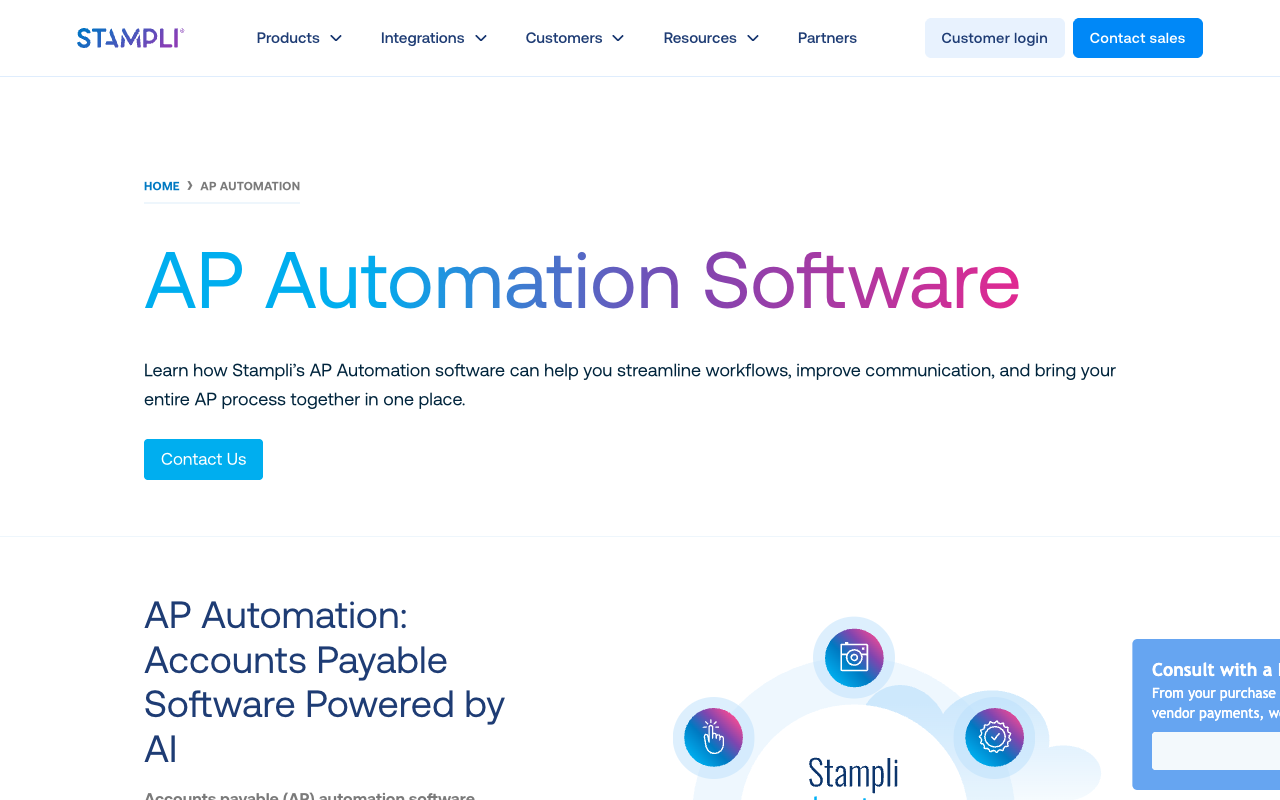
Best for: Heavy invoice approval workflows. Starting price: Quote only. Per transaction: Not published.
Stampli is the only platform in this group that publishes no figure at all. Its pricing page shows a feature comparison against unnamed rivals and a quote request. The one number it does give is a sizing one: the qualifying form states that Stampli is typically a strong fit for teams at 300 or more invoices a month.
The design idea is that the invoice carries its own conversation. Approvals, queries and messages to the vendor all attach to the document rather than living in email, with unlimited entities, vendors and invoice capture included. Direct Pay covers domestic check and ACH, global ACH and wire and virtual cards, the Stampli credit card is free to customers, and support replies in under 90 seconds.
Where the Free Tiers Stop Being Free
Six of the ten cost nothing to start, and they stop being free at different and quite specific points.
- Melio: after five ACH payments in a month on the Go plan, or the moment you need a second user.
- Ramp: when you need NetSuite or Sage Intacct sync, multi-entity support or AI-driven approvals, which all sit on Plus at $15 per user a month.
- Stripe, PayPal and Helcim: never on the subscription, because there is none. The cost is entirely per transaction.
- Square: never, though the free plan carries the highest card rates of the three tiers, so the subscription becomes the cheaper option as volume grows.
- Adyen, BILL, Tipalti and Stampli: no free tier at all.
That makes the comparison a question of volume rather than budget. Square Plus at $49 a month buys a 0.1 percentage point cut on card-present sales, so it pays for itself at about $49,000 of monthly volume and costs money below that. Melio Unlimited at $80 replaces per-seat and per-payment costs entirely.
Bank Transfers Still Carry the Volume
Cards dominate the conversation and bank transfers dominate the value. Nacha reported that the ACH Network carried 18.2 billion payments worth nearly $50 trillion in the first half of 2026, with business-to-business volume reaching 4.3 billion payments, up 10.3 percent on the same period a year earlier.
The fast lane grew hardest. Same Day ACH handled 838.7 million payments across that half year, a rise of 26.6 percent, worth almost $2.4 trillion. That is the service behind the $11.99 BILL charges for a same-day transfer and the premium every other payables tool attaches to a faster release.
For a business invoicing other businesses, the practical lesson is to price the card as the expensive option it is. A $4,000 invoice paid by bank debit costs $5.00 on Stripe or PayPal, where the 0.8 percent rate is capped. The same invoice paid by card costs $116.30 on Stripe and $140.09 through PayPal Checkout.
Picking the Right One
Answer the direction question first. If suppliers are the problem and you send fewer than fifty payments a month, Melio is the cheapest serious answer. Above a few hundred invoices, Stampli and Tipalti are the platforms built for it, and Tipalti is the one designed to pay people in other countries at scale.
If customers are the problem, the venue decides. Online with engineers available means Stripe. Across a counter means Square. Helcim fits anyone who wants the processor margin stated rather than implied, and Adyen fits a business already reading its own interchange. PayPal earns its higher rate only where buyers expect the button.
Businesses that need both sides covered should look at Ramp and BILL first, since each runs payables and receivables together. Software stacks tend to be bought in the same quarter, so these pair naturally with our guides to inventory management software and team communication tools.
Before signing, ask for the quote in writing with the transaction volume it assumes, since several of these band their pricing and a growing business crosses a band mid-contract. If trade credit is part of the plan, our explainer on how a credit score is calculated covers what a lender will look at.
Frequently Asked Questions
What does payment management software do?
It handles one of two jobs. Accounts payable tools such as BILL, Melio, Tipalti and Stampli capture supplier invoices, route them through approvals and release payment by ACH, check, card or wire. Acceptance tools such as Stripe, Square, PayPal, Helcim and Adyen take money from customers and settle it into your bank account. Ramp covers both.
Which payment management software is cheapest?
It depends on direction. For sending money, Melio Go is free for one user with five ACH payments a month and Ramp includes accounts payable on a free tier. For taking money, Helcim publishes the lowest structure at interchange plus 0.50 percent plus 25 cents, against 2.9 percent plus 30 cents on Stripe and 3.49 percent plus $0.49 on PayPal Checkout.
Do any of these tools publish no price?
One. Stampli shows no figure anywhere on its pricing page, only a feature comparison and a quote request, although its qualifying form says it suits teams processing at least 300 invoices a month. Tipalti publishes starting prices of $99 and $249 a month but leaves the per-invoice and per-payment charges unquantified.
How long does a payment take to settle?
A standard ACH transfer takes a few business days. Same Day ACH clears within the day if it is scheduled before the cutoff, which on BILL is 10:00 am Pacific and costs $11.99. Card settlement is faster to the merchant: Square and Helcim both advertise next-business-day deposits as standard on every plan.