How much liquid can you take on a plane comes down to two numbers. Each container must hold 3.4 ounces or 100 millilitres or less, and all of them together must fit in a single quart-sized bag. One bag per passenger, in your carry-on.
That is the whole rule, and almost every confiscation happens for one of three reasons: the container is too big even though it is nearly empty, the item was not thought of as a liquid, or the bag will not close. Each of those is covered below.
How Much Liquid You Can Take on a Plane: Limits at a Checkpoint
The rule, the exemptions and the definition, as the TSA publishes them.
| # | Category | Container limit | Bag | |
|---|---|---|---|---|
| 1 | The rule itself | Carry-on | 3.4 oz / 100 ml per container | One quart-sized bag per passenger |
| 2 | What is exempt | Exemption | Reasonable quantities, no 3.4 oz cap | Not required to fit in the bag |
| 3 | What counts as a liquid | Definition | Same 3.4 oz limit applies | Must fit the quart bag |
The Rule, the Exemptions and the Definition
Three things to understand, and the official page each one comes from.
1. The Rule Itself: Getting through the checkpoint without losing anything
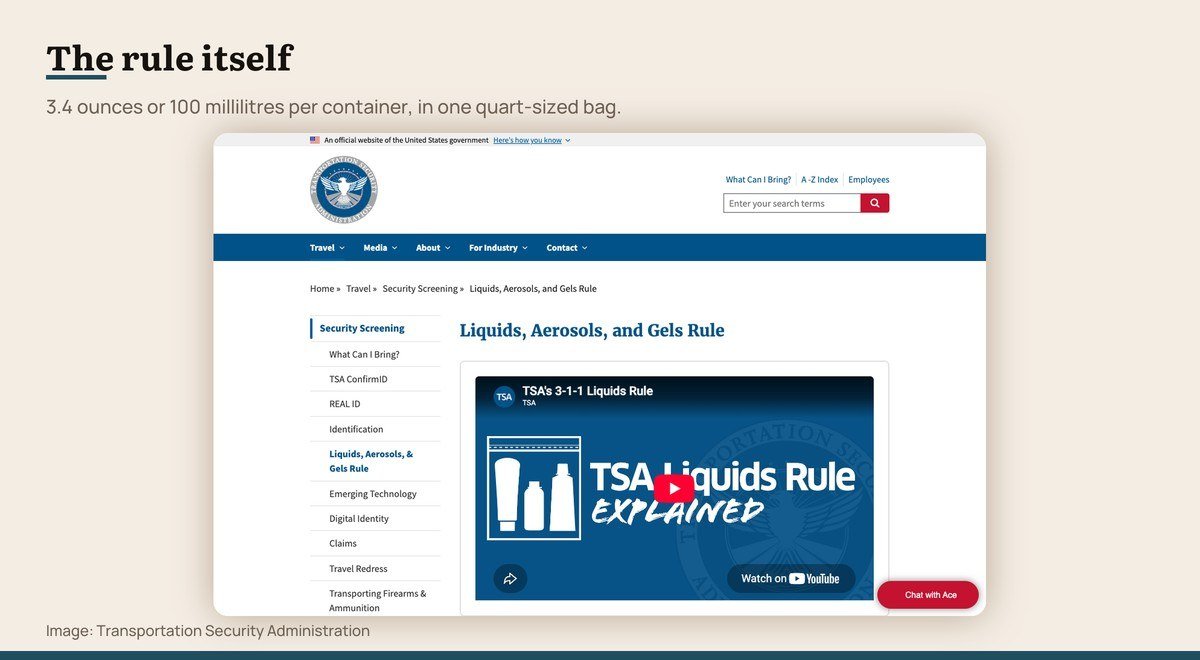
Container limit: 3.4 oz / 100 ml per container · Bag: One quart-sized bag per passenger · Where it applies: Carry-on only; larger goes in checked baggage
The rule covers liquids, aerosols, gels, creams and pastes. Each container must hold 3.4 ounces or 100 millilitres or less, and all of them together must fit inside a single quart-sized bag, one bag per passenger.
Two details decide most confiscations. The limit is the size of the container, not how much is in it, so a half-empty six ounce bottle is refused. And everything has to fit in the bag with it closing properly, which is what stops people claiming an overstuffed bag counts.
Anything larger belongs in checked baggage. The TSA also states that any liquid that alarms during screening gets additional screening regardless of its size, so a compliant container is not automatically a cleared one.
2. What Is Exempt: Travelling with medicine or a baby
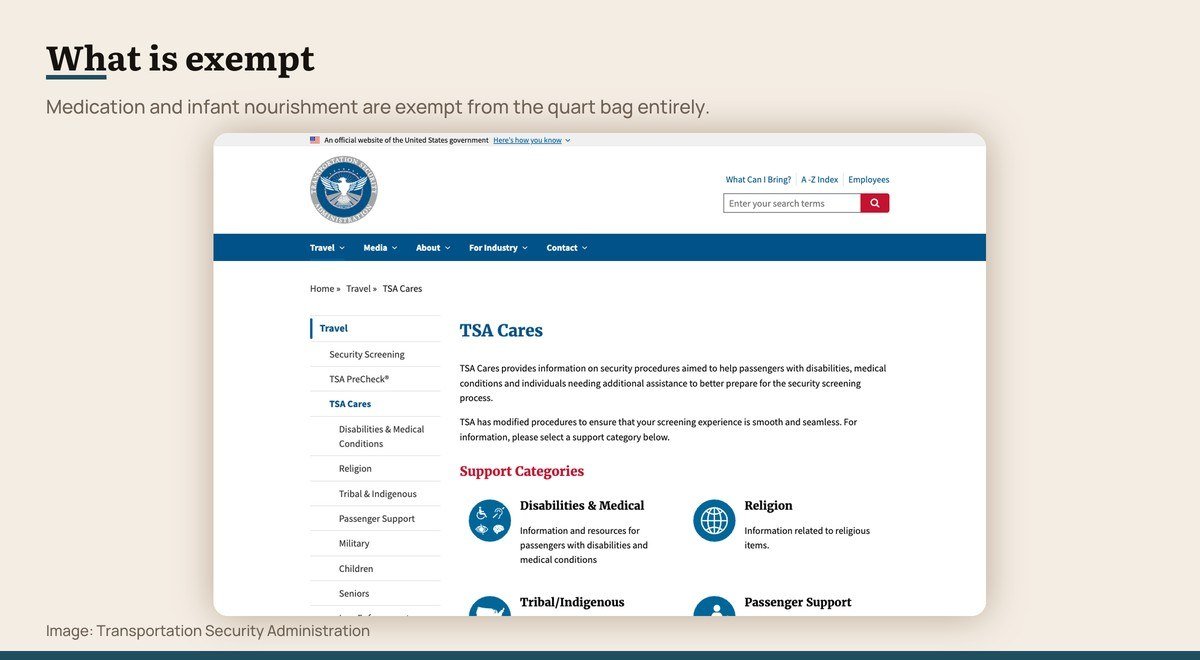
Container limit: Reasonable quantities, no 3.4 oz cap · Bag: Not required to fit in the bag · Where it applies: Declare at the checkpoint
Three categories sit outside the rule. Medications, infant and child nourishments, and liquids bought duty free in a sealed tamper-evident bag on an inbound international flight.
Medication and baby formula are not capped at 3.4 ounces and do not have to fit in the quart bag. They do have to be declared at the checkpoint and taken out for separate screening, and TSA recommends carrying no more than a reasonable quantity for the journey.
Travellers who need extra help or time can contact TSA Cares before flying, which arranges assistance at the checkpoint. It is worth knowing about for anyone carrying unusual medical equipment or a large quantity of prescribed liquid.
3. What Counts as a Liquid: Working out whether peanut butter counts

Container limit: Same 3.4 oz limit applies · Bag: Must fit the quart bag · Where it applies: Searchable item by item on the TSA list
The rule names liquids, aerosols, gels, creams and pastes, and it is the last three that catch people. Peanut butter, soft cheese, hummus, yoghurt, mascara and toothpaste are all treated as liquids regardless of what the packaging calls them.
The simple test is whether it would take the shape of its container or spread on bread. If yes, it is subject to the limit.
Solid versions are not. Stick deodorant, bar soap, solid perfume and powdered formula pass without counting against the bag, which is why switching to solid toiletries is the most effective way to free up space in a quart bag.
Why Nearly Empty Bottles Still Get Taken
The limit is printed on the container, not measured at the checkpoint. A six ounce bottle holding an inch of shampoo is a six ounce container and is refused.
This is not an officer being difficult. Screening equipment and procedure work from the stated capacity, and there is no practical way to assess how full something is on a belt. The rule is written that way deliberately.
The same logic applies to the bag. A quart-sized bag that will not close because it is overstuffed does not meet the rule, so the working test is whether it seals flat rather than how many items are inside.
The practical answer is to decant into travel containers before leaving home, or to buy the travel sizes. Both are cheaper than replacing confiscated toiletries at an airport.
Items People Do Not Expect to Count
The rule covers creams and pastes as well as liquids, which is where most surprises happen. If it would spread or take the shape of its container, it counts.
- Food. Peanut butter, hummus, soft cheese, yoghurt, jam, honey and dips are all treated as liquids. Solid food is not.
- Toiletries. Toothpaste, mascara, liquid foundation, hair gel and sunscreen all count against the bag.
- Aerosols. Dry shampoo, deodorant spray and shaving foam are included, and the cap must stay on.
- Less obvious ones. Snow globes, canned soup, bottled water bought before security and the gel inside a cool pack.
The useful counter-move is to switch to solid equivalents. Stick deodorant, bar shampoo, solid perfume, toothpaste tablets and powdered formula are not liquids and do not use space in the quart bag at all.
Where an item is genuinely ambiguous, the TSA publishes a searchable list covering thousands of specific items with a yes or no for carry-on and checked baggage, which settles most arguments before you get to the airport.
Medication, Babies and Duty Free
Three categories sit outside the limit entirely, and all three require you to say something rather than hope nobody notices.
Medication in liquid form is not capped at 3.4 ounces and does not have to fit the quart bag. Declare it at the checkpoint, take it out for separate screening, and carry a reasonable quantity for the trip. Prescription labelling is not required by the TSA, though it makes the conversation shorter.
Infant and child nourishment follows the same pattern: formula, breast milk, juice and baby food are permitted in quantities above the limit when a child is travelling, declared and screened separately. Ice packs to keep them cold are included.
Duty free is the third, and it is conditional. Liquids over the limit may stay in a carry-on on an inbound international flight only if they are in a sealed, transparent, tamper-evident bag from the retailer and show no sign of having been opened. Anything that alarms is still refused.
What Changes at the Checkpoint Itself
The rule is the same everywhere, and how you experience it is not. Two things change the procedure rather than the limit.
Newer scanners at many airports no longer require the bag to be taken out of your carry-on. Where older equipment is still in use, it does, and an officer will tell you which applies. Neither changes what you are permitted to bring.
Screening programmes such as TSA PreCheck change what you remove rather than what you pack, so the liquids allowance is identical for everybody in every lane.
Identification is a separate requirement that catches travellers out in the same way. the REAL ID requirement now applies to domestic flights, and a traveller without an acceptable form of identification faces a $45 fee under the TSA’s current procedure.
International departures are governed by the authority at the airport you are leaving from. Most major countries use the same 100 millilitre standard, and a few airports have installed scanners that permit more, so check the departure airport rather than assuming your home rules travel with you.
Frequently Asked Questions
How many ounces of liquid can I take on a plane?
3.4 ounces, or 100 millilitres, per container, with every container fitting inside one quart-sized bag. The limit is the size of the container rather than the amount inside it, so a part-used larger bottle is still refused.
Does toothpaste count as a liquid?
Yes. The rule covers gels, creams and pastes as well as liquids, so toothpaste, mascara, sunscreen, peanut butter and soft cheese all count. Solid alternatives such as toothpaste tablets and bar soap do not.
Can I take medication over 3.4 ounces?
Yes. Medication is exempt from both the container limit and the quart bag, in reasonable quantities for your trip. Declare it at the checkpoint and expect it to be screened separately from the rest of your bag.
Can I bring an empty water bottle through security?
Yes. An empty bottle is not a liquid, and most airports have refill points after the checkpoint. A bottle with water still in it has to be emptied before screening, regardless of its size.