
The most populous countries list has changed at the top: India passed China during this decade and now has 1.45 billion people against 1.41 billion. More striking than the order is the direction, because two of these ten are already shrinking.
Population rankings are usually published as a single column of totals, which hides everything interesting. The table below adds growth rate, urban share and births per woman, and those three columns tell you where each country is heading rather than only where it is.
The Number That Decides the Future Is Fertility
A population keeps growing until two things line up: births per woman falling below replacement, and the generation already born passing through childbearing age. The second takes decades after the first.
- Replacement level is about 2.1 births per woman. Below that a population will eventually fall, once age structure stops disguising it.
- Six of these ten are already below it. India at 1.96, China at 1.01, the United States at 1.63, Brazil at 1.61, Russia at 1.42, and Indonesia and Bangladesh sitting almost exactly at replacement.
- Three are well above. Nigeria at 4.38, Ethiopia at 3.91 and Pakistan at 3.55, which is why every long-range projection moves them up this list.
India is the case that confuses people. Its fertility is below replacement and its population is still growing at 0.89 percent a year, because a large young generation is still having children even though each is having fewer. That momentum runs for decades.
China shows what happens when momentum runs out. At 1.01 births per woman, less than half of replacement, its population is now falling, and sub-replacement fertility at that level is extremely difficult to reverse through policy.
Most Populous Countries: Population, Growth and Fertility
All ten for 2024, with the growth rate and births per woman beside each.
| # | Country | Population | Growth | Urban | Fertility |
|---|---|---|---|---|---|
| 1 | India | 1,450,935,791 | 0.89% a year | 35.4% urban | 1.96 births per woman |
| 2 | China | 1,408,975,000 | -0.12% a year | 65.9% urban | 1.01 births per woman |
| 3 | United States | 340,003,797 | 0.96% a year | 80.1% urban | 1.63 births per woman |
| 4 | Indonesia | 283,487,931 | 0.81% a year | 58.8% urban | 2.12 births per woman |
| 5 | Pakistan | 251,269,164 | 1.51% a year | 39.2% urban | 3.55 births per woman |
| 6 | Nigeria | 232,679,478 | 2.08% a year | 63.0% urban | 4.38 births per woman |
| 7 | Brazil | 211,998,573 | 0.41% a year | 87.9% urban | 1.61 births per woman |
| 8 | Bangladesh | 173,562,364 | 1.21% a year | 32.7% urban | 2.14 births per woman |
| 9 | Russian Federation | 143,669,648 | -0.11% a year | 75.1% urban | 1.42 births per woman |
| 10 | Ethiopia | 132,059,767 | 2.58% a year | 23.6% urban | 3.91 births per woman |
The 10 Most Populous Countries, Ranked
Each entry gives the growth rate and fertility alongside the total, because those are what determine the ranking a decade from now.
1. India: 1,450,935,791 people

Population: 1,450,935,791 · Growth: 0.89% a year · Urban share: 35.4% urban · Fertility: 1.96 births per woman
India holds first place with 1.45 billion people, having passed China during this decade. It is still growing, at 0.89 percent a year.
The number that matters for the future is fertility, now 1.96 births per woman, which is below the replacement level of about 2.1. India’s population is still rising because of age structure rather than family size: a young population keeps growing for decades after fertility falls.
It is also the least urbanised of the three largest countries, at 35.4 percent, which means the internal movement from countryside to city still has a long way to run.
2. China: 1,408,975,000 people
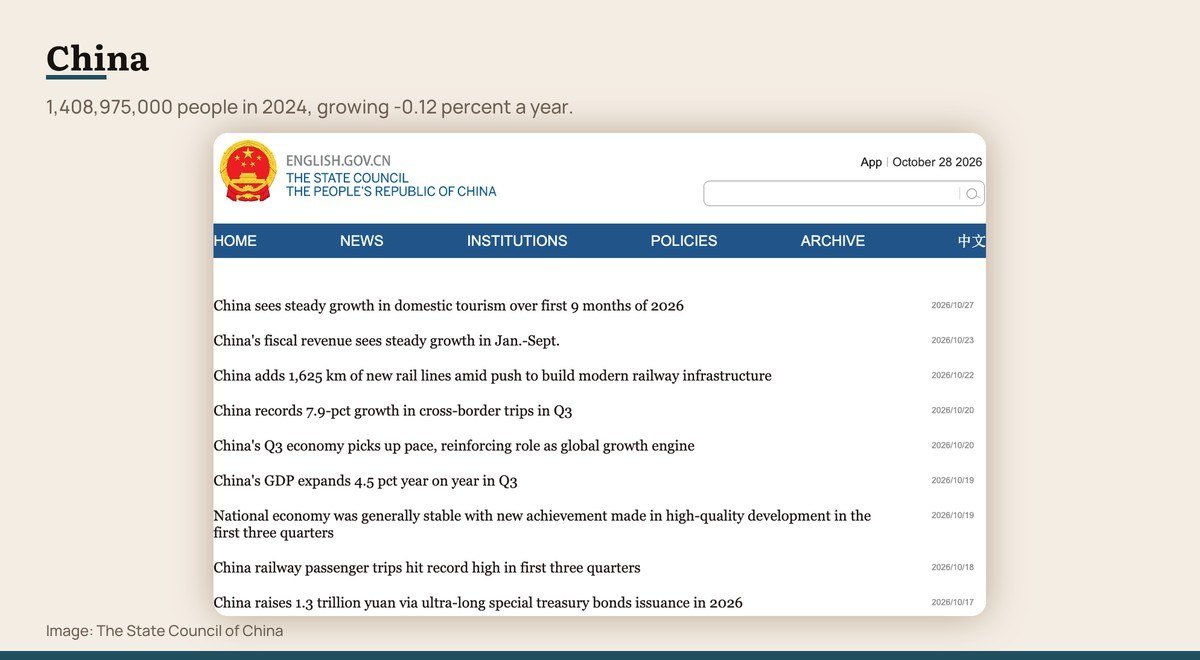
Population: 1,408,975,000 · Growth: -0.12% a year · Urban share: 65.9% urban · Fertility: 1.01 births per woman
China has 1.41 billion people and is now shrinking, at minus 0.12 percent a year. It is one of two countries on this list with a declining population.
Fertility of 1.01 births per woman is the lowest here by a wide margin and less than half the replacement level. That is the legacy of the one-child policy compounded by the cost of urban family life, and policy reversals have not moved it.
At 65.9 percent urban it sits in the middle of this list, having moved several hundred million people into cities within a single generation.
3. United States: 340,003,797 people

Population: 340,003,797 · Growth: 0.96% a year · Urban share: 80.1% urban · Fertility: 1.63 births per woman
The United States has 340 million people and is growing at 0.96 percent, the fastest rate of any high-income country here.
Its fertility rate of 1.63 is below replacement, so that growth is immigration rather than births. Remove migration from the arithmetic and the American population would be flat or falling like Europe’s.
At 80.1 percent urban it is among the most urbanised large countries, behind only Brazil on this list.
4. Indonesia: 283,487,931 people

Population: 283,487,931 · Growth: 0.81% a year · Urban share: 58.8% urban · Fertility: 2.12 births per woman
Indonesia is fourth with 283 million people spread across thousands of islands, growing at 0.81 percent.
Its fertility rate of 2.12 sits almost exactly at replacement level, which makes it the clearest example here of a country arriving at demographic stability rather than overshooting or undershooting it.
Urbanisation of 58.8 percent and a young workforce give it the combination economists call a demographic dividend, where the working-age share of the population is at its most favourable.
5. Pakistan: 251,269,164 people

Population: 251,269,164 · Growth: 1.51% a year · Urban share: 39.2% urban · Fertility: 3.55 births per woman
Pakistan has 251 million people and is growing at 1.51 percent, among the fastest of the large countries.
Fertility of 3.55 births per woman is well above replacement and the second highest here. On current rates Pakistan will add tens of millions more within a decade.
At 39.2 percent urban it remains largely rural, and the combination of rapid growth with low urbanisation puts pressure on water, farmland and schooling simultaneously.
6. Nigeria: 232,679,478 people

Population: 232,679,478 · Growth: 2.08% a year · Urban share: 63.0% urban · Fertility: 4.38 births per woman
Nigeria has 233 million people and is growing at 2.08 percent, the second fastest rate on this list.
Its fertility rate of 4.38 is the highest here, which is why nearly every long-range projection has Nigeria among the three largest countries in the world before the end of the century.
It is already 63 percent urban, more than India or Pakistan, and Lagos is among the fastest growing large cities anywhere.
7. Brazil: 211,998,573 people

Population: 211,998,573 · Growth: 0.41% a year · Urban share: 87.9% urban · Fertility: 1.61 births per woman
Brazil has 212 million people and is growing slowly at 0.41 percent, the lowest positive rate on this list.
At 87.9 percent it is the most urbanised country here by a clear margin, more so than the United States, and its fertility rate of 1.61 is below replacement.
Brazil completed its demographic transition unusually quickly, moving from large families to below-replacement fertility within about two generations and without the coercive policy China used.
8. Bangladesh: 173,562,364 people
Population: 173,562,364 · Growth: 1.21% a year · Urban share: 32.7% urban · Fertility: 2.14 births per woman
Bangladesh has 174 million people in one of the most densely populated countries on earth, growing at 1.21 percent.
Its fertility rate of 2.14 is essentially at replacement, down from more than six births per woman in the 1970s. That decline is one of the most studied in demography and is attributed largely to female education and family planning provision.
At 32.7 percent urban it is the least urbanised country on this list, which given the density means an extraordinarily crowded countryside.
9. Russian Federation: 143,669,648 people

Population: 143,669,648 · Growth: -0.11% a year · Urban share: 75.1% urban · Fertility: 1.42 births per woman
Russia has 144 million people and is shrinking at minus 0.11 percent a year, the second declining population here.
Fertility of 1.42 is well below replacement, and Russia’s decline has been running for most of the period since the Soviet Union ended, interrupted only briefly.
At 75.1 percent urban it is heavily concentrated in cities, and the population is distributed very unevenly across the largest land area of any country.
10. Ethiopia: 132,059,767 people

Population: 132,059,767 · Growth: 2.58% a year · Urban share: 23.6% urban · Fertility: 3.91 births per woman
Ethiopia closes the ten with 132 million people and the fastest growth rate on this list at 2.58 percent.
Fertility of 3.91 births per woman is the second highest here, and at 23.6 percent urban it is by far the least urbanised country in this group.
That combination, high fertility and a largely rural population, describes where the rest of this list was several decades ago, and it is why projections put Ethiopia well inside the top ten for the rest of the century.
Two Countries Are Already Shrinking
China and Russia both recorded negative growth in 2024, at minus 0.12 and minus 0.11 percent. Those are small numbers describing a large turn.
For China it is the end of a half-century during which its population was the defining fact about it. The decline is driven by fertility at 1.01, far below what the relaxation of the one-child policy was expected to produce, and the age structure now works against recovery rather than for it.
Russia’s decline is longer running and differently caused, with low fertility compounded by mortality and emigration patterns that have persisted since the 1990s.
The United States is the instructive contrast. Its fertility rate of 1.63 is also below replacement, and it still grows at 0.96 percent because immigration supplies what births do not. That is a policy choice rather than a demographic one.
Urbanisation Tells You Which Stage Each Is At
The urban column tracks the fertility column closely, and the relationship is one of the most reliable in demography: as people move to cities, families get smaller.
Brazil is 87.9 percent urban with 1.61 births per woman. The United States is 80.1 percent urban at 1.63. Russia is 75.1 percent at 1.42. All three completed the transition decades ago.
At the other end, Ethiopia is 23.6 percent urban with 3.91 births, Bangladesh 32.7 percent at 2.14, and India 35.4 percent at 1.96. The two African countries here are where the growth is, and both still have most of their urbanisation ahead of them.
Bangladesh breaks the pattern and is worth noting for it. It reached replacement-level fertility while remaining the least urbanised country on this list, which is usually credited to female education and family planning provision rather than to economic change.
How These Figures Are Compiled
All of these come from the World Bank population series, which assembles estimates reported by national statistical agencies onto a consistent basis.
They are estimates between censuses, and census quality varies substantially. Nigeria has not completed a census since 2006, so its figure rests on projection rather than enumeration, and estimates of its population differ by tens of millions depending on the source.
Definitions matter too. Urban share depends on each country’s own definition of a town, which is not standardised internationally, so that column compares like with roughly like rather than exactly.
Totals are also revised backwards when a new census lands, which is why a country’s population for a given year can change in later editions without anybody having been born or died.
Frequently Asked Questions
Which country has the largest population?
India, with 1.45 billion people in 2024, having overtaken China this decade. China is second at 1.41 billion and is now shrinking, while India continues to grow at 0.89 percent a year.
Why is China shrinking?
Fertility of 1.01 births per woman, less than half the replacement level of about 2.1. The one-child policy suppressed births for decades and its relaxation did not reverse the trend, with urban living costs now the binding constraint.
Which country is growing fastest?
Of these ten, Ethiopia at 2.58 percent a year, followed by Nigeria at 2.08 and Pakistan at 1.51. All three have fertility rates well above replacement, which is why projections place them higher on this list in future.
Is the world population still growing?
Yes, though the rate is slowing. Six of the ten largest countries are at or below replacement fertility, and growth now comes from age structure and from the countries that remain well above it rather than from a broad global trend.