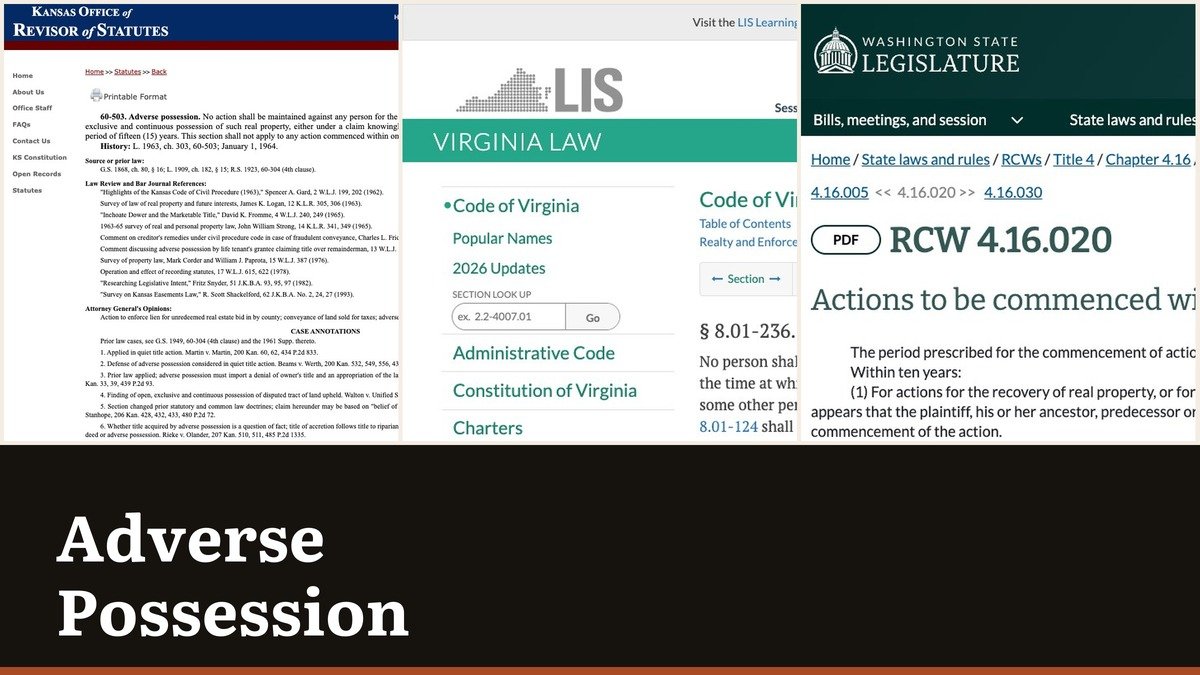
Adverse possession is the legal doctrine that lets a person who occupies land they do not own become its legal owner after a set number of years. The occupant has to meet a list of requirements for the entire period, and the true owner must not have stopped the use in that time.
The period is the part that differs most from state to state. In 2026 Arizona and Texas allow as little as 3 years for an occupant holding a deed-like document, while Ohio requires 21, and the paperwork and tax conditions change the answer more than the number of years does.
What Is Adverse Possession?
Adverse possession is a way to acquire title by occupying land. A claimant who uses another person’s land as an owner would, openly and without permission, can file a court action asking to be declared the owner once the statutory period has run. The law works because owners are expected to watch their property and act when someone intrudes.
The Elements of Adverse Possession
New York’s RPAPL 501 sets out the full set in one sentence: occupancy must be adverse, under claim of right, open and notorious, continuous, exclusive and actual. Other jurisdictions reach nearly the same list through court decisions. Each element is a separate point where a claim can fail.
Hostile or Adverse Use
Hostile means without the owner’s consent, not that the occupant is angry. Someone who rents, borrows or was told they could stay is using the land with permission, and that use cannot count. Kansas frames the point as possession under a claim knowingly adverse or a belief of ownership, and New York asks for a claim of right, defined as a reasonable basis for believing the property belongs to the occupant.
Actual Possession
The claimant must physically use the land in the way a typical owner of that land would. California and South Dakota both give a concrete test: land counts as possessed if it is protected by a substantial enclosure or is usually cultivated or improved. Florida also treats using land to supply fuel or fencing timber as possession.
Open and Notorious Possession
The use has to be visible. A claim built on secret or occasional use fails because an owner could not be expected to notice it. Fencing, building, planting and regular upkeep are the typical proof, and they are also what a careful owner would see on an inspection.
Exclusive Possession

The claimant acts as the only possessor and does not share control with the owner or the public. Kansas frames its test as 15 years of open, exclusive and continuous possession, which puts all three of those elements in one statute.
Continuous Possession
The occupation must run without a real break for the full period. Short, natural gaps such as seasonal absences are generally treated differently from abandonment, but an owner’s lawsuit or a written order to leave can interrupt the clock.
How Long Adverse Possession Takes
The period set by state law decides when a claim can succeed. A few examples show how the figures and the conditions around them vary.
10 Years: Washington

Washington’s RCW 4.16.020 sets a 10-year period for actions about real property. A separate route in RCW 7.28.070 shortens it to 7 successive years when the possession is under claim and color of title made in good faith and all taxes are paid.
15 Years: Virginia
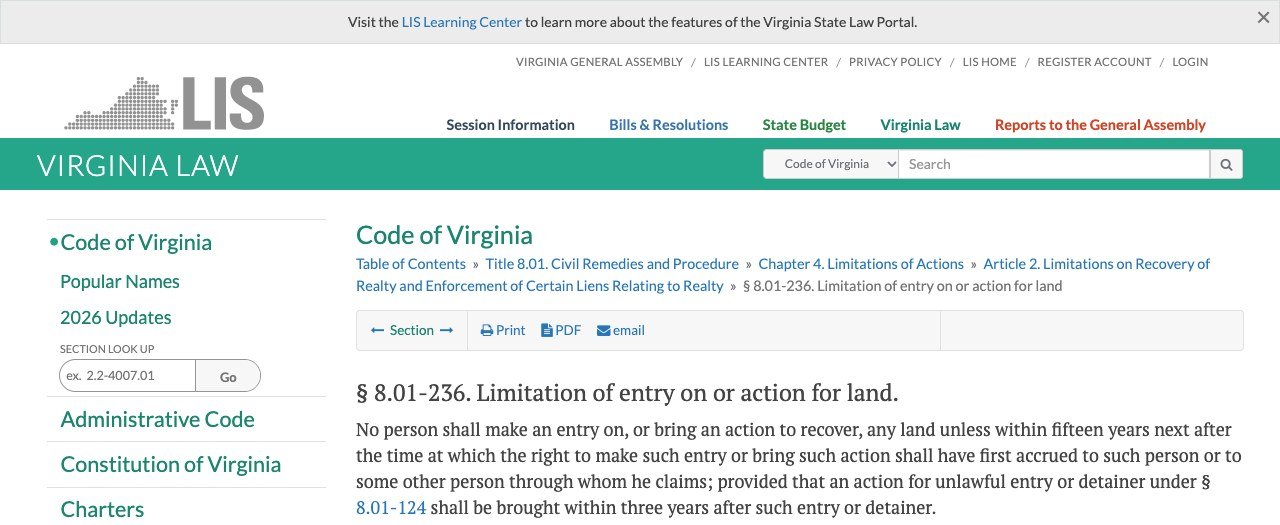
Virginia Code 8.01-236 bars entry on land or an action to recover it unless brought within 15 years after the right accrued. The same figure applies in Connecticut, Kansas, Kentucky, Minnesota, Vermont and the District of Columbia. The text is on the Virginia Law portal.
20 Years: Maine and North Dakota

Title 14, section 801 of the Maine statutes provides that a person has no right of entry or action unless brought within 20 years after the right accrued. Delaware, Hawaii, Maryland, North Dakota and South Dakota also use 20 years.
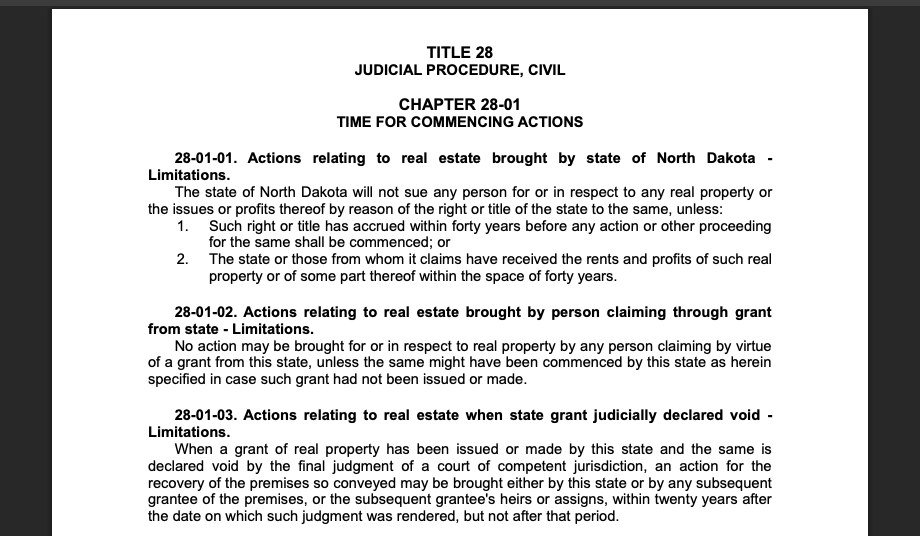
North Dakota’s chapter 28-01 contains the 20-year rule in 28-01-04 for actions about real property. Hawaii attaches a size limit: the extended adverse possession claim in HRS 657-31.5 applies only to property of five acres or less.
Color of Title and Tax Payment Shortcuts
Color of title means the occupant holds a document that appears to give ownership but turns out to be defective, such as a flawed deed. Several states reward that situation with a shorter period, often paired with a requirement to pay the property taxes. The main shortcuts:
- Arizona: 3 years under title or color of title (A.R.S. 12-523), against 10 years of peaceable possession otherwise (12-526), which is capped at 160 acres.
- Texas: 3 years under title or color of title (16.024), 5 years with cultivation, taxes paid and a duly registered deed (16.025), 10 years of use (16.026) and a 25-year outer limit regardless of disability (16.027).
- Florida: 7 years under a written instrument, decree or judgment (95.16), or 7 years without one if the occupant pays taxes within a year of entering and files a return with the property appraiser within 30 days (95.18).
- Washington: 7 years under claim and color of title in good faith with all taxes paid (RCW 7.28.070).
- South Dakota: 10 successive years under claim and color of title in good faith with all taxes paid (15-3-15), against 20 years otherwise (15-3-1).
- California: 5 years with all taxes paid for those years, with no color of title needed (Code of Civil Procedure 325(b)).
- Minnesota: 15 years, with at least five consecutive years of taxes on a separately assessed parcel (541.02).
The statutes for Washington, Minnesota and South Dakota are online: RCW 7.28.070, Minnesota 541.02 and SDCL 15-3-1.
Adverse Possession Periods Grouped by Length
| # | Period | Where it applies | Conditions |
|---|---|---|---|
| 1 | 3 years | Arizona, Texas | Only with title or color of title |
| 2 | 5 years | California, Montana | California also requires taxes paid for all 5 years; Texas offers 5 with a registered deed and taxes |
| 3 | 7 years | Florida, Washington | Florida: color of title, or taxes paid and a return filed. Washington: color of title and taxes |
| 4 | 10 years | Arizona, Iowa, Nebraska, New York, Rhode Island, South Carolina, South Dakota, Texas, Washington, Wyoming | South Dakota: 10 only with color of title and taxes; Arizona and Texas use 10 years without a title document |
| 5 | 15 years | Connecticut, District of Columbia, Kansas, Kentucky, Minnesota, Vermont, Virginia | Minnesota requires five consecutive years of taxes on separately assessed parcels |
| 6 | 20 years | Delaware, Hawaii, Maine, Maryland, North Dakota, South Dakota | Hawaii limits claims to property of five acres or less |
| 7 | 21 years | Ohio | Limit on actions to recover real property |
| 8 | 25 years | Texas | Outer limit regardless of disability |
Statutes change and each state has its own details, so the current state code or an attorney licensed there controls for a particular property.
What Happens in Court: Quiet Title
Adverse possession does not transfer title automatically. When the period ends the claimant usually files a quiet title action, which asks a court to confirm ownership and clear the record. The owner is named as a defendant and can contest each element.
- The claimant files a complaint describing the land, the dates of occupation and the facts behind each element.
- The owner responds and can raise permission, interruption of the period, or missing tax payments.
- Both sides present proof such as photographs, tax receipts, fencing records, utility bills and witness statements.
- The court decides and, if the claimant proves every element for the full period, issues a judgment that becomes the new record of ownership.
The claimant carries the burden of proof, which is why records matter so much. Simple procedures for small disputes sit in small claims court, but title questions go to a regular civil court.
How to Defend Against an Adverse Possession Claim
Each defense attacks one element or the clock:
- Show permission. A lease, a signed note or a dated message allowing the use makes the use non-hostile.
- Act inside the period. Statutes such as Delaware’s and Maine’s bar entry or action after the period, so a timely court action or documented demand to leave protects the owner.
- Prove taxes were not paid by the claimant. In California, Florida, Minnesota, Washington, South Dakota and Texas, a route fails without the tax payments the statute requires.
- Dispute the possession. Photos, inspection logs and testimony can show use that was occasional, hidden or shared.
- Keep boundaries clear. A recent survey and a maintained fence reduce the chance that a neighbor can claim a strip of land.
Landlords who manage rentals often keep inspection and tax records in property management software, which doubles as evidence of ownership and control.
Frequently Asked Questions
How many years does adverse possession take?
It depends on the state and on whether the occupant holds a deed-like document. Arizona and Texas allow 3 years with a deed-like document, and Ohio requires 21. Common figures are 10, 15 and 20 years.
Does the claimant have to pay property taxes?
In some places, yes. California requires taxes paid for all 5 years, Florida requires payment and a filed return on the 7-year no-title route, and Washington requires them with color of title. Elsewhere, such as Delaware and Maryland, the statute sets a time limit with no tax requirement.
Can an owner stop the clock?
Yes. Giving written permission, sending a written demand to leave and filing a timely action all interrupt the continuous, hostile use the claim depends on.
Is adverse possession the same as squatting?
Squatting is the situation and adverse possession is the legal claim that can grow out of it. A squatter who lacks permission may be removed by the owner at any point, and ownership only passes through a court judgment after the full period.