The best gacha games hand you the whole game and sell you the characters. There is no paywall in the campaign, usually no advertising, and nothing stops a player who never spends from finishing the story. What there is instead is a banner, a randomised draw where a fixed sum of in-game currency buys one attempt, and the odds are published because several countries now require it.
That makes this the one corner of mobile gaming where you can do the maths in advance. Pity, soft pity and the fifty-fifty are documented mechanics rather than secrets, and once the arithmetic is on paper the decision about whether to spend stops being a feeling.
What the Published Odds Actually Say
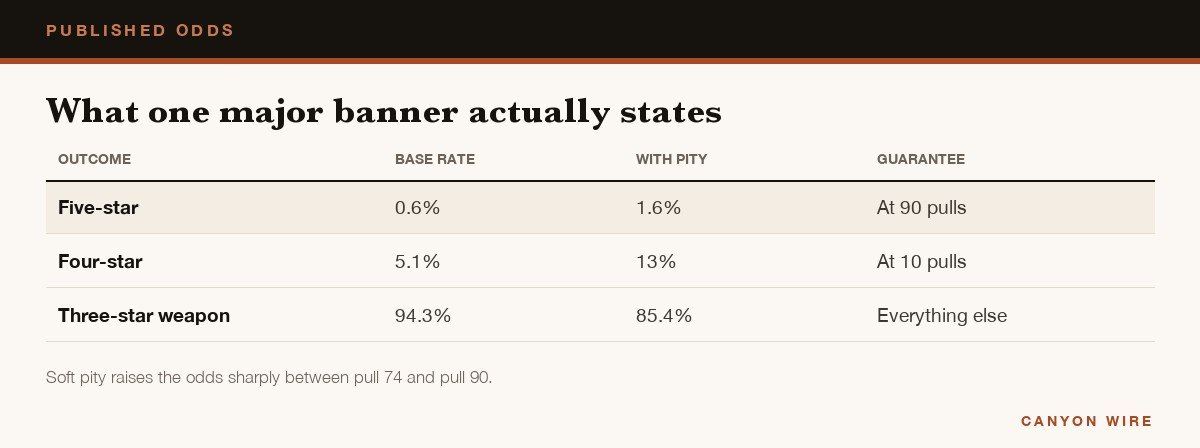
| Outcome | Base rate | With pity | Guarantee |
|---|---|---|---|
| Five-star | 0.6% | 1.6% | Guaranteed at 90 pulls |
| Four-star | 5.1% | 13% | Guaranteed at 10 pulls |
| Three-star weapon | 94.3% | 85.4% | Everything else |
A 0.6 per cent base rate reads as hopeless and is not the number that governs anything, because the system has a floor. Go 89 pulls without a five-star and the ninetieth is guaranteed to be one. That is hard pity, and it converts an open-ended gamble into a purchase with a known ceiling.
Soft pity is the part most people never hear about. The odds do not sit at 0.6 per cent until pull 90 and then jump; they climb steeply from around pull 74, which is why the average five-star arrives well before the guarantee and why the effective rate including pity is published as 1.6 per cent rather than 0.6. A parallel guarantee covers four-stars every tenth pull.
The Real Cost of One Character
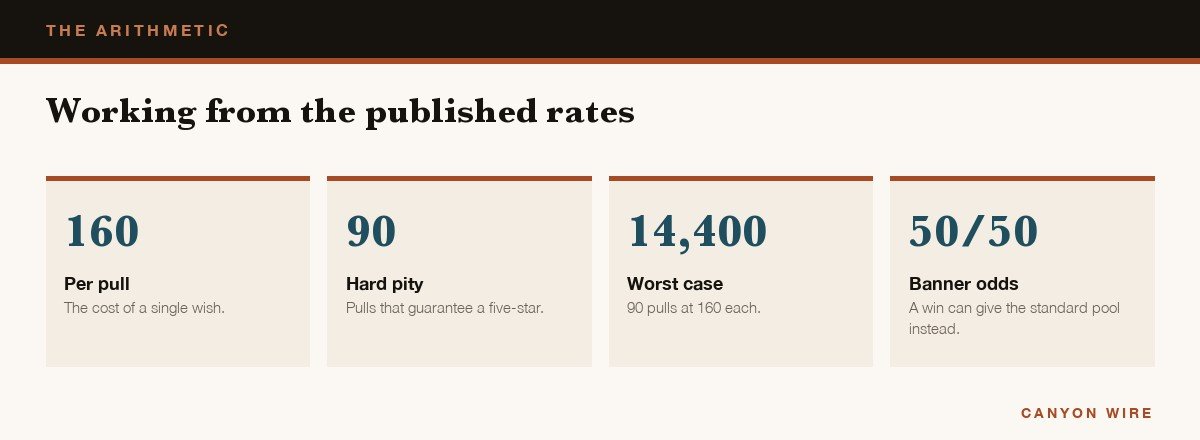
One pull costs 160 units of premium currency, so hard pity at 90 pulls is 14,400 units in the worst case, and soft pity puts the realistic average nearer 60 to 70 pulls. That is the number worth memorising, because every free reward can be measured against it: a daily login paying 60 units is about a third of a single pull.
Then comes the fifty-fifty, which is the mechanic that catches people out. Winning a five-star on a limited banner does not mean getting the featured character. Half the time you receive one from the permanent pool, and only then is the next five-star guaranteed to be the one you wanted, so the worst case for a specific character is roughly double the single-pity figure.
- Hard pity: the pull at which a five-star is certain, usually 80 to 90.
- Soft pity: the window before it where the odds rise sharply.
- The fifty-fifty: whether that five-star is the featured character.
- Guaranteed next: losing the fifty-fifty makes the following one certain.
- Carry-over: pity counters usually persist between banners, so nothing is wasted by stopping.
None of that is concealed. What the format relies on is that very few people ever do the subtraction, and that is also the line drawn between a gacha system and the loot boxes several countries have restricted outright.
Eight of the Best Gacha Games Beyond the Obvious Three
The three biggest titles in this genre are well documented everywhere. These eight are the ones that answer a more useful question, which is what the format looks like when it is not an open-world blockbuster.
| Game | Type | Out since | Download |
|---|---|---|---|
| Honkai Impact 3rd | Action RPG | 2018 | 3283 MB |
| AFK Journey | Idle RPG | 2024 | 1323 MB |
| Epic Seven | Turn-based RPG | 2018 | 108 MB |
| GODDESS OF VICTORY: NIKKE | Shooter RPG | 2022 | 648 MB |
| Punishing: Gray Raven | Action RPG | 2021 | 3997 MB |
| Azur Lane | Side-scrolling shooter | 2018 | 4010 MB |
| Reverse: 1999 | Turn-based card RPG | 2023 | 3908 MB |
| Umamusume: Pretty Derby | Raising simulation | 2025 | 396 MB |
1. Honkai Impact 3rd
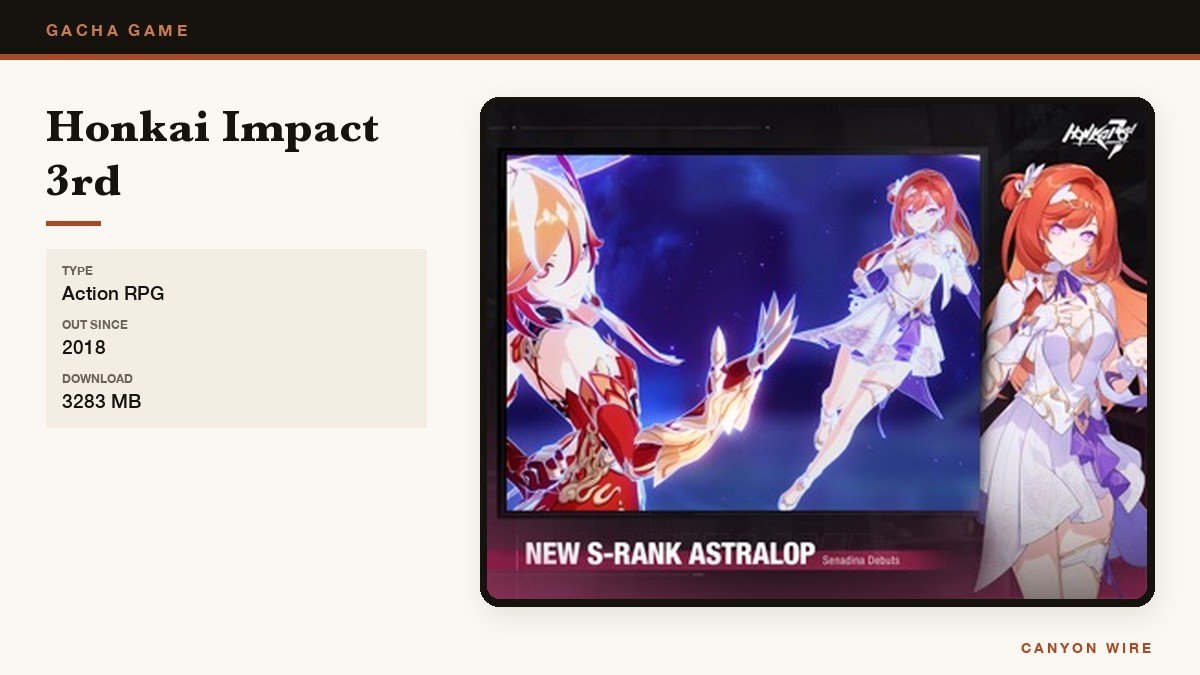
The game that paid for everything its publisher has made since. Real-time character-switching combat on a far older engine than its siblings, which is why it still runs on phones that cannot open the newer titles. Eight years of story means the opening hours are generous in a way a new release never is, and the economy has loosened steadily as the audience moved on.
Honkai Impact 3rd is free from COGNOSPHERE PTE. LTD., released 2018-03-28, around 3283 MB before updates.
2. AFK Journey
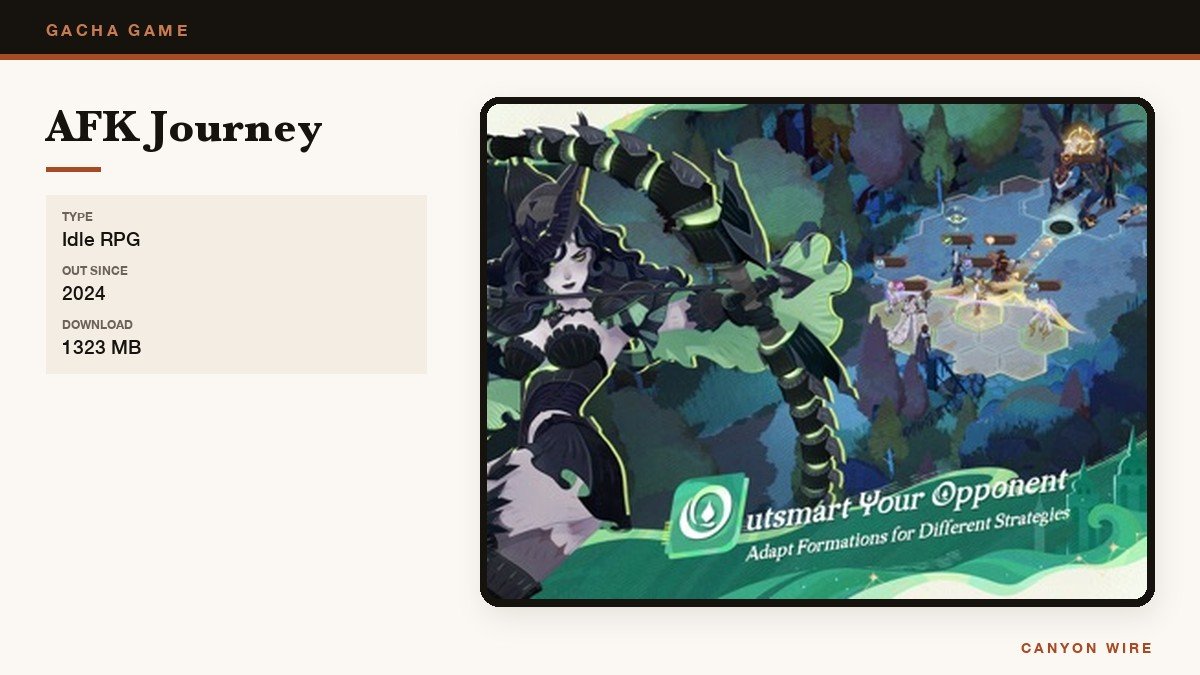
Idle progression is the gentlest version of this format and the one most likely to survive on a phone long term. Resources accumulate while the app is closed, sessions are measured in minutes, and the banners pull from a roster you are mostly collecting rather than chasing. The trade is that the ceiling arrives quickly and the late game is a queue of timers.
AFK Journey is free from FARLIGHT PTE. LTD., released 2024-03-27, around 1323 MB before updates.
3. Epic Seven
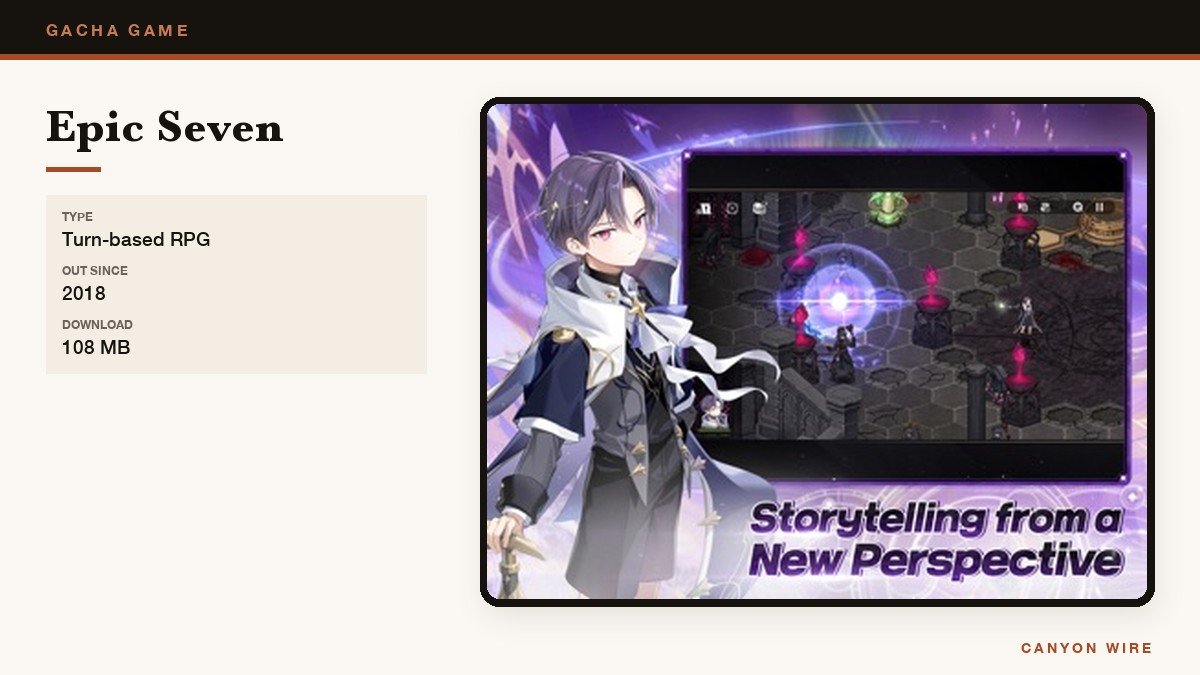
Animated in a style closer to a television series than a mobile game, with turn-based combat built around speed order rather than raw numbers. It has one of the longest-running player-versus-player scenes in the genre, which is also where the spending pressure concentrates: the story content is comfortably clearable with common units.
Epic Seven is free from Smilegate, Inc., released 2018-11-03, around 108 MB before updates.
4. Goddess of Victory: Nikke
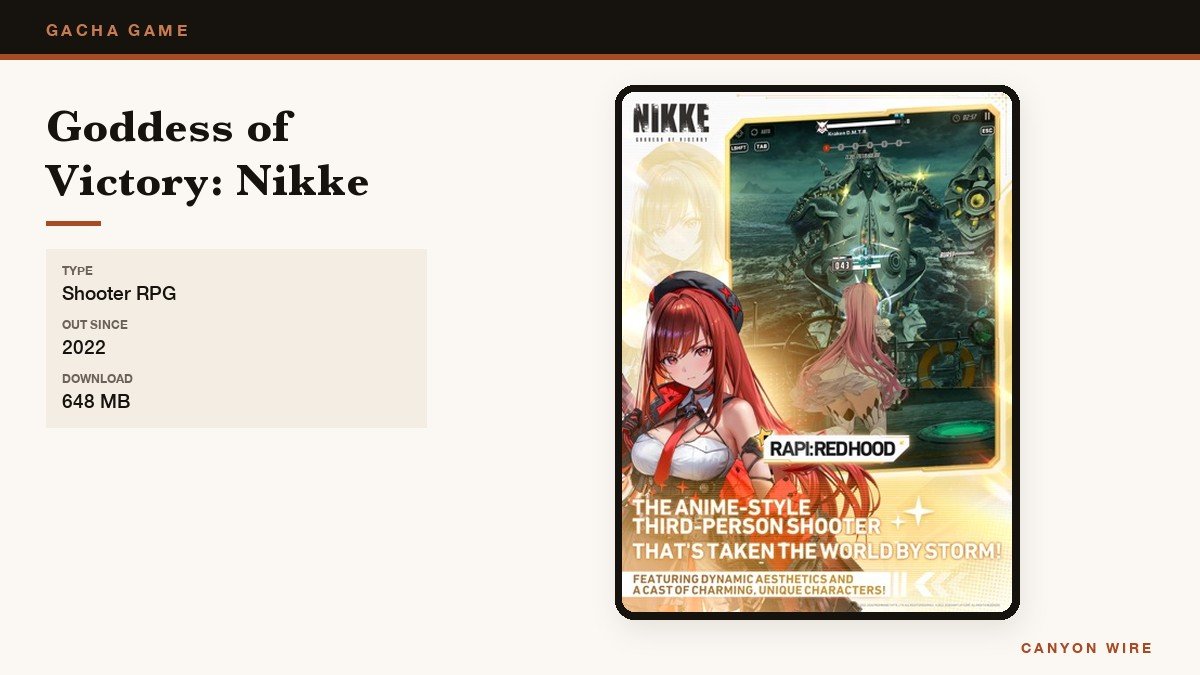
A cover shooter rather than a party RPG, which makes the moment-to-moment play genuinely different from everything else here. Characters are weapons with reload timings and burst windows, the story is unusually well regarded, and the pull economy is conventional enough that the rate arithmetic below applies almost unchanged.
GODDESS OF VICTORY: NIKKE is free from PROXIMA BETA PTE.LIMITED, released 2022-11-02, around 648 MB before updates.
5. Punishing: Gray Raven
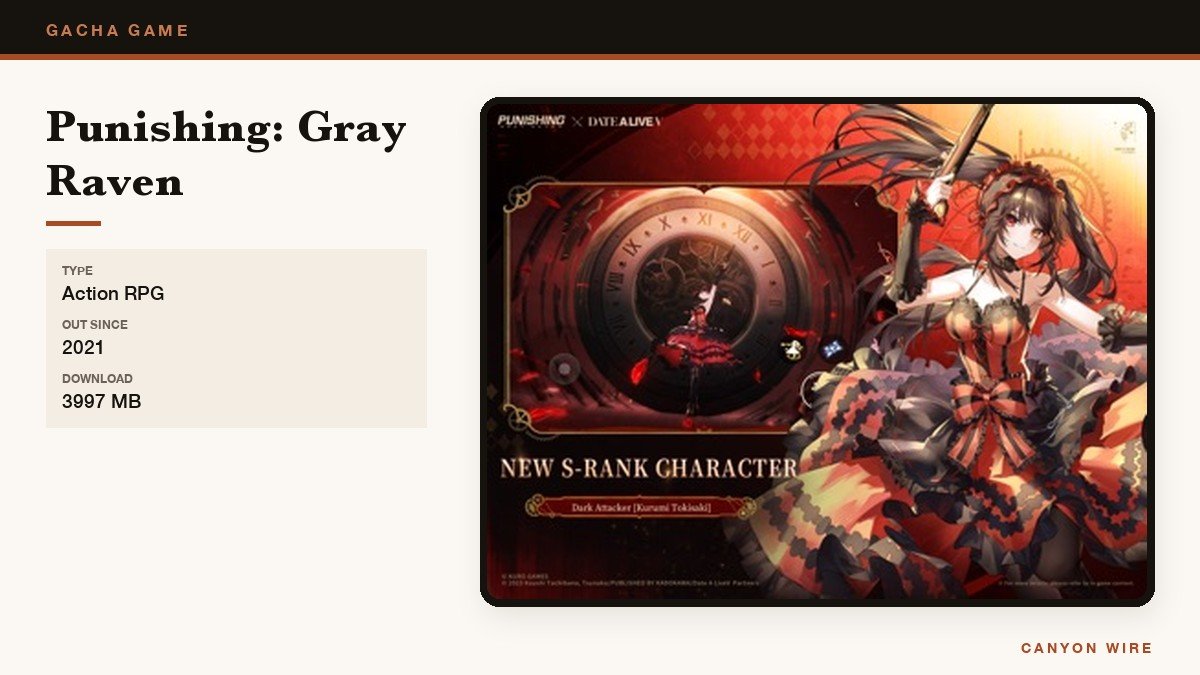
The most demanding combat in the genre, built on dodge-counters and a matching system that rewards execution over roster strength. That changes the economics: a skilled player with common characters clears content that defeats a spender who cannot dodge. Its publisher went on to make one of the biggest open-world titles on mobile.
Punishing: Gray Raven is free from KURO TECHNOLOGY HONG KONG CO. LIMITED, released 2021-07-14, around 3997 MB before updates.
6. Azur Lane
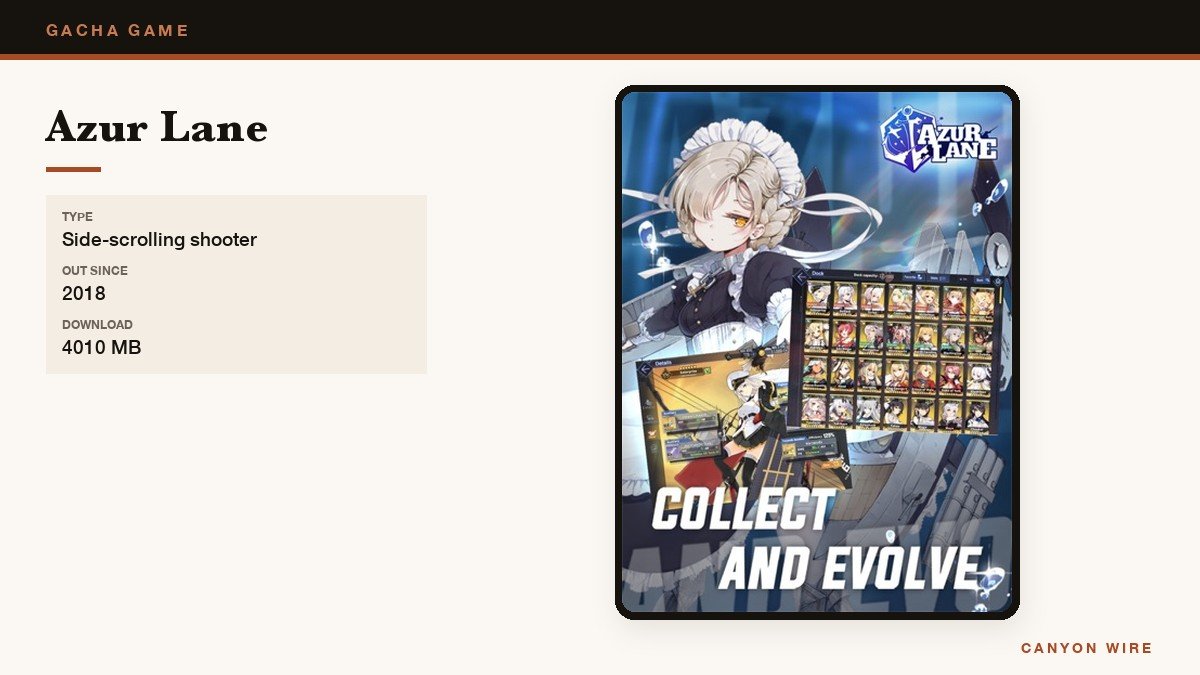
The outlier on generosity. Most of its roster drops from ordinary stage clears rather than from paid banners, which means the collection fills up by playing rather than by pulling. It has run since 2018 on that model, and it is the usual recommendation for anyone who wants the collecting without the gambling attached to it.
Azur Lane is free from YOSTAR (HONG KONG) LIMITED, released 2018-08-17, around 4010 MB before updates.
7. Reverse: 1999
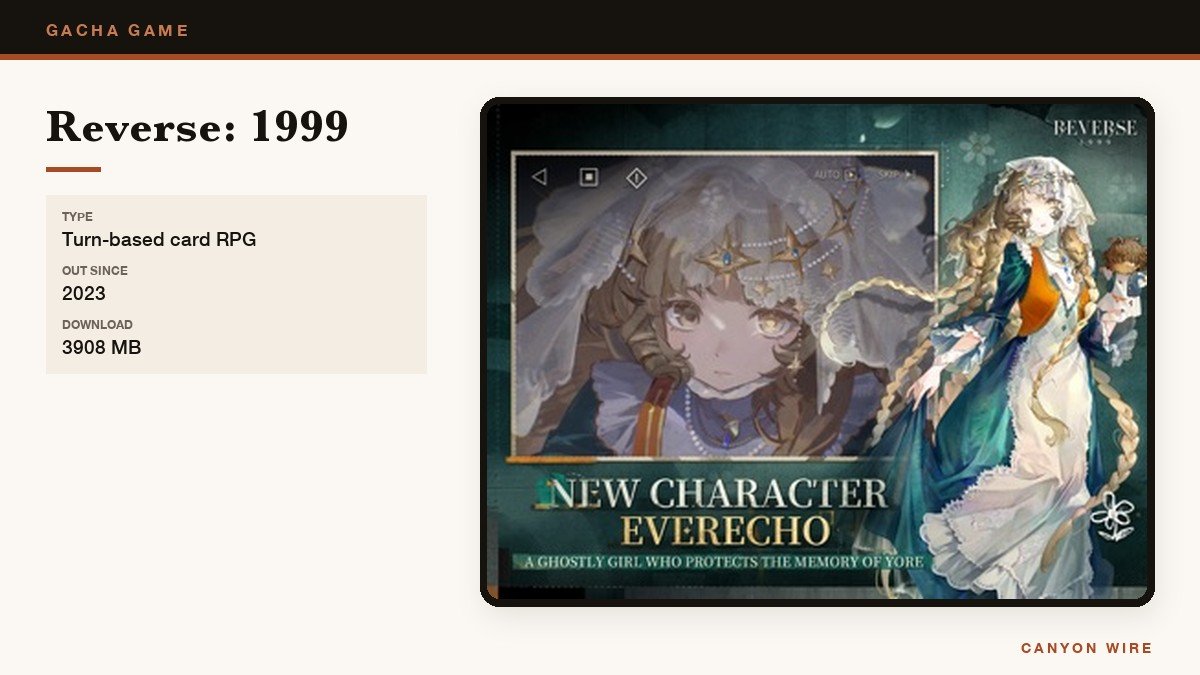
Combat is card-based rather than skill-based, set in a twentieth century where magic is receding, and the writing and voice work are the reason people stay. Turn-based card play suits short sessions on a phone, and the roster is small enough that missing a banner is not the setback it is in a game with two hundred characters.
Reverse: 1999 is free from BLUEPOCH GAMES CO., LIMITED, released 2023-10-25, around 3908 MB before updates.
8. Umamusume: Pretty Derby
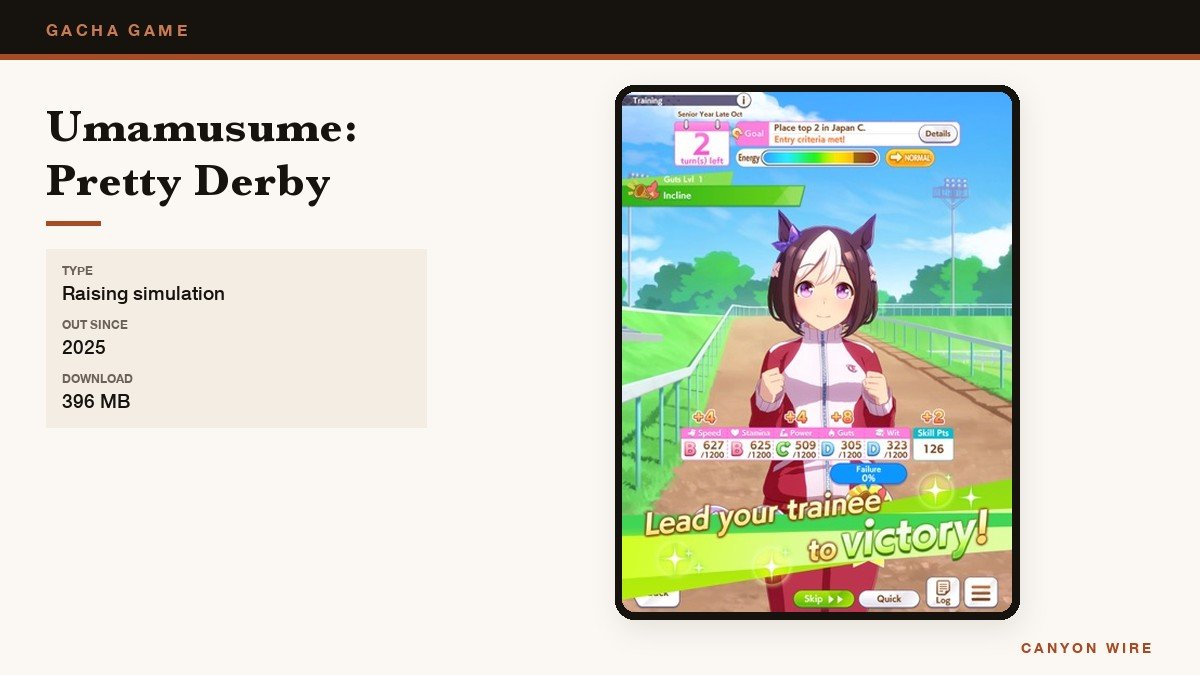
Not a combat game at all. You train a character over a fixed number of turns and then race, which makes each run a self-contained forty minutes with a result at the end. The gacha supplies both characters and support cards, and the support cards are where the money actually goes, which is a structure worth recognising before you start.
Umamusume: Pretty Derby is free from Cygames, Inc., released 2025-06-25, around 396 MB before updates.
Playing One Without Paying
All eight are completable without spending, and the large majority of players never do. What free play costs is selectivity: you cannot own everything, so the skill is in deciding which banners to ignore.
- Decide on one character per patch at most, and skip the rest however good they look.
- Never start pulling below the pity you need, because that is how people end with nothing.
- Claim every free source, since dailies, events and mail add up to more than most realise.
- Build the low-rarity characters you already have, which clear almost all story content.
- Budget for roughly double the pity figure when you want one specific limited character.
Generosity varies more between these titles than the shared mechanics suggest. A game where most of the roster drops from ordinary stages is a fundamentally different bargain from one where every character comes off a banner, even when both publish the same rates. Release pace matters as much: a slower schedule makes the same free income go further.
What These Games Do to a Phone
Several of these are real-time 3D games and they are among the heaviest things on either store. Expect the download to double after the first round of updates, expect a sustained frame rate well under the peak, and expect the handset to warm within twenty minutes.
Capping the frame rate rather than chasing the display refresh is the single most effective setting and costs less visually than dropping resolution. Beyond that, the advice in our guide to a phone that keeps overheating applies, and a clip-on cooler is the hardware answer for anything longer than half an hour.
Frequently Asked Questions
What does pity mean?
Pity is a counter guaranteeing a rare result after a set number of unsuccessful pulls. Hard pity is the guarantee itself, usually at 80 to 90, and soft pity is the window before it where the published odds climb. Pity normally carries over between banners.
Are gacha games gambling?
Legally it depends on jurisdiction. Several countries treat randomised paid rewards as gambling and regulate them, which is why publishing odds became standard. The distinction usually drawn is that nothing won can be converted back into money, though the mechanics that make it compelling are the same.
Which gacha game is the most generous?
The ones where characters drop from ordinary gameplay rather than only from banners, which on this list means the side-scrolling shooter and the idle title. A slower character release schedule has the same effect, because the same free income covers a larger share of what is released.
Can you catch up in an old gacha game?
Usually more easily than in a new one. Long-running titles hand new accounts large starter rewards, their early content has been rebalanced repeatedly, and years of characters have moved into the permanent pool. Starting late is close to an advantage.