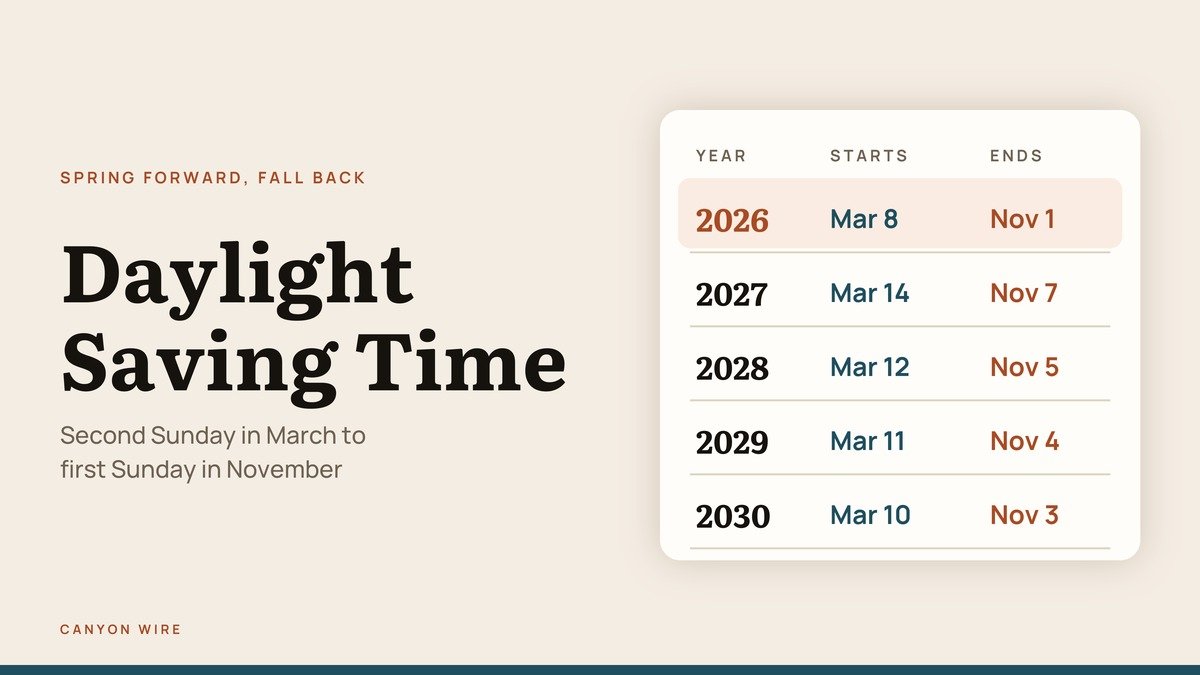
Daylight saving time began as a wartime fuel-saving measure in 1916, and more than a century later the United States is closer than ever to ending the twice-yearly switch. In July 2026 the House voted to make daylight time permanent, but until the Senate acts, clocks still fall back at 2 a.m. on Sunday, November 1, 2026.
The fight over the clock is older than most people think. It runs from a Benjamin Franklin joke through two world wars, an energy crisis, 19 state laws waiting on Congress and a medical lobby that wants the opposite outcome. Here is how the system was built, who is trying to change it, and the dates that stay on the calendar until they do.
Is Daylight Saving Time Ending?
Not yet. The House passed the Sunshine Protection Act on July 14, 2026, by 308 to 117, but the Senate has not voted on it. As of October 2026 the bill sits in the Senate Commerce Committee, so daylight saving time still ends on November 1, 2026, and returns on March 14, 2027.
A Timeline of Daylight Saving Time, 1784 to 2026
| Year | What changed |
|---|---|
| 1784 | Benjamin Franklin’s satirical essay urges Parisians to rise with the sun and save candles |
| 1895 | George Hudson proposes a two-hour seasonal shift in New Zealand |
| 1907 | William Willett publishes “The Waste of Daylight” in Britain |
| 1916 | Germany advances clocks one hour from May 1 to September 30; Britain follows |
| 1918 | Standard Time Act creates U.S. time zones and summer DST; first switch March 31 |
| 1919 | Congress repeals national DST over President Wilson’s veto |
| 1942-1945 | Year-round “War Time” until September 30, 1945 |
| 1966 | Uniform Time Act sets national dates and lets states opt out |
| 1974-1975 | Year-round DST trial during the oil embargo, cut short by winter standard time |
| 1986 | Start moves from the last Sunday in April to the first |
| 2007 | Energy Policy Act of 2005 rules begin: second Sunday in March to first Sunday in November |
| 2022 | Senate passes the Sunshine Protection Act by unanimous consent; the House never votes |
| 2026 | House passes the Sunshine Protection Act 308 to 117 on July 14 |
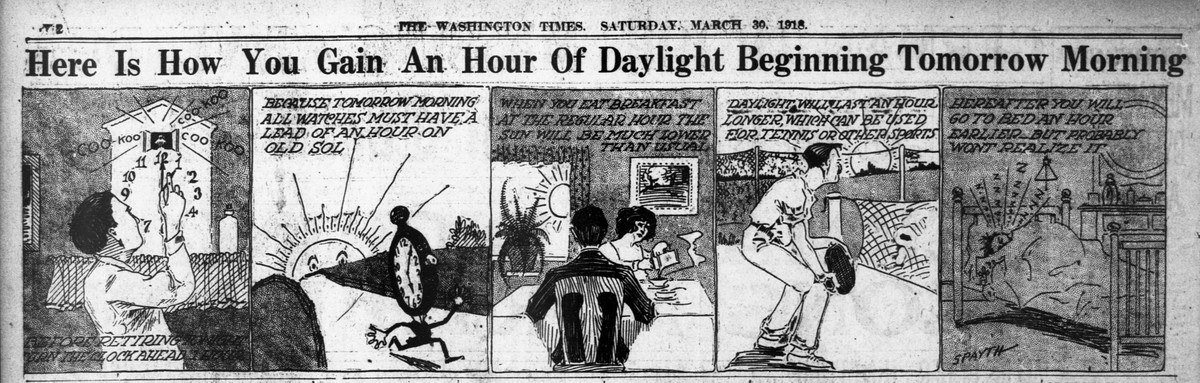
Newspapers spent the spring of 1918 teaching readers a brand-new habit. On March 30, 1918, The Washington Times ran a strip promising “an hour of daylight beginning tomorrow morning,” with the reassurance that “there is no occasion for the slightest confusion in the matter of daylight saving.”
Where the Idea Came From
Franklin’s Joke and Hudson’s Insects
Franklin is often named as the inventor, but his 1784 essay “An Economical Project” in the Journal de Paris was satire. He proposed that Parisians simply get up earlier, with candles rationed to one pound per family a week and cannon fired in the streets at sunrise. He never suggested moving the clock.
The first serious clock-shift plan came from George Vernon Hudson, a Wellington post office clerk and insect collector who valued after-work daylight. In 1895 he presented a paper to the Wellington Philosophical Society proposing a two-hour seasonal shift, and he followed it up in 1898.
Willett’s Pamphlet and the 1916 German Order
In Britain, William Willett self-published “The Waste of Daylight” in 1907, angry at sunlit summer mornings lost to sleep. He died in 1915, a year before any country acted on the idea.
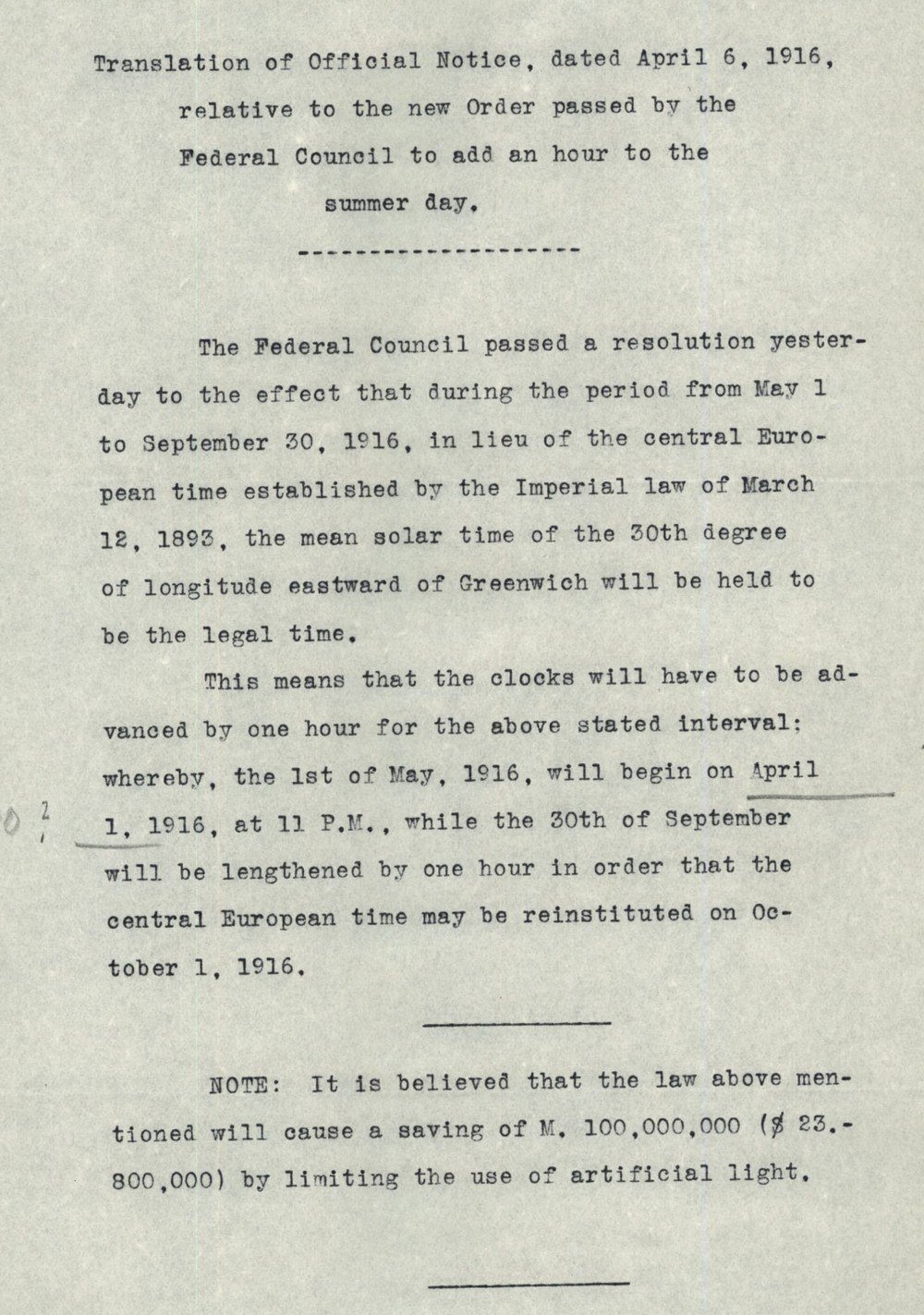
Imperial Germany moved first. Its Federal Council passed the order on April 6, 1916, advancing clocks one hour from May 1 to September 30, and the U.S. embassy in Berlin sent a translation to Washington two days later. The note expected savings of 100 million marks, about $23.8 million, by limiting artificial light. The 1916 German order preserved at the National Archives shows how closely Washington was watching. Austria-Hungary followed within weeks, and Britain a few weeks after Germany.
1918: America’s First Switch
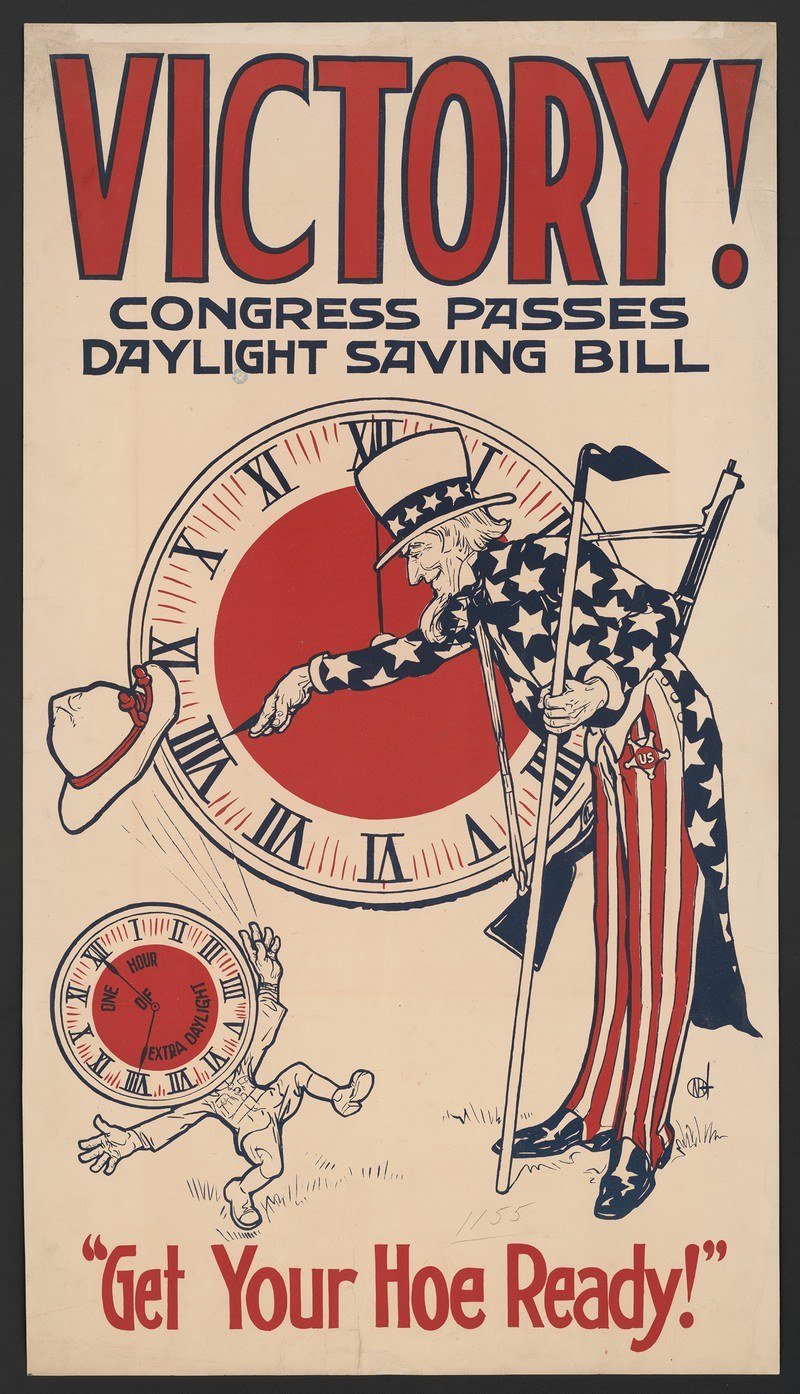
The Standard Time Act, enacted March 19, 1918, created five U.S. time zones and a summer daylight period from the last Sunday in March to the last Sunday in October. Clocks first sprang forward on March 31, 1918, and fell back on October 27. A United Cigar Stores Company poster celebrated the law with Uncle Sam, a rifle, a hoe and the slogan “Get your hoe ready!”
The law lasted barely a year. On August 20, 1919, Congress repealed daylight saving time over President Woodrow Wilson’s veto, leaving it to cities and states.
From War Time to the Uniform Time Act
Congress brought the clock back in January 1942 as year-round “War Time,” meant to ease evening peak loads on the power grid. It expired on September 30, 1945. For the next two decades, towns and states set their own rules, and in 1961 the Interstate Commerce Commission asked Congress to reexamine “the entire field of standard time.”
The answer was the Uniform Time Act of 1966. It set national dates, the last Sunday in April to the last Sunday in October, and let a state exempt itself only as a whole. Hawaii opted out in 1967 and Arizona in 1968, and the Department of Transportation took charge of time zones the same year the act passed.
The closest earlier test of permanent daylight time came during the 1973 oil embargo. A trial of year-round DST began on January 6, 1974, but Congress restored standard time from October 27, 1974, to February 23, 1975. The Transportation Department’s 1974 report found effects “so small that they could not in general be reliably separated” from other changes.
The Sunshine Protection Act and the Fight in Congress
The bill to “lock the clock” was first introduced in 2018. Its 2021 version, sponsored by Sen. Marco Rubio, passed the Senate by unanimous consent on March 15, 2022, then died when the House never took it up.
The current version, H.R. 139 from Rep. Vern Buchanan of Florida and S. 29 from Sen. Rick Scott, was introduced in January 2025. The Senate Commerce Committee held a hearing on April 10, 2025, titled “If I Could Turn Back Time: Should We Lock the Clock?” In the House, the measure was folded into a motor vehicle bill that Energy and Commerce approved 48 to 1 in May 2026.
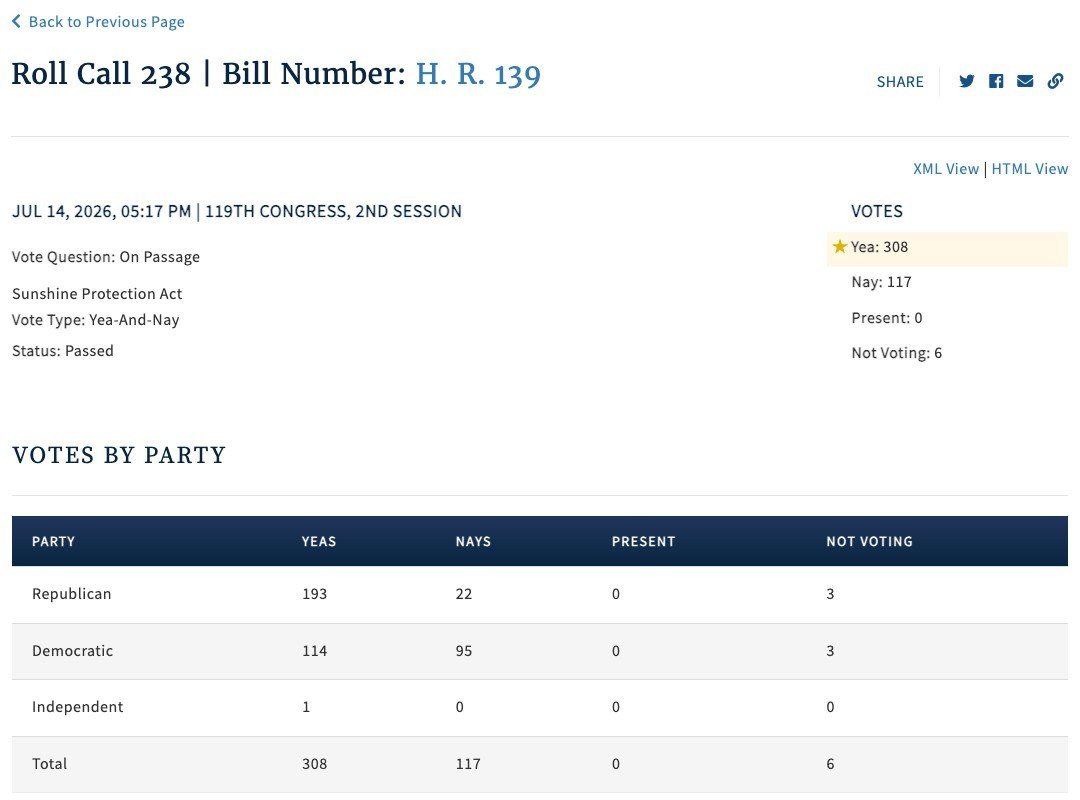
On July 14, 2026, the House passed it 308 to 117, as House roll call 238 records. Republicans voted 193 to 22 in favor and Democrats 114 to 95. The text of H.R. 139 as passed by the House repeals the seasonal switch and moves every standard time zone one hour ahead, while states that skip daylight time today may keep their current clocks.
The bill reached the Senate on July 15, 2026, and was referred to the Commerce Committee, its last recorded action. Rival bills point the other way, including the Sunshine for Our Kids Act of 2026, which would make standard time permanent, and the Daylight Act of 2026, which would split the difference with a 30-minute shift.
The 19 State Laws Waiting on Congress
States can already choose permanent standard time, but permanent daylight time needs federal approval. Since 2015, lawmakers in 47 states have filed bills to change their clocks, and 19 states have passed “trigger” laws that switch them to year-round daylight time once Congress allows it:
| Year enacted | States | Count |
|---|---|---|
| 2018 | Florida | 1 |
| 2019 | Delaware, Maine, Oregon, Tennessee, Washington | 5 |
| 2020 | Idaho, Louisiana, South Carolina, Utah, Wyoming | 5 |
| 2021 | Alabama, Georgia, Minnesota, Mississippi, Montana | 5 |
| 2022 | Colorado | 1 |
| 2024 | Oklahoma | 1 |
| 2025 | Texas | 1 |
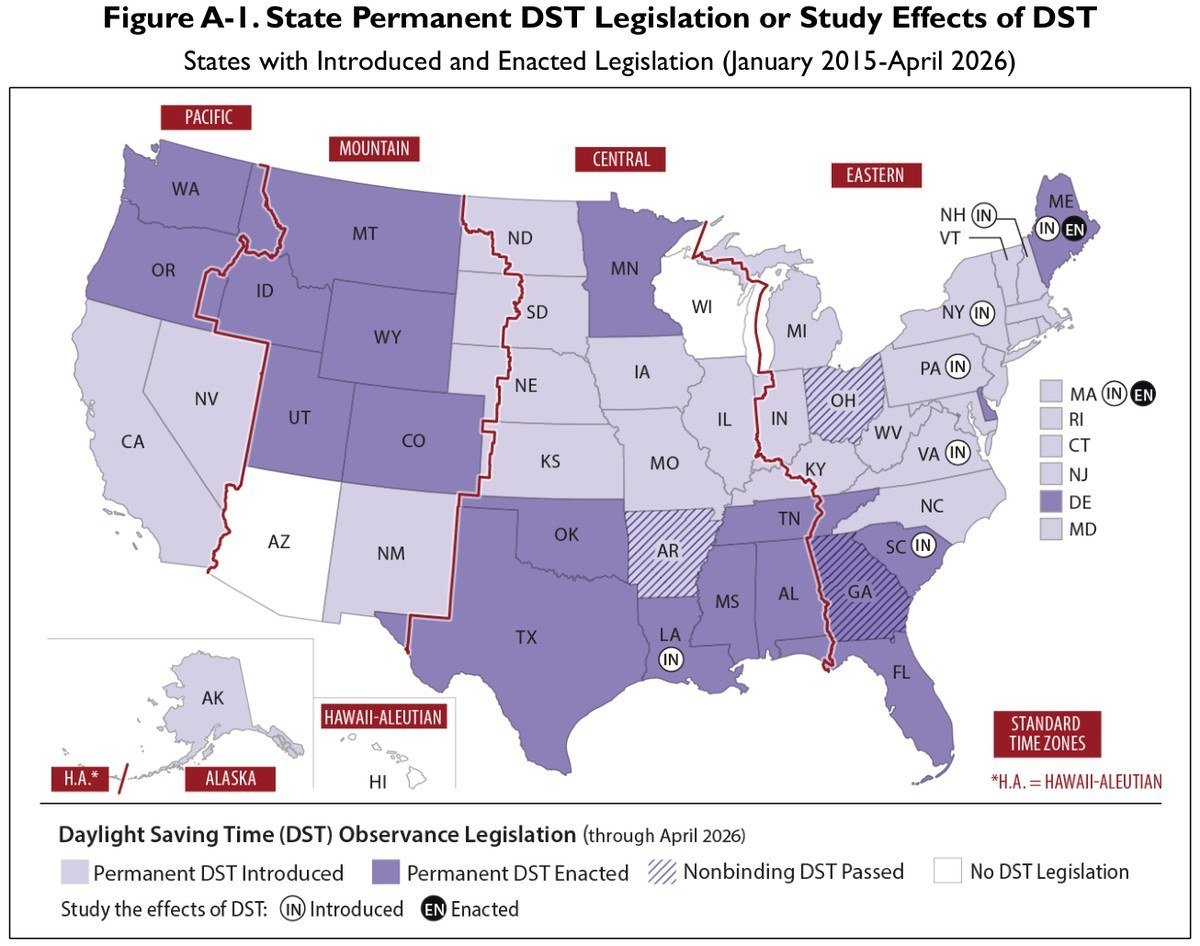
Some laws carry extra conditions. Idaho’s applies to its Pacific time zone counties only after Washington makes the move, Delaware’s waits on Pennsylvania, New Jersey and Maryland, and Oregon’s must go to voters. California voters approved Proposition 7 in 2018 with nearly 60% of the vote, but its follow-up bill died in the state Senate.
Permanent Standard Time vs. Permanent Daylight Time
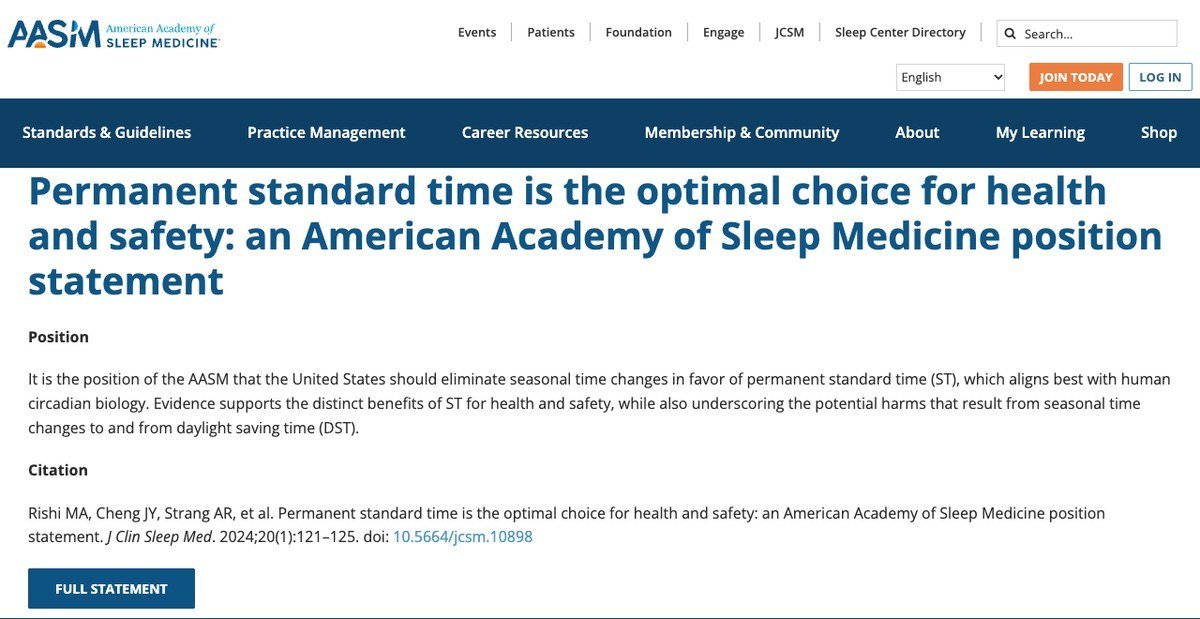
Ending the switch does not settle which clock to keep. The American Academy of Sleep Medicine argues for permanent standard time, which it says “aligns best with human circadian biology,” and its 2024 statement was endorsed by 20 groups including the National Safety Council and the National PTA.
The safety data mostly concerns the switch itself. A 2020 study in Current Biology found the spring change raised U.S. fatal crash risk by 6%, mainly in the morning, with no effect in the fall. The academy also warns that sleep stays disrupted for five to seven days after each change, which is a good week to make sure your mattress is doing its job.
The energy case has faded too. The Department of Energy found that the 2007 extension cut national electricity use by 0.03%, about 0.02% of total energy consumption.
How Other Countries Settled the Time Change
About a third of the world’s countries use daylight saving time, mostly in Europe and North America, while China, India and Russia keep one clock all year. The others have tried several exits:
- European Union: summer time ends at 1 a.m. GMT on the last Sunday in October. Parliament voted in March 2019 to end the switch from 2021, but the Council of the EU has not approved it, so the clocks still change.
- Mexico: dropped daylight saving time for most of the country in October 2022, keeping it along the U.S. border.
- British Columbia: sprang forward on March 8, 2026 for the last time and will not fall back on November 1, staying on year-round Pacific time at UTC-7.
Daylight Saving Time Dates Through 2030
Until a law changes, the rule from 2007 holds: 2 a.m. on the second Sunday in March to 2 a.m. on the first Sunday in November. Hawaii, most of Arizona, Puerto Rico, Guam, American Samoa, the Northern Mariana Islands and the U.S. Virgin Islands skip it.
| Year | Starts | Ends | Days on DST |
|---|---|---|---|
| 2026 | March 8 | November 1 | 238 |
| 2027 | March 14 | November 7 | 238 |
| 2028 | March 12 | November 5 | 238 |
| 2029 | March 11 | November 4 | 238 |
| 2030 | March 10 | November 3 | 238 |
The fall change means darker evenings from November through mid-March, the season when good lamps for the home earn their keep, and the long weekend of Thanksgiving always lands on standard time.
Frequently Asked Questions
Why do we have daylight savings time?
Germany introduced it in 1916 and the U.S. in 1918 to save fuel during World War I, by shifting an hour of daylight into the evening. The current national system dates from the Uniform Time Act of 1966.
Did the Sunshine Protection Act become law?
No. The House passed it on July 14, 2026, but the Senate has not voted on it. A 2022 version passed the Senate and died in the House.
Can a state stay on daylight saving time all year?
Not without Congress. Federal law allows states to stay on standard time all year, as Hawaii and Arizona do, but not on daylight time, so 19 state laws are waiting on federal action.
Who invented daylight saving time?
New Zealand’s George Hudson proposed a seasonal clock shift in 1895, and Britain’s William Willett campaigned for one from 1907. Benjamin Franklin’s 1784 essay was a joke about waking up earlier, not a plan to change clocks.