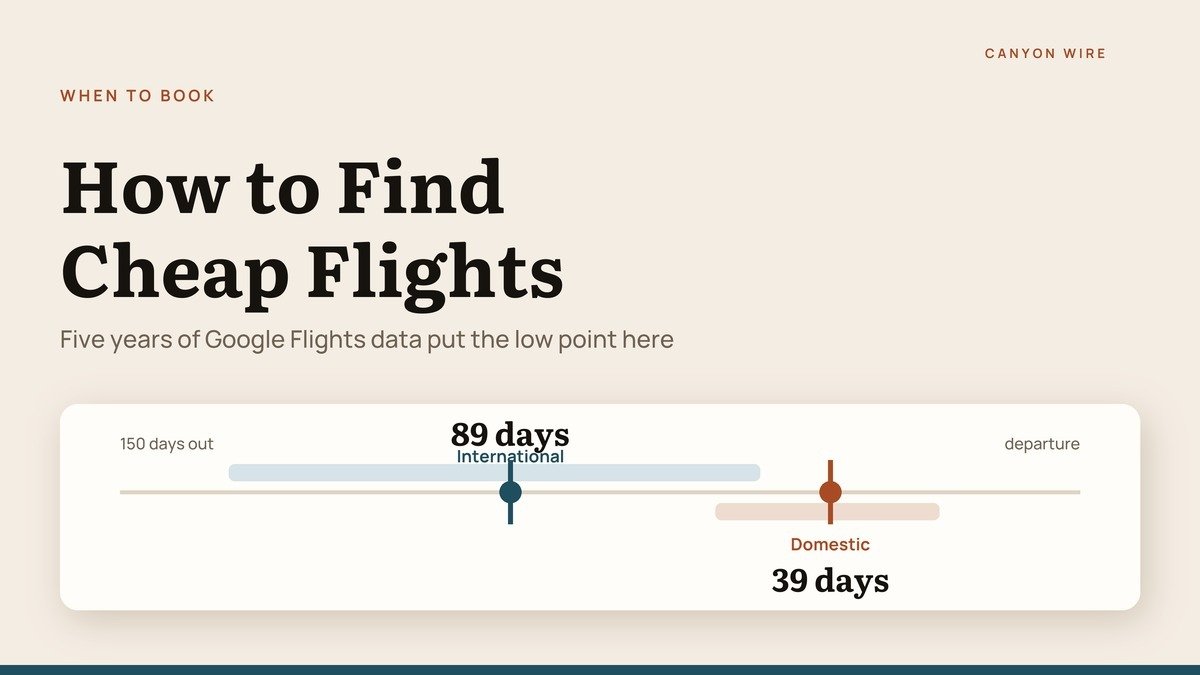
Knowing how to find cheap flights comes down to two decisions: roughly when you buy, and exactly which days you fly. Google released an analysis on 5 October 2026 built from five years of its own flight searches, and it puts the low point for US domestic fares at 39 days before departure and for international fares at 89 days. Miss that window badly and no comparison site will rescue the price.
The second decision is worth more. Flying out on a Monday and home on a Tuesday or Wednesday averages about 14 percent less than the same trip across a weekend. A nonstop ticket runs roughly 20 percent above one with a connection. Below are 15 tactics built around those two levers, the tools that make each one quick, and what the checkout page adds once you have clicked through.
The Booking Window, Route by Route
Airlines release a cabin in fare buckets. The cheapest seats go first, and the system steps up a bucket each time one empties, which is why the same seat costs different amounts on different days. The window below is where those buckets have historically been at their lowest.
| Trip type | Average low point | Low price range |
|---|---|---|
| US domestic | 39 days before departure | 22 to 57 days |
| International | 89 days before departure | 50 to 133 days |
| Europe | 90 days before departure | 49 days or more |
| Mexico and the Caribbean | 43 days before departure | 24 to 69 days |
| Thanksgiving | 34 days before departure | 21 to 57 days |
| Christmas | 56 days before departure | 33 to 67 days |
| Spring break, March or April | 50 days before departure | 29 to 64 days |
| Summer, July or August | 21 days before departure | 20 to 47 days |
On long-haul routes the average saving inside the low range is small, so landing anywhere in the window is enough. The day of the week you buy barely matters at all: purchasing on a Wednesday instead of a Sunday, the dearest purchase day, moved the price about 1.4 percent.
1. Price the Route on Two Search Engines, Not One
Comparison engines index fares and then pass you to an airline or an agency to pay. Each indexes a slightly different set of sellers, so the lowest number is rarely identical across two of them.
| Tool | What it does best | Who takes the payment |
|---|---|---|
| Google Flights | Date grid, price graph and price history together | Hands off to an airline or agency |
| Skyscanner | Explore everywhere search, nearby-airports toggle | Hands off to an airline or agency |
| KAYAK | Smart Filters for stops, departure times and trip length | Hands off to an airline or agency |
| Momondo | A second index for pricing a fare again | Hands off to an airline or agency |
| MakeMyTrip | Card offers and promotional codes on Indian routes | Sells the ticket itself |
| ixigo | Student, senior, armed forces and medical fares | Sells the ticket itself |
| EaseMyTrip | The same special-fare categories plus seasonal codes | Sells the ticket itself |
| Cleartrip | Flat-fee date changes offered at booking | Sells the ticket itself |
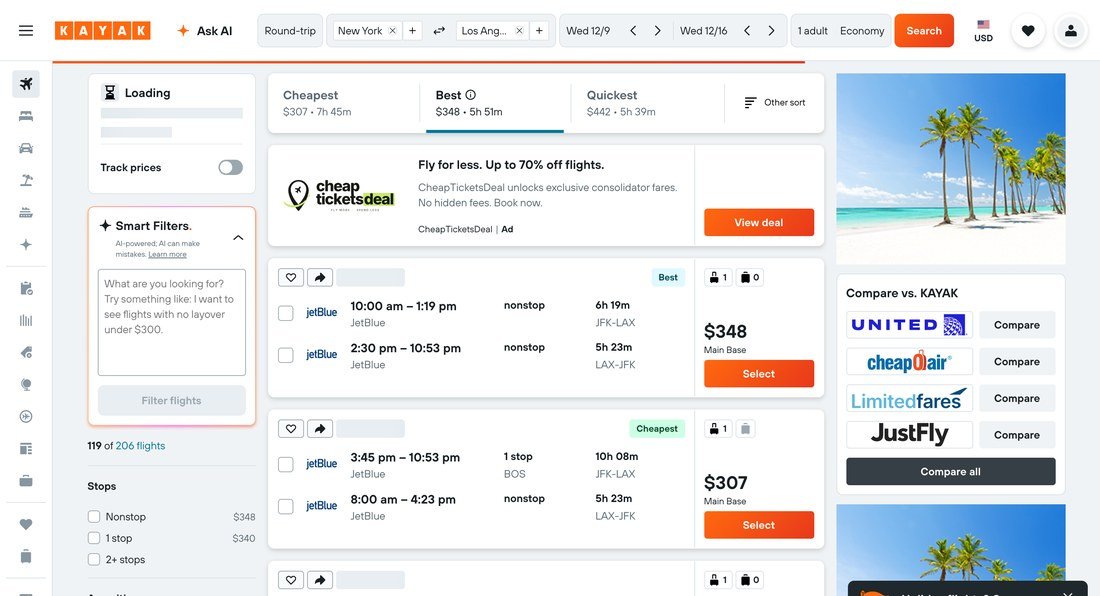
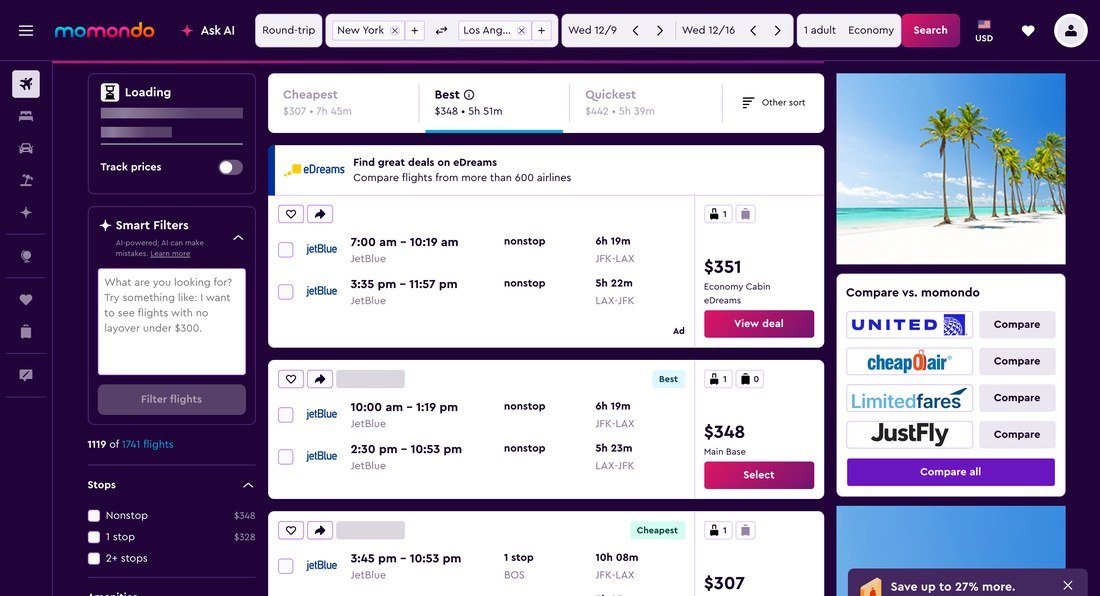
Start on Google Flights for the calendar view, then repeat the identical search on KAYAK or Momondo. Compare the totals you would actually pay rather than the headline fares, because a $40 gap usually closes once one site adds a bag at checkout.
2. Move Your Dates Before You Move Anything Else
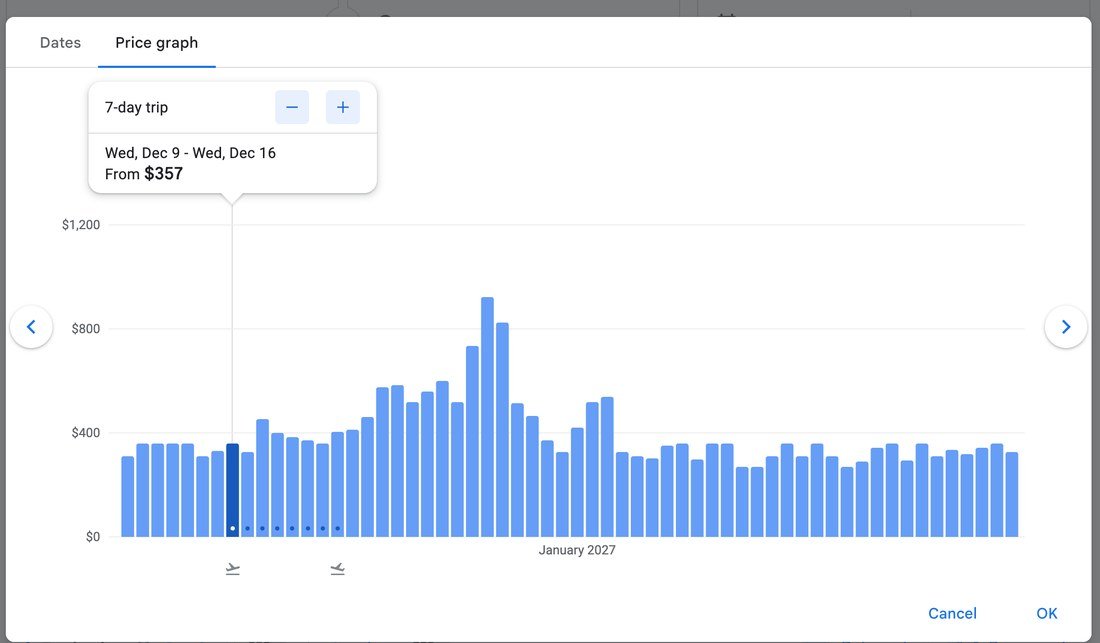
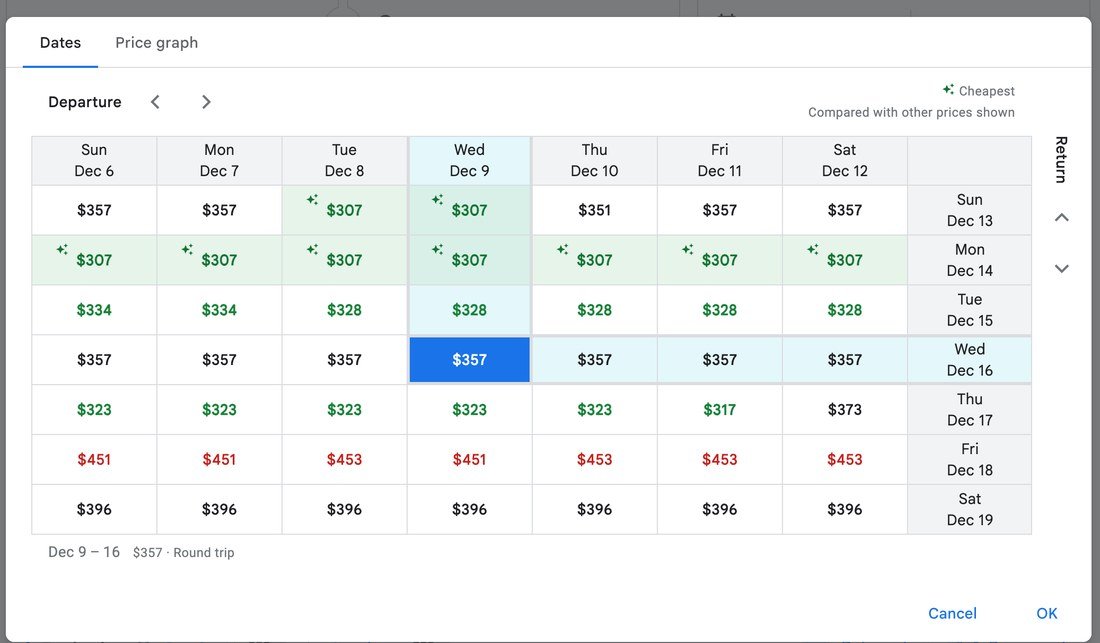
A date grid prices every departure and return pairing for a route side by side. It is the single fastest saving available, and it takes about ten seconds to read.
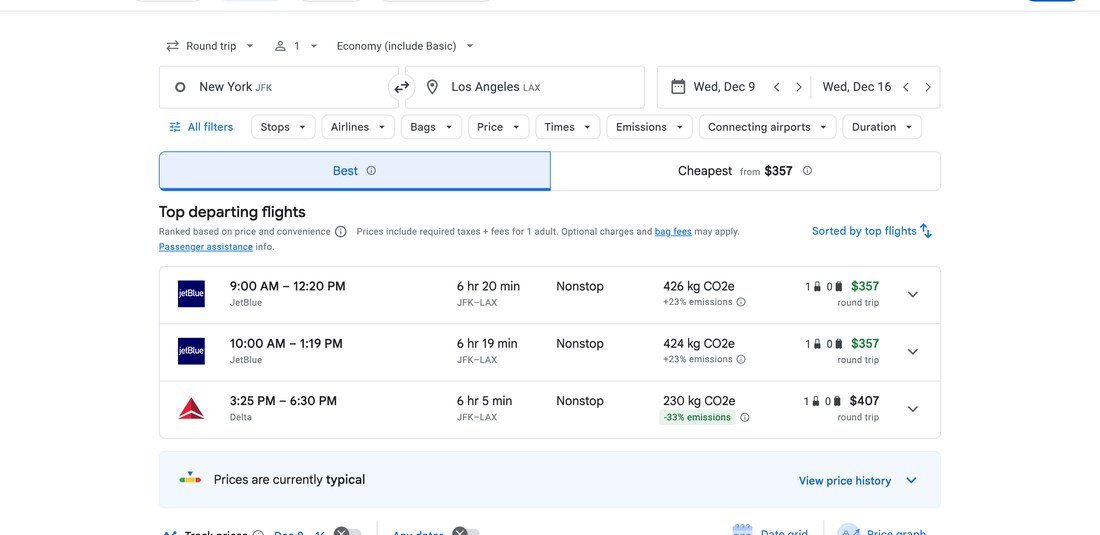
Here is a live one. A New York to Los Angeles round trip in the second week of December 2026 priced at $357 on the dates we chose. Leaving a day earlier and coming back two days earlier brought the same week to $307. Flying home on the Friday instead took it to $453, a 48 percent spread across one grid.
Set any saving against what the change costs. Fifty dollars for leaving a day early is a good trade; the same fifty dollars is a poor one when it buys an extra night of accommodation.
3. Search Without a Destination
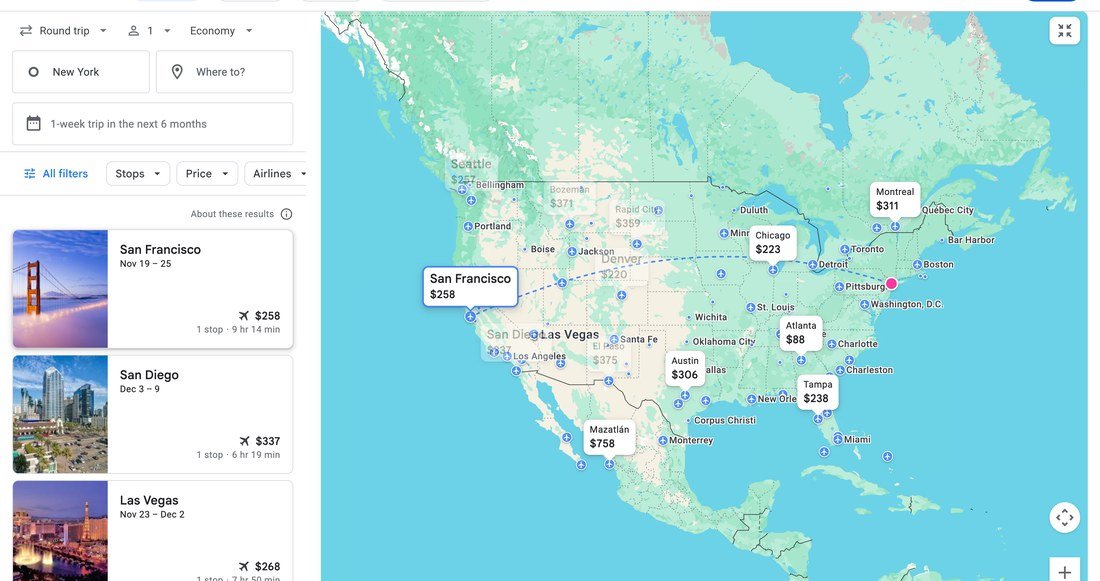
If the trip matters more than the place, let the fare decide. Google Flights has an explore map and Skyscanner has an everywhere search. Both take an origin and a trip length and return cities ranked by price.
Run from New York for a one-week trip in the next six months, that map came back with San Francisco at $258, Las Vegas at $268 and San Diego at $337. Before booking the cheapest pin, price the journey from that airport to where you are actually going. An arrival city two hours short of your destination is not the bargain the map suggests.
4. Set a Price Alert and Stop Refreshing
Google Flights, Skyscanner, KAYAK and Momondo will all follow a route and set of dates and email you when the fare moves. Set the alert the day the trip is decided rather than the fortnight before you fly.
Watching early teaches you what normal looks like on your route, which is the only way to tell a real drop from a number that merely sounds low. When an alert arrives, open the fare again on the seller’s own page before paying. Indexed prices go stale between refreshes.
5. Widen the Search to Nearby Airports
Most large cities have a second airport, and that is usually where the low-cost carriers operate. Skyscanner and KAYAK both have a nearby-airports setting that widens a search without you entering each airport code by hand.
Do the arithmetic before switching. Parking, a rail fare, a longer taxi ride and two extra hours can erase a $70 gap, and a connection that changes airports within a city adds a missed-flight risk on top. For a sense of how the major hubs compare on traffic, we ranked the busiest airports in the world.
6. Compare Two One-Way Fares Against the Round Trip
There is no rule that the airline flying you out has to fly you home. When one carrier is cheap outbound and another is cheap inbound, two one-way tickets can beat the round trip.
The trade-off is protection. Separate tickets are separate contracts, so a delay on the first leaves the second airline owing you nothing. Leave several hours between them, never book a same-day connection across two tickets, and check each ticket’s baggage allowance before assuming you have saved money.
7. Judge a Low-Cost Carrier on the Checkout Total
Budget airlines unbundle what legacy carriers include, so the fare buys the seat and little else. The only fair comparison is the final total with the extras you will genuinely use added to both options.
Price the cabin bag, the checked bag, seat selection and the change fee on each carrier, then check which airport each uses. A fare $55 lower from an airport 50 miles out is not lower. Filter out the itineraries that fail on stops or journey length first, so you are comparing flights you would actually take.
8. Check the Airline’s Own Site Before You Pay
Once you have a fare you like, search the same flight on the airline’s website. US carriers are required under 14 CFR 259.5 to disclose when their lowest fare is available elsewhere, so the numbers often match, and booking direct leaves you with one party to deal with when a schedule changes.
Weigh four things, not one: the final total, the baggage allowance, the change and cancellation terms, and who handles support. A $20 saving through an agency is a poor trade for a non-refundable ticket and a queue.
9. Use the Discounts You Already Qualify For
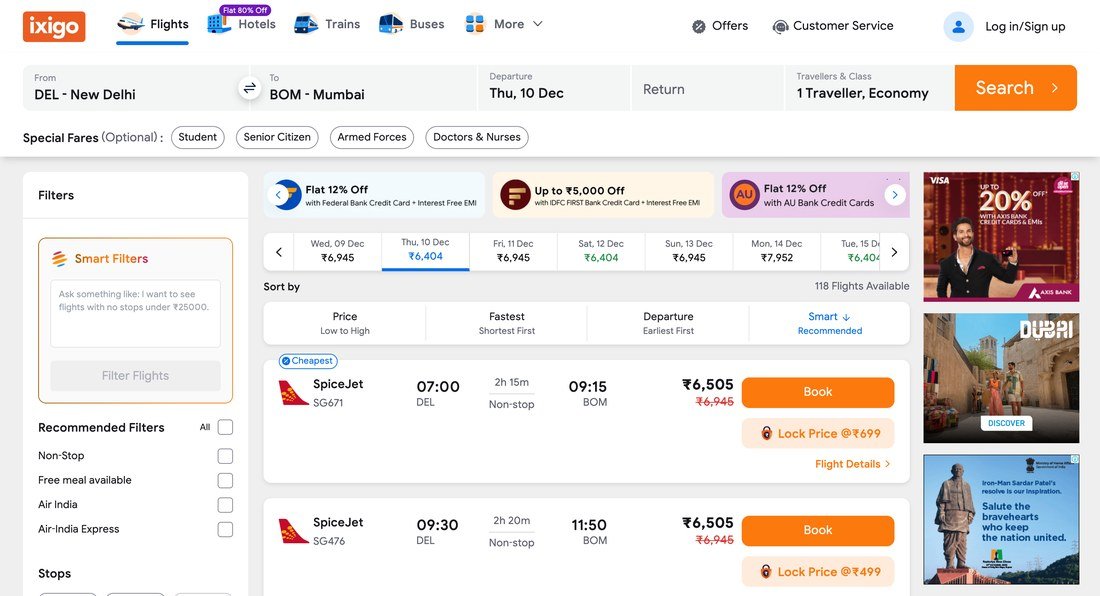
Some fares are not shown unless you ask for them. Indian booking platforms make this explicit: ixigo, EaseMyTrip and Cleartrip all carry special-fare toggles on the search form for students, senior citizens and armed forces personnel, with two of them adding doctors and nurses, typically worth up to 600 rupees off or additional baggage.
The same discounts exist elsewhere under other names: student and youth fares, senior fares, loyalty programmes, co-branded card benefits and promotional codes. Read the eligibility rules and the documents you will need at the airport, then check the discounted total against the ordinary fare. A special fare is not automatically the lowest.
10. On Indian Routes, Price the Platforms and the Airline
MakeMyTrip, ixigo, EaseMyTrip and Cleartrip sell the ticket themselves rather than passing you to the carrier, and most of their edge comes from bank-card offers and promotional codes rather than a lower base fare.
A Delhi to Mumbai search for 10 December showed how tight the field is: SpiceJet from 6,945 rupees, Air India Express from 7,681, Air India from 7,852 and Akasa Air from 8,008. Non-stop started at 6,945 rupees against 7,732 for the cheapest one-stop routing, so the connection cost more and took longer. Price the airline’s own site as a fifth option.
11. Redeem Miles Only Where They Beat the Cash Fare
Frequent-flyer miles and transferable card points cut the cash price of a seat, but only on the right redemption. Divide the cash fare by the points required and compare that return against what the same points fetch elsewhere.
Check the taxes and carrier charges attached to the award before you confirm. On several long-haul routes those run into the hundreds, which can leave a reward seat costing more cash than a discounted paid fare on the same day.
12. Travel Light Enough to Skip the Bag Fee
Checked bags are where a cheap fare stops being cheap. Delta charges $45 for a first standard checked bag on a domestic flight and $55 for the second, each way. American, under allowances updated on 18 May 2026, charges $50 for the first or $45 prepaid online, and $60 for the second or $55 online, with $5 more on each for Basic Economy.
For two people on a round trip, that is $180 of luggage sitting on top of the fare. Check your bag against what each US airline allows as a carry-on before you leave, prepay online if you must check one, and keep toiletries inside the TSA liquid rules so nothing is pulled at the checkpoint.
13. The Errors That Add Money After the Search
Most airfare is lost after you have found a good price, not before. These are the expensive ones:
- Believing in incognito mode. A fare reflects demand, how many seats are left in a bucket and when the airline last republished it. Clearing cookies holds nothing, and a price that climbs between two searches is almost always a bucket selling out.
- Buying from a seller you have not checked. A $25 edge at an unfamiliar agency is a poor trade when a schedule change leaves you on hold. Read the cancellation terms before you enter a card.
- Skipping the fee page. Seat selection, bags, payment surcharges and service fees all land after the fare you compared.
- Leaving a tight connection across two tickets. A late first leg does not oblige the second airline to rebook you.
- Overlooking visa and transit rules. A cheap routing through a third country can need a transit visa you do not hold.
- Wasting the 24-hour window. US carriers must hold a reservation at the quoted fare, or allow a cancellation without penalty, for at least 24 hours after booking, as long as it was made a week or more before departure. That is a free day to keep looking.
14. Build the Habit of Checking Twice
Fares published by an airline reach comparison engines on a delay, so the number you clicked is not always the number at checkout. Open the final page and read the total, the bag allowance and the fare rules before you pay.
If anything has moved, go back and re-run the comparison rather than accepting the new figure. A search that took twelve minutes is worth repeating for a difference of $40.
15. How to Find Cheap Flights in Eight Steps
Done in this order, the whole search takes about fifteen minutes:
- Settle on a destination and a rough set of dates.
- Search Google Flights for a baseline fare on the route.
- Open the date grid and price graph, and note the cheapest pairing.
- Repeat the identical search on KAYAK or Momondo.
- Add nearby airports and test whether the saving survives the ground transport.
- Not ready to buy? Set a price alert and leave it.
- Add bags, seats and fees to both finalists so the totals are comparable.
- Check the airline’s own site last, and read the change and refund terms before paying.
One habit outranks every tactic here: never buy the first number you see. A single second opinion and one shift of the calendar usually beats everything else combined.
Frequently Asked Questions
How far in advance should I book a flight?
US domestic fares average their lowest around 39 days before departure, within a low range of 22 to 57 days. International fares bottom out nearer 89 days. Christmas sits earlier again at about 56 days, Thanksgiving at 34. Start watching the route early and buy once you are inside the window.
Which website finds the cheapest flights?
Google Flights is the best opening move because its date grid and price graph answer the two questions that move a fare most. Run it again on KAYAK or Momondo and confirm on the airline’s site. The cheapest seller varies by route, so no one site wins every search.
Is it cheaper to book directly with the airline?
Sometimes, and rarely by much. US carriers must disclose when a lower fare is available elsewhere, so the prices often match. Booking direct generally gives better change terms and one party to deal with, which is worth more than a small discount through an agency.
Do flight prices rise if you search the same route twice?
Not because of the search. Prices change when a fare bucket sells out, when demand shifts or when fares are republished, and comparison sites show cached numbers that age between refreshes. Incognito mode does not hold a price, so check the fare on the seller’s page before paying.