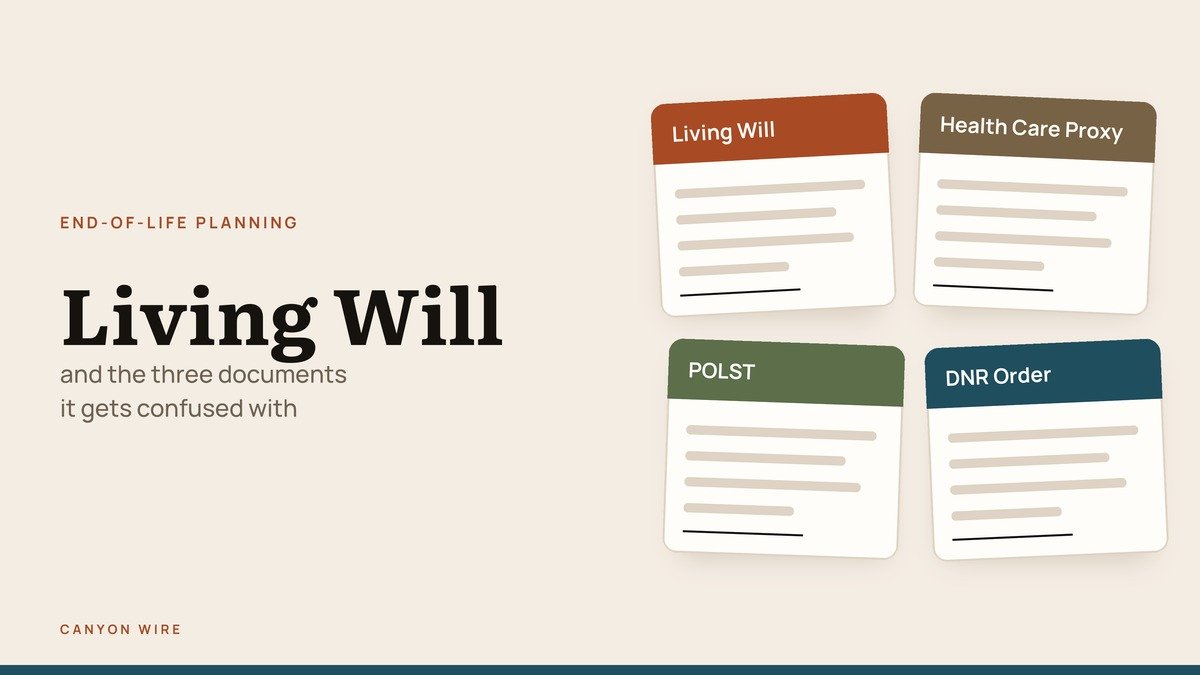
A living will is your written instruction to doctors about life-sustaining treatment, used only if you can no longer speak for yourself. It is one of several end-of-life documents, and people often confuse it with a health care proxy, a POLST form or a do-not-resuscitate order, each of which does a different job.
Getting the mix right matters because each document kicks in at a different moment and binds different people. This guide explains what a living will says, how it compares with the others, which decisions to make before you sign, and the forms and coverage available to veterans and people on Medicare.
Living Will Meaning: Your Treatment Choices in Writing
Medicare splits advance directives into two parts. The first is the health care proxy, a person you trust to make decisions. The second is the living will, which describes the treatments you want if your life is threatened, including dialysis, breathing machines, resuscitation and tube feeding, and whether you want to donate organs or tissue.
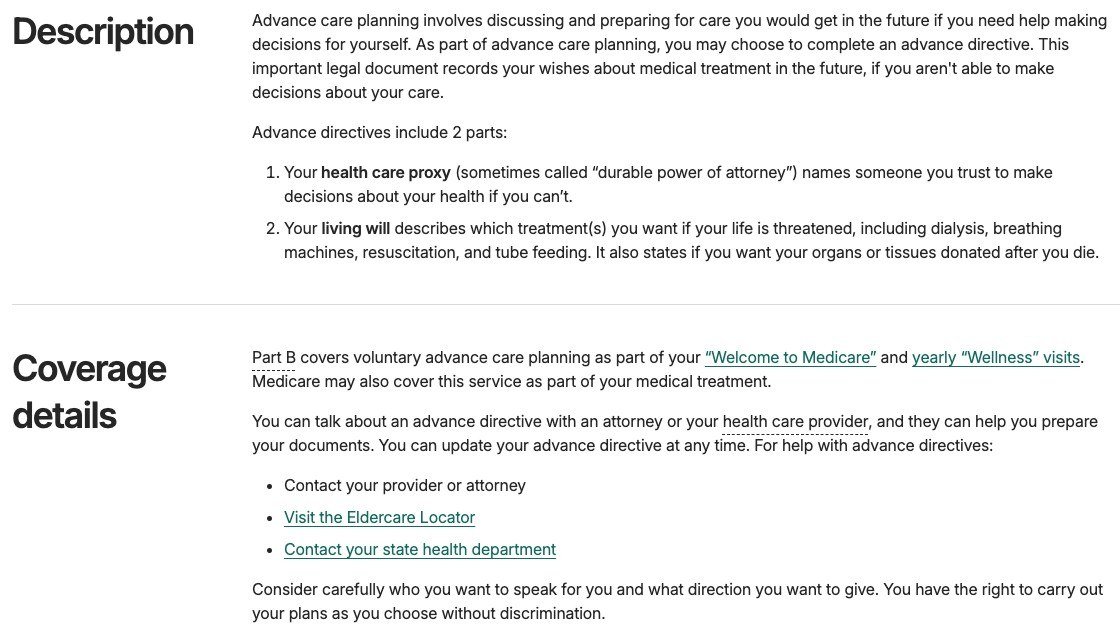
Federal law uses similar language. It defines an advance directive as a written instruction, such as a living will or a durable power of attorney for health care, recognized under state law and applying when a person is incapacitated.
A landmark case shows why the document matters. In Cruzan v. Director, Missouri Department of Health, decided June 25, 1990, the U.S. Supreme Court held that a state may require clear and convincing evidence of an incapacitated patient's wishes before treatment is withdrawn. A signed living will puts those wishes in writing before anyone has to ask.
Living Will vs Health Care Proxy, POLST, DNR and a Last Will
These five documents overlap, but none fully replaces another:
| Document | What it does | Who signs | When it applies |
|---|---|---|---|
| Living will | Your written instructions on treatments such as CPR, ventilators and tube feeding | You, following your state's witness or notary rules | When you can no longer communicate |
| Health care proxy (durable power of attorney for health care) | Names a person to make medical decisions for you | You, following your state's rules | When you can no longer decide for yourself |
| POLST or MOLST | Medical orders emergency staff can act on at once | A clinician (which types varies by state), after discussing it with you or your decision-maker | Immediately, usually near the end of life or in serious illness |
| DNR order | Tells staff not to attempt CPR | A clinician, placed in your medical chart | Immediately |
| Last will and testament | Distributes property and names guardians for dependents | You, under your state's will rules | After death |
The key difference is between instructions and orders. A living will states your wishes for doctors to follow. A POLST, MOLST or DNR is a medical order signed by a clinician, which medical staff can act on immediately; an out-of-hospital DNR is the version that tells EMS crews. The National Institute on Aging notes that even if your living will says you do not want CPR, having a DNR order in your file helps, because without one staff will try to restart your heart.
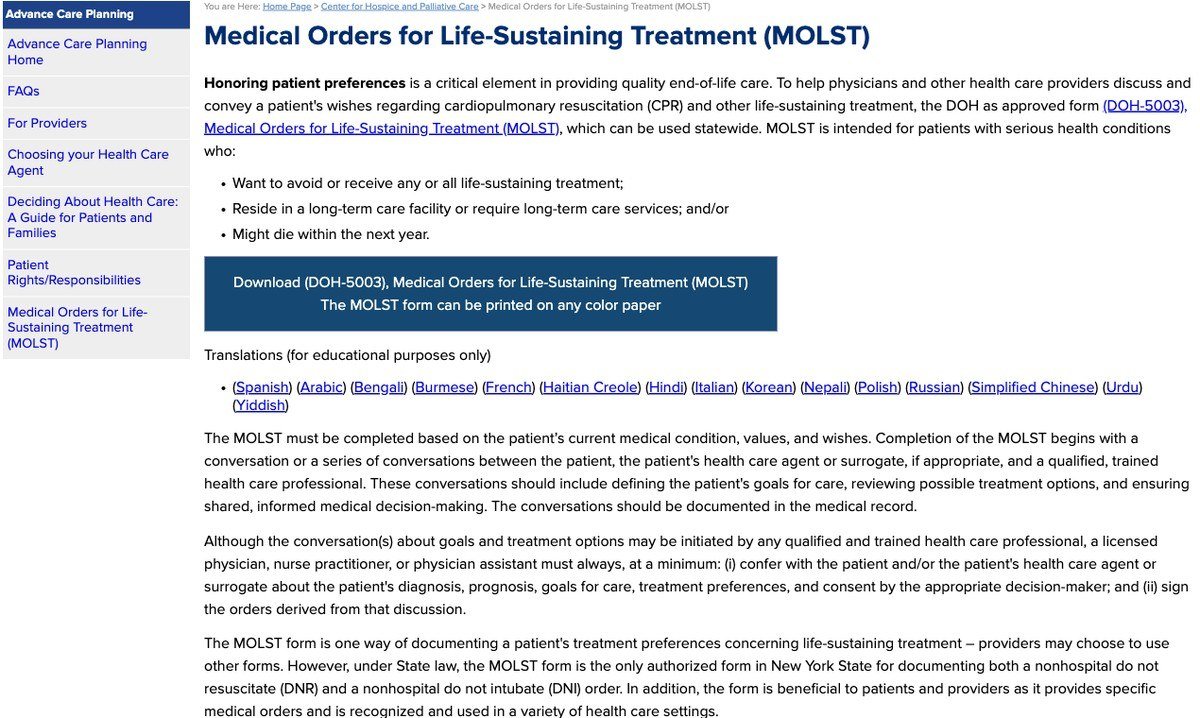
New York shows how specific this gets. Its MOLST, form DOH-5003, is meant for people who want to avoid or receive life-sustaining treatment, live in or need long-term care, or might die within the next year. Under state law it is the only authorized form for documenting both a nonhospital DNR and a nonhospital do-not-intubate order, and a physician, nurse practitioner or physician assistant must sign the orders.
Texas makes the split explicit with three separate tools: a Directive to Physicians, a Medical Power of Attorney and an Out-of-Hospital DNR Order.
Decisions to Make Before You Fill Out the Form
State forms ask you to choose in advance, so it helps to know what each choice means. Common questions include:
- Prolong life or not? California's form asks whether you want treatment withheld if you have an incurable and irreversible condition that will cause death within a relatively short time, become unconscious with no reasonable chance of waking, or the burdens of treatment would outweigh the benefits.
- What if death is expected soon? Texas asks what you want if you have a terminal condition with death expected within six months: comfort care only, or being kept alive with available life-sustaining treatment.
- Feeding tubes: NIA notes hand feeding is an alternative for people with dementia, and that artificial nutrition near the end of life does not meaningfully extend it.
- Implanted devices: an implanted defibrillator can be switched off, so say what you want if a doctor raises it.
- Pain relief: California's form lets you ask for pain treatment even if it hastens death.
Choose your proxy with the same care. The National Institute on Aging says a proxy must be at least 18 in most states, or 19 in Alabama and Nebraska. Guidance from the American Bar Association, shared by NIA, warns against naming your own doctor, the owner or operator of your care facility, or someone already acting as proxy for 10 or more people.
Signing Requirements Change From State to State
A living will only works if it meets your state's signing rules, and those rules differ more than most people expect:
- California: two qualified witnesses or a notary. An electronic directive must be notarized, and at least one witness must be unrelated to you and not entitled to your estate.
- Texas: two witnesses, one of whom must be disinterested, or a notary. A doctor or hospital cannot demand notarization or insist on its own form.
- South Carolina: a notary or other oath officer and two witnesses, and the officer can be one of the two. Hospital and nursing home patients need a state ombudsman as one witness.
- New York: a health care proxy needs two adult witnesses, who can now watch by audio-video link, and the agent cannot be one of them.
Where a notary is an option and your state allows remote online notarization, our comparison of online notary services explains how it works. Note one hard limit in some states: Texas does not allow life-sustaining treatment to be withdrawn from a pregnant patient under a directive, and South Carolina's declaration has no effect during pregnancy.
Moving does not always mean starting over. Texas honors advance directives validly signed in another state. California's attorney general notes that state law requires certain provisions but no single required form.
VA Advance Directive and Medicare Coverage
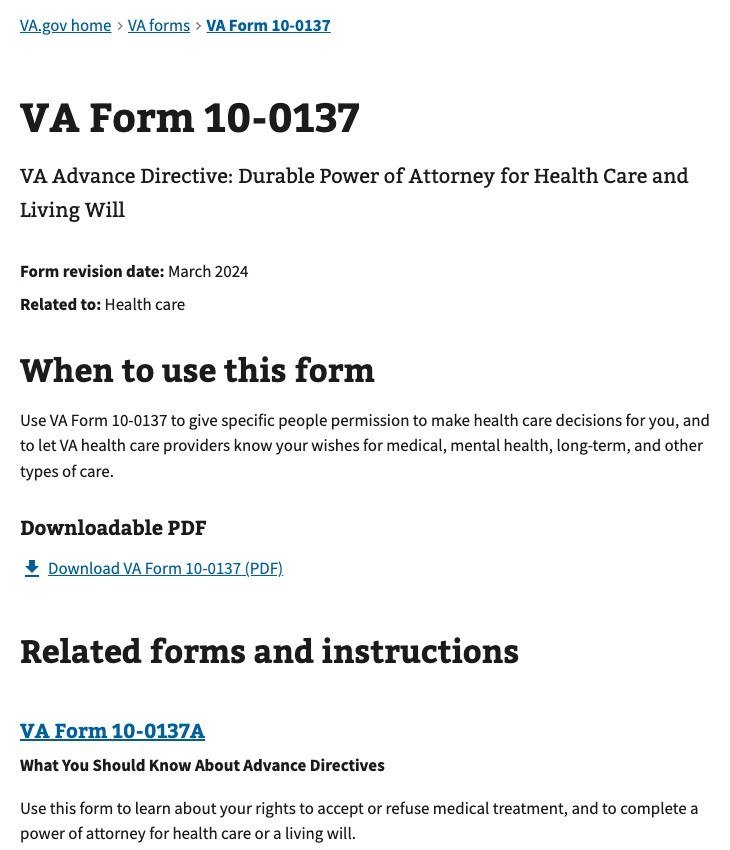
Veterans have their own document. VA Form 10-0137, titled VA Advance Directive: Durable Power of Attorney for Health Care and Living Will, was last revised in March 2024 and takes about 30 minutes to complete.
The VA form has a few features worth knowing:
- It needs two witnesses, and neither can be a beneficiary of your estate, your named agent or someone financially responsible for your care.
- Notarization is optional inside VA facilities, but the VA says you may need it for the form to be binding elsewhere.
- The VA recognizes all legal advance directives, including state and Department of Defense forms, so make sure any you sign do not conflict.
- If you name no agent, the VA follows a set order: legal guardian, spouse, adult child, parent, sibling, grandparent, grandchild, then a close friend.
Medicare pays for the conversation. Medicare Part B covers advance care planning as part of the "Welcome to Medicare" visit and yearly wellness visits, at no cost when your provider accepts assignment. Outside those visits, the usual deductible and coinsurance apply.
Facilities have duties too. The federal rule in 42 CFR 489.102 requires hospitals, nursing facilities, hospices and others to give you written information about advance directives and to state clearly if they will not honor one on grounds of conscience. If you arrive too ill to read it, they can give it to family but must still give it to you later.
Keeping Your Living Will Where It Will Be Found
A living will in a locked drawer helps no one. New York's health department says everyone over 18 should have a health care agent, and advises giving copies to that agent, your primary care provider and family, plus carrying one in a wallet or purse.
Some states run registries that make the document easier to find, for example:
- California's Secretary of State registry holds a copy or just its location.
- North Carolina's registry cards have carried a QR code linking to the filed directive since February 17, 2022.
Keep the signed original with your other vital records, such as the birth certificate and passport you would gather for REAL ID. Review the document at least once a year and after a move, divorce, retirement or new diagnosis. In California, a copy of the statutory form has the same effect as the original, which makes extra copies safe to hand out.
Frequently Asked Questions
What is the difference between a living will and an advance directive?
An advance directive is the umbrella term. A living will is one kind of advance directive, and a health care proxy appointment is the other common kind. California's form and the VA form combine both in one document.
Can a doctor refuse to follow a living will?
Yes, in limited cases. NIA says a provider may decline for reasons of conscience, facility policy or medical standards, but must tell your proxy immediately and consider transferring your care.
Can I cancel my living will?
Yes. In Florida you can revoke it with a signed, dated writing, by destroying it, by saying so out loud or by signing a new one that is materially different, and the change takes effect once it is communicated to your surrogate, provider or facility. Texas allows revocation at any time, regardless of your mental state, and a written or spoken revocation takes effect once your doctor is told.
Does Medicare pay for help making a living will?
Medicare Part B covers voluntary advance care planning during the Welcome to Medicare visit and yearly wellness visits, with no cost to you when the provider accepts assignment.