
A power of attorney is a document you sign to give a trusted person, your agent, legal authority to handle your money, property or medical decisions. Setting one up in 2026 takes a state form, the right signatures and, in most states, a notary, often for $15 or less.
The harder part is understanding what the agent may and may not do once you sign. This guide gives the setup steps, the signing rules in California, Texas and New York, the duties state law places on agents, and the places a power of attorney stops working. It is general information, not legal advice.
How Does a Power of Attorney Work?
You, the principal, sign a power of attorney naming an agent, also called an attorney-in-fact, and listing what that agent may do. The agent then signs checks, contracts or forms in your name. The agent must act in your interest, keep records, and loses all authority if you revoke the document or die.
Acceptance is informal. Under the Uniform Power of Attorney Act, an agent accepts the job simply by acting under the document. From that moment the agent is a fiduciary, and the Consumer Financial Protection Bureau (CFPB) warns that a careless one can be removed, sued, ordered to repay money or investigated by police.
Power of Attorney Types and How Long Each Lasts
| # | Type | Scope | Duration |
|---|---|---|---|
| 1 | General | All financial matters the principal could handle | Ends at incapacity unless durable |
| 2 | Limited (special) | A named task, account or period | Ends when the task is done |
| 3 | Durable | Any scope, stated in the document | Lasts until death or revocation |
| 4 | Springing | Any scope, dormant until a trigger | Starts at incapacity, then lasts |
| 5 | Non-durable | Any scope, for a capable principal | Ends at incapacity |
| 6 | Medical (health care) | Treatment decisions only | Starts when you cannot communicate |
Most estate plans pair a durable financial power of attorney with a separate medical one. A limited power of attorney suits a single errand, such as a house sale you cannot attend in person.
How to Set Up a Power of Attorney in Six Steps
- Pick the type. Decide whether authority should start now (durable) or only at incapacity (springing), and confirm your state allows springing powers.
- Choose an agent and a successor. Texas Estates Code 751.023 lets you name successors who step in if the first agent dies, resigns or declines, and 751.021 allows co-agents.
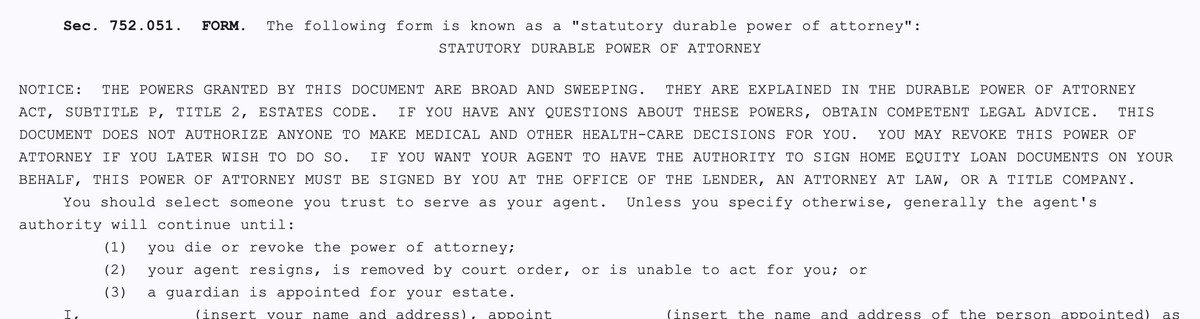
- Get your state’s statutory form. Texas prints its “statutory durable power of attorney” in Estates Code 752.051, California its Uniform Statutory Form in Probate Code 4401.
- Initial any special powers. Gifts, trust changes and beneficiary changes need express wording, described below.
- Sign under your state’s rules. Use a notary, witnesses or both, as the next section shows.
- Distribute and record copies. Give copies to your agent and bank. In Texas, a power of attorney used for a recorded real estate deal must be filed with the county clerk within 30 days.
Read the form’s own warnings before signing. The Texas notice calls the powers “broad and sweeping” and says that to let an agent sign home equity loan papers, you must sign at the lender’s office, an attorney’s office or a title company.
Power of Attorney Signing Rules in California, Texas and New York
| State | What a valid signing needs | Statute |
|---|---|---|
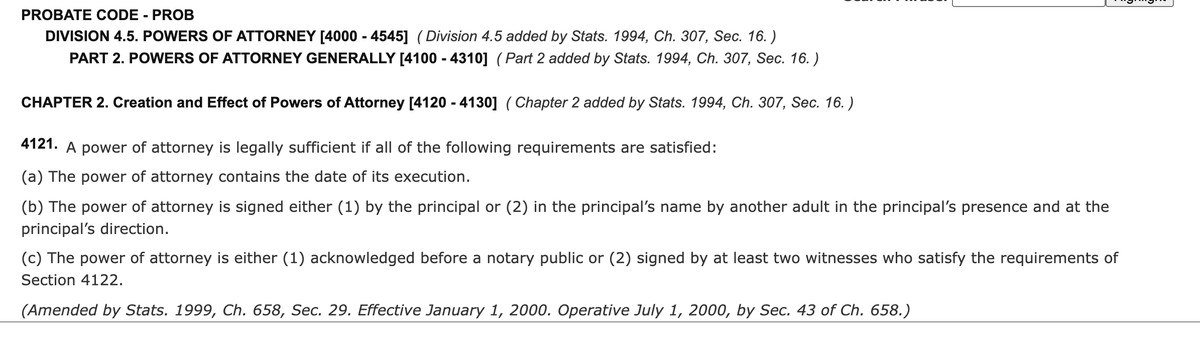
| California | Notary or two adult witnesses; the agent cannot witness | Probate Code 4121, 4122 |
| Texas | Acknowledged before a notary, with durability wording | Estates Code 751.0021 |
| New York | Notary plus two witnesses, 12-point type, agent also signs | Gen. Oblig. Law 5-1501B |
California is the most flexible: Probate Code 4121 accepts a notary acknowledgment or two adult witnesses, and 4122 bars the agent from serving as a witness. Texas requires acknowledgment before an officer who can take acknowledgments and administer oaths, which in practice means a notary.
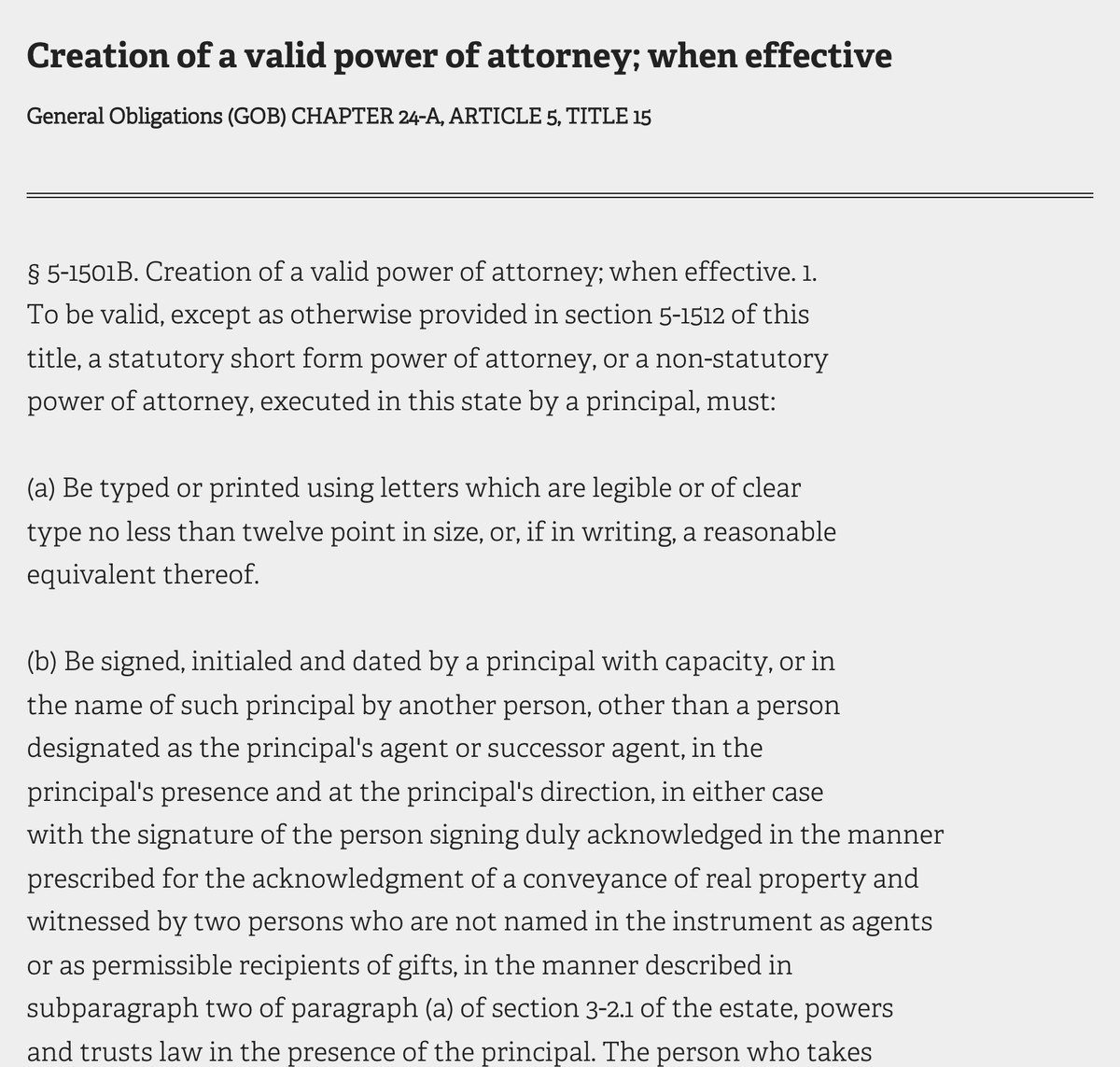
New York is the most formal. Section 5-1501B requires 12-point type, a notarized signature and two witnesses who are not named agents or gift recipients, though the notary may be one of them. The agent must sign with an acknowledged signature too, and the power takes effect for that agent only on that date.
What a Power of Attorney Costs
The statutory forms are printed in the statutes themselves, so the document can cost nothing. The main out-of-pocket cost is the notary, and states cap it:
- California: up to $15 per signature acknowledged, under Government Code 8211.
- Texas: $10 for the first signature and $1 for each additional one, under Government Code 406.024.
- Florida: no more than $10 per notarial act, under section 117.05.
Remote signing is another option, compared in our guide to the best online notary services. Ongoing cost is the agent’s pay: unless the document says otherwise, Section 112 of the uniform act and Texas Estates Code 751.024 entitle an agent to reasonable compensation and expenses.
What Your Agent Must Do Under State Law
Section 114 of the uniform act sets three duties no document can waive: act on the principal’s known reasonable expectations, or otherwise in the principal’s best interest; act in good faith; and stay within the authority granted. By default it adds loyalty, avoiding conflicts, ordinary care, and keeping a record of every receipt, payment and transaction.
Texas spells out the paperwork. Under Texas Estates Code chapter 751, the agent must timely inform the principal of each action, keep records, and deliver an accounting on demand; an agent who ignores a demand for 60 days can be sued. The CFPB reduces it to four duties:
- Act only in the principal’s best interest.
- Manage the principal’s money and property carefully.
- Keep the principal’s money and property separate from your own.
- Keep good records.
The CFPB also tells agents to sign as “Juan Doe, as agent for Martina Roe,” never with the principal’s name alone, and to avoid joint accounts and cash payments.
What Your Agent Cannot Do
Some powers never come with a general grant. Under Section 201 of the uniform act and Texas Estates Code 751.031, an agent may create or change a trust, make gifts, change survivorship rights or beneficiary designations, or delegate authority only if the document expressly says so. An agent outside the family line cannot use those powers to benefit himself unless the document allows it.
- Social Security: the Treasury does not recognize power of attorney for Social Security or SSI payments; the agent must apply to Social Security as a representative payee.
- VA benefits: VA appoints its own fiduciary after a field exam, and the CFPB says an agent needs that separate appointment to manage the money.
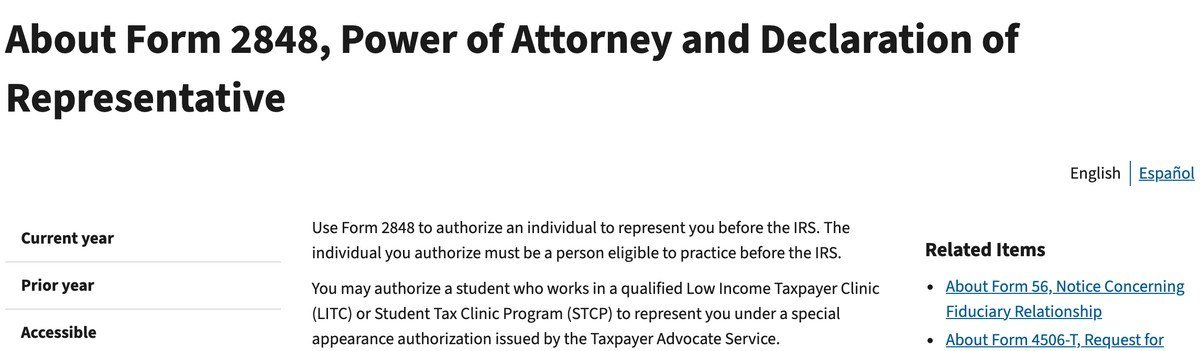
- The IRS: IRS Form 2848 representation is limited to people eligible to practice before the IRS, such as attorneys, CPAs and enrolled agents.
- After death: authority ends the moment the principal dies.
Durable and Springing Powers Under the Uniform Act
The Uniform Power of Attorney Act, approved in 2006, is law in 32 jurisdictions, 31 states plus the District of Columbia, according to the Uniform Law Commission’s enactment record on October 22, 2026. Under its Section 104, a power of attorney is durable unless it says otherwise. New York applies the same default.
California and Texas still require durability language, such as Texas’s “This power of attorney is not affected by subsequent disability or incapacity of the principal.” Springing powers vary even more. California lets you name someone who declares under penalty of perjury that the trigger occurred, the uniform act falls back on a physician’s written finding, and Florida has barred new springing powers since October 1, 2011.
If a Bank Refuses Your Power of Attorney
Banks sometimes balk at an outside form. Under Texas Estates Code 751.201, a bank must accept a valid durable power of attorney or, within 10 business days, ask for an agent’s certification or a lawyer’s opinion, then accept within seven business days of getting it. Section 751.202 bars it from demanding its own form.
The uniform act sets a seven-business-day window under Section 120. Refusal is allowed only for listed reasons, such as knowing the power was revoked, a good-faith belief it is invalid, or a report to adult protective services.
Guardianship When There Is No Power of Attorney
Without a power of attorney, a family may need a court. The CFPB explains that a court can appoint a guardian or conservator when it decides a person cannot manage money alone and has no power of attorney in place. In Texas, once a permanent guardian of the estate qualifies, any existing agent’s powers are automatically revoked.
Courts also police agents. Section 116 of the uniform act lets the principal, a spouse, parent or descendant, a presumptive heir, a caregiver or a government agency ask a court to review an agent’s conduct.
Revoking or Ending a Power of Attorney
Texas Estates Code 751.131 ends a durable power of attorney when the principal dies or revokes it, its stated purpose or end date arrives, the last agent can no longer serve, or a permanent guardian of the estate qualifies. An agent’s authority also ends at divorce or annulment from the principal.
In California, Probate Code 4153 lets you revoke simply by telling the agent, orally or in writing. Put it in writing anyway and send copies to every bank and brokerage, because an institution that has not been told is protected if it keeps dealing with the agent.
Medical Power of Attorney Is a Separate Document
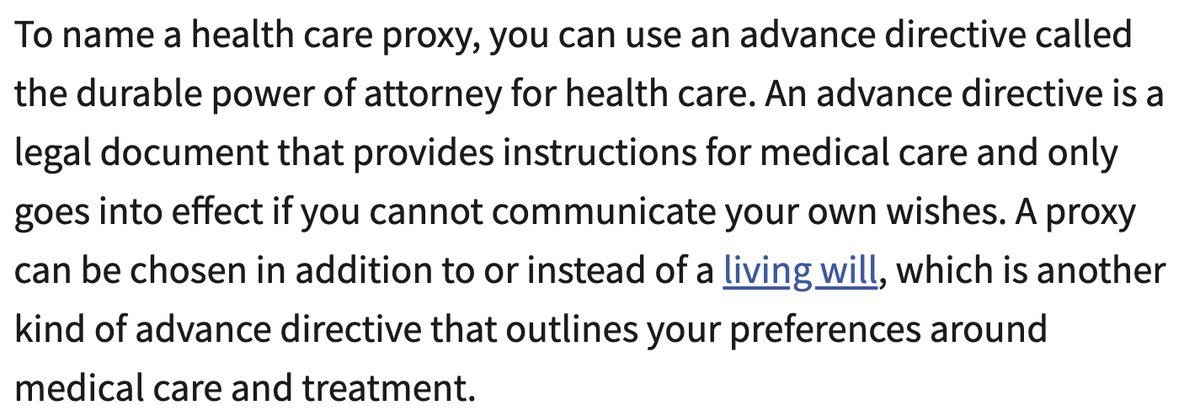
A financial form does not cover treatment decisions, and the Texas statutory form says so on its first page. The National Institute on Aging guide to health care proxies calls the medical version a durable power of attorney for health care and notes that most states require the agent to be 18, or 19 in Alabama and Nebraska.
Instructions about life support and other treatments go in a different advance directive, explained in our guide to the living will.
Spotting Misuse by an Agent
Agent abuse is not rare. FinCEN counted 155,415 suspicious activity filings tied to elder financial exploitation in the year to June 15, 2023, worth roughly $27 billion, and found adult children were the most frequent perpetrators of elder theft. Watch for sudden withdrawals, new names on accounts, changed beneficiaries and a helper who isolates the principal, and call the Eldercare Locator at 1-800-677-1116 to reach adult protective services.
Frequently Asked Questions
How do I get power of attorney for a parent?
Your parent signs it, or directs another adult to sign in their presence, while still able to make decisions; New York requires a principal “with capacity.” If your parent already lacks capacity, the route is usually a court guardianship or conservatorship.
Does a power of attorney need to be notarized?
Texas requires a notary, New York requires a notary plus two witnesses, and California accepts a notary or two witnesses. Under the uniform act, a notarized signature is presumed genuine, which makes banks far more likely to accept it.
Can my agent be paid?
Yes, unless the document says otherwise. The uniform act and Texas law allow reasonable compensation plus reimbursement of reasonable expenses, and the CFPB tells paid agents to keep detailed records of their work.
Does a power of attorney end at death?
Yes. Death ends every power of attorney, durable or not, and the agent can no longer pay bills or sign for the principal.