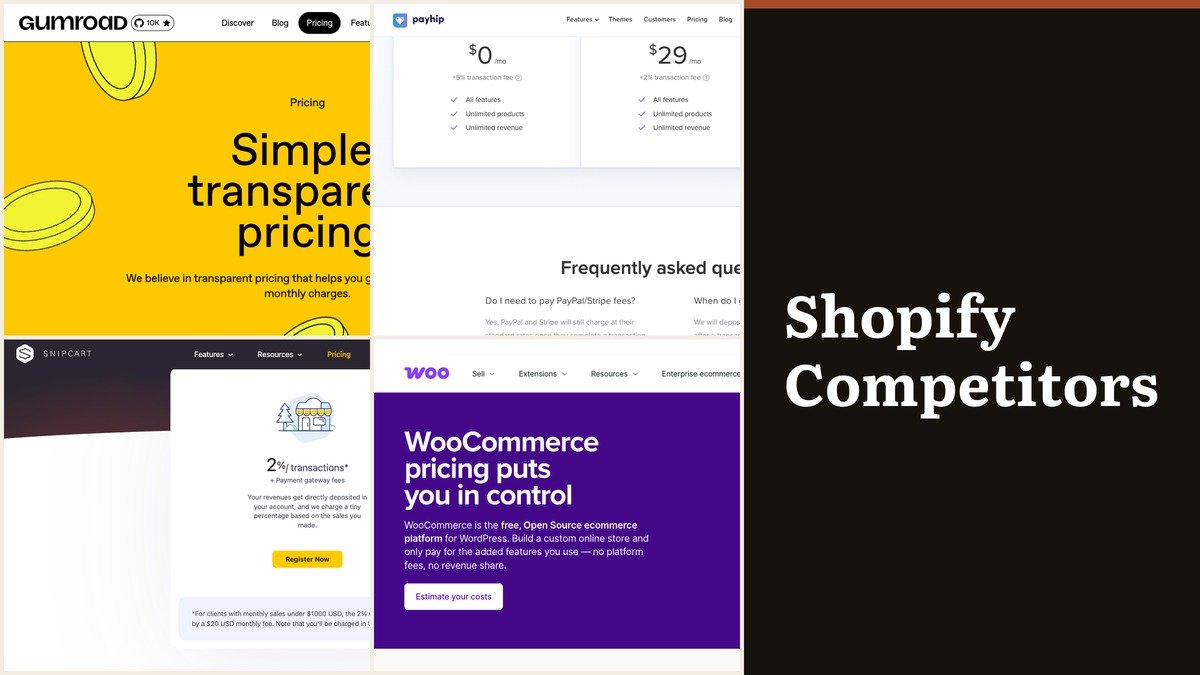
Shopify competitors divide into three groups once you ignore the feature lists: those that charge a flat monthly fee, those that take a percentage of every sale, and those that do both. Which group suits you is a function of revenue, not of taste.
Shopify itself does both. Alongside the monthly plan it applies a fee to orders that go through an outside payment provider, and that fee only falls when you buy a more expensive tier.
The Shopify Charge That Scales With Your Revenue
Shopify runs four tiers, Basic, Grow, Advanced and Plus. Each applies a percentage to orders processed through a payment provider other than Shopify Payments, and it is built into the plan rather than sold as an extra.
| Shopify plan | Fee on outside payment providers |
|---|---|
| Basic | 2% |
| Grow | 1% |
| Advanced | 0.6% |
| Plus | 0.2% |
Two percent on Basic sounds small until it meets volume. A store doing $20,000 a month hands over $400, which dwarfs the subscription, and that sits on top of whatever the payment processor itself charges.
The rate falls to 1 percent on Grow, 0.6 on Advanced and 0.2 on Plus, so reducing it means spending more. Monthly plan prices are quoted in the currency of the country you buy from, so confirm those on your own storefront rather than from any comparison.
Shopify Competitors Compared on Fee and Cut
Ordered from the platforms that take nothing per sale to the ones that take the most. The cost-shape column is the one to read against your own turnover.
| # | Platform | Cut per sale | Entry price | Cost shape | Strength |
|---|---|---|---|---|---|
| 1 | WooCommerce | None from the platform | $0 platform fee | Hosting and extensions instead | No platform fee, because there is no platform |
| 2 | Big Cartel | None | $15 a month | Flat fee, nothing per order | Fifteen dollars, and none of your sales |
| 3 | Webflow | Varies by plan | $15 a month billed yearly | Site plan plus ecommerce | Two plans, not one, so read both |
| 4 | Snipcart | 2% of sales | $20 a month minimum | 2%, floored at $20 a month | Checkout bolted onto the site you have |
| 5 | Sellfy | None, revenue capped by plan | $22 a month | Flat fee with a sales ceiling | Flat fee with a revenue ceiling attached |
| 6 | BigCommerce | None | $29 a month billed yearly | Flat fee, capped by annual sales | The straight swap, gated by annual sales |
| 7 | Medusa | None, no revenue share | $29 a month | Infrastructure cost only | Infrastructure you pay for, revenue you keep |
| 8 | Podia | 5% on Mover, none above | $42 a month billed yearly | Fee disappears on upgrade | Pay more monthly to delete the cut |
| 9 | Payhip | 5% free, 2% on Plus, 0% on Pro | $0 a month | Fee falls as the plan rises | A sliding cut you buy your way out of |
| 10 | Gumroad | 10% + $0.50 a sale | $0 a month | Highest rate, zero fixed cost | Nothing monthly, ten percent a sale |
The Ten Platforms in Detail
1. WooCommerce: No platform fee, because there is no platform
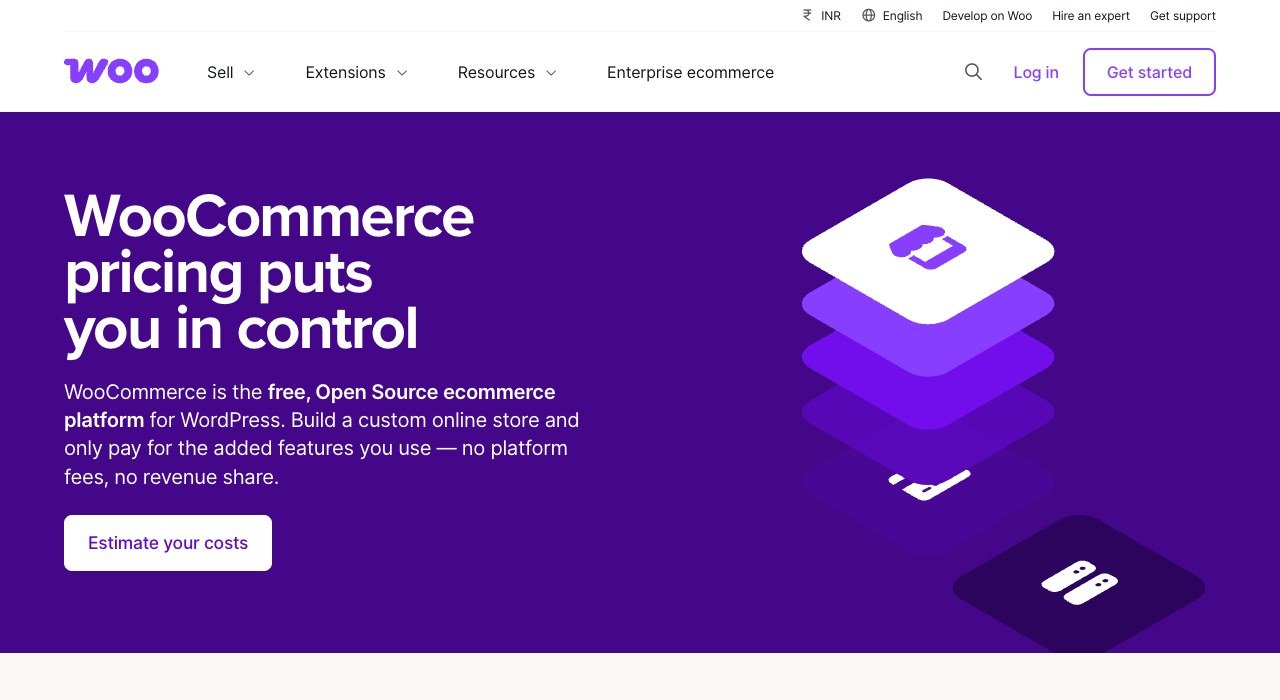
Cut per sale: None from the platform. Monthly from: $0 platform fee. Shape: Hosting and extensions instead.
WooCommerce takes no platform fee and no share of revenue, because it is a plugin rather than a service. What you pay for instead is hosting, roughly $25 to $350 a month depending on traffic, and extensions at $29 to $299 a year each.
For an owner comfortable with WordPress this is the cheapest serious option on the page and the only one with no ceiling of any kind. For everyone else the absence of a support line turns a broken checkout into a very long evening.
2. Big Cartel: Fifteen dollars, and none of your sales
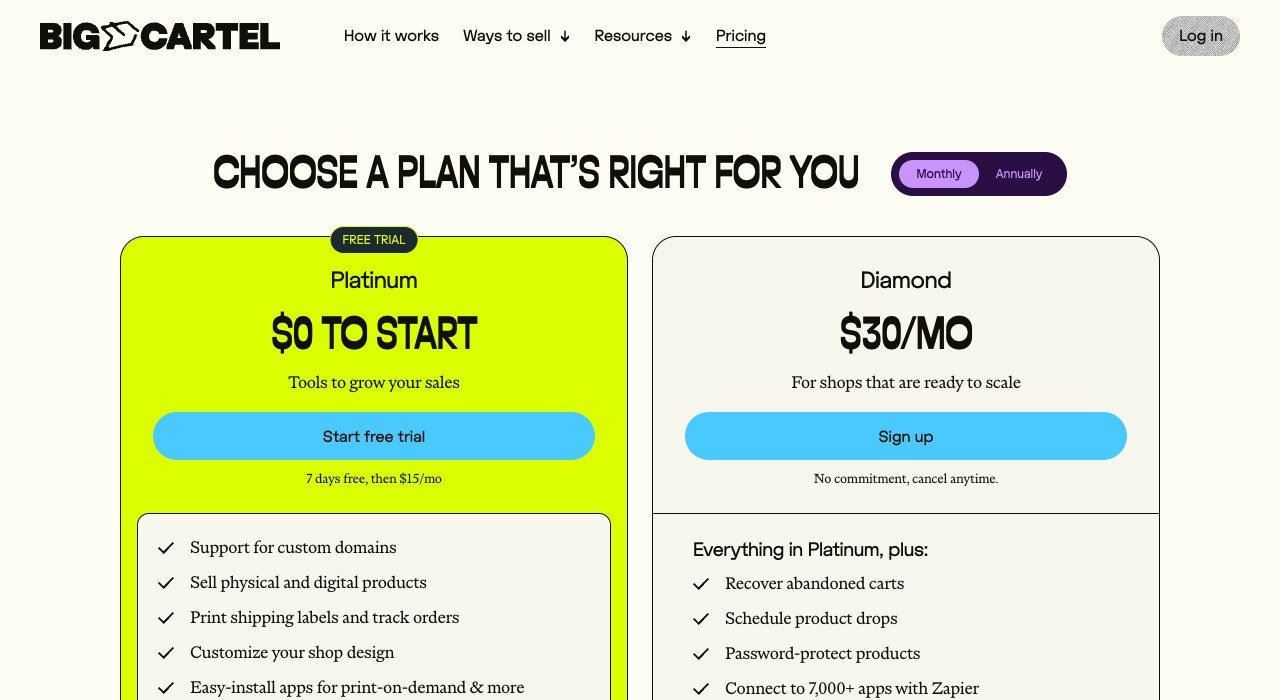
Cut per sale: None. Monthly from: $15 a month. Shape: Flat fee, nothing per order.
Big Cartel is $15 a month for Platinum and $30 for Diamond, with nothing taken from sales. For an independent maker moving a few hundred orders a month, the platform cost stops there.
The product is intentionally narrow: no multichannel selling, no serious inventory tooling, no enterprise features. It has survived a procession of better-funded competitors by staying cheap and staying out of the way.
3. Webflow: Two plans, not one, so read both
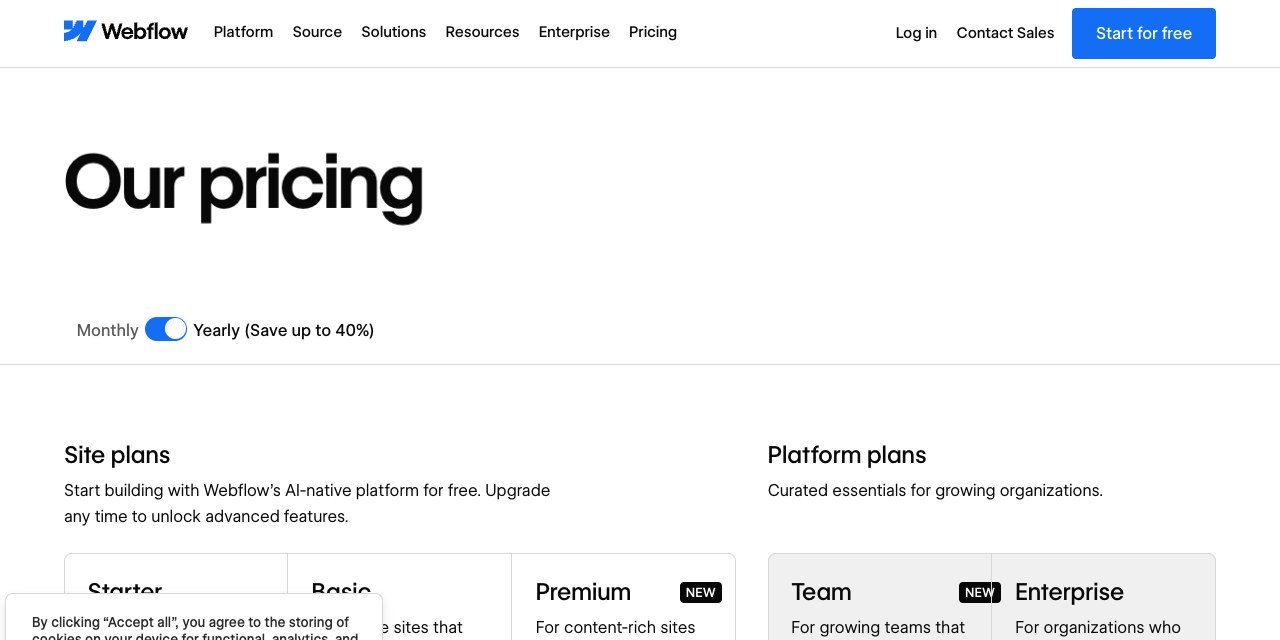
Cut per sale: Varies by plan. Monthly from: $15 a month billed yearly. Shape: Site plan plus ecommerce.
Webflow is a design tool with commerce attached, which makes it the right answer when the complaint about Shopify is the template rather than the price. Site plans begin at $15 a month billed yearly and the CMS plan is $25.
Budget for two plans rather than one. A site plan and a workspace or platform plan are separate charges, and the lowest number on the pricing page is rarely the combination a working store actually needs.
4. Snipcart: Checkout bolted onto the site you have
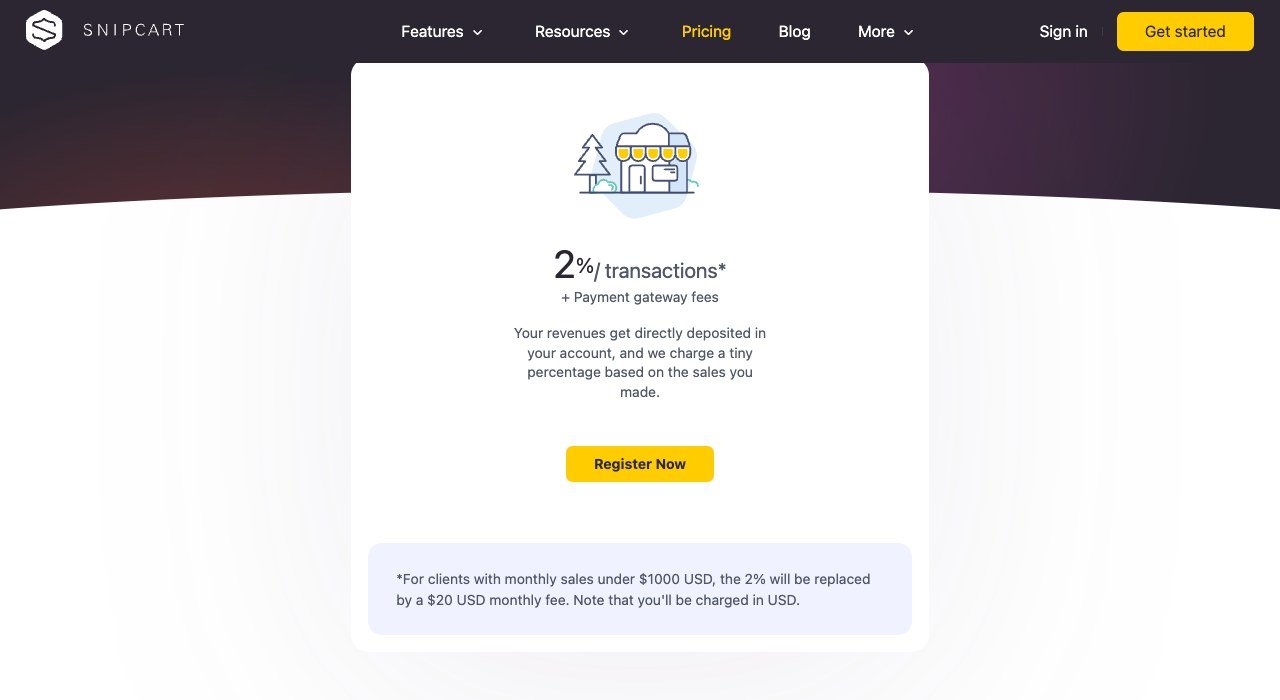
Cut per sale: 2% of sales. Monthly from: $20 a month minimum. Shape: 2%, floored at $20 a month.
Snipcart sells a checkout rather than a shop. You keep the site you already have and add a cart to it, for 2 percent of sales, which suits a content site that has started selling something.
Below $1,000 a month in sales the 2 percent is replaced by a $20 monthly minimum, so the smallest shops pay proportionally the most. Past that threshold it is among the cheapest ways to sell from a site you have already built.
5. Sellfy: Flat fee with a revenue ceiling attached
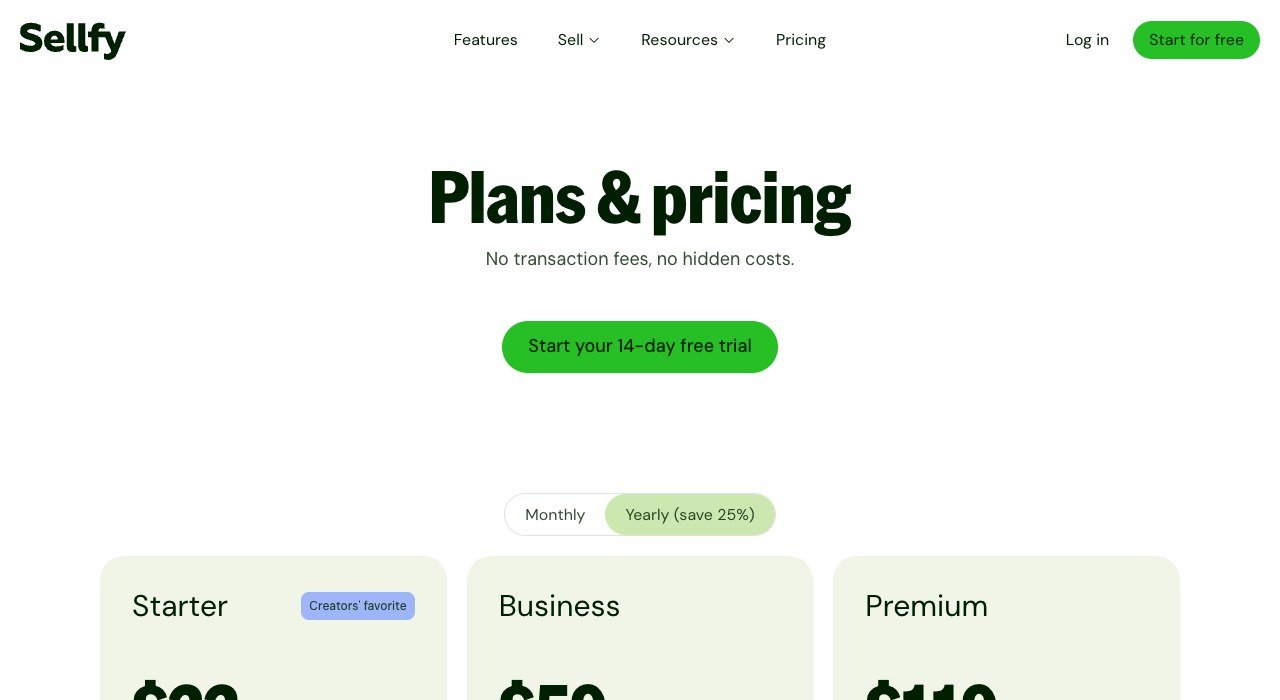
Cut per sale: None, revenue capped by plan. Monthly from: $22 a month. Shape: Flat fee with a sales ceiling.
Sellfy handles downloads, subscriptions and print-on-demand merchandise together. Starter is $22 a month, Business $59 and Premium $119, and none of them takes a percentage of your sales.
The limit is a revenue ceiling instead: $10,000 a year on Starter, $50,000 on Business and $200,000 on Premium. Your effective rate therefore rises in steps as you cross each ceiling, rather than climbing smoothly with turnover.
6. BigCommerce: The straight swap, gated by annual sales
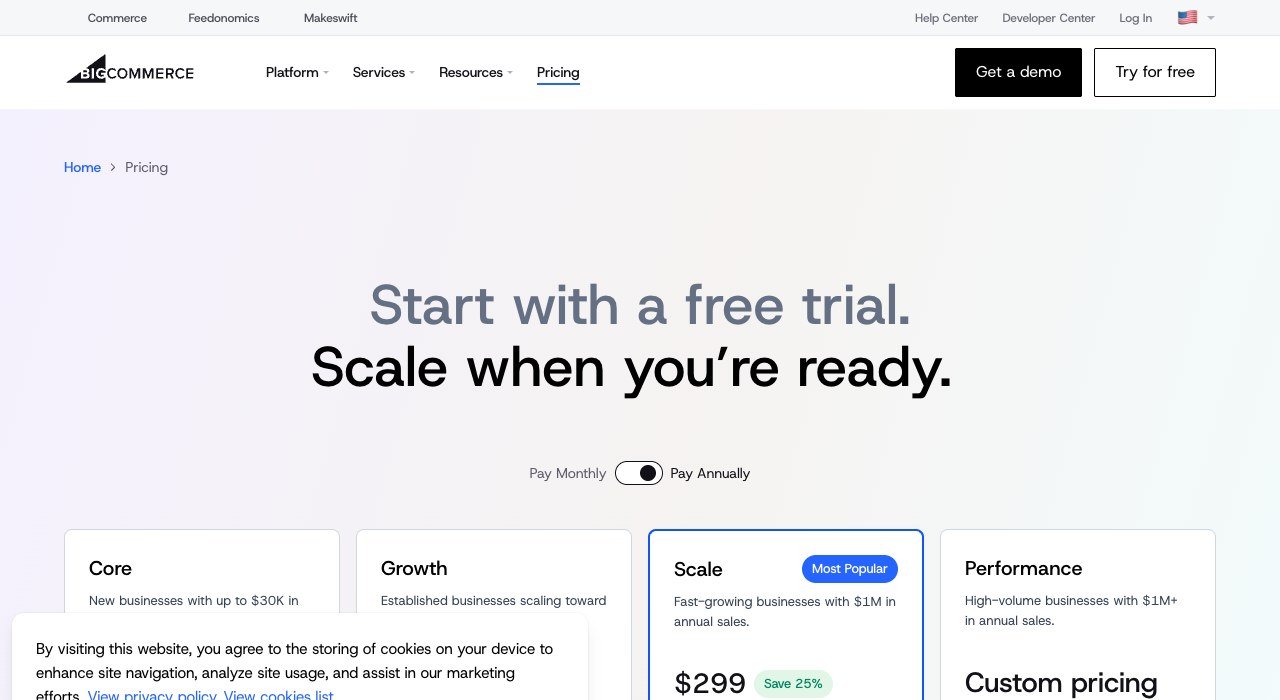
Cut per sale: None. Monthly from: $29 a month billed yearly. Shape: Flat fee, capped by annual sales.
BigCommerce is the closest thing here to a straight swap, a full hosted platform that charges no transaction fee of its own. The entry tier is $29 a month on annual billing, with the next step at $79.
Tiers are gated on trailing annual sales rather than features alone, with Core covering up to $30,000 before upgrading automatically. Costs stay predictable right up until growth moves you, which is a better problem than most on this list.
7. Medusa: Infrastructure you pay for, revenue you keep
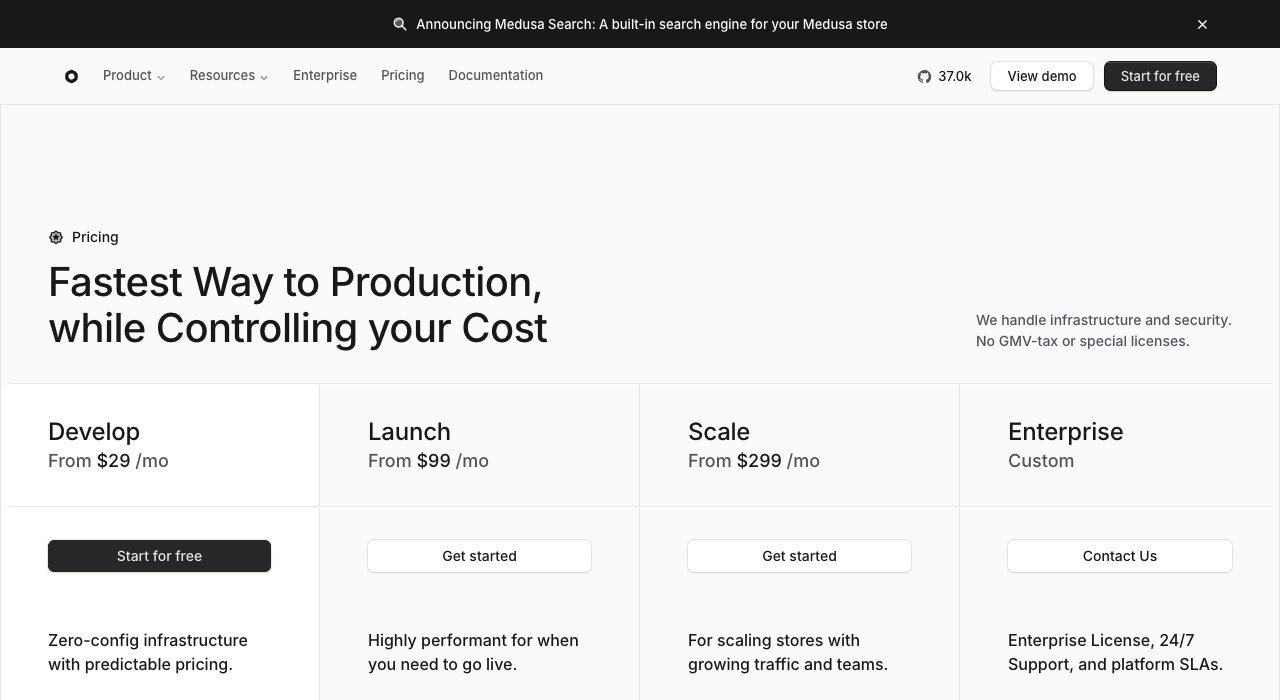
Cut per sale: None, no revenue share. Monthly from: $29 a month. Shape: Infrastructure cost only.
Medusa is open-source commerce infrastructure for teams that intend to build their own storefront. Hosted plans run from $29 a month for Develop to $99 for Launch and $299 for Scale, with no share of revenue.
At high turnover, deleting the percentage is worth far more than any monthly fee, which is the entire argument for it. The requirement is engineering capacity, because nothing about a custom storefront maintains itself.
8. Podia: Pay more monthly to delete the cut
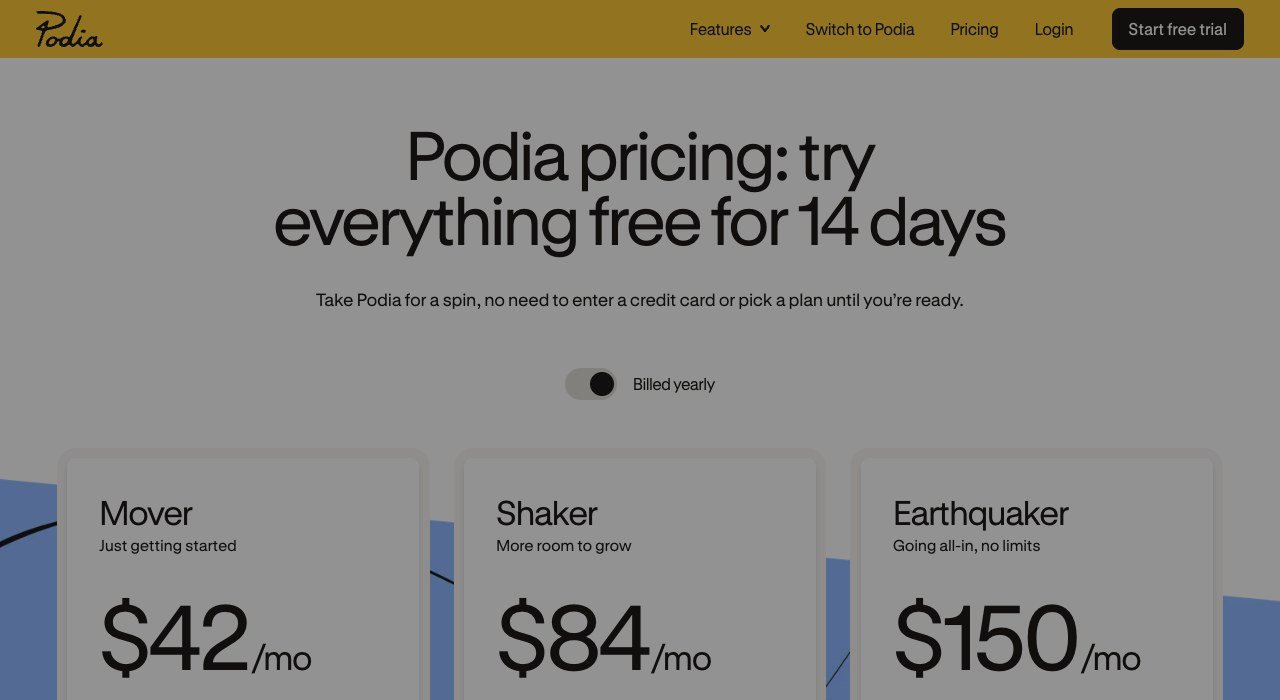
Cut per sale: 5% on Mover, none above. Monthly from: $42 a month billed yearly. Shape: Fee disappears on upgrade.
Podia puts digital products, email and community in one place for creators selling to an audience they already have. Mover is $42 a month billed yearly, Shaker $84 and Earthquaker $150.
Mover carries a 5 percent fee that the tiers above remove, so upgrading buys the cut back. Plans are capped by email subscriber count rather than sales, an unusual meter that is worth checking against your list before you commit to a year.
9. Payhip: A sliding cut you buy your way out of
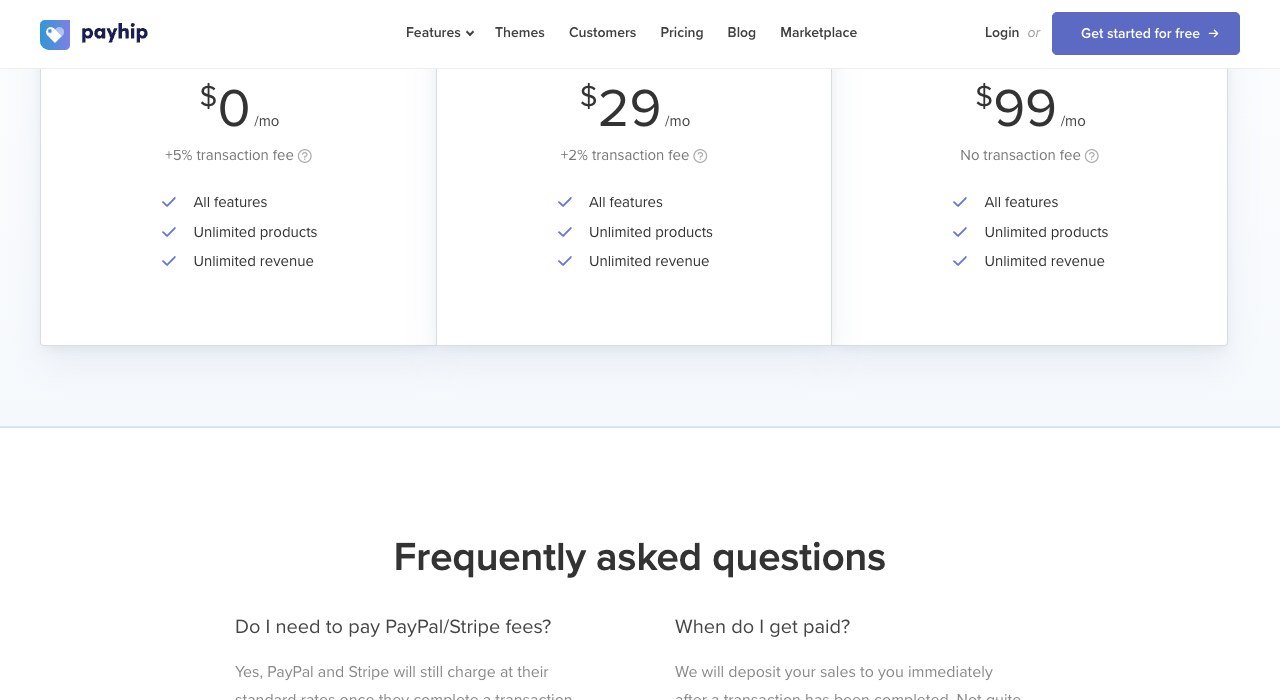
Cut per sale: 5% free, 2% on Plus, 0% on Pro. Monthly from: $0 a month. Shape: Fee falls as the plan rises.
Payhip is free with a 5 percent cut, $29 a month for 2 percent, and $99 a month for none. Products and revenue are unlimited on every tier, so the only thing changing as you climb is the rate.
That makes the upgrade decision arithmetic rather than judgement. At $1,000 a month in sales the free plan costs $50 and Plus costs $49, so the crossover has already happened. Work out your own and move on the month you pass it.
10. Gumroad: Nothing monthly, ten percent a sale
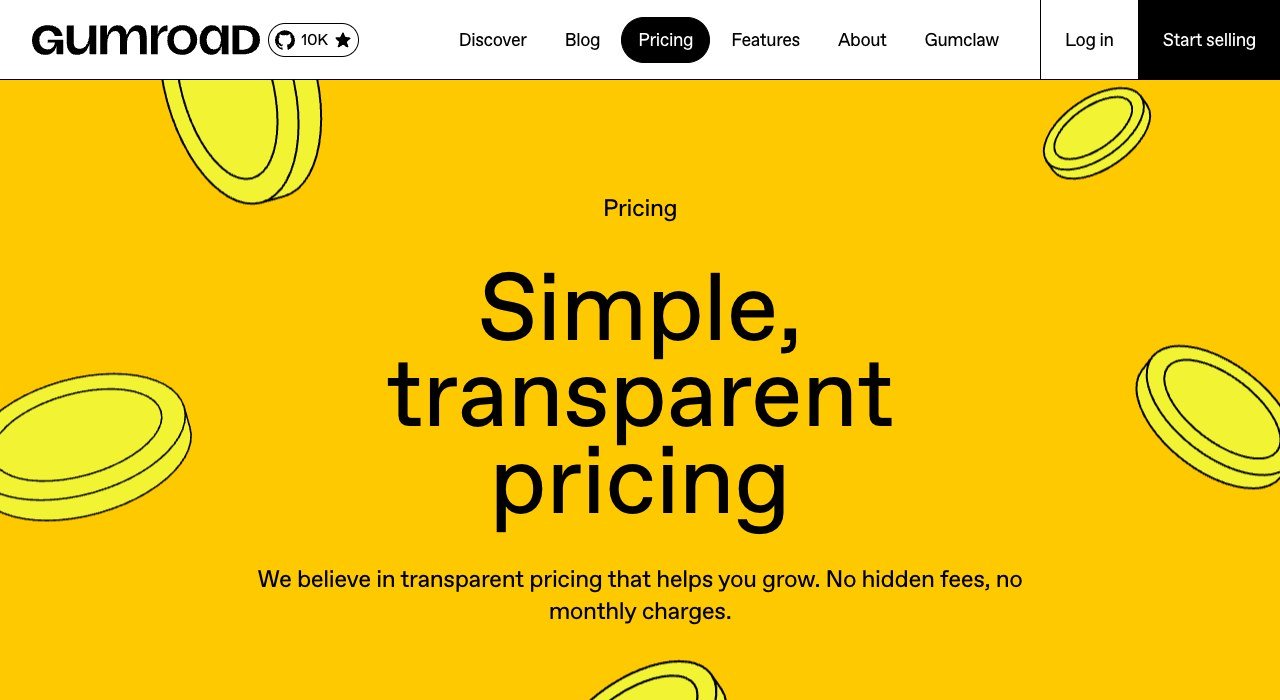
Cut per sale: 10% + $0.50 a sale. Monthly from: $0 a month. Shape: Highest rate, zero fixed cost.
Gumroad charges nothing monthly and 10 percent plus 50 cents on each sale through your own links, rising to 30 percent when a buyer arrives through Gumroad’s own discovery.
It is the highest rate here and still the cheapest option for a seller doing a few hundred dollars a month, because a quiet month costs nothing at all. Around $1,000 a month the flat fee models overtake it decisively.
Where Each Cost Model Stops Making Sense
Every model here is the cheapest one at some revenue and the most expensive at another. The crossover points are what the comparison tables leave out.
- Pure percentage (Gumroad, free Payhip): cheapest below roughly $500 a month, because a quiet month costs nothing and there is no commitment.
- Low percentage with a floor (Snipcart): sensible from about $1,000 a month, below which the $20 minimum dominates.
- Flat fee, no cut (Big Cartel, BigCommerce, Sellfy): wins from around $1,000 a month upward, until a revenue ceiling forces an upgrade.
- Pay to delete the cut (Payhip Pro, Podia Shaker): worth it the month the saved percentage exceeds the price difference.
- Self-hosted (WooCommerce, Medusa): cheapest at high volume and most expensive in time, which never shows up on an invoice.
Run your own last twelve months through two or three of these shapes before choosing. A store doing $5,000 a month pays about $500 on Gumroad and $15 on Big Cartel for the same orders, and no feature comparison will tell you that.
Two Bills That Arrive Regardless of Platform
Whichever option you land on, two costs follow the store rather than the software, and neither appears in any pricing table.
The first is reporting. Payment processors and marketplaces file your sales with the tax authorities, and the IRS explains the thresholds and the form in its guidance on Form 1099-K for payment card and third-party network transactions. The reported figure is gross, before refunds, chargebacks and platform fees, which is never the number in your dashboard.
The second is bookkeeping. Platform fees and per-sale cuts are deductible, and Publication 334, the IRS tax guide for small business covers which costs qualify. Recording the monthly fee and the per-order cut as separate lines makes both the deduction and the platform comparison far easier, which is a good argument for sorting out your accounting software before the store rather than after it.
Choosing Between Them
Revenue first, product type second. Those two answers remove most of this list before anyone opens a feature matrix.
- Under $1,000 a month: Gumroad or Payhip free.
- $1,000 to $10,000: Big Cartel, BigCommerce Core or Payhip Plus.
- Above $10,000: BigCommerce, WooCommerce or Medusa, where the percentage matters more than the subscription.
- Courses and digital products: Podia or Sellfy.
- You already have a site you like: Snipcart or Webflow.
If the reason for leaving is the payment fee rather than the platform, the other half of that decision is the processor itself, and sellers moving stock they do not hold should understand the legal position on dropshipping before committing to any of these.
Frequently Asked Questions
What extra does Shopify charge for outside payment providers?
Two percent of the order on Basic, 1 percent on Grow, 0.6 percent on Advanced and 0.2 percent on Plus. That is a platform fee on top of the rate your payment processor already charges, and it applies to every order not taken through Shopify Payments.
Which Shopify competitor takes no cut of sales?
WooCommerce, Big Cartel, BigCommerce and Medusa take nothing per order. Payhip Pro at $99 a month and Podia Shaker at $84 also remove the fee, and Sellfy charges none but caps annual sales by plan instead.
Is it cheaper to pay a percentage or a monthly fee?
Below roughly $500 a month in sales, a percentage is cheaper because a quiet month costs nothing. Above about $1,000 a month a flat fee with no cut wins, and the gap widens quickly: at $5,000 a month the difference between the two models here is several hundred dollars.
Can I keep my domain and URLs if I move off Shopify?
The domain moves with you. Product and collection URLs usually do not, because every platform builds its own paths. Map the old addresses to the new ones with redirects before launch, or the store loses the search traffic it already has.