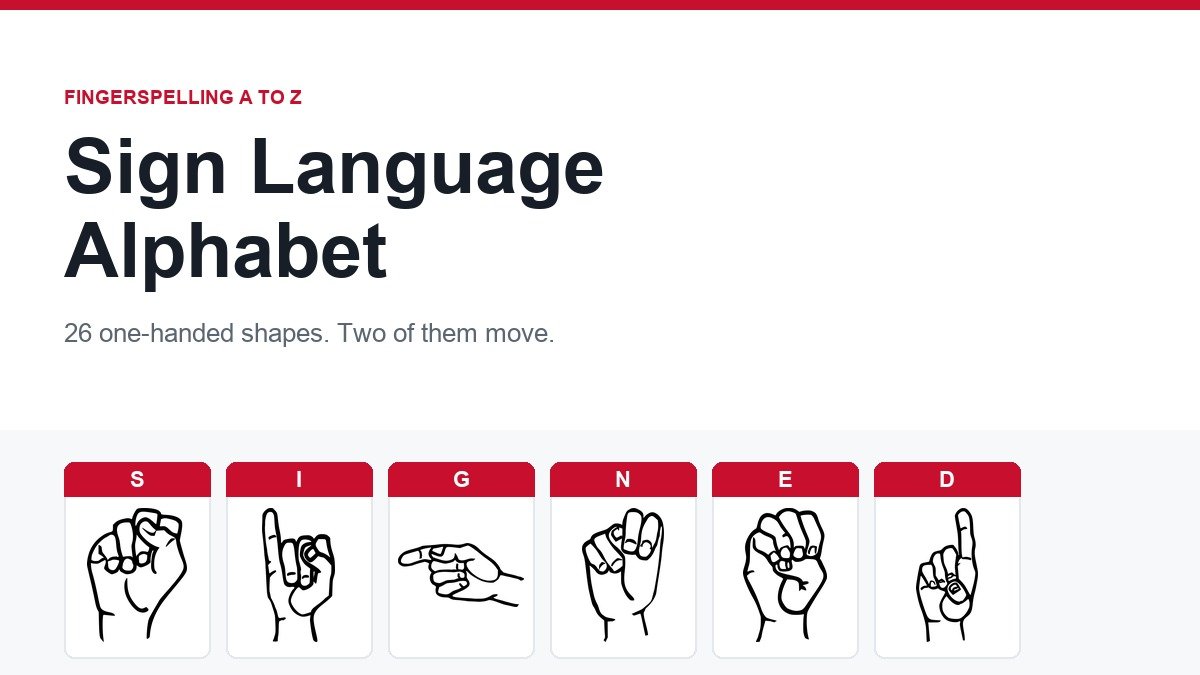
The sign language alphabet used across the United States and much of Canada is a set of 26 handshapes made with one hand, one for each letter of the written alphabet. Signers call using it fingerspelling, and it exists to carry the words that have no sign of their own: names, places, brands and anything too new or too specific to have settled into a sign.
Working through it alphabetically is the slow way to learn it. Grouped by what the hand is actually doing, the 26 letters fall into five families, and most of the confusion disappears once you can see which letters are competing with which.
The Sign Language Alphabet in Full
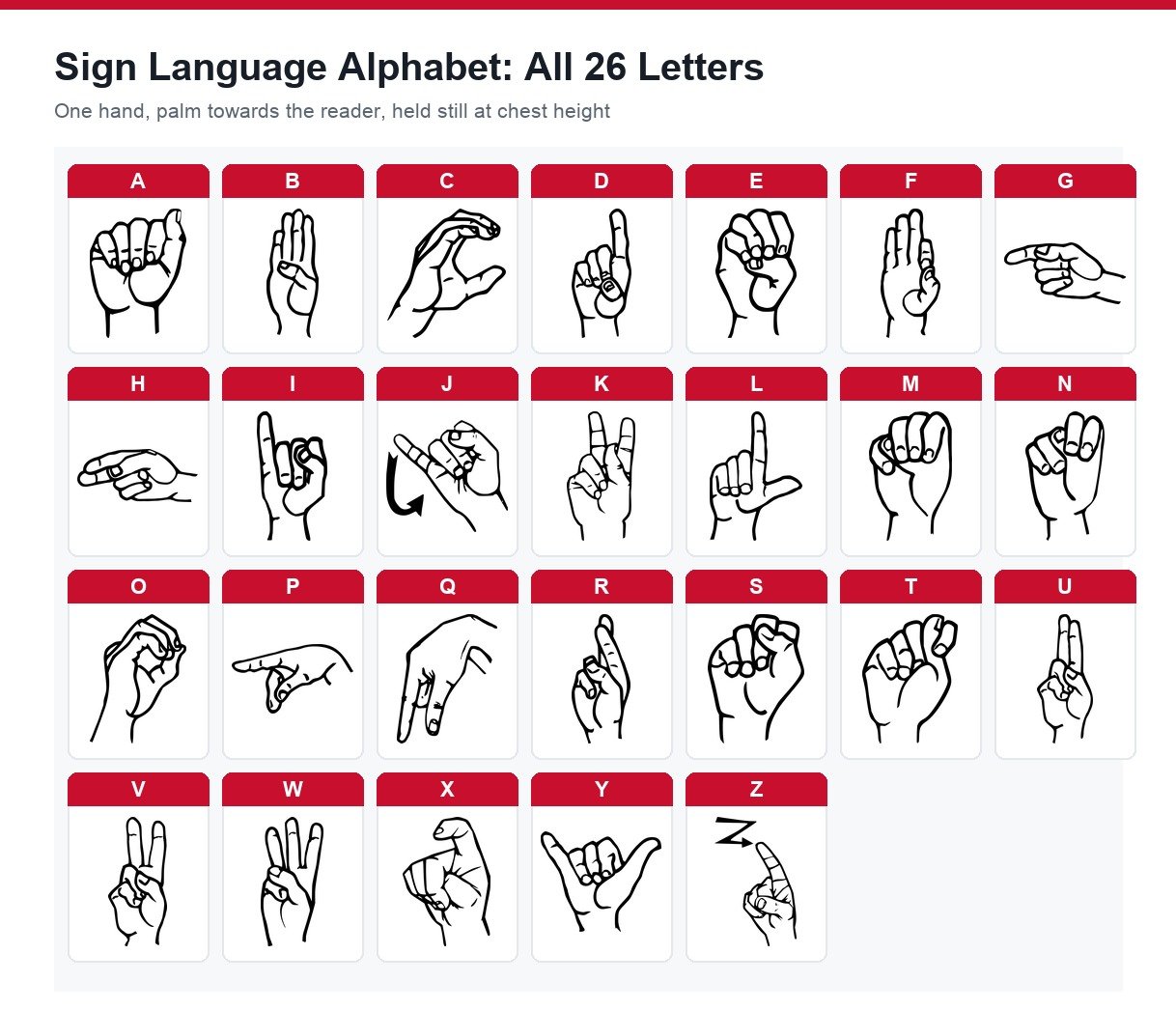
Hold your dominant hand at roughly chest height with the palm facing whoever is reading. The hand stays in one spot throughout a spelled word; it is the fingers that change, not the arm.
| Letter | Handshape |
|---|---|
| A | Closed fist, thumb flat against the side |
| B | Flat palm, fingers together, thumb across the palm |
| C | Hand curved into a C |
| D | Index finger up, other fingertips on the thumb |
| E | Fingers curled down onto the thumb |
| F | Thumb and index make a circle, three fingers up |
| G | Index and thumb extended, pointing sideways |
| H | Index and middle extended together, pointing sideways |
| I | Little finger up, rest closed |
| J | Little finger up, then traced down and hooked |
| K | Index up, middle angled out, thumb between them |
| L | Index up, thumb out at a right angle |
| M | Thumb under three fingers |
| N | Thumb under two fingers |
| O | Fingers and thumb closed into a ring |
| P | The K shape turned to point down |
| Q | The G shape turned to point down |
| R | Index and middle crossed |
| S | Fist, thumb across the front of the fingers |
| T | Thumb between index and middle finger |
| U | Index and middle up, touching |
| V | Index and middle up, apart |
| W | Index, middle and ring up |
| X | Index finger hooked |
| Y | Thumb and little finger out |
| Z | Index finger traces a Z in the air |
Five Handshape Families
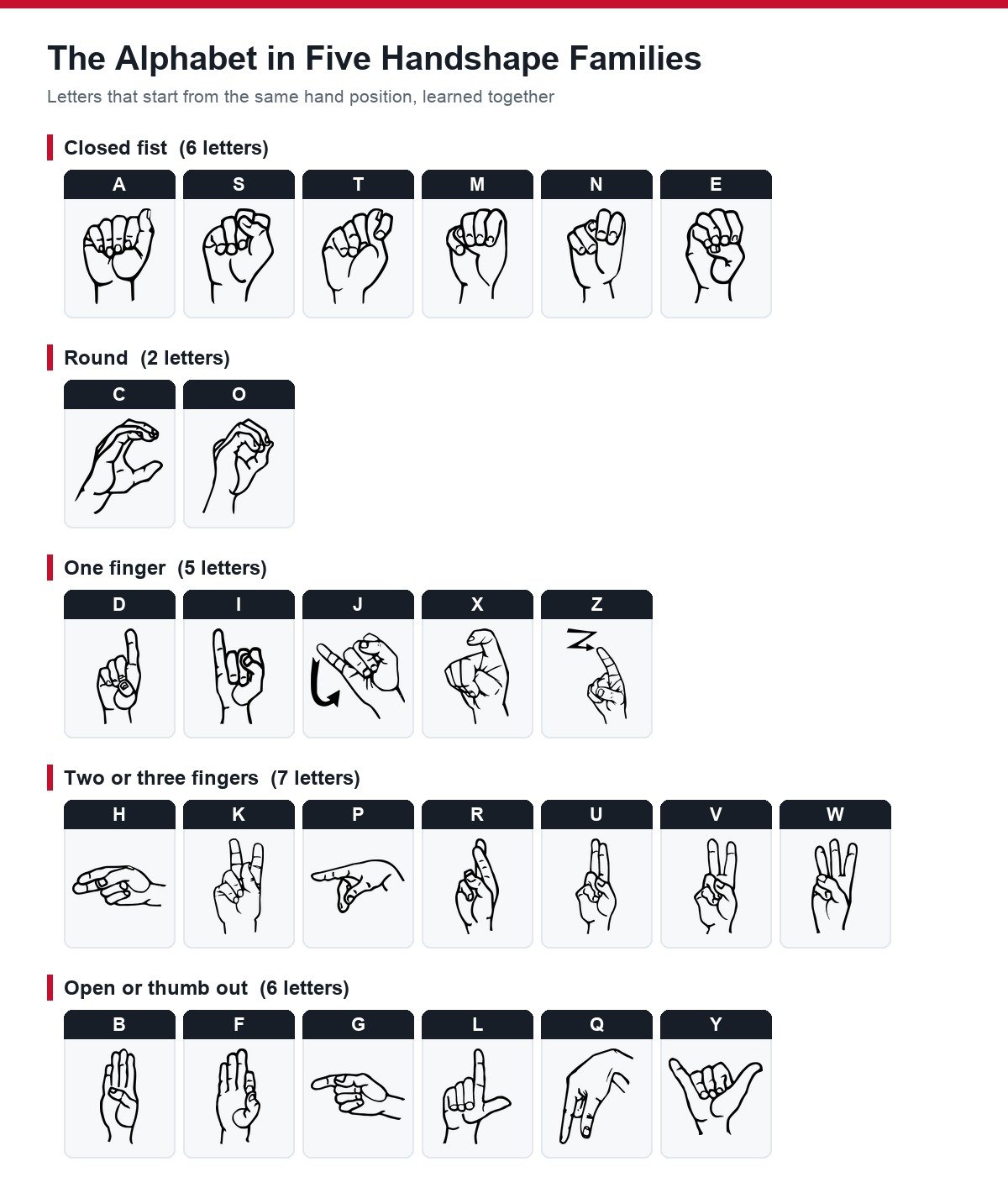
Letters inside a family share a starting position, so learning them as a set means learning one shape and a handful of small adjustments rather than 26 separate things.
| Family | Letters | What they share |
|---|---|---|
| Closed fist | A, S, T, M, N, E | The hand stays shut and only the thumb moves. |
| Round | C, O | The fingers and thumb curve to enclose a space. |
| One finger | D, I, J, X, Z | A single digit is raised, straight, hooked or moving. |
| Two or three fingers | H, K, P, R, U, V, W | Count the raised fingers, then check the angle. |
| Open or thumb out | B, F, G, L, Q, Y | The thumb is clear of the palm and visible. |
The closed fist family is the one to learn first and the one most beginners get wrong. A, S, T, M, N and E are all a shut hand, and the only information is where the thumb sits: flat along the side for A, crossing the fingers for S, poking up between index and middle for T, under three fingers for M, under two for N, and underneath curled fingertips for E.
Turning the hand slightly outward on all six makes the thumb visible from the front. Signers do this without thinking about it, and it is the single habit that most improves how readable a beginner is.
Where to Hold Your Hand
Position matters as much as shape. Fingerspelling that is technically correct can still be unreadable if the hand is in the wrong place or facing the wrong way.
- Height. Just in front of the shoulder on your dominant side, roughly between chin and collarbone. Spelling down near the waist forces the reader to look away from your face.
- Palm direction. Facing the reader for most letters. G, H, P and Q are the exceptions, where the hand turns to point sideways or down.
- Stillness. The hand should not drift sideways as you spell. Bouncing the hand once per letter is a common beginner habit and makes a word much harder to follow.
- Pace. Even spacing beats speed. A short pause between words, not between letters, is what separates two spelled words.
- Double letters. A repeated letter is usually shown with a small bounce or a slide to the side rather than by forming the shape twice from scratch.
Keeping the hand near your face also lets the reader take in your expression at the same time, which carries grammar in sign language in the way intonation does in speech.
Three Pairs That Differ Only in Direction
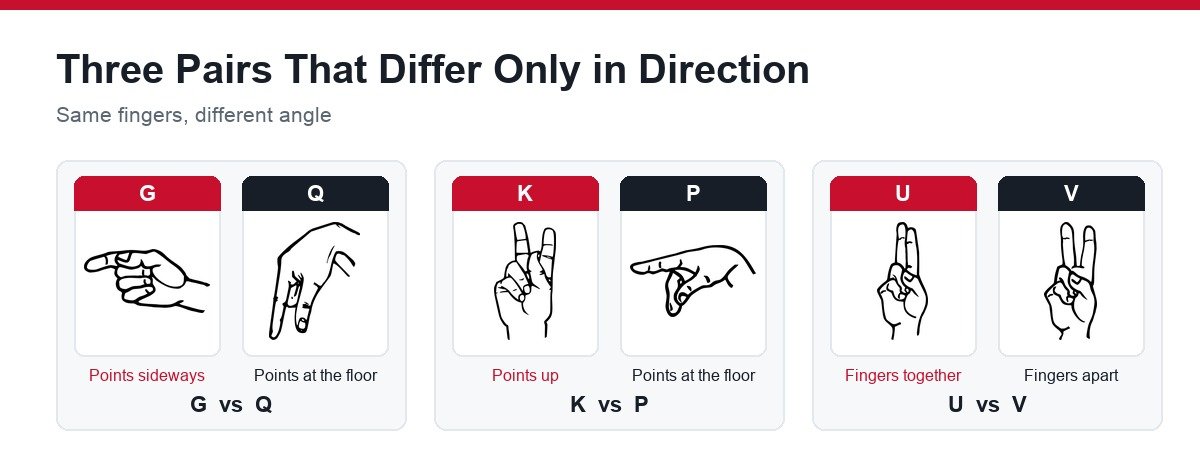
Some letters are not different shapes at all. They are the same shape pointed somewhere else, which means that if a letter looks wrong, the angle is the first thing to check.
- G and Q. Index finger and thumb extended in both. G points sideways, Q points at the floor.
- K and P. Index up, middle angled out, thumb wedged between them in both. K points up, P points down.
- U and V. Two fingers raised in both. U holds them together, V spreads them.
- D and F. Not an angle but a count: one finger up and three down for D, three up and a thumb-index circle for F.
- I and Y. Both raise the little finger. Y adds the thumb.
The Two Letters With Movement
Twenty-four letters are still shapes. J and Z are drawn, which is why neither can be photographed in one frame and why both take longer to produce than anything else in the alphabet.
- J starts as I, with the little finger raised, then the finger traces down and hooks towards the signer’s left, following the shape of the letter.
- Z starts with the index finger extended and draws the three strokes of a Z in the air, moving away from the body.
When you are reading rather than signing, these two are useful landmarks. A fast spelled word visibly slows at a J or a Z, which gives you a moment to catch up.
What Fingerspelling Is Actually For
Fingerspelling is a part of American Sign Language, not a replacement for it. The National Institute on Deafness and Other Communication Disorders describes it as the element used to spell out English words, with each letter matched to a distinct handshape, used mostly for proper names or to give the English word for something.
- People and place names. No sign exists for a stranger’s surname, so it is spelled. Learners usually practise on the most common last names because they come up constantly.
- Brands, titles and acronyms. Spelled in full or shortened once the context is set.
- New vocabulary. Terms arrive spelled and acquire a sign later, if at all.
- Precision. A signer may spell a word to pin down exactly which English term is meant.
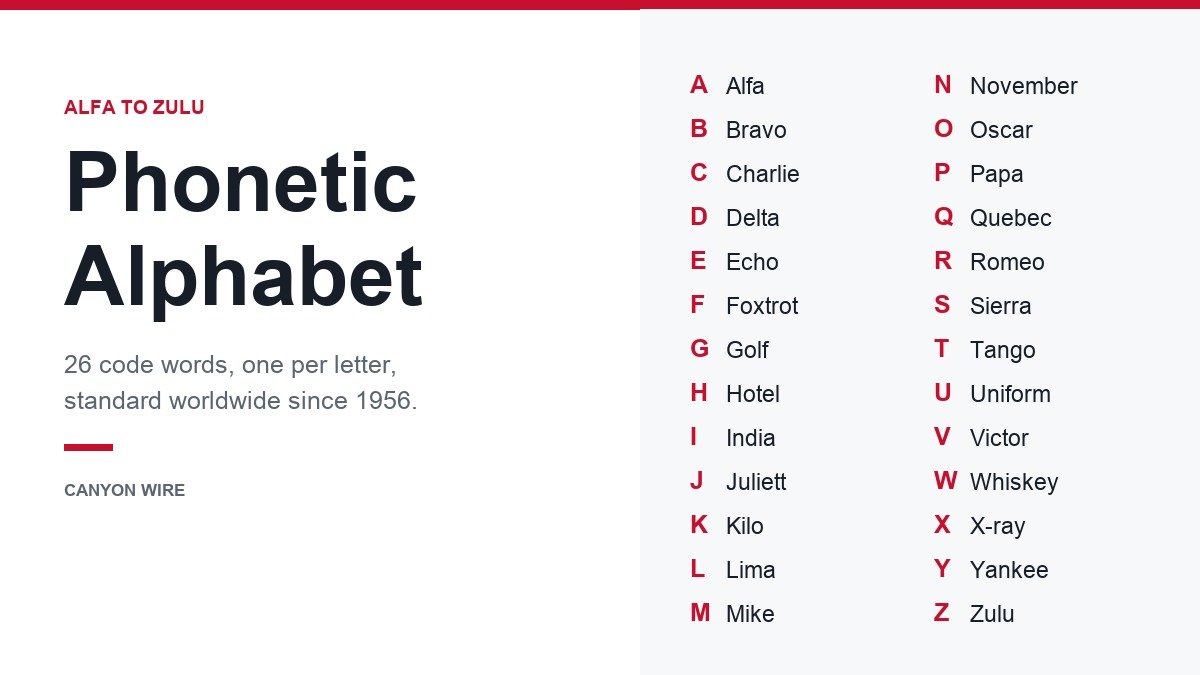
A normal conversation is signed, with spelling woven through it in short bursts. The closest spoken equivalent is a speaker pausing to spell an unusual name aloud, in the way the phonetic alphabet works on a phone call.
There Is No Worldwide Sign Language
Different countries and regions use different sign languages, and they are genuinely different languages rather than accents. British Sign Language is not American Sign Language, and its alphabet is made with two hands rather than one, so an American signer cannot read British fingerspelling without learning it from scratch.
American Sign Language was not designed by anyone. It is thought to have emerged more than 200 years ago from local sign languages mixing with French Sign Language, and the two have since diverged far enough that their users can no longer understand each other. It is a complete natural language with its own grammar and word order, and it marks a question by raised eyebrows, widened eyes and a forward tilt rather than by pitch. It also has regional accents, with variation in rhythm, slang and the signs people choose, much like the spoken languages covered in our guide to the five love languages.
Nine out of ten children born deaf are born to parents who hear, so in most families the language is learned rather than inherited, often by the parents at the same time as the child. The alphabet is where that learning starts because it is the part a beginner can use correctly almost immediately.
Frequently Asked Questions
How long does the sign language alphabet take to learn?
Forming all 26 handshapes takes most people a few days. Spelling slowly and correctly takes about a week. Reading someone else at conversational speed is the hard part and takes months.
Which hand do you use?
Your dominant hand, and the same one every time. Changing hands part way through a word is what makes spelling difficult to read.
Is the sign language alphabet the same in the UK?
No. British Sign Language uses a two-handed alphabet and is an unrelated language. Irish Sign Language, Auslan and others each differ again.
Do you spell every word when signing?
No. Most words have their own sign. Fingerspelling is reserved for names and for words that have no established sign, and it appears in short bursts inside otherwise signed conversation.