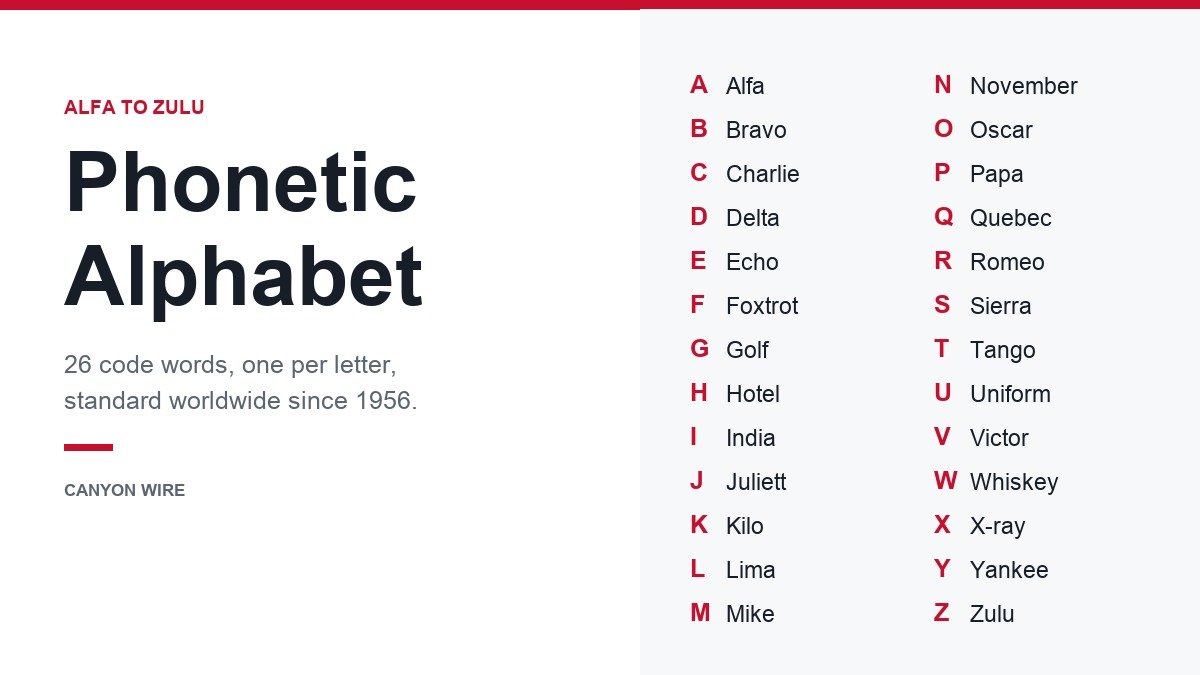
A phonetic alphabet swaps each letter for a whole word so that a listener cannot confuse it with anything else. Say “B” on a crackling line and it may land as P, V, D or T; say “Bravo” and there is nothing else it could be. The version almost everyone means is the one that runs Alfa, Bravo, Charlie through to Zulu, written for radio and now used far beyond it.
This page lists all 26 code words with the pronunciation as it is printed for pilots, the Morse code for each letter, the ten digits, and the reasoning that produced some very strange spellings.
The Phonetic Alphabet in Full
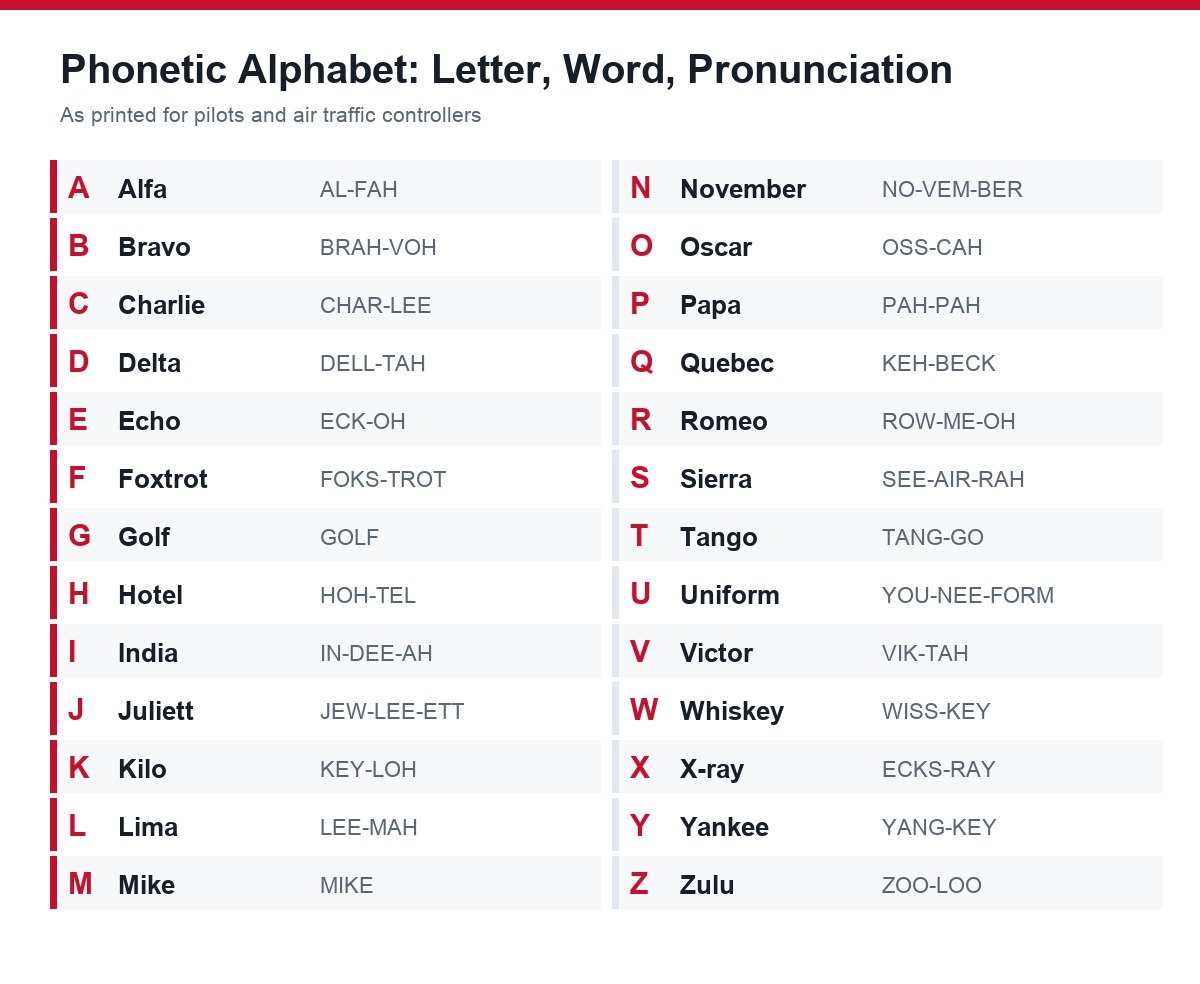
The pronunciation column matters more than the spelling. Each word was picked so that its stressed syllable still carries when the rest of the transmission is lost.
| Letter | Code word | Pronunciation | Morse code |
|---|---|---|---|
| A | Alfa | AL-FAH | .- |
| B | Bravo | BRAH-VOH | -… |
| C | Charlie | CHAR-LEE or SHAR-LEE | -.-. |
| D | Delta | DELL-TAH | -.. |
| E | Echo | ECK-OH | . |
| F | Foxtrot | FOKS-TROT | ..-. |
| G | Golf | GOLF | –. |
| H | Hotel | HOH-TEL | …. |
| I | India | IN-DEE-AH | .. |
| J | Juliett | JEW-LEE-ETT | .— |
| K | Kilo | KEY-LOH | -.- |
| L | Lima | LEE-MAH | .-.. |
| M | Mike | MIKE | — |
| N | November | NO-VEM-BER | -. |
| O | Oscar | OSS-CAH | — |
| P | Papa | PAH-PAH | .–. |
| Q | Quebec | KEH-BECK | –.- |
| R | Romeo | ROW-ME-OH | .-. |
| S | Sierra | SEE-AIR-RAH | … |
| T | Tango | TANG-GO | – |
| U | Uniform | YOU-NEE-FORM or OO-NEE-FORM | ..- |
| V | Victor | VIK-TAH | …- |
| W | Whiskey | WISS-KEY | .– |
| X | X-ray | ECKS-RAY | -..- |
| Y | Yankee | YANG-KEY | -.– |
| Z | Zulu | ZOO-LOO | –.. |
Two words carry a second accepted pronunciation. Charlie is said either CHAR-LEE or SHAR-LEE, and Uniform is either YOU-NEE-FORM or OO-NEE-FORM, because the list had to work for French and Spanish speakers as well as English ones.
The Letter Pairs the Alphabet Was Built to Separate
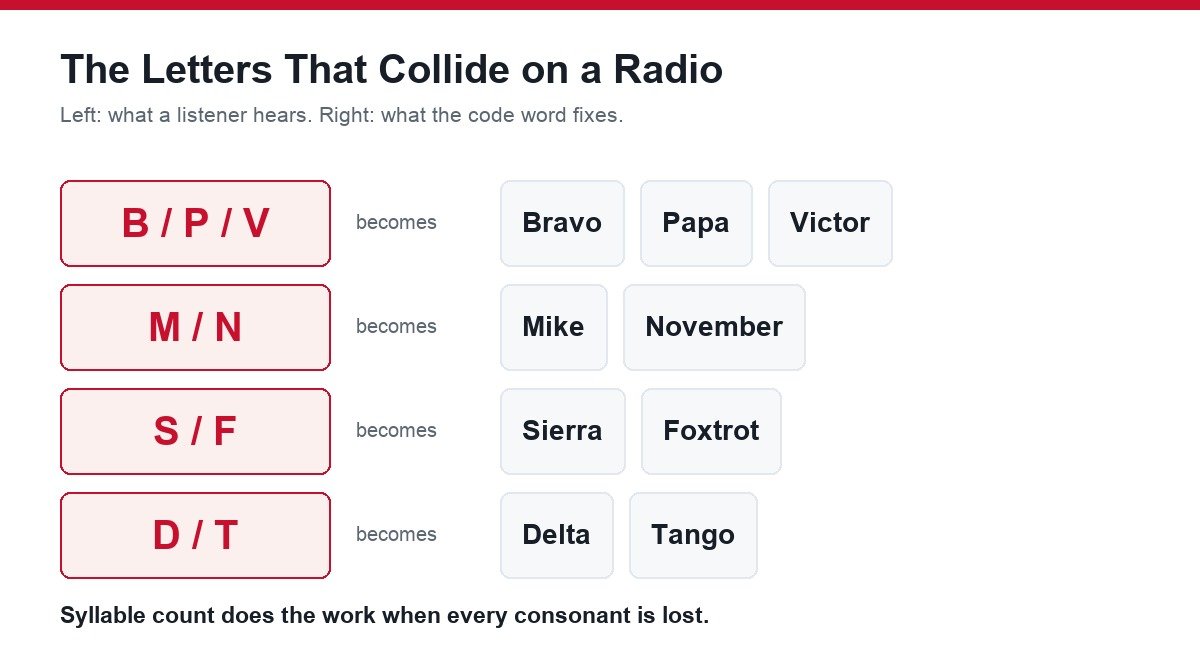
Radio does not degrade evenly. Consonants go first, high frequencies go next, and what survives is syllable count and vowel shape. These are the collisions the code words are designed to prevent.
| Confused letters | Code words | Why they collide |
|---|---|---|
| B / P / V | Bravo / Papa / Victor | All three are plosives that flatten into one sound on a weak signal. |
| M / N | Mike / November | One syllable against three, so length alone separates them. |
| S / F | Sierra / Foxtrot | Both are hissed consonants and both vanish first in static. |
| D / T | Delta / Tango | Near-identical when clipped by a transmitter. |
| A / 8 | Alfa / Ait | Letters and digits share the same channel, so the digit is distorted too. |
This is why a longer word is sometimes chosen over a shorter one. November has three syllables where Mike has one, and that gap is the whole point: even if every consonant is lost, the rhythm of the word still identifies the letter.
Numbers, and the Five Digits That Are Deliberately Mispronounced
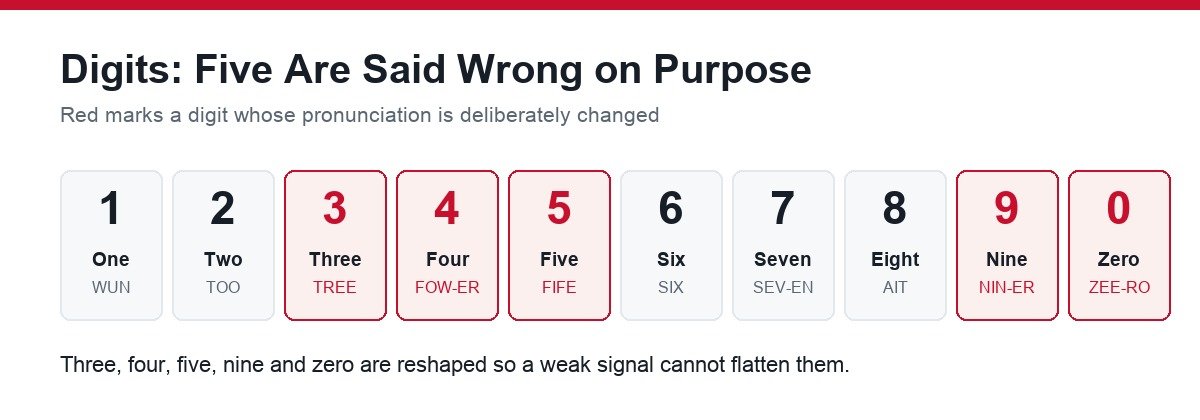
| Digit | Spoken as | Pronunciation |
|---|---|---|
| 1 | One | WUN |
| 2 | Two | TOO |
| 3 | Three | TREE |
| 4 | Four | FOW-ER |
| 5 | Five | FIFE |
| 6 | Six | SIX |
| 7 | Seven | SEV-EN |
| 8 | Eight | AIT |
| 9 | Nine | NIN-ER |
| 0 | Zero | ZEE-RO |
Three is said TREE and five is said FIFE because the “th” and “v” sounds are among the first to be lost. Nine becomes NIN-ER so it cannot be taken for the German nein. Four stretches to FOW-ER and zero to ZEE-RO so that neither collapses into one short syllable.
Digits are always read one at a time. A flight number of 1549 is “one five four niner”, and a reference of 30 is “three zero”. Reading them as ordinary numbers is the single most common mistake people make when they first use the alphabet.
Why Alfa Has an F and Juliett Has Two Ts
Alfa is spelled without the “ph” because that combination only makes an f sound in English. A reader whose first language is French, Spanish or Italian would be entitled to say it with a p, which defeats the purpose of a word that is supposed to be unmistakable.
Juliett gets a doubled t for the mirror-image reason. In French a single final t is silent, so Juliet would be read as “Julie”. The extra letter forces the sound to be pronounced by everyone who reads it.
Both spellings are frequently corrected back to Alpha and Juliet by people who have only heard the words spoken, and both corrections are wrong. The published forms are Alfa and Juliett.
Using the Alphabet on a Phone Call
The procedure is the same whether you are clearing an aircraft or confirming a delivery address.
- Say the word normally first, then announce that you are going to spell it.
- Give the letter, then the code word. “Hayes: Hotel, Alfa, Yankee, Echo, Sierra.”
- Keep a steady rhythm. Rushing runs two code words together.
- Read digits singly and say “zero”, never “oh”.
- Ask for a read-back. The other person repeats it; that is where the error shows up.
Mixed alphanumeric strings are where the alphabet earns its keep. A reference such as D4K9B is a guessing game out loud and completely unambiguous as “Delta, four, Kilo, niner, Bravo”. It is the same instinct behind other systems designed to be read correctly the first time, from the connector shapes in our guide to USB types to the matchup grid in the Pokemon type chart.
Where the Phonetic Alphabet Comes From
The International Telecommunication Union published the first internationally recognised version in 1927, built from place names such as Amsterdam, Baltimore, Canada and Denmark, and revised it in 1932. The problem with both was that the words were long and the list was still shaped by one set of ears.
In 1941 the United States adopted a Joint Army/Navy alphabet across every branch, known as Able Baker after its first two words. The Royal Air Force adopted it in 1943. It ran Able, Baker, Charlie, Dog, Easy, Fox, George, How, Item, Jig, King, Love, Mike, Nan, Oboe, Peter, Queen, Roger, Sugar, Tare, Uncle, Victor, William, X-ray, Yoke, Zebra.
The criticism of Able Baker was that it skewed heavily towards English. The International Air Transport Association proposed a replacement drawn from sounds common to English, French and Spanish, and it came into force for civil aviation on 1 November 1951 with Coca, Gold, Metro, Nectar, Union and eXtra among its words.
Militaries stayed on Able Baker while civil aviation used the IATA list, which produced exactly the confusion the exercise was meant to end. NATO reviewed the IATA alphabet in the mid-1950s and proposed changing five words. The North Atlantic Military Committee Standing Group ruled on 8 April 1955 that the new alphabet would take effect on 1 January 1956 regardless of whether the International Civil Aviation Organization agreed. ICAO did agree, choosing November over Nectar for the letter N, and on 21 February 1956 NATO set the effective date at 1 March 1956. The ITU adopted it shortly afterwards, which is what turned it into the global standard for military, civil and amateur radio alike.
The Names People Use for the Same 26 Words
- International radiotelephony spelling alphabet. The formal name, used in ITU and ICAO documents.
- NATO phonetic alphabet. The common name, because NATO led the final revision.
- ICAO alphabet. Used in aviation, where the Federal Aviation Administration prints the table for pilots and controllers.
- Military alphabet. The everyday name outside aviation.
- Police alphabet. Loosely applied, though some forces use their own word lists.
Only the last is unreliable. The first four all describe the identical set of 26 words, and anyone using one of them will understand the others without a pause, the way the most common last names in America share vocabulary across borders.
Code Words That Left the Radio
Several of the 26 words have escaped into ordinary speech, usually as two-word pairs that stand for an initialism. They are worth knowing because they turn up in writing where no radio is involved.
- Bravo Zulu. BZ, a naval signal meaning well done. It survives as a compliment in written orders and in civilian workplaces that borrowed it.
- Oscar Mike. OM, on the move. Used to report that a unit has left its position.
- Charlie Mike. CM, continue the mission.
- Whiskey Tango Foxtrot. WTF, the polite written form of an impolite question.
- Zulu time. The Z time zone, which is Coordinated Universal Time. Flight plans and weather reports are timed in Zulu so that no one has to convert between local clocks.
Zulu time is the one that does real work. An aviation weather report stamped 1430Z means 14:30 UTC everywhere on earth, which removes the ambiguity that time zones introduce into any schedule crossing a border. The letter was chosen because Z is the final zone in the system of military time zone letters, with A through M running east of Greenwich and N through Y running west.
Frequently Asked Questions
Is the phonetic alphabet the same as the NATO alphabet?
Yes. The phonetic alphabet, the NATO phonetic alphabet, the ICAO alphabet and the international radiotelephony spelling alphabet are four names for one list of 26 code words adopted in 1956.
What is the phonetic alphabet for the letter Z?
Zulu, pronounced ZOO-LOO. In Morse code it is two dashes followed by two dots. Zulu also gives its name to Zulu time, the aviation and military term for Coordinated Universal Time.
Is it spelled Alpha or Alfa?
Alfa. The f replaces “ph” so that speakers of languages where “ph” is not an f sound still pronounce it correctly. Alpha appears constantly in print and is understood, but it is not the official form.
Do police use the same phonetic alphabet?
Not always. Many forces use it, but some departments keep their own lists in which, for example, A is Adam and B is Boy. Aviation, shipping and the military all use the 1956 list without variation.