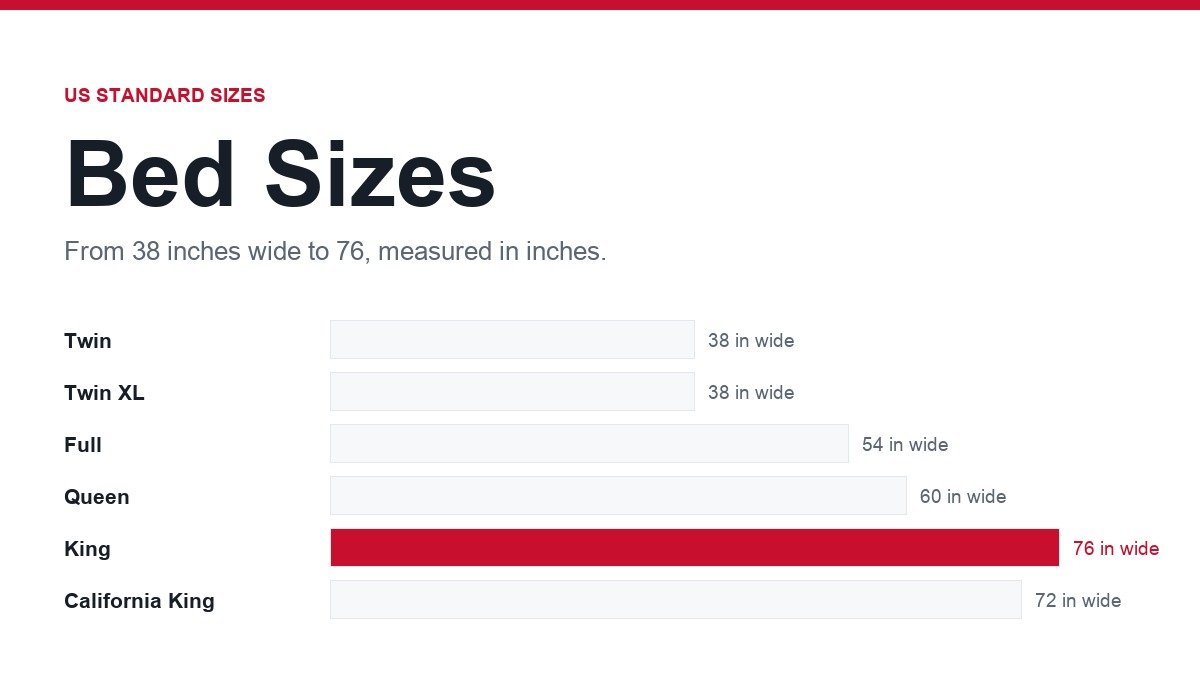
Standard bed sizes in the United States run from a Twin at 38 by 75 inches to a King at 76 by 80, with Twin XL, Full, Queen and California King in between. Width is always the first number. The useful figure, though, is not the width of the bed but the width each person actually gets, and that ranges from 27 inches on a full to 38 on a king.
What follows is the full chart, the sleeping width per person for each size, how much the frame adds to the footprint, and which of the many names on sale describe the same bed.
Bed Sizes Chart
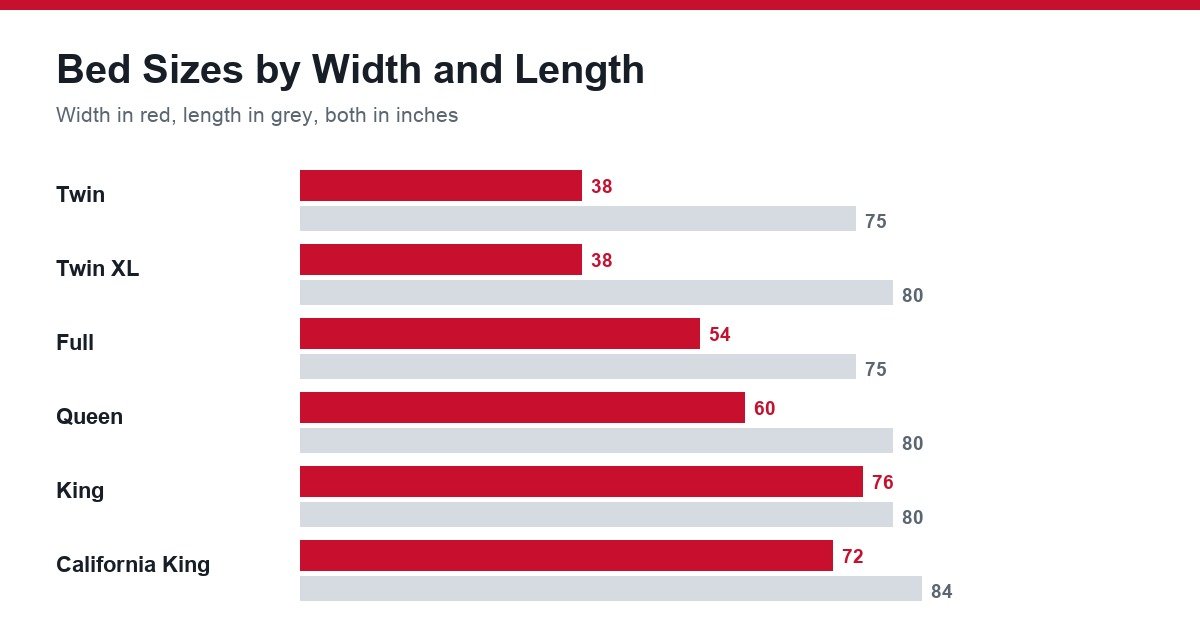
Every figure below is the mattress, measured width first. The last column divides the width between two sleepers, which is the number that decides whether a bed feels crowded.
| Size | Inches (W x L) | Suits | Width per sleeper (of two) |
|---|---|---|---|
| Twin | 38 x 75 | Single sleeper | 19 in |
| Twin XL | 38 x 80 | Taller single sleeper | 23 in |
| Full | 54 x 75 | One adult, or two at a squeeze | 27 in |
| Queen | 60 x 80 | Two adults | 30 in |
| King | 76 x 80 | Two adults with room | 38 in |
| California King | 72 x 84 | Tall sleepers | 36 in |
Note what does not change. Twin and Twin XL are the same width. Queen, King and Twin XL are all 80 inches long. Only the California King breaks the pattern, at 84 inches.
How Much Width Each Sleeper Gets
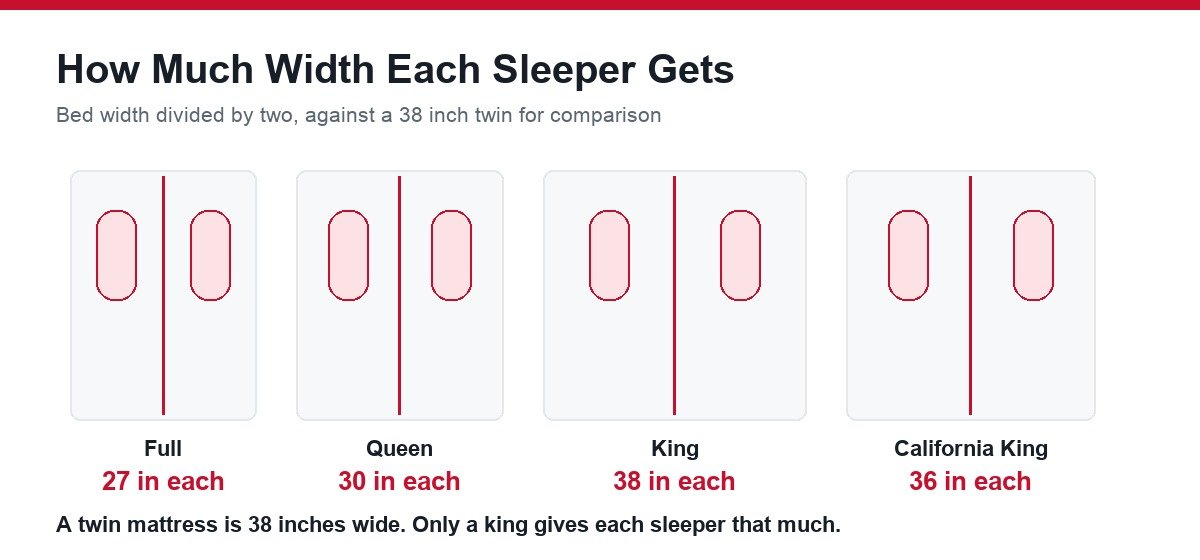
A single adult on a twin has 38 inches. Two adults on a queen have 30 inches each, which is less than a baby gets in a full-size crib. That comparison is the clearest argument for sizing up.
- Full, 27 inches each. Workable for one adult, tight for two every night.
- Queen, 30 inches each. The usual compromise, and the reason partners feel each other move.
- California King, 36 inches each. Four extra inches of length bought with four fewer inches of width.
- King, 38 inches each. The only size that gives each sleeper a full twin’s width.
Movement transfer scales with how close two people are. On a queen, a partner turning over is felt; on a king, often it is not, regardless of what the mattress is built from. Our size-by-size picks are in the guide to the best mattress.
The Frame Adds to the Footprint
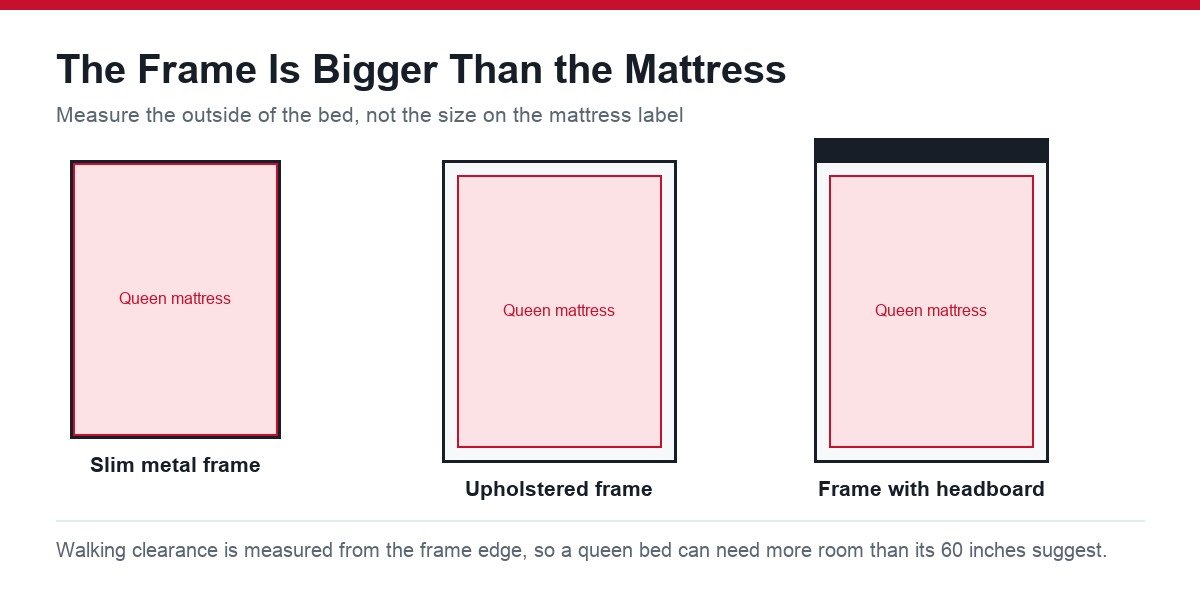
A bed takes up more floor than its mattress. A slim metal frame adds almost nothing on each side; an upholstered or storage frame can add several inches all round, and a headboard pushes the whole bed further from the wall.
Measure the outside dimensions of the frame you intend to buy, then add walking space to that, not to the mattress figure. Thirty inches on each side you need to walk down and thirty at the foot is the usual allowance.
| Size | Room it comfortably needs |
|---|---|
| Twin | 9 x 9 ft |
| Twin XL | 9 x 10 ft |
| Full | 10 x 9 ft |
| Queen | 10 x 10 ft |
| King | 12 x 10 ft |
| California King | 11 x 10 ft |
A bed in a corner needs much less, at the cost of one sleeper climbing over the other. Check the route in as well: a king mattress is 76 inches across and will not turn a tight staircase unless it ships compressed.
Full and Double Are the Same Bed
Bed naming is inconsistent, and some of the names that look like different sizes are not. These are the ones that cause the most confusion on a product page.
| Size | Also sold as | What to know |
|---|---|---|
| Full | Double | The same 54 by 75 inch bed under two names |
| Twin | Single | Twin is the US term, single is used elsewhere |
| Twin XL | Dorm twin | Twin XL is the size almost every US dormitory uses |
| King | Eastern King | Eastern King distinguishes it from a California King |
| California King | Western King | Longer and narrower than a standard king |
| Split King | Dual King | Two Twin XL mattresses on one base |
When a listing uses an unfamiliar name, the dimensions settle it. Any bed described in inches as 54 by 75 is a full, whatever it is called.
Regional naming adds another layer. A bed sold as a single in the United Kingdom or Australia is not the same rectangle as a US twin, and a British king is narrower than an American one. Any listing that quotes centimetres rather than inches is working from a different set of standard sizes, so convert the numbers before assuming that a frame, a base or a fitted sheet will fit it.
Twin XL and the Dormitory Rule
Twin XL exists because a 75-inch twin is too short for a tall adult. It keeps the 38-inch width and adds five inches of length, which is why it is the standard in United States college housing and why dormitory bedding is sold as a separate category.
It has a second use. Two Twin XL mattresses side by side measure 76 by 80 inches, identical to a king, which is how a split king is assembled.
Split Beds and Adjustable Bases
A split bed is one bed made from two mattresses on a shared base, so each half can be raised, lowered or chosen at a different firmness.
- Split King. Two pieces at 38 by 80 inches each, 76 by 80 together.
- Split California King. Two pieces at 36 by 84 inches each, 72 by 84 together.
- Bedding. Fitted sheets are bought per half. Flat sheets and duvets are bought for the full size.
- The seam. The two halves meet in the middle. A foam filler strip softens it rather than removing it.
Crib Beds Are Set by Regulation
Adult bed sizes are industry convention, not law. Crib sizes are the exception. The Consumer Product Safety Commission defines a full-size crib as measuring 52 and three-eighths inches by 28 inches, each with a tolerance of five-eighths of an inch, and crib mattresses have to meet the mandatory standard ASTM F2933 under 16 CFR part 1241.
That is why a crib mattress leaves almost no gap at the sides, and why aftermarket replacements carry compatibility requirements that no adult size has. The CPSC guidance for crib mattress makers sets out the dimension, firmness and thickness requirements in full.
The Third Dimension Nobody Quotes
Bed sizes describe a rectangle. Height is left out entirely, and it is not standardised at all, which is why two queens can be the same size on paper and feel completely different to get into.
- Mattress depth runs from roughly 6 inches on a thin foam bed to 15 or more on a pillow-top hybrid. Deep mattresses need deep-pocket fitted sheets, and a standard sheet will pop off a corner all night.
- Base height adds again. A platform base sits low, a traditional box spring on legs sits high, and an adjustable base is somewhere between with motors underneath.
- Total bed height is what matters in use. Sitting on the edge with feet flat on the floor and knees at about a right angle is the comfortable range for most people.
- Headboard clearance. A deep mattress pushes the sleeping surface up towards the top of the headboard, which looks wrong and can leave a gap pillows fall into.
When replacing a mattress inside a frame you are keeping, measure the inside depth of the frame rails as well as the width and length. A 14-inch mattress in a frame built for an 8-inch one leaves very little rail showing to hold it in place.
Choosing a Bed Size for a Room
- Measure the room, then subtract 60 inches of width for walking space. What is left is the widest frame that fits.
- Measure the tallest sleeper. Over six feet means 80 inches of length at minimum.
- Count everyone in the bed, children and dogs included. They cost width.
- Check what you already own. Moving from queen to king replaces the frame, the base and every piece of bedding.
- Check doorways and stairs before ordering anything not shipped compressed.
Size changes sleep more reliably than most advertised features. Two adults on a full will wake each other whatever the mattress is made of, which shows up plainly if you track your sleep on an Apple Watch.
Frequently Asked Questions
What are the standard bed sizes?
Twin at 38 by 75 inches, Twin XL at 38 by 80, Full at 54 by 75, Queen at 60 by 80, King at 76 by 80 and California King at 72 by 84. Queen is the most common in US bedrooms.
Which bed size is best for two adults?
A king, which gives each sleeper 38 inches. A queen at 30 inches each works in a smaller room, and a full at 27 inches each is tight for two people every night.
Is a double bed the same as a full?
Yes. Double and full both describe a 54 by 75 inch bed. Double is the older term and still appears on bedding packaging.
What room size does a king bed need?
About 12 by 10 feet if you want to walk down both sides and past the foot. A king will physically fit a smaller room, but one side usually ends up against a wall.