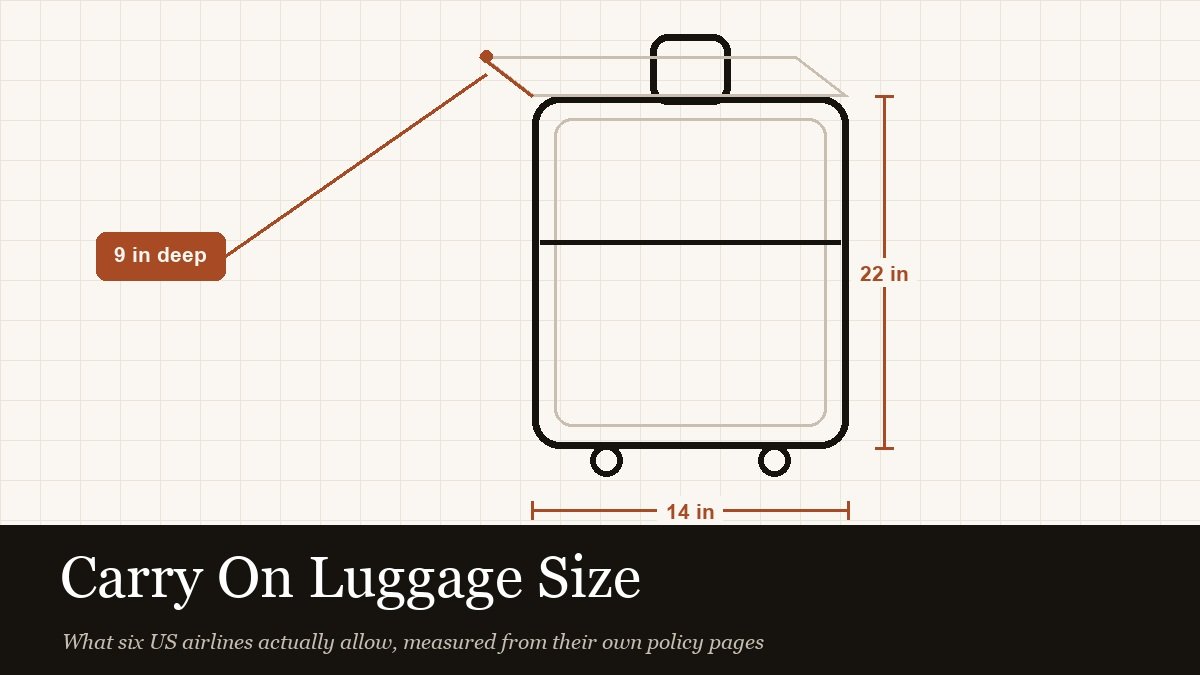
There is no single carry on luggage size in the United States, which is why a bag that flew fine last month gets sent to the hold this month. Four of the six largest carriers use the same figure, one allows noticeably more, and the limit that actually catches people is the personal item, not the roller bag.
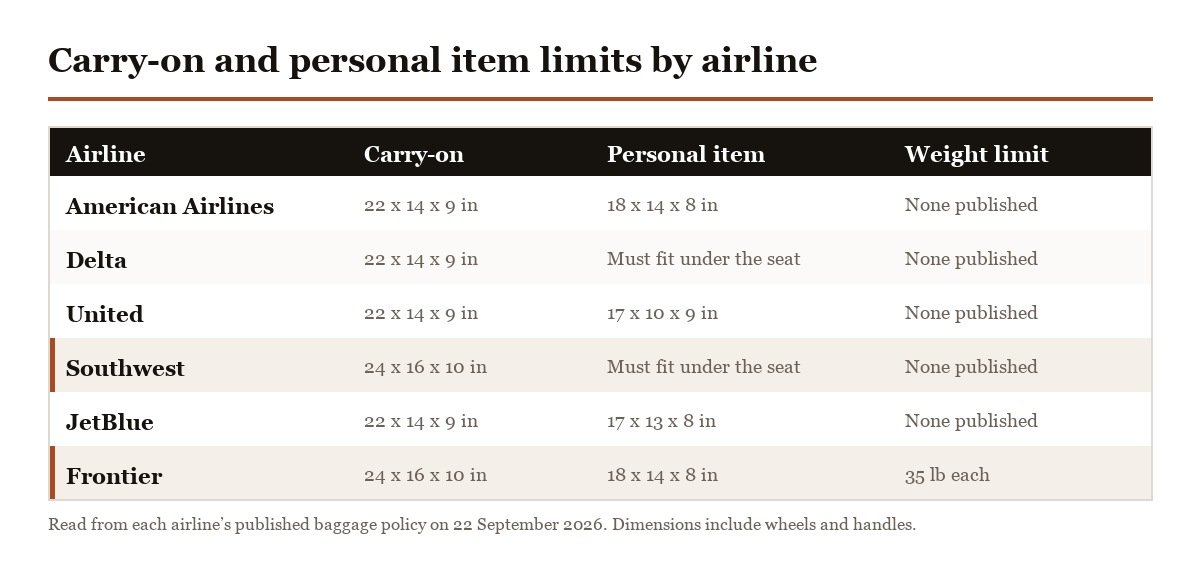
The table below was read off each airline’s own baggage page rather than from a booking screen, because booking screens summarise and the policy pages do not. Every dimension includes handles and wheels unless the airline says otherwise, and most of them say so explicitly.
Carry On Luggage Size by Airline
| Airline | Carry-on | Personal item | Weight limit |
|---|---|---|---|
| American Airlines | 22 x 14 x 9 in | 18 x 14 x 8 in | None published |
| Delta | 22 x 14 x 9 in | Must fit under the seat | None published |
| United | 22 x 14 x 9 in | 17 x 10 x 9 in | None published |
| Southwest | 24 x 16 x 10 in | Must fit under the seat | None published |
| JetBlue | 22 x 14 x 9 in | 17 x 13 x 8 in | None published |
| Frontier | 24 x 16 x 10 in | 18 x 14 x 8 in | 35 lb each |
Four carriers, American, Delta, United and JetBlue, all publish 22 x 14 x 9 inches. That is the number luggage makers design to, and it is why almost every bag sold as a cabin case measures within a fraction of it. Southwest and Frontier allow 24 x 16 x 10 instead, which is a meaningfully larger box, roughly 60 percent more volume than the common limit.
Delta adds a second constraint the others do not: the combined length, width and height must not exceed 45 linear inches. A bag measuring exactly 22 x 14 x 9 adds up to 45, so a compliant bag passes both tests, but an expandable case unzipped to 22 x 14 x 11 fails the linear rule even if no single side is over.
The Personal Item Is Where Bags Get Refused

Cabin bags are standardised enough that most travellers get them right. Personal items are not, and the spread between airlines is wide enough that one backpack can be legal on one carrier and charged for on another.
- United publishes 17 x 10 x 9 inches, the tightest of the six and small enough to rule out many everyday backpacks.
- JetBlue allows 17 x 13 x 8, wider but shallower than United.
- American and Frontier both allow 18 x 14 x 8, the most generous published figures here.
- Delta and Southwest publish no dimensions, stating only that the item must fit under the seat in front of you.
That last category sounds relaxed and usually is, but it hands the decision to whoever is at the gate. Frontier goes the other way and says outright that the size of your personal item is checked during boarding, with anything oversized subject to a charge. On an ultra low cost carrier that charge is the business model, not an accident.
What Counts Toward the Measurement

The dimensions are for the bag as you carry it, not the bag as the manufacturer measured the shell. This is where a 22 inch case becomes a 24 inch case.
- Wheels count. Southwest states that wheels, handles and any attachments are included in the limit.
- Handles count, both the telescopic one and the grab handle on the side.
- Expansion zips count when opened, which is what breaks Delta’s 45 linear inch rule.
- Straps and clipped-on items count, including a water bottle in a side pocket.
- The airport sizer is the tiebreaker. American says the bag must fit its sizer, and if it does not fit, the tape measure does not matter.
A practical consequence: buy a case advertised at 21 inches rather than 22 if you fly the airlines using the 22 x 14 x 9 limit. Manufacturers usually quote the body height and add the wheels on top, so a “22 inch carry-on” often measures 23 inches at the checkpoint.
Weight Limits and the One Airline That Enforces Them
Most US carriers do not weigh cabin bags at all. JetBlue says so directly, telling passengers there is no weight restriction provided you can lift the bag into the bin yourself.
- American, Delta, United, Southwest and JetBlue publish no carry-on weight limit for standard domestic travel.
- Frontier caps both bags at 35 pounds, the carry-on and the personal item.
- Frontier also caps checked bags at 40 pounds, below the 50 pound norm elsewhere.
- Overweight checked charges escalate quickly, at $75 for 41 to 50 pounds and $129 for 51 to 99.99 pounds on bookings made on or after 4 April 2026.
If you fly mostly legacy carriers, weight is a non-issue in the cabin and you can pack a carry-on as heavy as you can lift. Book a low cost ticket and the calculation changes completely, because the weight allowance shrinks at the same time as the fee for exceeding it grows.
Basic Economy and Regional Jets
Two situations remove the carry-on you thought you had booked, and neither is about the size of the bag.
- Check the fare class before you pack. United states that you may bring a carry-on bag and a personal item if you are not travelling in Basic Economy.
- Check the aircraft on short hops. Delta notes that on Delta Connection flights, including aircraft with 50 seats or fewer, passengers may only carry personal items on board.
- Expect a valet tag on regional jets. American valets bags larger than a personal item on American Eagle flights, tagging them at the gate at no charge and returning them on the jetbridge.
- Take your essentials out first. Medication, keys, documents and batteries should move to your personal item before the bag leaves you.
Gate checking is free in all of these cases, so the cost is time rather than money. The exception is buying a Basic Economy fare and then discovering at the gate that the cabin bag needs to be checked at the full airport rate, which is where the cheap fare stops being cheap.
Choosing a Bag That Works on Every Airline
Buying for the smallest published limit costs you very little space and removes the whole problem. The difference between a 22 inch case and a 24 inch case is one pair of shoes, and the 22 inch case never gets stopped at a gate on an airline you do not usually fly. Toiletries take up the rest, which is worth bearing in mind if a hard brush case is going in too; our guide to the best electric toothbrushes says which ones include one.
One case can satisfy all six carriers, and it is the smaller of the two standards rather than a compromise between them.
- Buy to 22 x 14 x 9 inches including wheels, which clears every airline in the table.
- Prefer a soft-sided case if you often fly regional aircraft, since it compresses into a tight bin.
- Keep the personal item under 17 x 10 x 9 and it passes even United.
- Weigh it once at home if a low cost carrier is anywhere in the itinerary.
- Check the fare, not just the airline, because Basic Economy changes the allowance on a carrier whose standard fares include a cabin bag.
Packing light also reduces what you have to unpack at the checkpoint. Keeping toiletries within the TSA liquid rules and putting a charger and power bank in an outer pocket means the bag goes through the X-ray once rather than being opened on a table. Power banks have to travel in the cabin rather than the hold, and our guide to the best power bank for Galaxy S26 Ultra explains the watt-hour limit that decides which ones are allowed.
Measure your own bag rather than trusting the label, and measure it packed. A soft case gains half an inch in every direction once it is full, and the sizer at the gate is measuring the packed bag, not the empty one you held up in the shop. Travelling with a baby adds its own measuring problem, which our guide to the best baby stroller travel systems works through.
Frequently Asked Questions
Is 22 x 14 x 9 standard for all airlines?
It is the most common US limit and is used by American, Delta, United and JetBlue, but it is not universal. Southwest and Frontier both allow 24 x 16 x 10 inches, and international carriers often publish smaller dimensions with a weight limit attached.
Do wheels and handles count in carry-on size?
Yes, on every airline in this comparison. Southwest states it most plainly, including wheels, handles and any attachments in the limit, and American requires the bag to fit its airport sizer, which makes the point physically rather than in writing.
What happens if my carry-on is too big?
It gets checked. At the gate that is usually free, and the bag is returned on the jetbridge or at baggage claim. At the ticket counter you pay the standard checked bag fee, which on a low cost fare can cost more than the ticket did.
Can I bring a backpack and a carry-on?
Yes, provided the backpack fits the personal item dimensions and goes under the seat. That is the catch on United, whose 17 x 10 x 9 inch limit is smaller than many commuter backpacks once they are packed for a trip.