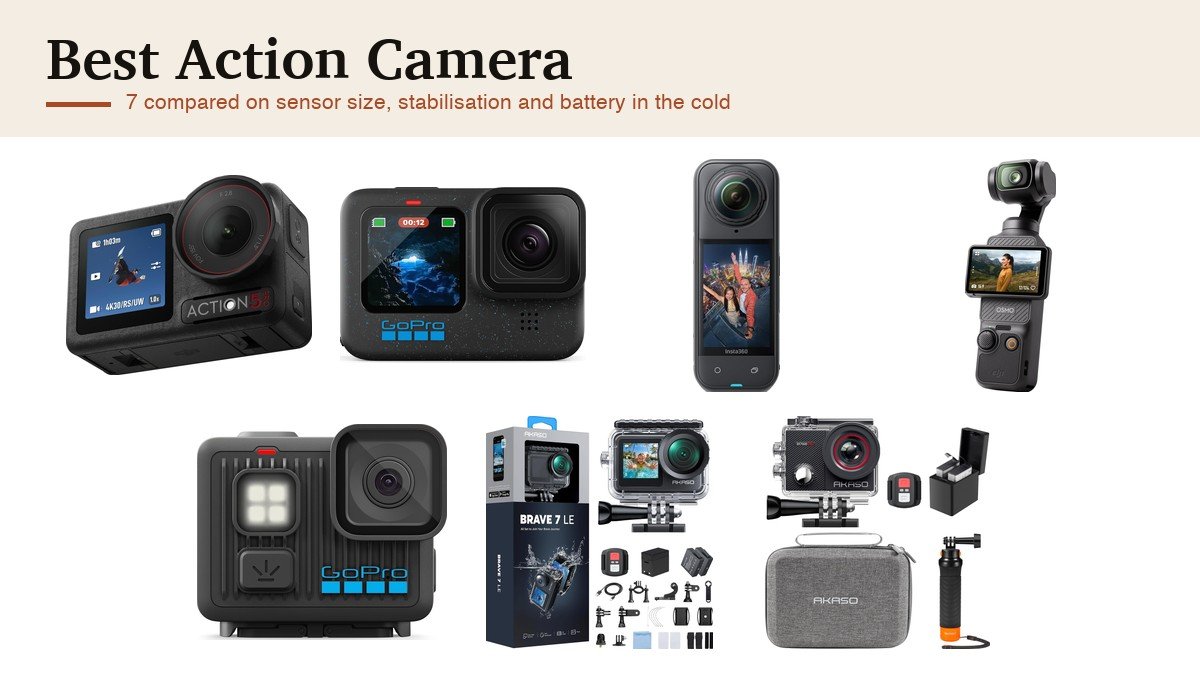
The best action camera for you is decided by two numbers that rarely appear in the headline. The first is sensor size, because every one of these shoots 4K and only some of them produce a usable image once the light drops. The second is battery life in the cold, since the conditions people buy action cameras for, skiing, winter cycling, early starts, are exactly the conditions that halve a lithium cell.
Resolution is the specification that sells and the one that separates these least. A budget camera at 4K30 and a flagship at 4K120 both produce sharp footage in daylight. Put them under trees at dusk and the gap is enormous, and it is a sensor gap rather than a pixel one. The seven below state their sensor where the maker publishes it, and the table notes which ones need a housing to go underwater and which do not.
Best Action Camera Picks Compared on Sensor, Stabilisation and Water
Read sensor and waterproofing together. A camera rated to a depth on its own body is a different product from one that needs a plastic housing, because the housing costs you sound quality and a touchscreen.
| Camera | Sensor and video | Stabilisation | Waterproof | Battery |
|---|---|---|---|---|
| DJI Osmo Action 5 Pro | 1/1.3 inch, 13.5-stop dynamic range | 360 degree HorizonSteady | IP68 to 20m with no housing | 1950mAh, up to 4 hours |
| GoPro HERO12 Black | 5.3K60 video, 27MP photos | HyperSmooth | Waterproof with no housing | Enduro battery included |
| Insta360 X5 | Dual 1/1.28 inch, 8K30 in 360 | Triple AI chip processing | Waterproof body | Not quoted on the listing |
| DJI Osmo Pocket 3 | 1 inch CMOS, 4K120 | 3-axis mechanical gimbal | Not waterproof | Not quoted on the listing |
| GoPro LIT Hero | 4K60, 12MP photos | GoPro stabilisation | To 16 feet with no housing | Not quoted on the listing |
| AKASO Brave 7 LE | 4K30, 20MP photos | 6-axis EIS 2.0 | With the supplied housing | Two batteries supplied |
| AKASO EK7000 Pro | 4K30 and 1080p60, 20MP | EIS | To 131 feet with the housing | Two 1350mAh, 140 min each |
Sensor Size, Gimbals and the Housing Question
Sensor size is the single best predictor of how an action camera performs when the light is poor. A 1/1.3 inch sensor gathers substantially more light than the small sensors in budget cameras, and a 1 inch sensor more again, which is why the DJI Osmo Pocket 3 outperforms everything here indoors and at dusk despite not being a conventional action camera at all. Pixel count has almost nothing to do with it.
Stabilisation splits into two approaches. Most of these use electronic image stabilisation, which crops into the frame and shifts it digitally to cancel shake, costing a little field of view and working less well in low light because it needs a fast shutter. The Osmo Pocket 3 instead uses a three-axis mechanical gimbal that physically moves the camera, which is better in every respect except that it is fragile and cannot be thrown down a mountain.
Waterproofing is where the price difference shows most clearly. The flagships are rated on the bare body, so you keep the touchscreen and usable audio, and the DJI quotes IP68 to 20 metres. The budget cameras need a clear plastic housing, which muffles the microphone, blocks the touchscreen and fogs if you take it from a warm car into cold water. That trade is fine for a pool or a snorkel and poor for a bike helmet, and it is worth understanding before buying on depth alone.
1. DJI Osmo Action 5 Pro: The Best Action Camera Overall
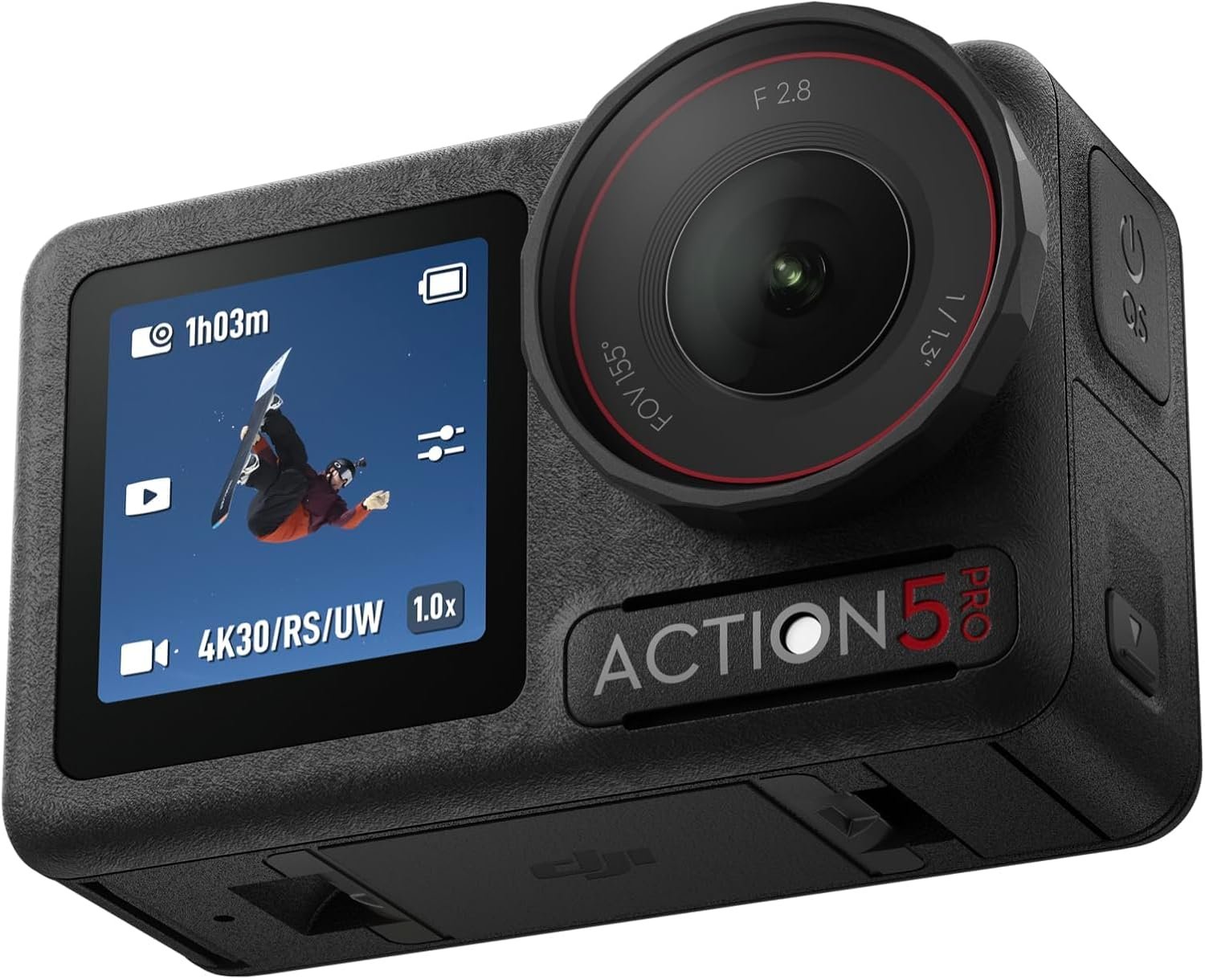
The Osmo Action 5 Pro is the camera to buy if you want one that handles everything. A 1/1.3 inch sensor with 2.4 micrometre pixels and 13.5 stops of dynamic range is the largest in any conventional action camera here, and it is what lets it hold detail in a shaded trail with bright sky above rather than blowing one out to save the other.
The battery figure is the one that matters in practice: 1950mAh rated at up to four hours of recording, and still 3.6 hours at minus 20 degrees Celsius. That cold-weather number is unusual to publish and it is the difference between a camera that works on a ski day and one that dies at lunchtime. It is IP68 rated to 20 metres with no housing, HorizonSteady cancels roll on all 360 degrees so the horizon stays level however the camera tumbles, and subject tracking keeps a moving rider centred in either 16:9 or 9:16.
What it does well
- The largest sensor of any conventional action camera here.
- 3.6 hours of recording at minus 20 degrees Celsius.
- IP68 to 20 metres with no housing needed.
- 360 degree HorizonSteady keeps the horizon level in a tumble.
What to know before buying
- Essential Combo is the bare camera, so mounts cost extra.
- More expensive than the GoPro it competes with.
- DJI accessories are a smaller ecosystem than GoPro’s.
2. GoPro HERO12 Black: The Biggest Accessory Ecosystem
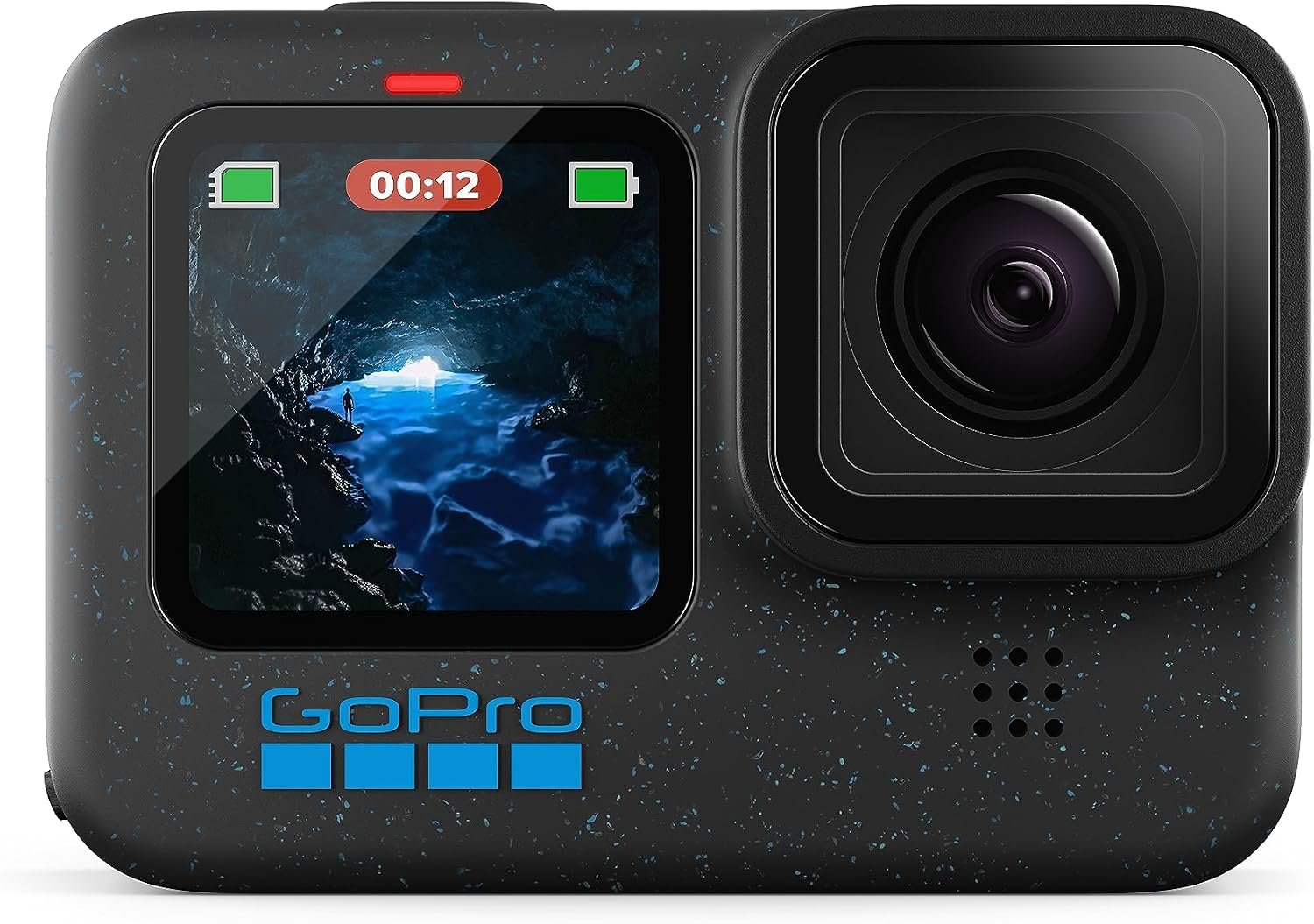
GoPro is no longer automatically the best camera in this category, but it is still the one everything else is built to fit. Every helmet mount, chest harness, bike clamp and third-party accessory in a shop is designed around the GoPro finger mount, and that matters more over three years than a sensor comparison does.
The HERO12 Black records 5.3K at 60 frames per second and takes 27MP photos, which is higher resolution than anything else here outside the 360 cameras, and the pack includes the Enduro battery designed specifically for cold performance rather than the older standard cell. It is waterproof without a housing. Buying the previous generation rather than the newest is the standard way to get GoPro quality without the launch price, and this is that camera.
What it does well
- 5.3K at 60fps and 27MP stills, the highest conventional resolution here.
- Fits the enormous GoPro accessory ecosystem.
- Enduro battery included for better cold performance.
- Waterproof with no housing.
What to know before buying
- A previous-generation flagship rather than the current one.
- Smaller sensor than the DJI Osmo Action 5 Pro.
- GoPro subscription is pushed hard during setup.
3. Insta360 X5: Point It Nowhere and Reframe Later

A 360 camera changes how you film rather than how sharp the result is. The X5 records everything around it in 8K at 30 frames per second using dual 1/1.28 inch sensors, and you choose the framing afterwards in software rather than aiming at the time. For a mountain bike descent or a motorcycle ride that means you never miss the moment because the camera was pointing the wrong way.
The invisible selfie stick is the feature that sells it and it genuinely works: the stick falls into the blind spot between the two lenses and disappears, producing third-person shots that look like a drone. A triple AI chip design handles noise reduction, which is Insta360 addressing the usual 360 camera weakness in dim light, and InstaFrame outputs a normal flat video immediately so you are not forced into editing before you can share anything.
What it does well
- Films everything at once, so framing is decided afterwards.
- Dual 1/1.28 inch sensors at 8K30.
- Invisible selfie stick produces drone-like third-person shots.
- InstaFrame gives a flat, shareable video straight away.
What to know before buying
- 360 footage needs editing to be useful, which takes time.
- Files are very large and demand a fast card and computer.
- The listing does not quote a battery figure.
4. DJI Osmo Pocket 3: The Best Image Quality, With a Caveat

The Pocket 3 is not an action camera and it produces better video than any of them. A 1 inch CMOS sensor, the largest here by a wide margin, records 4K at up to 120 frames per second, and a three-axis mechanical gimbal physically stabilises the camera rather than cropping the image digitally.
That combination makes it the pick for anyone whose footage is mostly walking, vlogging, travel or low light rather than impact sports. The two inch screen rotates so it shoots horizontally or vertically without reframing, and ActiveTrack 6.0 keeps you centred while you move. The caveat is simple and important: it is not waterproof and the exposed gimbal is a mechanical part. Mount it on a helmet at speed and you will break it. Use it as a travel and vlogging camera and nothing here comes close.
What it does well
- A 1 inch sensor, far larger than any action camera here.
- Three-axis mechanical gimbal rather than digital cropping.
- 4K at up to 120fps and a screen that rotates for vertical video.
- ActiveTrack 6.0 keeps a moving subject centred.
What to know before buying
- Not waterproof at all.
- An exposed gimbal is fragile and not built for impacts.
- Does not fit the standard action camera mount ecosystem.
5. GoPro LIT Hero: The Light Is the Point

The LIT Hero is GoPro’s entry-level camera and it has one feature nothing else in this guide offers: a built-in light panel with three brightness settings that works when the camera is off and while it is charging. For caving, night riding, filming inside an engine bay or any situation where the subject is closer than a few feet, that removes the need for a separate light.
The rest is a sensibly simplified camera. Controls are reduced to tapping and swiping between video, photo and slow motion, so there is nothing to learn, and it records 4K at 60 frames per second with 12MP photos and can pull 11MP stills out of video in the Quik app. It is waterproof to 16 feet with no housing, which covers swimming and rain but not diving. It is the smallest and lightest GoPro, which makes it the easy one to actually carry.
What it does well
- A built-in light that works with the camera off.
- Waterproof to 16 feet with no housing.
- Simplified controls with nothing to configure.
- The lightest camera here, so it gets carried.
What to know before buying
- 16 feet is shallow next to the DJI at 20 metres.
- 4K60 rather than the HERO12 5.3K.
- Entry-level, so fewer professional settings.
6. AKASO Brave 7 LE: The Budget Camera With Real Stabilisation
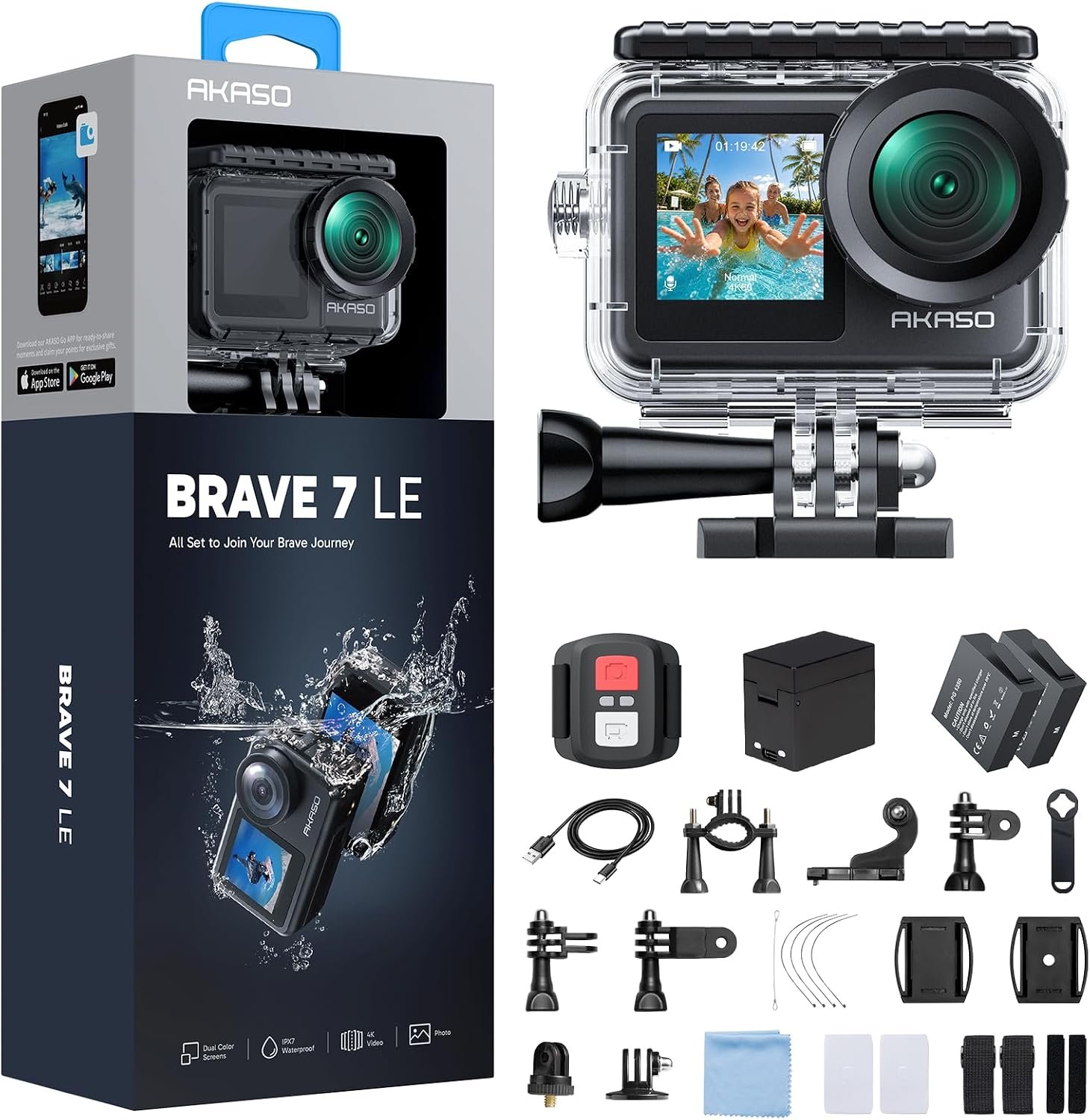
At the budget end the thing that usually fails is stabilisation, and footage that shakes is footage nobody watches twice. The Brave 7 LE uses six-axis EIS 2.0, which AKASO describes as gimbal-like, and it is good enough that handheld walking footage is watchable rather than nauseating.
It records 4K at 30 frames per second with 20MP photos, has a touch screen and a remote, and ships with two batteries so a day out does not end at lunchtime. Waterproofing comes from the supplied housing rather than the body, which is the standard budget compromise. For a first action camera, a child’s camera, or a second body you can mount somewhere risky without worrying, this is the sensible amount to spend.
What it does well
- Six-axis EIS 2.0 that genuinely steadies handheld footage.
- Two batteries and a full accessory bundle included.
- Touch screen and a remote at a budget price.
- Cheap enough to mount somewhere you might lose it.
What to know before buying
- Needs the housing to go underwater.
- Small sensor, so low light is poor.
- 4K30 only, with no higher frame rate option.
7. AKASO EK7000 Pro: The Cheapest One Worth Buying
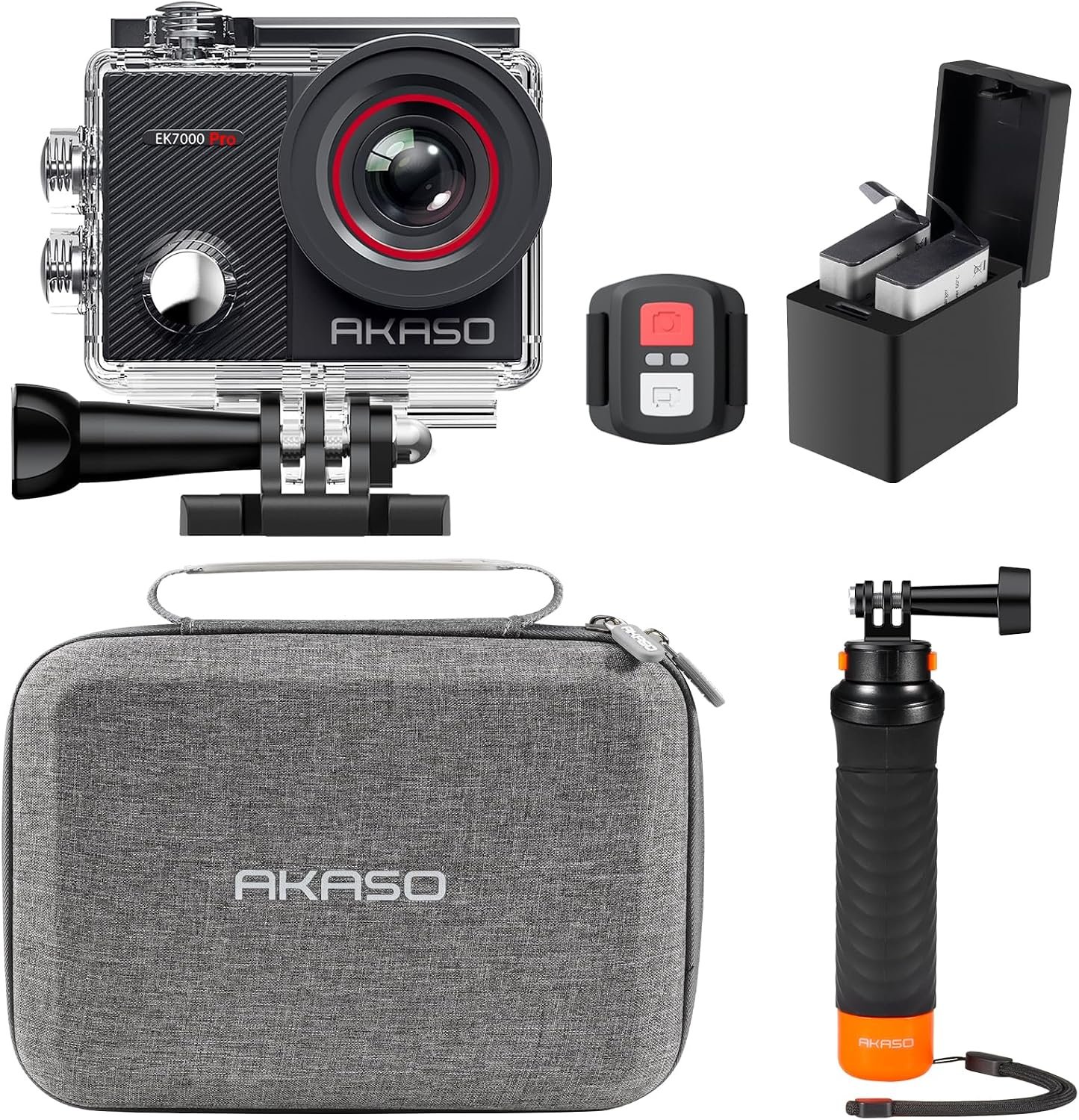
The EK7000 has been the default cheap action camera for years and the Pro version adds the two things the original lacked: a touch screen and electronic image stabilisation. It records 4K at 30 frames per second, 1080p at 60, and 20MP photos.
The numbers that matter at this price are the battery and the depth. Two 1350mAh batteries are included, each rated at up to 140 minutes, which is nearly five hours of recording across the pair, and the upgraded waterproof housing is rated to 131 feet, making it genuinely usable for diving and snorkelling rather than just for rain. Buy it as a holiday camera, a watersports camera or a first camera for someone who may not stick with it.
What it does well
- Two batteries rated at 140 minutes each.
- Housing rated to 131 feet, deep enough for diving.
- Touch screen and EIS, which the original EK7000 lacked.
- The cheapest camera here by a clear margin.
What to know before buying
- Smallest sensor in this guide, so poor in low light.
- Housing required for any water use.
- Build quality reflects the price.
Matching the Camera to What You Actually Film
Action cameras are bought for a specific activity and then used for everything, which is why the right question is what you film most rather than what you film occasionally. Work down this list before comparing specifications.
- Mixed outdoor use in all weather: a flagship with body waterproofing, not a housing.
- Skiing or winter cycling: check the cold-weather battery figure, not the room-temperature one.
- Mountain biking or motorcycling: a 360 camera, so you never miss the moment by aiming wrong.
- Vlogging, travel and low light: a large sensor and a mechanical gimbal, and accept it is not rugged.
- Snorkelling and holidays: a budget camera with a deep-rated housing is genuinely enough.
- Night riding or confined spaces: a camera with a built-in light saves carrying one.
Audio is the part people forget. Wind noise ruins more action footage than shake does, and a camera inside a housing records almost nothing usable. If the footage needs a voiceover or music over the top, plan for that rather than hoping, and a decent pair of wireless earbuds makes reviewing clips on a phone far easier than a laptop speaker.
Mounting is the hidden cost. GoPro’s finger-mount pattern is the de facto standard, so a GoPro fits everything on the shelf while other brands need an adapter, and a chest harness, helmet mount and bar clamp together often cost as much as a budget camera. Storage matters too: 4K at high frame rates fills cards quickly and demands a fast one, the same consideration our guide to the best dash cam raises about endurance cards. For shots from above rather than from a helmet, our guide to the best drone covers the weight limit that decides the paperwork.
Which Action Camera to Buy
For most people the DJI Osmo Action 5 Pro is the right answer: the largest sensor of any true action camera here, IP68 to 20 metres with no housing, and a published cold-weather battery figure that nothing else matches. The GoPro HERO12 Black is the alternative if the accessory ecosystem matters more to you than the sensor, and it remains the higher-resolution camera at 5.3K60.
The Insta360 X5 is the one to buy for bikes and motorcycles, because filming everything and choosing the angle later solves the problem those sports actually have. The DJI Osmo Pocket 3 produces the best image here and is the wrong tool for anything involving impact. At the budget end, the AKASO Brave 7 LE is the first camera worth owning and the EK7000 Pro is the holiday and snorkelling choice. The GoPro LIT Hero is the specialist pick if you film in the dark. Budget for mounts and a fast card on top of whichever you choose, and if the footage is going on a big screen, our guide to the best projectors covers that end.
Frequently Asked Questions
Does sensor size matter more than 4K on an action camera?
Yes. Every camera in this guide records 4K and they look similar in bright sunshine. The differences appear at dusk, under trees and indoors, and those are sensor differences rather than resolution ones. A larger sensor gathers more light, which is why the 1 inch Osmo Pocket 3 outperforms cameras with higher pixel counts.
Do I need a waterproof housing?
It depends on the camera. The flagships here are rated on the bare body, so you keep the touchscreen and clear audio. Budget cameras need a clear housing, which muffles the microphone, blocks the touchscreen and can fog when moving between temperatures. For a pool or a snorkel that is fine; for a helmet it is a real compromise.
Is a 360 camera better than a normal action camera?
For some sports, yes. Filming everything at once means you never miss a moment because the camera was pointing the wrong way, which is the usual failure on a bike or a motorcycle. The cost is that every clip needs reframing in software before it is watchable, and the files are large. If you will not edit, buy a conventional camera.
How long do action camera batteries last in the cold?
Considerably less than at room temperature, which is why the published cold figure is worth looking for. The DJI Osmo Action 5 Pro quotes 3.6 hours at minus 20 degrees Celsius against four hours normally, which is unusually little loss. Most makers do not publish the figure at all, so carrying a spare battery warm in an inside pocket is the practical answer.
Related Articles
- Best Gaming Handhelds: Power, Battery and Emulation Compared
- Best Power Banks: 7 Compared on Watts, Watt-Hours and Cables
- Best Webcams: Resolution, Low Light and Field of View Compared
As an Amazon Associate, CanyonWire earns from qualifying purchases.