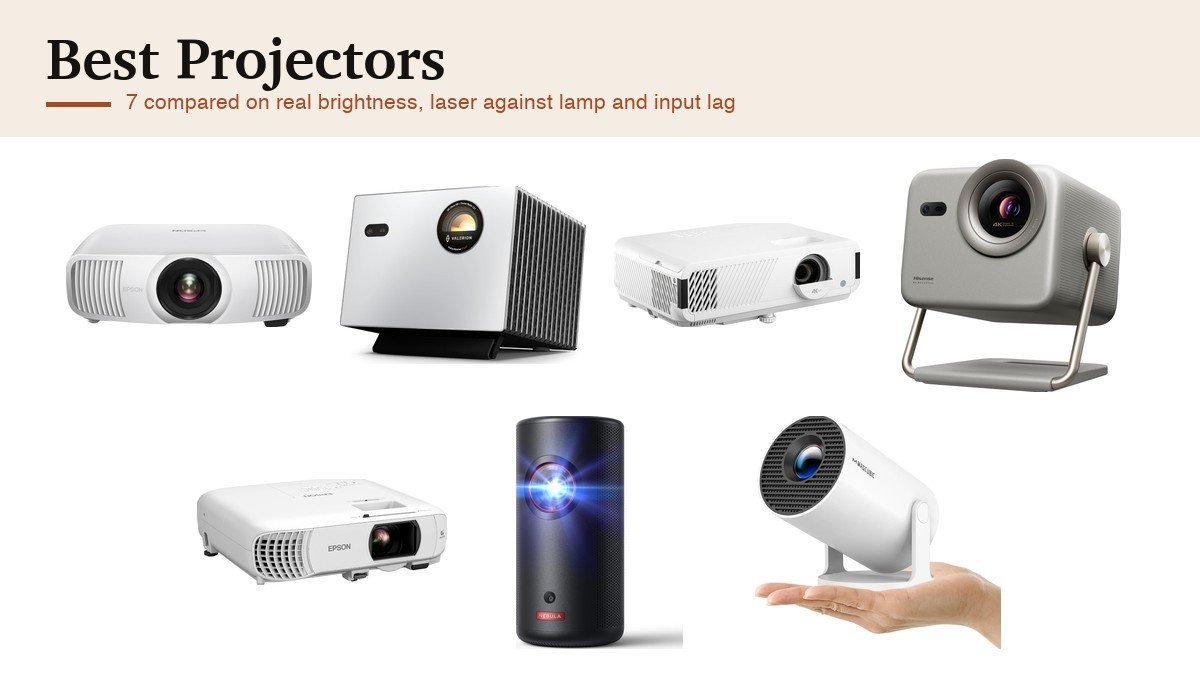
Brightness is where guides to the best projectors go wrong, because the number on the box is frequently not a number at all. Manufacturers quote ANSI lumens, ISO lumens, LED lumens and plain unqualified lumens, and only the first two are measured to a standard anyone can check. A cheap projector advertising 15,000 lumens and a serious one quoting 2,500 are not describing the same quantity, and the serious one is usually brighter on a wall.
The lumen measures total light output, and the honest figures in this guide run from 300 ANSI on a pocket projector to 4,000 on a bright living-room model. The second thing that decides what you get is the light source. A lamp is cheap to buy and needs replacing every few thousand hours; a laser costs more up front and runs for the life of the projector without a consumable. The seven below split across both, and across four very different uses.
Best Projectors Compared on Brightness, Light Source and Lag
Read brightness and light source together, then check input lag only if you game. Figures below are quoted in the units each maker publishes, because converting between them is how misleading comparisons start.
| Projector | Resolution | Brightness | Light source | Best suited to |
|---|---|---|---|---|
| Epson Home Cinema LS11000 | 4K, 8.29 million pixels | 2,500 lumens colour and white | Laser array, 3-chip 3LCD | A dedicated dark room |
| Valerion StreamMaster Plus2 | 4K up to 300 inches | Not quoted in ANSI on the listing | Laser | Gaming at 240Hz and 4ms |
| ViewSonic PX749-4K | 4K UHD 3840 by 2160 | 4,000 ANSI lumens | Lamp, DLP | A living room with some ambient light |
| Hisense M2 Pro | 4K UHD, 65 to 200 inches | 1,300 ANSI lumens | Triple laser, DLP | Moving between rooms and outdoors |
| Epson Home Cinema 980 | 1080p | 4,000 lumens colour and white | Lamp, 3-chip 3LCD | Sport and casual viewing on a budget |
| Nebula Capsule 3 Laser | 1080p up to 120 inches | 300 ANSI lumens | Laser | Travel and camping, on battery |
| Magcubic HY300PRO | Native 720p with 4K support | Not quoted in ANSI | LED | A bedroom or an occasional second screen |
Lumens, Throw Distance and Why Laser Costs More
Treat any brightness figure without ANSI or ISO beside it as marketing. ANSI lumens are measured by averaging readings across nine points of the projected image, which is why a 1,300 ANSI portable can look better than something claiming five figures. Where a maker does not publish an ANSI number, as with two entries here, that absence is itself information.
Throw distance is the specification people discover too late. The ratio between how far back the projector sits and how wide the image comes out is fixed by the lens, so a long-throw model in a small room produces a small picture no matter how bright it is. The ViewSonic here states it plainly: a 100 inch image from 13 feet away. Measure the room before choosing, and check whether there is zoom and lens shift rather than only keystone correction, because keystone fixes geometry by throwing away pixels. If the screen is a monitor rather than a wall, our guide to the best docking station covers driving two or more of them.
The last split is the imaging technology. DLP uses a chip of micro mirrors and can show a rainbow artefact to sensitive viewers on single-chip models, while Epson’s 3-chip 3LCD approach avoids it entirely and produces equal colour and white brightness. Laser light sources hold their output for the life of the projector and switch on instantly; lamps are cheaper but dim gradually and need replacing. If the projector is going outside, our guide to the best portable power stations covers running one away from a socket.
1. Epson Home Cinema LS11000: The Reference Pick for a Dark Room

The LS11000 is the projector to buy when the room is the priority rather than the price. A 3-chip 3LCD engine driven by a laser array produces 2,500 lumens of colour brightness and 2,500 of white, and the fact that those two numbers match is the whole point of the 3LCD approach: many single-chip projectors quote a high white figure and a much lower colour one, which is why their images look washed out.
Contrast is where it separates from everything else here, at a quoted 1,200,000 to 1 dynamic ratio, which is what produces genuine shadow detail rather than grey. Full 10-bit processing handles HDR10, HDR10+ and HLG with Epson’s 16-step real-time HDR adjustment, and the RX picture processor does 32-bit colour, contrast and frame interpolation work. It needs a room you can darken properly to be worth the money.
What it does well
- Equal colour and white brightness at 2,500 lumens each.
- Quoted 1,200,000 to 1 dynamic contrast ratio.
- HDR10+ with 16-step real-time adjustment.
- Laser light source with no lamp to replace.
What to know before buying
- The most expensive projector in this guide.
- Needs a properly darkened room to justify itself.
- Large and heavy, so it wants a permanent mount.
2. Valerion StreamMaster Plus2: Built Around Input Lag
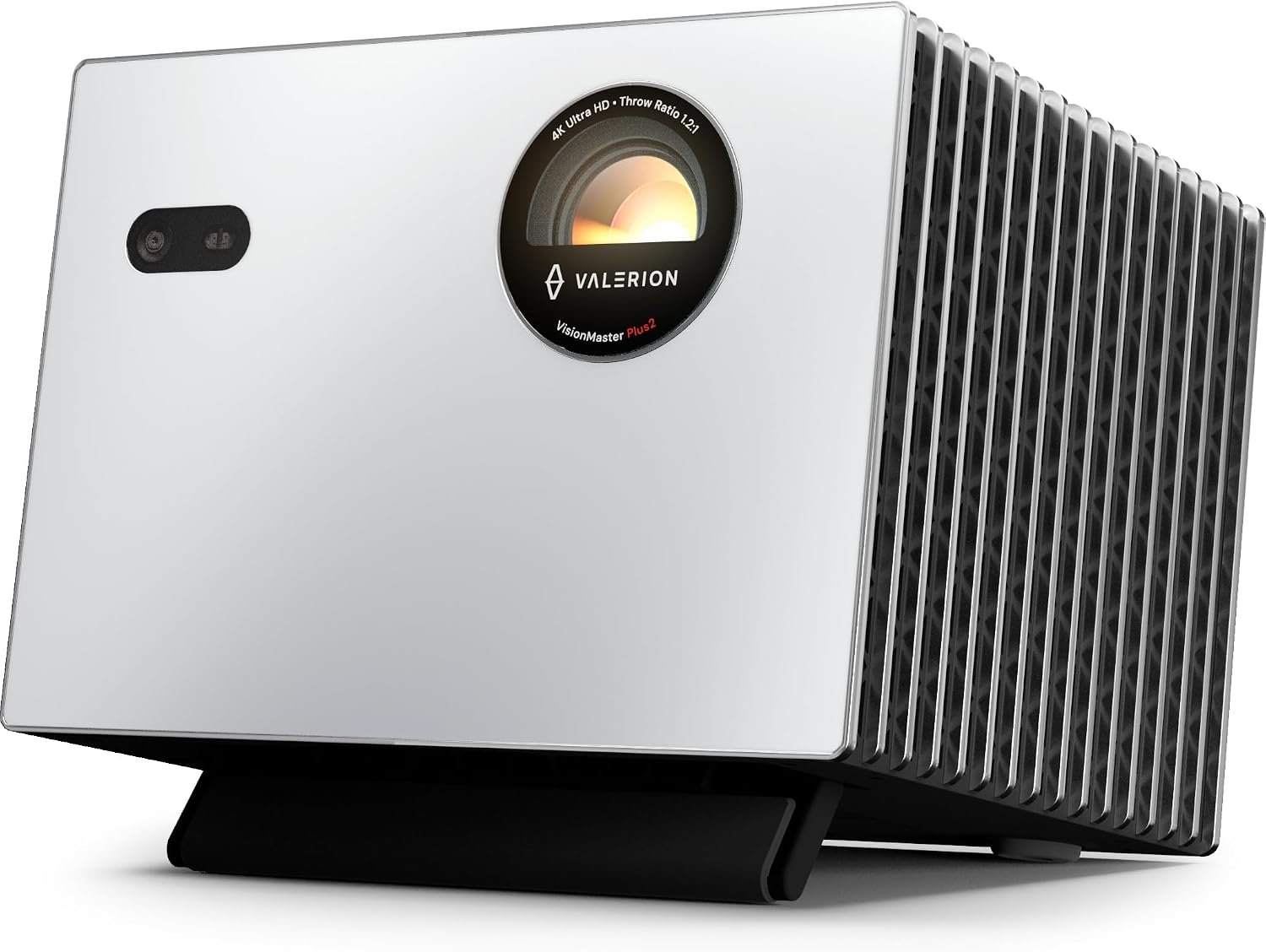
Projectors have historically been poor for competitive gaming because the processing that makes films look good adds delay. The StreamMaster Plus2 inverts that priority: 4ms input lag at a 240Hz refresh rate, which is console and PC monitor territory rather than projector territory.
Around that sit gaming-specific modes for RPG and FPS play plus an enhanced night-vision crosshair, and the projector throws up to 300 inches with IMAX Enhanced certification for film use. The listing is thin on a published ANSI figure, which is worth knowing before you buy, but the laser light source and the lag numbers are the reasons to consider it. This is the projector for someone replacing a large television in a games room rather than building a cinema.
What it does well
- 4ms input lag at 240Hz, the fastest here.
- Dedicated RPG and FPS modes with a night-vision crosshair.
- Laser light source and up to a 300 inch image.
- IMAX Enhanced certification for film viewing.
What to know before buying
- No ANSI brightness figure published on the listing.
- A newer brand with less service history than Epson or ViewSonic.
- Gaming features are wasted if you only watch films.
3. ViewSonic PX749-4K: The Brightest Living Room Choice

Four thousand ANSI lumens is the figure that matters here, because it is high enough to produce a watchable image in a room with the curtains partly open, which is how most people actually use a projector. Combined with 4K UHD resolution at 3840 by 2160 and HDR with HLG support, it is the most practical all-rounder in this guide.
ViewSonic has also made it a serious gaming projector: native Xbox compatibility with 1440p at 120Hz, a 240Hz refresh rate and 4.2ms input lag. Setup is unusually flexible for the price, with 1.3x optical zoom, horizontal and vertical keystone, auto keystone and four-corner adjustment, and the listing states the throw plainly as a 100 inch image from 13 feet. It uses a lamp rather than a laser, which is the main compromise against the price.
What it does well
- 4,000 ANSI lumens, the brightest measured figure here.
- 1440p at 120Hz Xbox support with 4.2ms input lag.
- 1.3x optical zoom plus four-corner and auto keystone.
- Throw distance published plainly on the listing.
What to know before buying
- A lamp, so it dims over time and eventually needs replacing.
- Single-chip DLP can show rainbow artefacts to sensitive viewers.
- Fan noise is higher than the laser models here.
4. Hisense M2 Pro: Triple Laser You Can Carry Outside
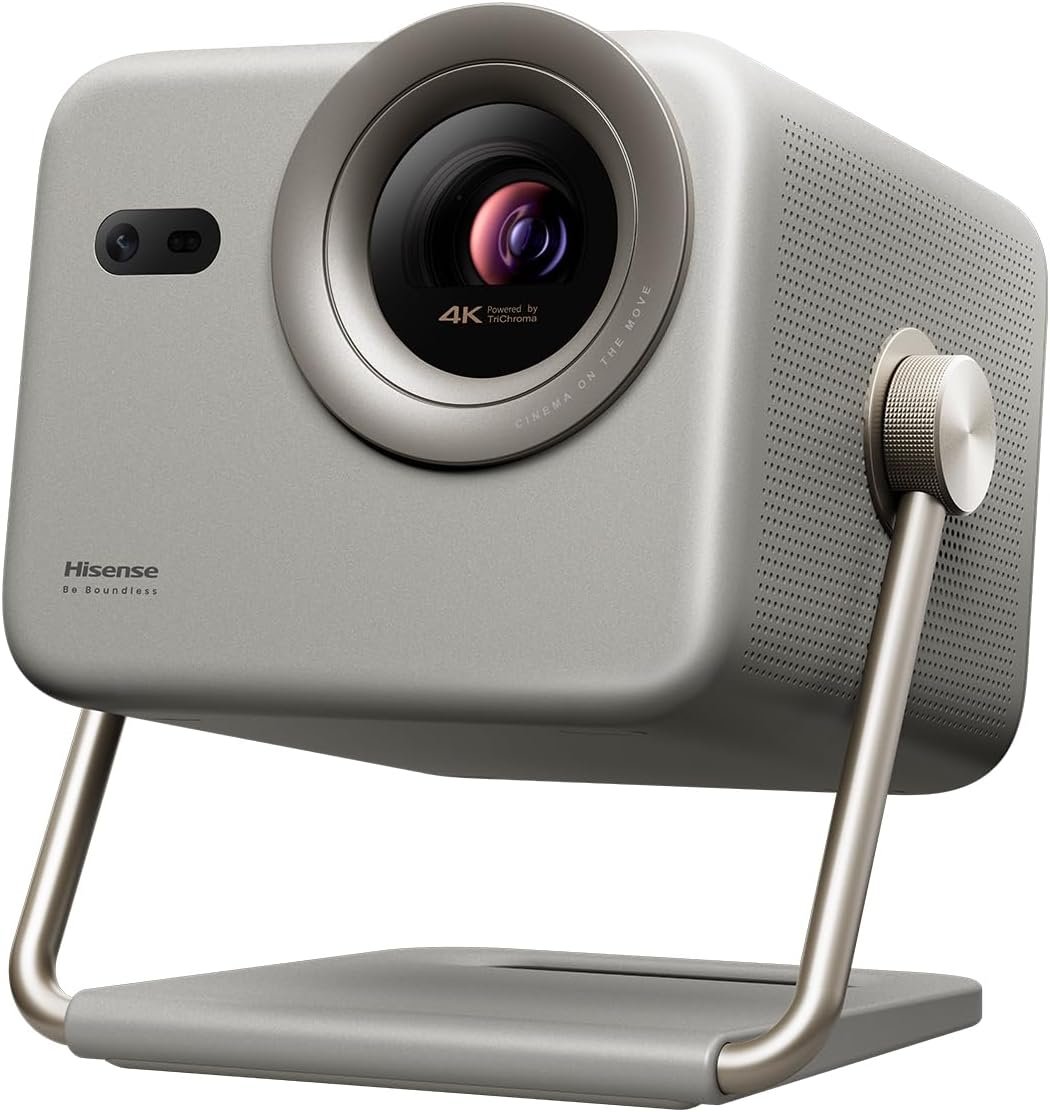
A triple laser light source uses separate red, green and blue lasers rather than one laser through a colour wheel, which produces a far wider colour range. Until recently that meant a large, expensive, fixed projector. The M2 Pro puts it in a body on a gimbal stand you can pick up and take into the garden.
The DLP system uses 2.07 million micro mirrors for 4K images between 65 and 200 inches, with AI processing that analyses content frame by frame for colour and clarity. Brightness is a genuine 1,300 ANSI lumens, which is honest rather than impressive: this is a low-light and after-dark projector rather than a daylight one. The gimbal is the practical feature, because aiming a portable projector at a wall is otherwise a matter of stacking books under one end.
What it does well
- Triple laser colour in a genuinely portable body.
- Honest 1,300 ANSI lumens rather than an invented figure.
- Gimbal stand makes aiming trivial.
- 65 to 200 inch range covers a room or a garden wall.
What to know before buying
- 1,300 ANSI needs darkness or near darkness.
- More expensive than fixed projectors of similar brightness.
- Single-chip DLP, so rainbow artefacts are possible.
5. Epson Home Cinema 980: The Bright Budget Workhorse

Not everyone needs 4K. The Home Cinema 980 is 1080p, and it spends the money saved on brightness instead: 4,000 lumens of colour brightness and 4,000 of white, matched the way Epson’s 3LCD engine always matches them, which means no washed-out colour in a lit room.
Epson positions it for fast-action sport and casual gaming, and 3LCD avoids the rainbow artefact that bothers some viewers on single-chip DLP projectors entirely. Two HDMI ports and a USB port that can power a streaming stick cover connectivity, so a Fire TV or Chromecast runs off the projector itself with no extra plug. A built-in speaker means it works straight out of the box, which matters for something you might move between rooms.
What it does well
- 4,000 lumens with colour and white brightness matched.
- 3LCD, so no rainbow artefacts.
- USB port powers a streaming stick directly.
- Built-in speaker for immediate use.
What to know before buying
- 1080p rather than 4K.
- A lamp that dims and eventually needs replacing.
- Basic contrast against the laser models here.
6. Nebula Capsule 3 Laser: A Cinema in a Drinks Can
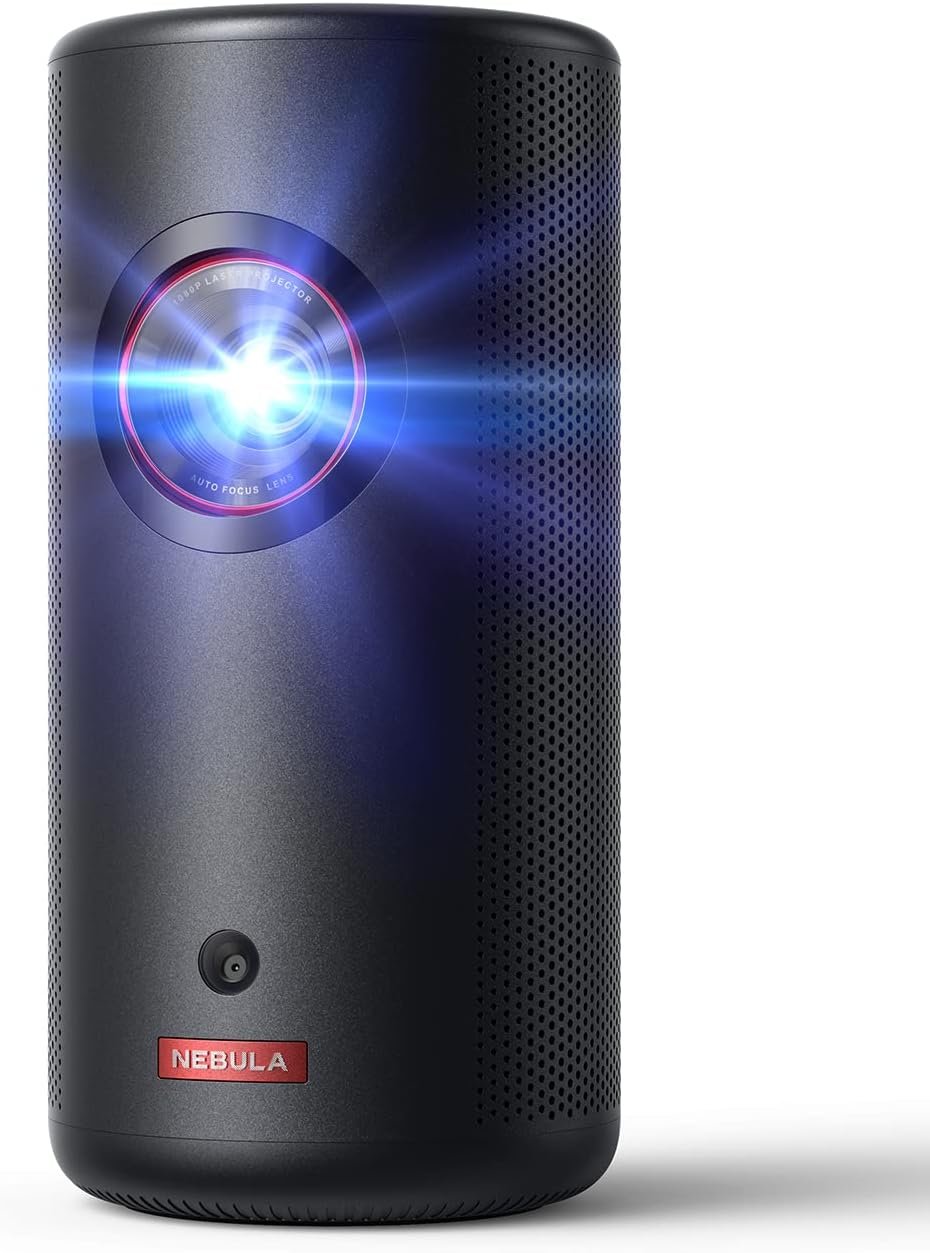
At 2 pounds and roughly the size of a large drinks can, the Capsule 3 Laser is the projector that actually travels. Anker states it is 90 percent smaller than others of similar brightness, and the laser light source gives 300 ANSI lumens at 1080p across an image up to 120 inches.
The battery is what makes it different from a small projector that needs a socket: a full 2.5 hour film on one charge, or 8 hours as a speaker, and it accepts USB-C power delivery so a power bank extends it indefinitely. Google TV, Google Assistant, Google Cast and an officially licensed Netflix app are built in, so there is no stick to carry, and 8W Dolby Digital speakers mean it works without anything else at all. Three hundred ANSI lumens means darkness, and that is the honest limit.
What it does well
- Two pounds, with a battery good for a full film.
- USB-C power delivery, so a power bank extends it.
- Google TV and licensed Netflix built in.
- 8W Dolby Digital speakers, so no separate audio needed.
What to know before buying
- 300 ANSI lumens requires genuine darkness.
- 1080p rather than 4K.
- A 120 inch maximum image, smaller than the fixed models here.
7. Magcubic HY300PRO: The Cheapest Way to Try One
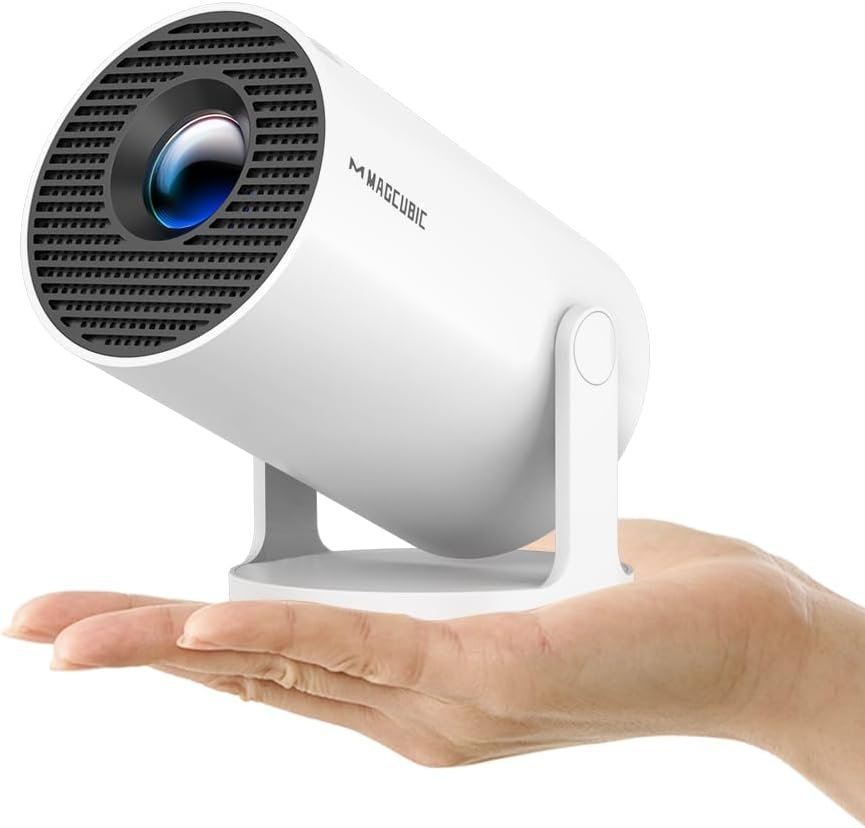
The HY300PRO is the projector to buy when you are not sure you want a projector. It is native 720p with 4K input support, which is an honest description rather than a claim of 4K output, and the price reflects that rather than pretending otherwise.
What you get for the money is genuinely useful: WiFi and Bluetooth streaming from phones, laptops and consoles, HDMI and USB ports, built-in apps so no streaming stick is required, and a 180 degree rotating stand that lets it throw onto a ceiling as easily as a wall. Magcubic states it is 30 percent smaller than the previous model with an external power supply for cooler running. Treat it as a bedroom or occasional second screen rather than a home cinema and it is good value.
What it does well
- Honest about being native 720p with 4K input support.
- 180 degree rotating stand throws onto walls or ceilings.
- Built-in apps, so no streaming stick needed.
- External power supply keeps it running cooler.
What to know before buying
- No published ANSI brightness figure.
- Native 720p, so detail is limited on a large image.
- The listing warns you to update the firmware before first use.
Matching a Projector to the Room You Actually Have
Work from the room outward. Brightness requirements are set by how dark you can make it, throw distance is set by where the projector can physically sit, and screen size follows from both. Buying the other way round is how people end up with a bright picture that is too small or a large one that is too dim.
- A room you can black out: 1,500 to 2,500 ANSI is plenty, and contrast matters more than brightness.
- A living room with curtains: 3,000 ANSI and up, or the image washes out.
- Outdoors after dark: anything from 300 ANSI works, so prioritise portability and battery.
- Gaming: check input lag in milliseconds, and ignore anything that does not publish it.
- Measure throw distance before anything else, and prefer optical zoom over keystone correction.
- Laser if you want it to last; lamp if you want it cheap today.
A screen helps more than people expect, because a painted wall scatters light in every direction and costs you contrast. If the projector is going outside for film nights, the screen and the power supply are both part of the decision, and it is worth planning the whole setup rather than buying the projector first. The audio usually needs attention too, since built-in speakers are an afterthought on all but the portable models here; our guide to the best over-ear headphones covers the late-night option when the rest of the house is asleep. For a room that doubles as a party space, a karaoke machine covers the audio and the entertainment in one box. Dark films suffer most from a bad setup, and our guide to the best halloween movies picks seven worth the effort. Outdoors that becomes a bigger problem again, and our guide to the best inflatable movie screen covers the blow-up option.
Which of These Projectors to Buy
For a dedicated room with controlled light, the Epson Home Cinema LS11000 is the clear answer, with matched colour and white brightness, a laser source and the contrast ratio that actually produces black. For a normal living room, the ViewSonic PX749-4K is the practical pick at 4,000 ANSI lumens with 4K resolution and genuinely low input lag.
Gamers who want the projector to behave like a monitor should look at the Valerion StreamMaster Plus2 for its 4ms and 240Hz. The Hisense M2 Pro is the one to buy if it has to move between rooms and outside, and the triple laser colour is a real step up. The Epson Home Cinema 980 is the bright budget workhorse for sport in a lit room, the Nebula Capsule 3 Laser is the only one here you can genuinely carry in a bag, and the Magcubic HY300PRO is the cheap way to find out whether you want a projector at all. Measure the throw distance before you order any of them.
Frequently Asked Questions
How many lumens do I need for a projector?
It depends entirely on the light in the room. A properly darkened room is well served by 1,500 to 2,500 ANSI lumens, a living room with ambient light wants 3,000 or more, and outdoors after dark even 300 ANSI produces a watchable picture. Ignore any figure not stated in ANSI or ISO lumens.
Is a laser projector better than a lamp one?
For longevity, clearly yes. A laser holds its brightness for the life of the projector, switches on instantly and has no consumable, while a lamp dims gradually and eventually needs replacing at real cost. A lamp projector is cheaper up front, which is why two of the brightest machines here still use one.
What is throw distance and why does it matter?
It is how far back the projector must sit to produce a given image width, fixed by the lens design. A long-throw projector in a small room simply produces a small picture. Check the published figure, such as a 100 inch image from 13 feet, and prefer optical zoom and lens shift over keystone correction, which squares the image by discarding pixels.
Are projectors good for gaming?
Some are now, which was not true a few years ago. Look for a published input lag figure in milliseconds and a refresh rate: the models here reach 4ms at 240Hz and 4.2ms at 240Hz, which is comparable to a gaming monitor. A projector that does not publish input lag at all is almost certainly slow.
Related Articles
- Best Gaming Headsets: 7 Compared on Battery, Platform and Mic
- Best Gaming Handhelds: Power, Battery and Emulation Compared
- Best Webcams: Resolution, Low Light and Field of View Compared
- Best Horror Movies: 8 Compared on Dread and Age
- Best Action Movies: 8 Thrillers Compared on Scale
As an Amazon Associate, CanyonWire earns from qualifying purchases.