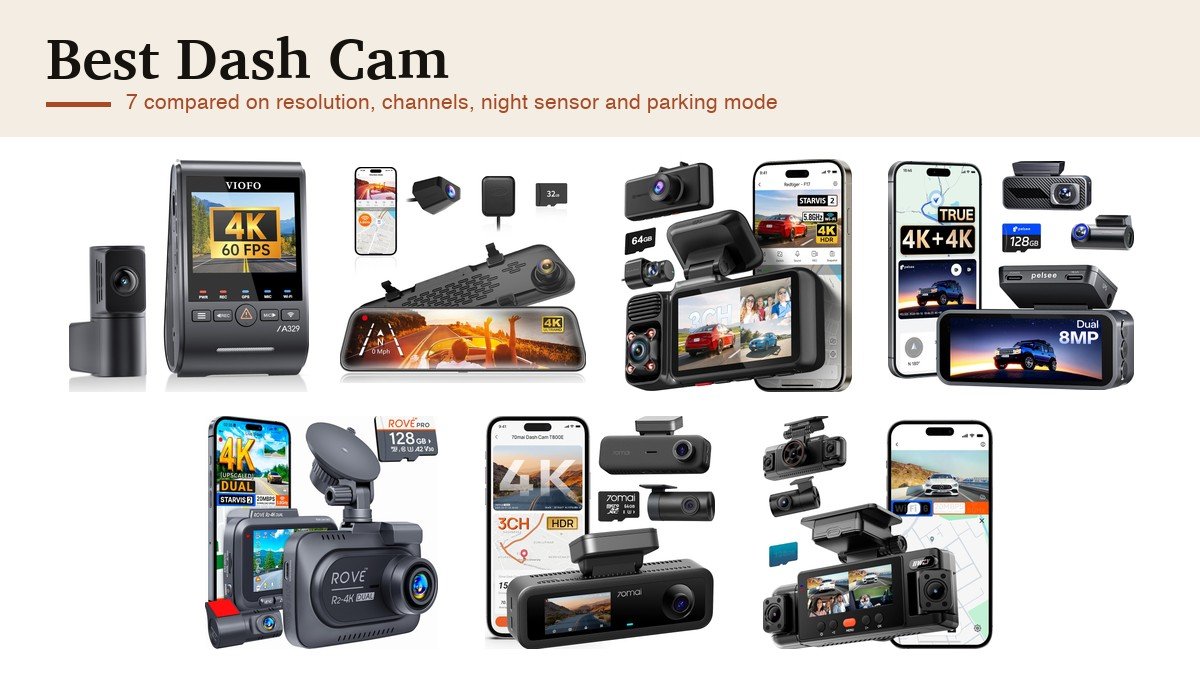
Choosing the best dash cam goes wrong in the same place every time: people buy on resolution and discover that the footage is useless at night, which is when most of the incidents worth recording happen. A 4K camera with a weak sensor produces a sharp picture of a dark smear where a number plate should be, and a 2K camera with a good one reads that plate under a street light.
A dashcam is a continuously recording camera rather than a security system, and that distinction sets the rest of the decision. Three things actually matter. The first is the sensor rather than the resolution. The second is how many channels you need, because a front camera alone misses the rear-end collision and the cabin entirely. The third is parking mode, which only works if the camera is hardwired to the fuse box, a detail most listings mention once and quietly. All seven below state their sensor and channel count, and the table says which ones need wiring.
Best Dash Cam Picks Compared on Resolution, Channels and Night Sensor
Read the channels column against where you actually need cover. Rideshare and delivery drivers need the cabin, most private drivers need front and rear, and a 360 degree set is for anyone parking on a street rather than a drive.
| Dash cam | Channels | Resolution | Night sensor | Included storage |
|---|---|---|---|---|
| VIOFO A329S | Front and rear | 4K at 60fps | Dual STARVIS 2 with HDR | Not included |
| WOLFBOX G840S | Front and rear, mirror | 4K front, 1080p rear | Not stated as STARVIS | 32GB card |
| REDTIGER F17 | Front, cabin and rear | 4K, 3 channel | STARVIS 2 with HDR | 64GB card |
| Pelsee S1 Pro | Front and rear | Native 4K plus 4K | Dual 8MP | 128GB card |
| ROVE R2-4K | Front and rear | 4K dual | STARVIS 2 | 128GB card |
| 70mai 4K 3 Channel | Front, cabin and rear | 4K, 3 channel | Super capacitor, not a battery | Not stated |
| IIWEY N6 | Four channel, 360 degrees | 4K plus three cameras | 8 infrared lights for the cabin | 128GB card |
Sensors, Channels and the Parking Mode Nobody Wires In
The image sensor is the component that decides whether footage is usable, and in this category the name to look for is Sony STARVIS 2, which four of the seven here use. It is designed for low light, and paired with HDR it holds detail in the two situations that defeat cheap cameras: a dark street with one bright headlight in frame, and a bright sky above a shadowed road. A listing that quotes 4K but will not name its sensor is telling you something.
Channel count is the next decision and it is about what you are protecting against. A single front camera covers the collision you cause. Front and rear covers the one caused into you, which is the more common claim. A third cabin camera only matters if you carry passengers for money, and a four-channel 360 degree set exists for cars parked on a public street where damage arrives from any direction.
Parking mode is where most buyers are disappointed, because it does not work from the cigarette lighter socket, which dies with the ignition. It needs a hardwire kit into the fuse box with a voltage cutoff so the camera stops before it flattens the battery. Several listings here note the kit is required and sold separately. Finally, check the card: SD cards in a dash cam are overwritten continuously, so a high-endurance card is the right purchase and a cheap one will fail within a year. Three of these include a card, which is worth counting into the price. One more practical note: a camera is only as good as the glass in front of it, so the windscreen interior needs cleaning properly rather than smeared, which is what our guide to the best microfiber cleaning cloths is about.
1. VIOFO A329S: The Best Dash Cam for Image Quality
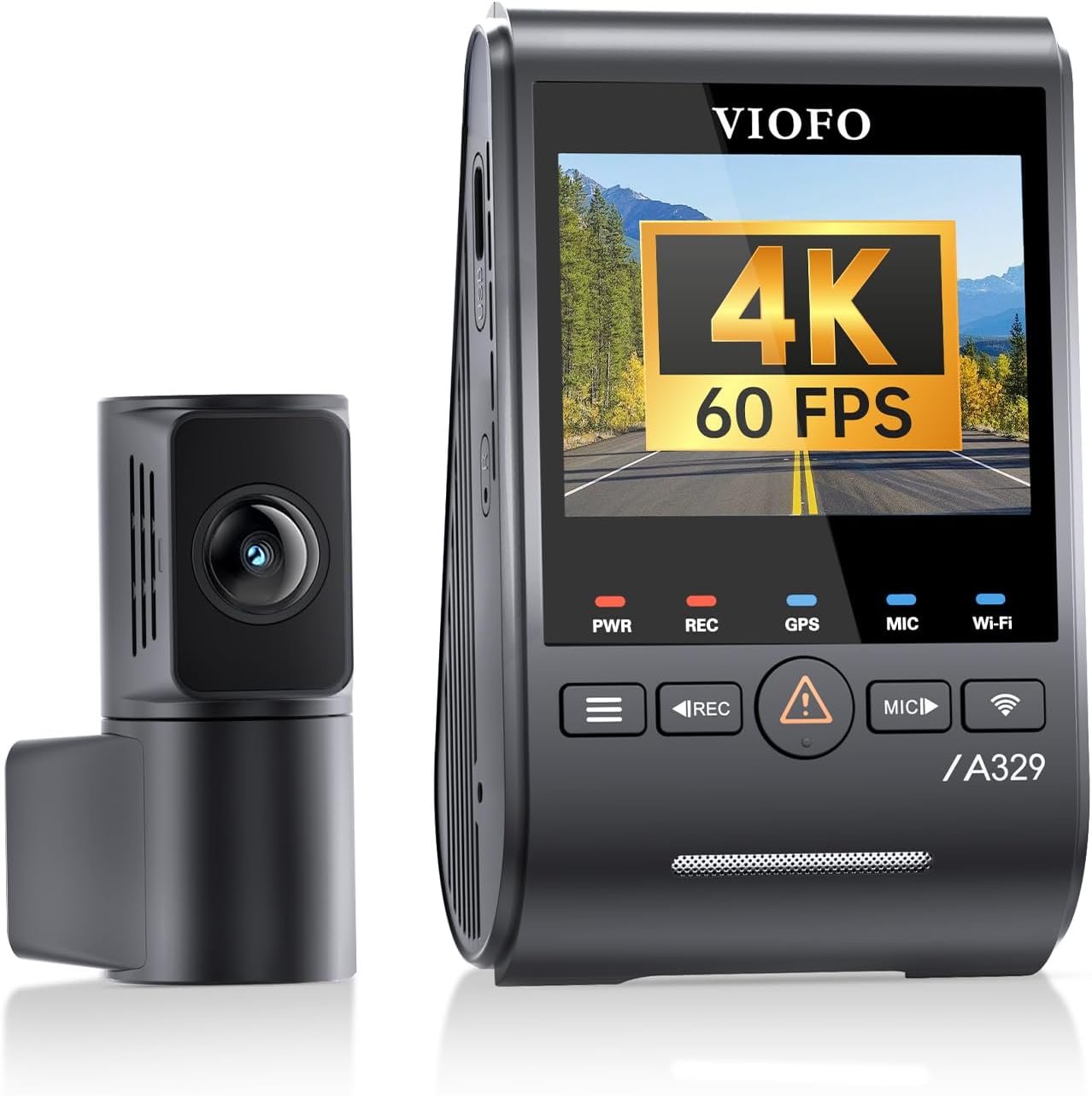
VIOFO builds for people who care about the footage rather than the gadget, and the A329S is the clearest example here. It records 4K at 60 frames per second rather than the usual 30, which doubles the number of frames available when you need to freeze on a plate at speed, and it uses dual Sony STARVIS 2 sensors with HDR front and rear.
The supporting features are the practical kind. Hands-free voice control starts and stops recording, takes photos and toggles wifi without taking a hand off the wheel, and it announces setting changes and memory card errors rather than failing silently, which is how most people discover their dash cam stopped recording three months ago. The GPS module reads GPS, BeiDou, Galileo and GLONASS, so location and speed data are logged properly for playback in the app or the PC player. Wi-Fi 6 makes pulling clips off it genuinely fast.
What it does well
- 4K at 60fps, double the frame rate of most cameras here.
- Dual Sony STARVIS 2 sensors with HDR at both ends.
- Voice alerts for memory card errors rather than silent failure.
- Four satellite systems for accurate speed and location data.
What to know before buying
- No memory card included, so budget for a high-endurance one.
- Parking mode needs a hardwire kit sold separately.
- The most expensive camera in this guide.
2. REDTIGER F17: Three Channels With a Proper Night Sensor
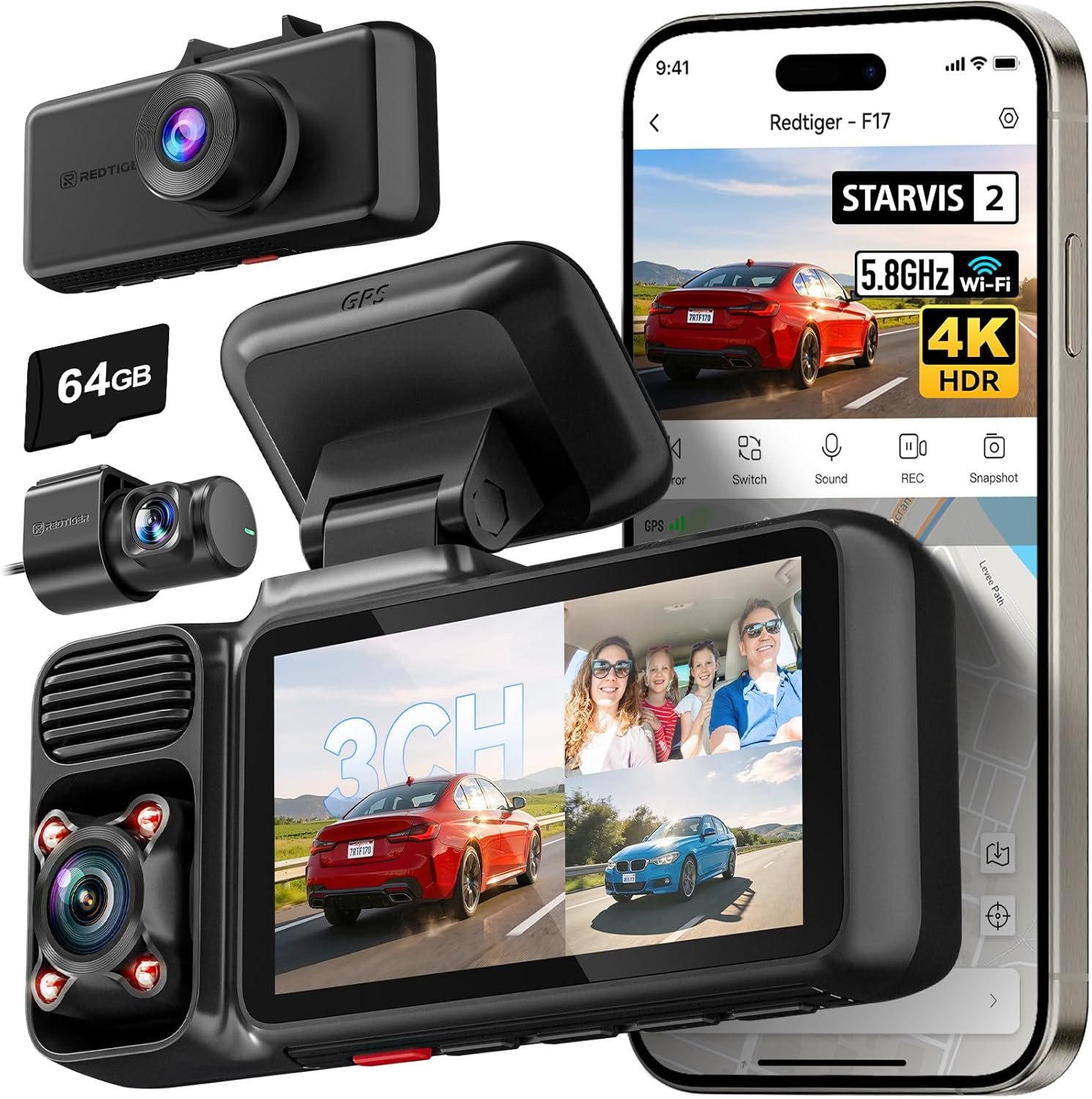
Three-channel cameras usually compromise somewhere, most often by putting a weak sensor in the front unit to pay for the other two. The F17 does not: it runs STARVIS 2 with HDR across a 4K three-channel system covering front, cabin and rear.
That combination is the one rideshare and delivery drivers actually need, because the cabin camera is the only evidence in a passenger dispute and the rear camera handles the collisions other people cause. A 64GB card is in the box, which is enough to start with, and 5.8GHz wifi moves clips to a phone far faster than the older 2.4GHz cameras. If you drive for a living and want one purchase rather than three, this is it.
What it does well
- Three channels with STARVIS 2 and HDR, not just on the front.
- 64GB card included in the box.
- 5.8GHz wifi for fast transfers to a phone.
- Covers the passenger dispute as well as the collision.
What to know before buying
- Three cameras mean three cable runs to hide.
- A cabin camera is wasted if you never carry passengers.
- Parking mode still requires hardwiring.
3. ROVE R2-4K: The Best Value With a Card in the Box
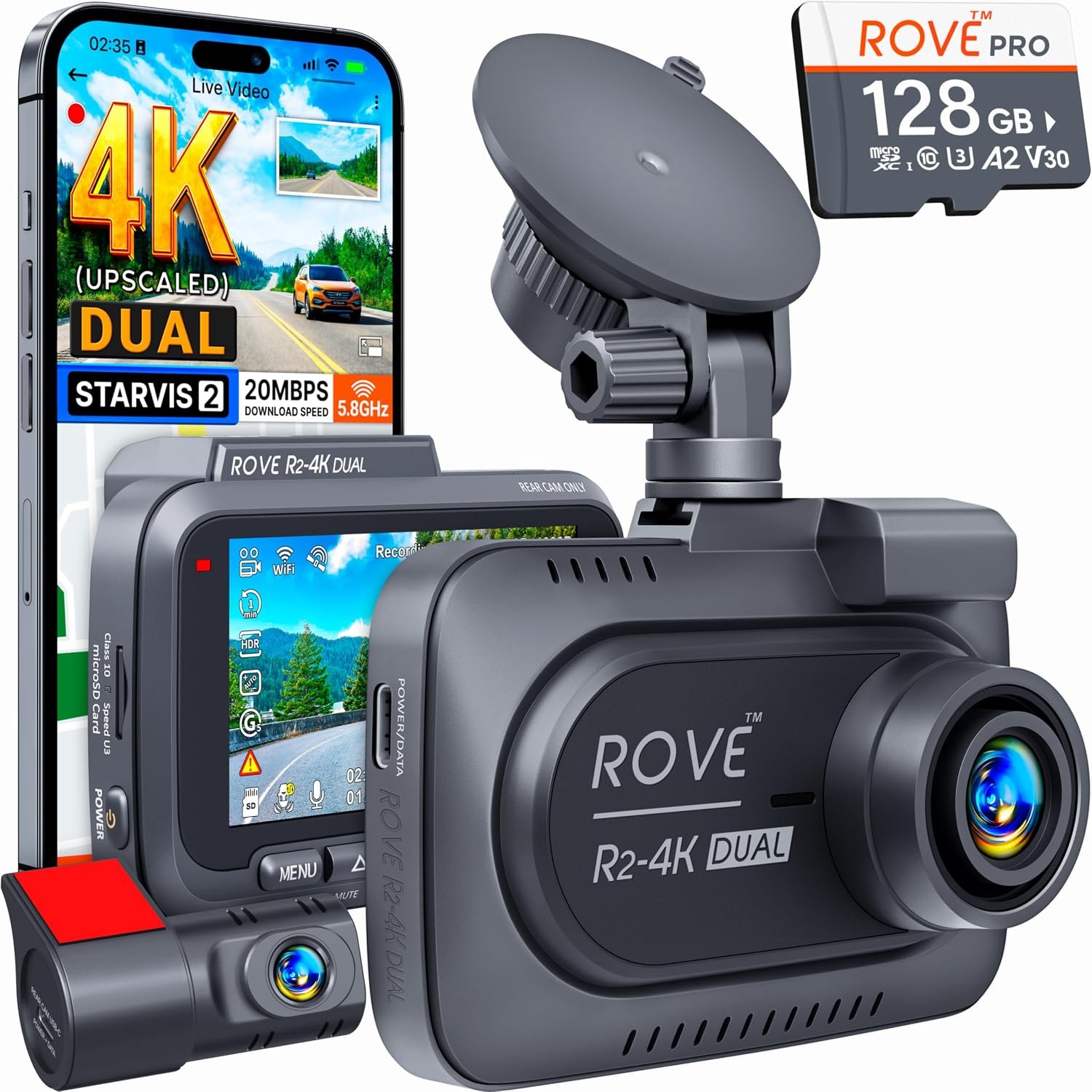
The R2-4K has been one of the most recommended dash cams in the United States for several generations, and this version pairs 4K dual-channel recording with a Sony STARVIS 2 sensor at a price well below the VIOFO.
What makes it the value pick is the 128GB card included, which is not a token 16GB but genuinely enough storage for days of loop recording before anything is overwritten. ROVE sells in volume in the US, which means firmware updates, replacement mounts and support are all easy to find, and that matters more than the specification sheet three years into owning a camera. For most private drivers this is the sensible purchase.
What it does well
- STARVIS 2 sensor at a mid-range price.
- 128GB card included, not a token card.
- Well supported in the US with easy replacement parts.
- Dual channel covers the collisions caused into you.
What to know before buying
- 30fps rather than the VIOFO 60fps.
- No cabin camera, so not suited to rideshare work.
- Suction mounts need resetting in cold weather.
4. Pelsee S1 Pro: Native 4K at Both Ends
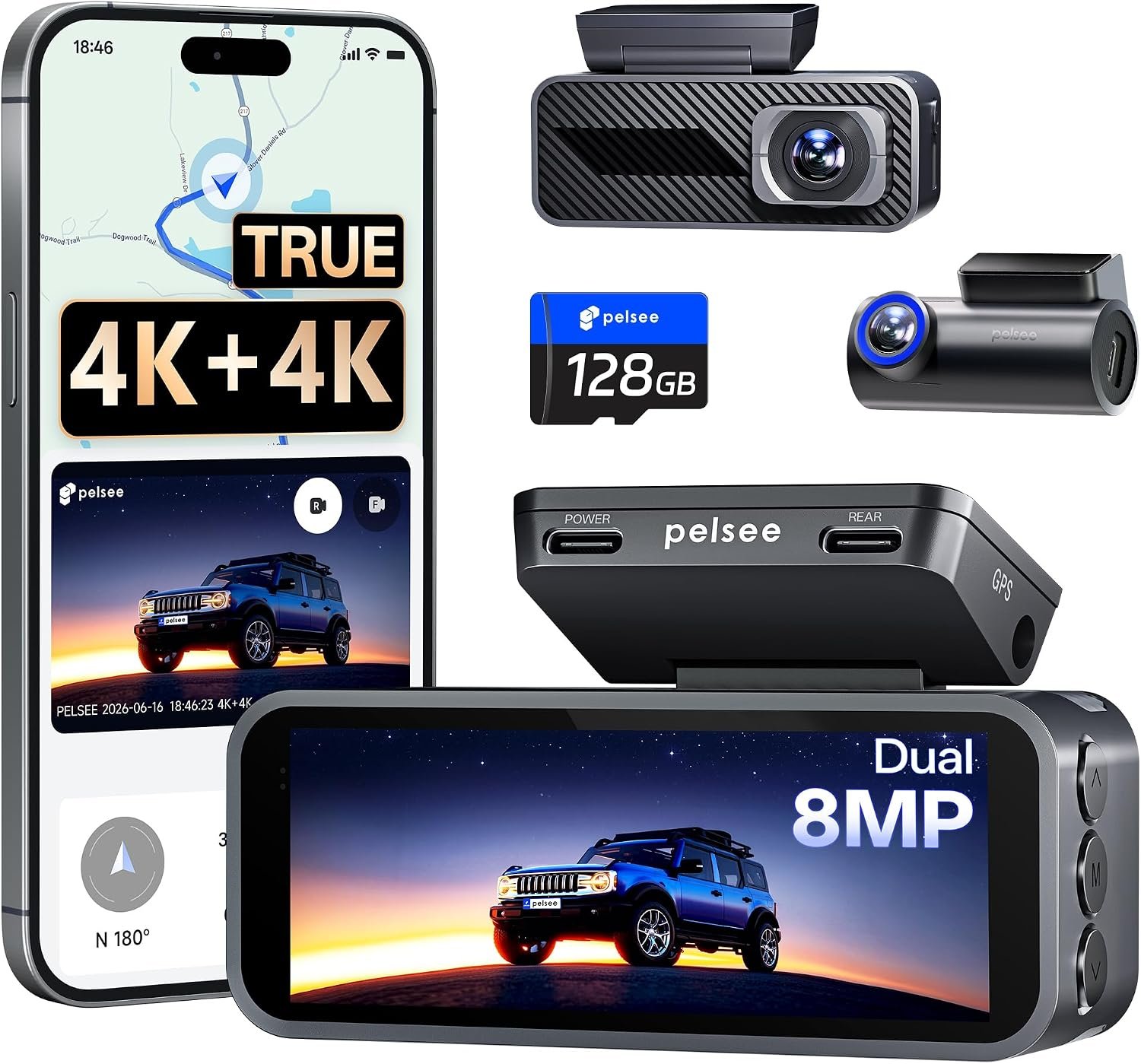
Most dual cameras advertise 4K and mean 4K at the front with 1080p behind, which is why rear footage so often fails at the moment you need it. The S1 Pro records native 4K front and rear from dual 8MP sensors, and the word native matters because several competitors upscale a lower native resolution and call it 4K.
That makes it the pick for anyone whose main concern is the vehicle behind, which covers most insurance claims. A 128GB card is included, so the camera is ready out of the box rather than needing a second order. Pelsee is a smaller brand than VIOFO or 70mai, which is the trade: the hardware specification is strong and the long-term support record is shorter.
What it does well
- Native 4K front and rear rather than 4K front and 1080p rear.
- Dual 8MP sensors at both ends.
- 128GB card included.
- Strongest rear-camera specification in this guide.
What to know before buying
- A smaller brand with less support history.
- Listing publishes less sensor detail than VIOFO or REDTIGER.
- Parking mode needs hardwiring as usual.
5. 70mai 4K 3 Channel: The One Built for Temperature Extremes

The specification that separates this one is not the camera at all, it is the power storage. 70mai uses a super capacitor rather than a lithium battery, rated for stable operation from 14F to 140F, which removes the failure mode that kills most dash cams: a lithium cell swelling or dying after a summer parked in the sun or a winter on a driveway.
If your car lives outside in a climate with real extremes, that single design choice matters more than any sensor. Around it sits a 4K three-channel system covering front, cabin and rear, so it competes directly with the REDTIGER on coverage while being the more durable of the two. 70mai is an established brand with a long product line, so accessories and hardwire kits are easy to source.
What it does well
- Super capacitor rather than a lithium battery.
- Rated for 14F to 140F, so it survives a car left outside.
- Three channel 4K covering front, cabin and rear.
- Established brand with widely available accessories.
What to know before buying
- The listing does not state an included memory card.
- Super capacitors hold less charge, so parking mode needs hardwiring.
- Less published sensor detail than the STARVIS 2 cameras here.
6. WOLFBOX G840S: The Mirror Camera That Replaces Your Rear View
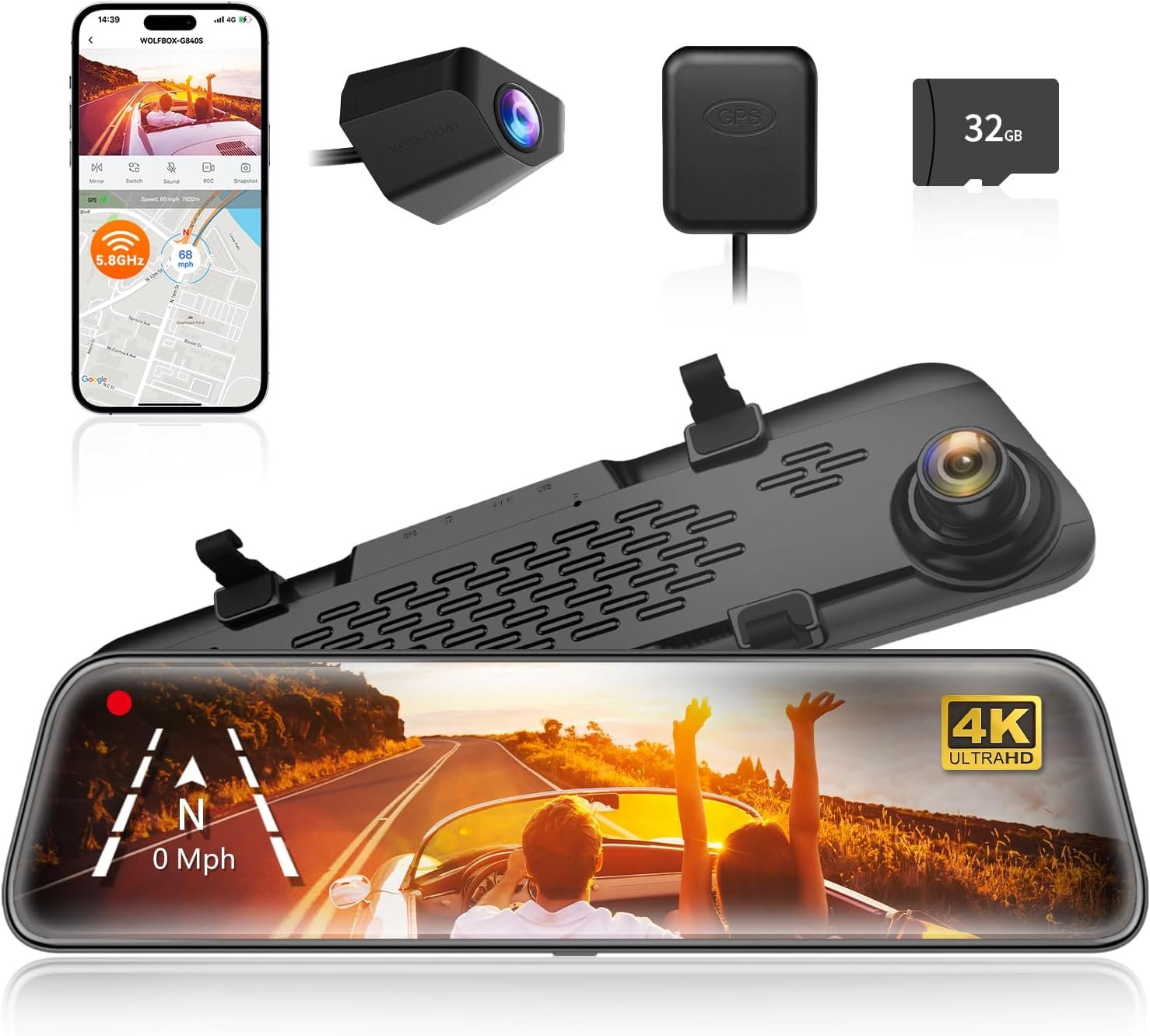
A mirror dash cam replaces the rear-view mirror with a 12 inch display showing the rear camera feed, and the G840S is the best-known version. WOLFBOX states the screen gives one and a half times the viewing area of a standard mirror, which genuinely reduces blind spots rather than just looking impressive.
It records 4K at the front and 1080p at the rear, includes a 32GB card and an external GPS antenna that puts live location and speed data on the display, and connects over 5.8GHz wifi to the WOLFBOX app for playback and sharing. A 24 hour parking monitor records in time lapse at a low frame rate to conserve power and storage, and like every parking mode here it needs a hardwire kit. The rear camera doubles as a reversing camera, which is the feature that sells it to people with older cars.
What it does well
- Twelve inch mirror display with a wider field than a normal mirror.
- Doubles as a reversing camera on cars without one.
- External GPS antenna with live speed on screen.
- 32GB card and time-lapse parking monitor included.
What to know before buying
- 1080p at the rear rather than 4K.
- The listing does not name a STARVIS sensor.
- A large screen in the mirror position is a distraction for some drivers.
7. IIWEY N6: Four Channels and 360 Degree Cover
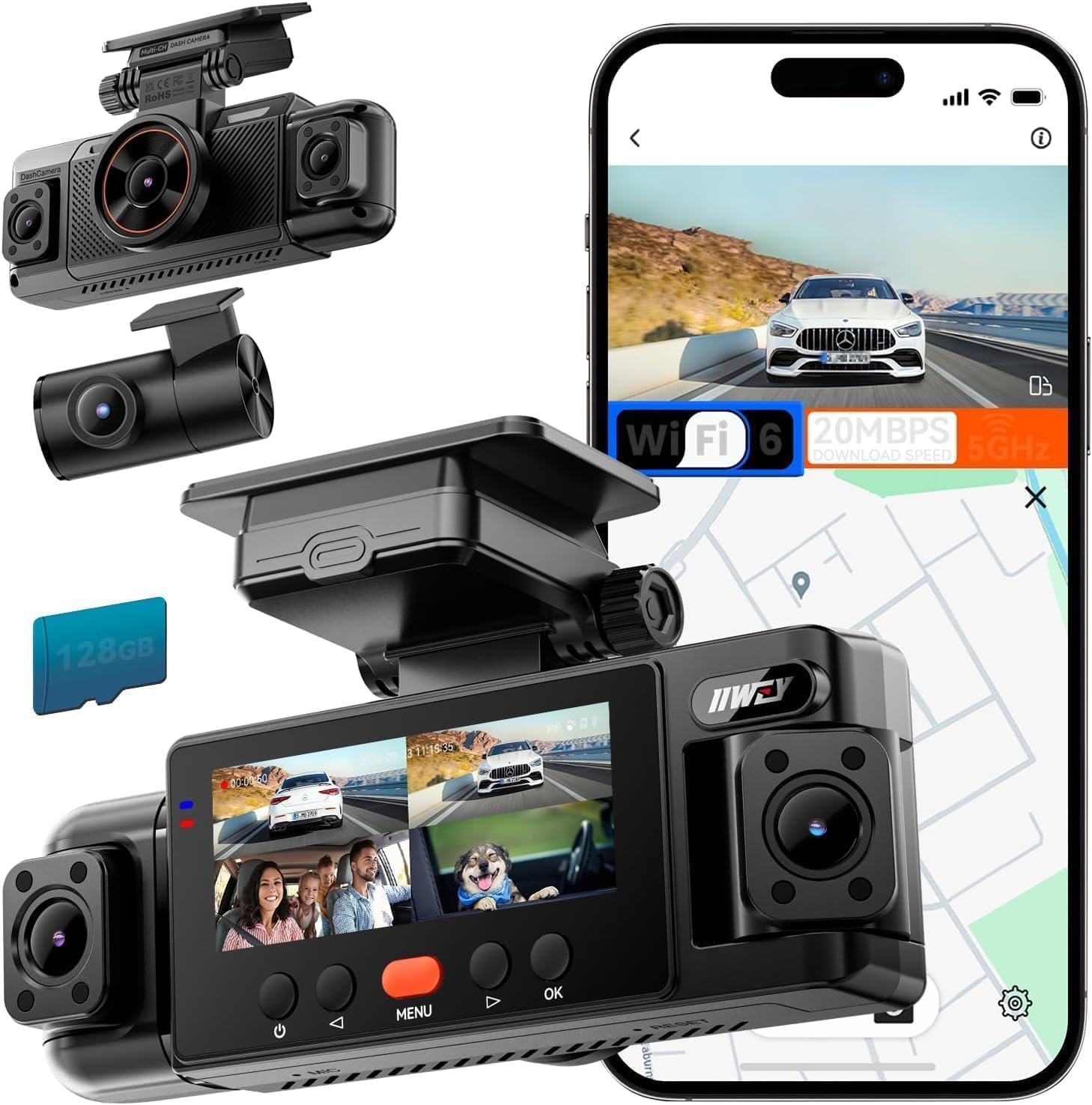
If the car is parked on a public street rather than a drive, damage arrives from directions a front and rear pair never sees. The N6 is a four-channel system covering front, rear, left and right for genuine 360 degree coverage, with eight infrared lights for the cabin so interior footage works in the dark.
Everything needed is in the box including a 128GB card, loop recording segments the footage so it stays manageable, and a G-sensor locks clips automatically under hard braking or impact so the important file is not overwritten. IIWEY backs it with twelve months of support and ships replacement accessories if any arrive missing. This is the most cameras for the money here, and the trade is that four modules take real time to install tidily.
What it does well
- Four channels covering all four sides of the car.
- Eight infrared lights for usable cabin footage at night.
- 128GB card included and G-sensor event locking.
- The most coverage per pound in this guide.
What to know before buying
- Four cameras is a long and fiddly installation.
- A newer brand with a shorter track record.
- Side cameras are wasted if the car is garaged.
Working Out How Many Channels You Need
Buy for the incident you are actually worried about rather than for the largest number on the box. More channels means more cameras to mount, more cable to hide and more storage consumed per hour.
- Private car, drive or garage: front and rear is the right answer for nearly everyone.
- Rideshare, taxi or delivery: add a cabin camera, because that is where disputes happen.
- Parked on a public street overnight: consider four channel, and hardwire it.
- An older car with no reversing camera: a mirror unit solves two problems at once.
- Any parking mode at all: budget for a hardwire kit with voltage cutoff.
- Any camera at all: buy a high-endurance card, because standard cards fail under constant overwriting.
Several of these move clips over 5.8GHz rather than the older 2.4GHz band, which is the difference between pulling a 4K clip off in seconds and waiting several minutes beside the car. If your phone or home router is older, our guide to Wi-Fi 6 against Wi-Fi 7 explains which band does what and why the faster one is worth having.
Installation is the part people underestimate. Cables run under the headliner and down the A-pillar, which takes a trim tool and an hour, and a rear camera on a hatchback has to cross the tailgate hinge. If the car has a 12V socket you are already using for other things, a dash cam is one more draw to plan around, in the same way our guide to the best portable power stations treats continuous output rather than peak figures. Helmet and bar mounts raise the same question for riders, which our guide to the best action camera covers alongside sensor size.
Which Dash Cam to Buy
For most private drivers the ROVE R2-4K is the sensible purchase: a STARVIS 2 sensor, dual channel cover and a real 128GB card in the box at a mid-range price. If image quality is the priority and you will pay for it, the VIOFO A329S is the best camera here, with 4K at 60fps and STARVIS 2 at both ends.
Drive for a living and the REDTIGER F17 is the one, because it is the only three-channel camera here that keeps a proper night sensor across all of them. The Pelsee S1 Pro is the pick if the rear camera matters most, since native 4K behind is rare. The 70mai is the durable choice for a car that lives outside in extreme temperatures, the WOLFBOX replaces a rear-view mirror and a reversing camera together, and the IIWEY N6 is the answer for a car parked on the street. Whichever you pick, hardwire it if you want parking mode and buy the endurance card, because those two decisions matter more than the badge.
Frequently Asked Questions
Does a dash cam need to be hardwired?
Only for parking mode. Plugged into the 12V socket a camera records whenever the ignition is on, which covers driving. Parking surveillance needs a hardwire kit into the fuse box with a low-voltage cutoff so the camera shuts down before it flattens the battery. Every parking mode in this guide works that way.
Is 4K worth it on a dash cam?
Less than the sensor is. A 4K camera with a weak sensor produces a sharp image of an unreadable dark smear at night, which is when most incidents worth recording happen. Look for Sony STARVIS 2 with HDR first and treat resolution as the second question. Frame rate matters too: 60fps gives twice the chance of a clean frame on a moving plate.
What memory card does a dash cam need?
A high-endurance card. Dash cams overwrite continuously through loop recording, which destroys ordinary cards within about a year, and a failed card means the camera has been recording nothing. Three cameras here include a card; for the others, buy an endurance-rated one rather than the cheapest available.
Do I need a cabin-facing camera?
Only if you carry passengers for money. For a private car it records your own family and adds nothing to an insurance claim. For rideshare, taxi and delivery work it is the single most useful channel, because passenger disputes are the thing a front camera cannot help with.
Related Articles
- Best Projectors: 7 Compared on Brightness, Laser and Input Lag
- Best Power Banks: 7 Compared on Watts, Watt-Hours and Cables
- Best Docking Station: 7 Compared on Monitors, Watts and Ports
- Best USB-C CarPlay Cable
- Best Microfiber Towels for Cars
As an Amazon Associate, CanyonWire earns from qualifying purchases.