Boil speed is the one electric kettle specification that barely varies. Nearly all of them run at 1500 watts on a US outlet, so a litre takes roughly the same time in a budget jug as in a designer one. What actually separates them is whether you can stop the water below boiling, what the water touches on the way out, and how much of the kettle you have to take apart to descale it. Cleaning access decides a lot of countertop appliances, and our toaster oven roundup notes which ovens have removable crumb trays.
Temperature control is the first fork. Green tea wants water well under boiling, black tea and French press want it at or near the top, and if you live somewhere high the boiling point itself moves down with the air pressure, which makes a fixed boil-only kettle a blunter instrument than it looks. The second fork is material. Several kettles below advertise that water never touches plastic, a claim aimed at people who have read about bisphenol A and food contact plastics. The seven here cover both forks, from a pour-over kettle accurate to the degree down to a plain stainless jug with one switch.
Best Electric Kettles Compared on Capacity, Control and Body Material
Capacity decides how many mugs you get per fill, and it is the specification people most often buy wrong: a 1.7 litre jug is slower to boil for one cup than a 1 litre one, because you will fill it past what you need. Control decides whether the kettle is useful for anything other than tea bags and instant noodles.
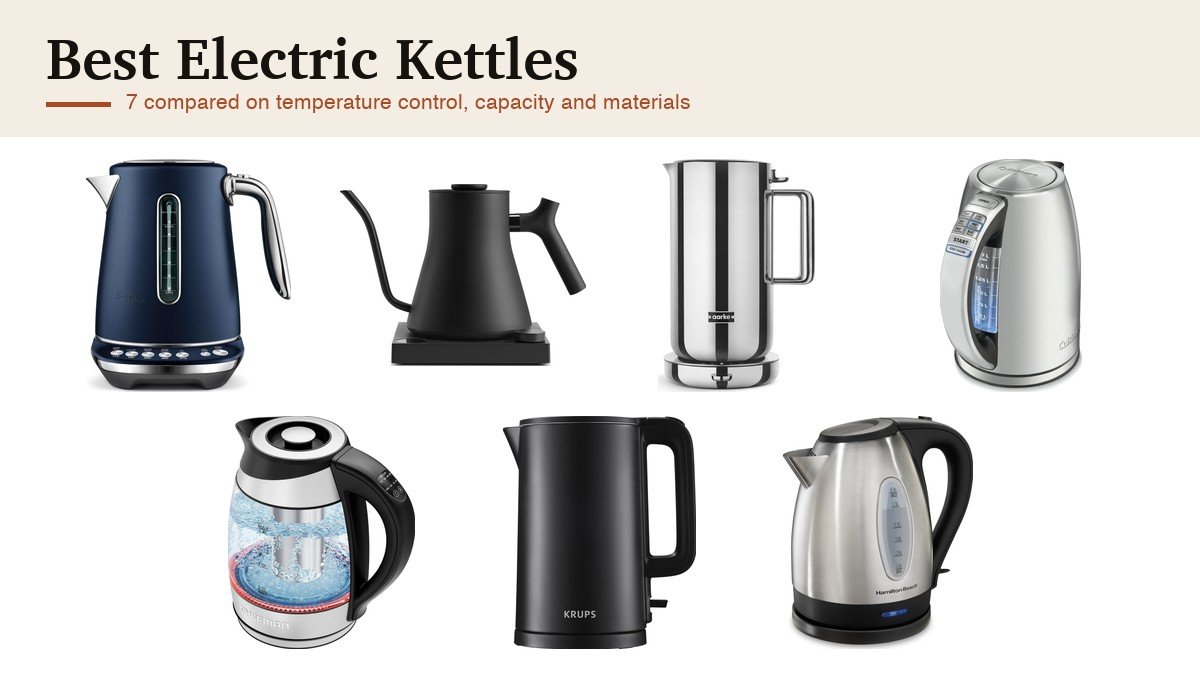
| Kettle | Capacity | Temperature control | Body | Notable feature |
|---|---|---|---|---|
| Fellow Stagg EKG Pro | 0.9 litres | To the degree, with an LCD screen | Stainless steel, gooseneck spout | Built-in brew timer |
| Breville Smart Kettle Luxe | 7 cups | 5 preset varietal settings | Stainless steel | Soft top lid that releases steam without splashing |
| Aarke Kettle | 1.2 litres | 104F to 212F, to the degree | Double-wall stainless steel | Memory function for your usual setting |
| Cuisinart CPK-17P1 | 1.7 litres | 6 presets from 160F to 200F | Stainless steel | 30 minute keep warm and a 2 minute off-base memory |
| Chefman Glass Kettle | 1.8 litres | Presets across 160F to 212F | Borosilicate glass | Removable tea infuser and a removable lid |
| KRUPS 1.5L Cool Touch | 1.5 litres | Boil only | Double-wall, stainless interior | One cup in 80 seconds, no plastic water contact |
| Hamilton Beach 1.7L | 1.7 litres | Boil only | Stainless steel, BPA-free interior | One switch, boil-dry protection |
Why Water Contact Matters More Than the Outside of the Kettle
A kettle described as stainless steel is often stainless on the outside and plastic everywhere the water actually goes: the lid underside, the spout filter, the sight window and the seal. That is why several makers now advertise no plastic contact with water as a feature rather than assuming it. The KRUPS here is explicit that the interior is stainless with no plastic contact, and the Hamilton Beach specifies a BPA-free interior, which is a different and weaker claim: it says the plastic is a particular kind, not that there is none.
Glass is the third option, and the Chefman is the one here that uses it. Borosilicate lets you see the water and see the limescale, which is useful, and it adds nothing to the taste. What it adds is weight and the possibility of breaking it, and glass shows every mineral deposit the moment it forms.
That brings up descaling, which is the maintenance job that decides how long any of these last. If your supply is hard, and most of the United States has moderately hard water or worse, scale builds on the element and slows the kettle down long before anything fails. A wide opening and a removable lid are worth more over five years than an extra preset, which is why the removable-lid models below are called out for it. Kitchen kit generally rewards the same attention: a kettle you can get a hand inside ages like a properly seasoned cast iron skillet rather than like a sealed appliance.
1. Fellow Stagg EKG Pro: The One Built Around Pour-Over Coffee

The Stagg EKG Pro is a gooseneck kettle, which means the spout is a long narrow tube rather than a lip. That shape exists for one job: pouring a slow, controlled, steady stream over a coffee bed instead of dumping water into it. If you brew with a V60, a Chemex or any flat-bottom dripper, the pour is half the recipe and this is the tool for it.
Fellow sets temperature to the degree and shows it on an LCD screen rather than through a ring of preset buttons, and the kettle includes a brew timer so you are not running a stopwatch on your phone alongside it. At 0.9 litres it is the smallest kettle here, which is correct for its purpose and wrong if you are filling hot water bottles or cooking pasta.
What it does well
- Gooseneck spout gives genuine control over the pour rate.
- Temperature set to the degree rather than to a preset.
- Built-in brew timer on the same screen as the temperature.
- The smallest footprint here, which suits a crowded worktop.
What to know before buying
- 0.9 litres is too small to be the only kettle in a household.
- The most expensive kettle in this guide.
- A gooseneck pours slowly by design, which is irritating for tea.
2. Breville Smart Kettle Luxe: Presets Named After What You Are Making

Breville takes the opposite approach to Fellow. Instead of a number you dial in, you get five buttons labelled for black, green, white and oolong tea plus French press coffee, and the kettle goes to the temperature that suits each. For most households that is the more useful interface, because nobody remembers that green tea wants somewhere around 175F but everybody can find the button marked green.
The keep warm function holds the setting for 20 minutes, which covers the gap between boiling and actually getting round to pouring. The detail that separates this from cheaper preset kettles is the soft top lid, designed to release steam gradually rather than let it jet out when you open it, and to stop the splash when the water is at a rolling boil. At 7 cups it is a full household kettle rather than a brewing accessory.
What it does well
- Five presets named for the drink rather than the temperature.
- Keep warm holds the chosen setting for 20 minutes.
- Soft top lid releases steam gently instead of in a burst.
- Cordless base rotates 360 degrees with cord storage underneath.
What to know before buying
- Presets only, so no setting an exact temperature.
- Capacity is quoted in cups rather than litres.
- A large footprint for a worktop that is already full.
3. Aarke Kettle: Degree Control in a Double-Walled Body
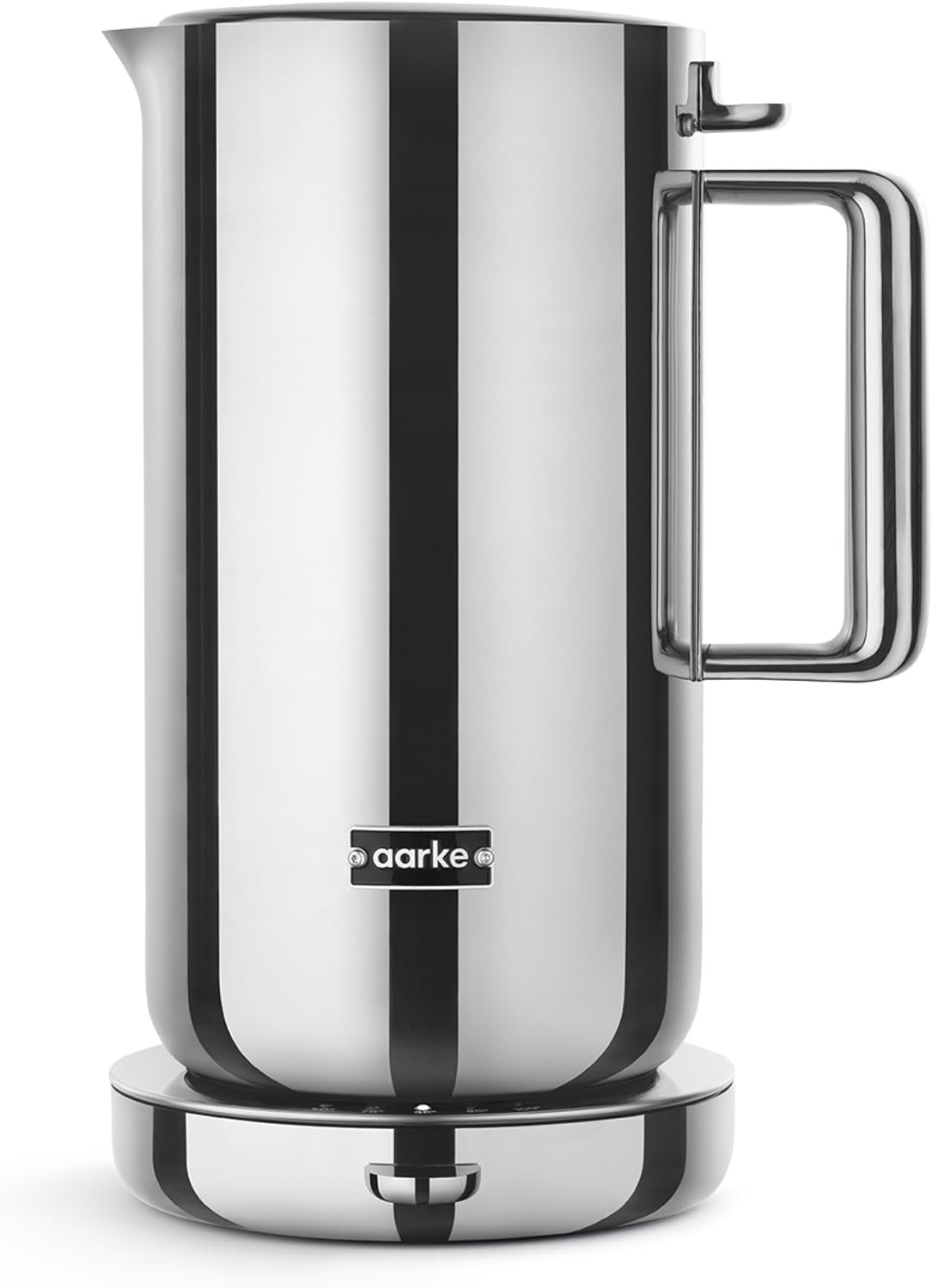
The Aarke is the design pick, and unusually for that category the specification holds up. It sets anywhere from 104F to 212F, which is a wider floor than any preset kettle here reaches, and it remembers your usual setting rather than defaulting to boiling every time.
The construction is the real argument. Double-wall stainless keeps the water hot longer and keeps the outside cool enough to touch, and it runs quietly, which matters more than people expect in an open-plan kitchen. The heating element is hidden and the opening is wide, so descaling is a wipe rather than an operation, and the cord recoils under the base. At 1.2 litres it sits between the brewing kettles and the family jugs.
What it does well
- Temperature range starts at 104F, lower than any preset here.
- Double-wall body stays cool to the touch and holds heat.
- Hidden element and a wide opening make descaling easy.
- Memory function recalls your usual temperature.
What to know before buying
- You pay a premium for the design as well as the specification.
- A 1.2 litre body is small for a household that drinks tea in rounds.
- Stainless shows fingerprints the way the matte finishes do not.
4. Cuisinart CPK-17P1: The Preset Kettle Most Kitchens Should Buy

The CPK-17P1 has been the default recommendation in this category for years, and the reason is the spread of what it does. Six presets from 160F to 200F cover delicate, green, white and oolong teas plus French press and black tea, at 1.7 litres, in a stainless body, with a backlit water window so you can see the level across the kitchen.
Two features do more work than the preset list. A 30 minute keep warm means the kettle is still at your temperature when you come back to it, and a memory function lets you lift it off the base for up to two minutes without it forgetting where it was in the cycle. That second one sounds trivial until you have poured one mug, put the kettle back and watched a lesser model restart from cold.
What it does well
- Six presets covering every common tea and French press.
- Full 1.7 litre capacity, so it works as the only kettle.
- 30 minute keep warm and a 2 minute off-base memory.
- Backlit water window is readable from across the room.
What to know before buying
- The top preset is 200F, below a full rolling boil.
- The lid does not lift out for cleaning.
- Styling is dated next to the Aarke and the Breville.
5. Chefman Glass Kettle: The One With a Tea Infuser Built In

Most kettles boil water and hand the tea-making to something else. The Chefman includes a removable infuser basket, so a pot of loose leaf is made in the kettle itself and poured out for several people. That is a genuinely different product for anyone who has been using a separate teapot.
The body is borosilicate glass with temperature settings across 160F to 212F, and a tri-colour light tells you at a glance whether it is idle, heating or holding. The lid lifts out completely, which makes both filling and descaling easier than on any sealed-lid kettle here, and matters more with glass because limescale is visible the moment it forms. At 1.8 litres it is the largest in this guide.
What it does well
- Removable infuser makes loose leaf tea in the kettle itself.
- Lid lifts out completely for filling and cleaning.
- Largest capacity here at 1.8 litres.
- Coloured lights distinguish standby, heating and keep warm.
What to know before buying
- Chefman quotes the preset count inconsistently on its own listing.
- Glass shows every mineral deposit and every fingerprint.
- Heavier and more fragile than the stainless options.
6. KRUPS 1.5L Cool Touch: Fast, and the Water Never Touches Plastic

If temperature presets are irrelevant to you and the thing you actually want is hot water quickly and no plastic in the path, this is the kettle. KRUPS quotes one cup in 80 seconds and builds it with a stainless interior and no plastic contact with the water, which is the specific claim worth paying for rather than the vaguer BPA-free wording.
The body is double-walled, so the outside stays cool to the touch, which is the feature to look for if there are children in the house or the kettle lives at the edge of a worktop. The lid opens with a button rather than by being pulled, and the opening is wide enough to get a hand and a cloth inside. There is no temperature control at all: it boils, and that is the whole interface.
What it does well
- Stainless interior with no plastic contact with the water.
- Double-wall construction keeps the exterior cool.
- One cup in 80 seconds, the fastest claim here.
- Button-release lid and a wide opening for cleaning.
What to know before buying
- Boil only, with no temperature control of any kind.
- No keep warm function.
- Double walls hide the water level, so you rely on the gauge.
7. Hamilton Beach 1.7L: The Cheapest One Worth Owning

At the bottom of the range the question is not which features you get but which corners were cut. The Hamilton Beach 1.7 litre keeps the ones that matter: a stainless body, a BPA-free interior, boil-dry protection with automatic shutoff, and a water window so you are not guessing at the level.
There is one switch and one light. It boils, it stops, and if you put it on empty it shuts down rather than scorching the element. For a spare bedroom, an office, a first flat or a holiday let, that is the entire specification anyone needs, and the money saved against the kettles above buys a lot of tea. Note the wording on the interior: BPA-free is a claim about which plastic is used, not a promise that there is none.
What it does well
- Boil-dry protection and automatic shutoff at the lowest price here.
- Stainless exterior rather than painted plastic.
- Clear water window on the side.
- One switch, nothing to configure or break.
What to know before buying
- Boil only, with no temperature control.
- BPA-free interior is a weaker claim than no plastic contact.
- The base and handle are plastic, so it feels its price.
How to Choose Between Temperature Control and Simplicity
The honest test is what you drink. If the answer is tea bags and instant coffee, a preset dial is a feature you will use twice and then stop thinking about, and the money is better spent on build quality. If you drink green or white tea, or brew coffee by hand, the temperature is part of the recipe and a boil-only kettle will keep producing a slightly bitter cup you cannot diagnose.
- Buy a gooseneck only if you brew pour-over coffee; it is a poor general kettle.
- Buy presets if more than one person in the house drinks a different kind of tea.
- Buy boil-only if nobody has ever complained about the water being too hot.
- Buy a wide opening and a removable lid whatever else you choose, because descaling is the job you will actually be doing.
- Check capacity against your real use, not your largest imaginable use.
Power draw is worth a thought if the kettle is not going to live in a kitchen. These run at 1500 watts, which is near the ceiling of a standard US circuit and well beyond what most small batteries will carry, so a kettle is one of the harder things to run from a portable power station. Check the continuous output rating rather than the peak figure before assuming a camper or a van setup will boil anything. For machines that do the pouring themselves, see our guide to the best coffee makers. If that is the plan, our guide to the best pour over coffee maker covers what the kettle pours into.
Which of These Electric Kettles to Buy
For most kitchens the Cuisinart CPK-17P1 is the right answer: six presets, a full 1.7 litres, keep warm, and an off-base memory, with nothing clever enough to go wrong. The Breville Smart Kettle Luxe is the upgrade if you want presets labelled by drink and a lid that does not spit steam at you.
The Fellow Stagg EKG Pro is for pour-over coffee and nothing else, and it is excellent at that one job. The Aarke is the pick if you want degree-level control, a cool exterior and a kettle you are happy to leave on display. The Chefman is the only one that makes the tea as well as the water. The KRUPS is the one to buy if no plastic contact is the deciding factor, and the Hamilton Beach is the sensible cheap one for a room where nobody is fussy. Whichever you pick, it sits next to the other appliance that gets used every single morning without anyone thinking about it, which is an argument for applying the same care you would give a daily-use electric toothbrush: buy for the part you touch every day. The same test sorts the coffee worktop, which our guide to the best home espresso machines works through machine by machine.
Frequently Asked Questions
Does an electric kettle use less energy than a stovetop one?
Generally yes, because an immersed element puts almost all of its heat into the water while a gas ring loses a good deal of it around the sides of the pot. The bigger saving is boiling only what you need, which is why capacity is worth matching to your actual use rather than buying the largest jug available.
What temperature should I use for green tea?
Below boiling. The preset kettles here start around 160F and the dedicated tea settings sit under 185F, which is the range that avoids scalding delicate leaves. Black tea and French press coffee want the top of the range instead, which is why a single boil-only kettle suits some households and frustrates others.
How often should I descale an electric kettle?
It depends entirely on your water. In a hard water area a visible film can form within weeks, and the kettle gets slower as the element furs up. The practical rule is to descale when you can see it rather than on a schedule, which is one reason a glass body or a wide opening is useful. Basket coatings raise the same question on the appliance beside it, which our guide to the best air fryers goes into.
Is a BPA-free kettle the same as one with no plastic contact?
No, and the difference is worth knowing. BPA-free says the plastic used does not contain that particular compound. No plastic contact with water says the lid, filter and interior are metal or glass so the water never touches plastic at all. Two kettles in this guide make the second, stronger claim. Reading what a listing actually claims matters in other categories too, as our guide to the best personal lubricants sets out.
Related Articles
- How to Build a Morning Routine That Survives a Bad Week
- How to Clean a Computer Screen Without Damaging the Coating
- Carry On Luggage Size: What Six US Airlines Actually Allow
As an Amazon Associate, CanyonWire earns from qualifying purchases.